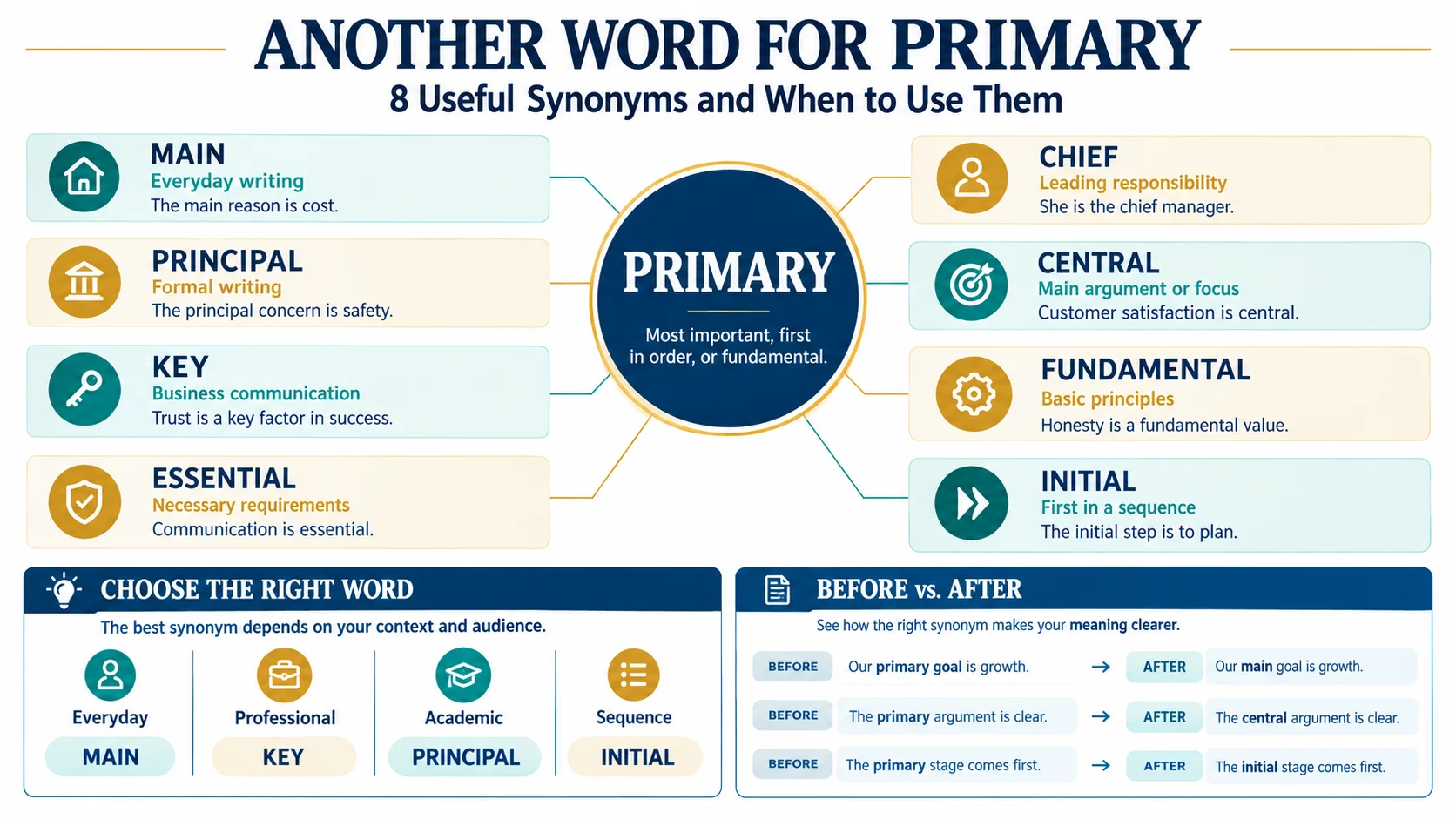
Another word for primary is main, principal, chief, essential, or key. The best synonym depends on what you want to express. Use main for the most important item, principal for a formal or professional tone, essential for something necessary, and primary alternatives such as initial or first when referring to order or sequence.
What Does Primary Mean?
Definition
Primary is an adjective that describes something that is first in order, most important, fundamental, or serving as the principal source of something. Its precise meaning depends on the context.
For example, a primary objective is the most important goal, primary education refers to an early stage of schooling, and a primary source provides original information about an event or subject.
Because the word has several meanings, no single synonym works in every situation. Choosing an appropriate replacement requires understanding the intended meaning.
Common Uses
The word primary appears in several common contexts:
- Importance: The primary concern is employee safety.
- Order: The primary stage comes before the secondary stage.
- Education: Primary school provides foundational education.
- Research: A primary source contains original evidence.
- Business: The primary objective is to increase customer retention.
- Healthcare: A primary care provider coordinates routine medical care.
These distinctions matter when selecting a replacement. For instance, essential may replace primary when discussing necessity, but it does not always work when describing chronological order.
Best Synonyms for Primary
The following table compares useful alternatives, their meanings, and examples.
| Synonym | Meaning | Best Used When | Example |
|---|---|---|---|
| Main | Most important or central | Everyday and professional writing | Our main objective is growth. |
| Principal | Chief or most important | Formal, academic, and business writing | Cost is the principal concern. |
| Chief | Highest in importance or rank | Leadership and priorities | Her chief responsibility is planning. |
| Essential | Absolutely necessary | Requirements and fundamental needs | Communication is essential to teamwork. |
| Key | Crucial or particularly important | Business, marketing, and everyday use | Trust is a key factor in success. |
| Major | Significant or substantial | Projects, problems, and decisions | We identified a major challenge. |
| Central | At the core of something | Arguments, themes, and strategies | Customer satisfaction is central to our strategy. |
| Fundamental | Forming a necessary foundation | Education and academic writing | Critical thinking is a fundamental skill. |
| Core | Constituting the central part | Business strategy and concepts | Quality is a core value. |
| Foremost | Highest in importance or prominence | Formal and persuasive writing | Safety remains our foremost priority. |
| Leading | Ranking first or having influence | Industry, research, and competition | The company is a leading provider. |
| First | Coming before others in order | Sequences and rankings | The first step is to identify the problem. |
| Initial | Occurring at the beginning | Processes and stages | The initial assessment revealed several issues. |
| Foundational | Providing a basis for further development | Education, research, and skills | Reading is a foundational academic skill. |
| Predominant | Most common, influential, or noticeable | Trends and analysis | Digital advertising is the predominant channel. |
Best overall choice: Main is the most versatile everyday alternative. Principal is often appropriate for formal writing, while essential is best when you mean necessary rather than simply important.
Synonyms by Context
Formal Writing
In formal writing, principal, foremost, fundamental, and central can replace primary, depending on the sentence.
Examples:
- Original: The primary reason for the delay was insufficient funding.
- Revised: The principal reason for the delay was insufficient funding.
- Original: The primary objective of the policy is public safety.
- Revised: The foremost objective of the policy is public safety.
Principal works especially well when identifying the leading reason, concern, or objective. Foremost emphasizes the highest priority, while fundamental suggests an underlying principle or requirement.
Professional Writing
For business documents, reports, presentations, and workplace communication, useful alternatives include main, key, principal, core, and major.
Business example:
Original: Our primary goal is to improve customer satisfaction.
Revised: Our main goal is to improve customer satisfaction.
More strategic alternative: Customer satisfaction is a key priority in our growth strategy.
In a professional email, main sounds natural and direct. In a strategic report, key and core can communicate priorities concisely.
Academic Writing
Academic writing benefits from precise word choice. Depending on the subject, consider principal, fundamental, central, foundational, or initial.
Academic example:
Original: The primary argument of the study concerns social inequality.
Revised: The central argument of the study concerns social inequality.
Research example:
Original: The researchers reviewed primary evidence.
Revised: The researchers reviewed original evidence.
The second revision is appropriate only when the intended meaning is original or firsthand evidence. In research methodology, primary source is an established term, so replacing it with original source may not preserve every technical distinction.
Daily Conversation
In everyday English, main, key, first, and most important are usually the clearest alternatives.
Examples:
- “What’s your primary concern?” becomes “What’s your main concern?”
- “Our primary task is cleaning the house” becomes “Our main task is cleaning the house.”
- “The primary thing to remember is to stay calm” becomes “The most important thing to remember is to stay calm.”
For casual conversation, straightforward words often sound more natural than formal alternatives such as foremost or principal.
Professional Alternatives for Primary
When writing a resume, cover letter, business proposal, or professional email, choose an alternative that communicates the exact responsibility or priority.
| Professional Context | Recommended Alternative | Example |
|---|---|---|
| Resume achievements | Key | Led key initiatives to improve operational efficiency. |
| Business objectives | Main | The main objective is to expand into new markets. |
| Strategic planning | Core | Developed core strategies for customer retention. |
| Leadership responsibilities | Chief | Managed the chief priorities of the department. |
| Project requirements | Essential | Identified essential requirements for implementation. |
| Research reports | Principal | The principal finding supports further investigation. |
Resume tip: Instead of writing “Primary responsibilities included managing projects,” consider “Key responsibilities included managing projects” or, more effectively, “Managed cross-functional projects and improved delivery timelines.”
The stronger version focuses on the work performed rather than merely labeling responsibilities.
Important Synonym Profiles
Main
- Meaning: The most important or central.
- Best used for: General explanations, reports, emails, and everyday communication.
- Tone: Neutral and direct.
- Difficulty: Easy.
- Usage frequency: Very common.
- Best for: Resumes, email writing, essays, marketing copy, and business writing.
Principal
- Meaning: Chief or highest in importance.
- Best used for: Formal documents, research, policies, and professional reports.
- Tone: Formal and precise.
- Difficulty: Medium.
- Usage frequency: Common.
- Best for: Academic essays, business writing, formal emails, and analytical reports.
Essential
- Meaning: Necessary or indispensable.
- Best used for: Requirements, critical skills, basic needs, and conditions for success.
- Tone: Direct and emphatic.
- Difficulty: Easy.
- Usage frequency: Very common.
- Best for: Resumes, educational writing, business communication, and persuasive copy.
Key
- Meaning: Particularly important or influential.
- Best used for: Factors, findings, priorities, skills, and strategic decisions.
- Tone: Professional and accessible.
- Difficulty: Easy.
- Usage frequency: Very common.
- Best for: Resumes, emails, marketing copy, presentations, and business reports.
Foundational
- Meaning: Providing the basis on which something develops.
- Best used for: Fundamental skills, principles, knowledge, and systems.
- Tone: Academic and explanatory.
- Difficulty: Medium.
- Usage frequency: Common.
- Best for: Essays, educational materials, research discussions, and professional development.
Simple Alternatives for Primary
If you want a word that readers can understand immediately, start with these options:
- Main: The main reason for leaving was the long commute.
- First: The first step is to review the instructions.
- Key: Listening is a key part of communication.
- Biggest: Our biggest concern is the deadline.
- Most important: The most important issue is employee safety.
These words are particularly useful for students, English learners, bloggers, and writers who value clarity.
However, biggest often suggests size or degree, and first usually refers to order. Neither is a universal substitute for primary.
Stronger Alternatives for Primary
Some situations call for a more precise or emphatic word.
- Foremost: Emphasizes the highest priority. Example: Protecting customer data is our foremost concern.
- Critical: Highlights something extremely important to an outcome. Example: Accurate data is critical to the analysis.
- Vital: Expresses essential importance. Example: Clear communication is vital to successful collaboration.
- Fundamental: Emphasizes a basic principle or underlying requirement. Example: Equality is a fundamental principle of the policy.
- Paramount: Indicates the highest level of importance. Example: Patient safety is of paramount importance.
These words add emphasis, but they are not interchangeable in every sentence. Use critical, vital, and paramount when the degree of importance justifies the stronger language.
Difference Between Similar Synonyms
Understanding subtle differences helps you choose a more accurate replacement.
| Word | Main Distinction | Example |
|---|---|---|
| Primary | First, principal, or most important, depending on context | The primary objective is efficiency. |
| Main | The central or most important item | Our main objective is efficiency. |
| Principal | The chief or leading item, often in formal contexts | The principal objective is efficiency. |
| Essential | Necessary for a purpose or outcome | Accurate records are essential. |
| Key | Particularly influential or important | Accurate records are key to the analysis. |
| Initial | Occurring at the beginning | The initial review identified errors. |
| Fundamental | Forming an underlying basis | Accuracy is fundamental to research. |
The most important distinction is between importance and sequence. If primary means most important, consider main, principal, or key. If it means occurring first, consider first, initial, or earliest. If it means necessary, consider essential or vital.
Business Example
Original: Our primary focus is customer retention.
Alternative: Our main focus is customer retention.
Academic Example
Original: The primary objective of the experiment was to measure accuracy.
Alternative: The principal objective of the experiment was to measure accuracy.
Daily Conversation Example
Original: My primary concern is getting home safely.
Alternative: My main concern is getting home safely.
Opposite Words
The opposite of primary depends on its meaning.
| Antonym | Meaning | Example |
|---|---|---|
| Secondary | Less important or subordinate | Budget is a secondary consideration. |
| Minor | Relatively unimportant or small in scale | The report contains a minor issue. |
| Insignificant | Too unimportant to have much effect | The difference was statistically insignificant. |
| Subsequent | Following something in time or order | Subsequent stages require approval. |
| Peripheral | Outside the central focus | The discussion addressed peripheral concerns. |
Secondary is often the closest antonym when primary means principal or most important. Subsequent is more appropriate when primary refers to something that comes first.
FAQs
What is another word for primary?
Common alternatives include main, principal, chief, key, essential, and fundamental. The best option depends on whether you mean most important, necessary, or first in order.
What is a formal synonym for primary?
Principal is a strong formal alternative when describing the leading objective, reason, concern, or factor. Foremost may work when emphasizing the highest priority.
What is a professional alternative for primary?
Main, key, principal, and core are useful in business writing. For resumes, describe a specific achievement or responsibility whenever possible instead of relying on a generic adjective.
What word can replace primary in an essay?
Use principal for the leading point, central for the main argument, fundamental for an underlying principle, or initial for the first stage. Match the word to the intended meaning.
Is primary the same as essential?
No. Primary generally identifies what comes first or matters most, whereas essential means necessary. A primary objective may be important without being the only essential requirement.
Is main a better word than primary?
In everyday writing, main is often simpler and more natural. Primary may be preferable in established technical expressions, formal classifications, or contexts involving a distinction between primary and secondary categories.
What is another word for primary in a resume?
Depending on the sentence, use key, main, core, or principal. Strong resume writing often replaces the adjective with a specific action, responsibility, or measurable accomplishment.
What is the opposite of primary?
Secondary is the most common opposite when discussing importance or rank. Subsequent may be appropriate when referring to sequence, while minor can describe something of lesser significance.
Conclusion
The best alternative for primary depends on your intended meaning and audience. Choose main for everyday clarity, principal for formal writing, key for professional communication, essential for necessity, and initial for chronological order. For stronger emphasis, consider foremost, critical, or paramount when the context supports that degree of importance.
The most effective synonym is not necessarily the most sophisticated word. It is the one that preserves your meaning and helps your reader understand your message immediately.
