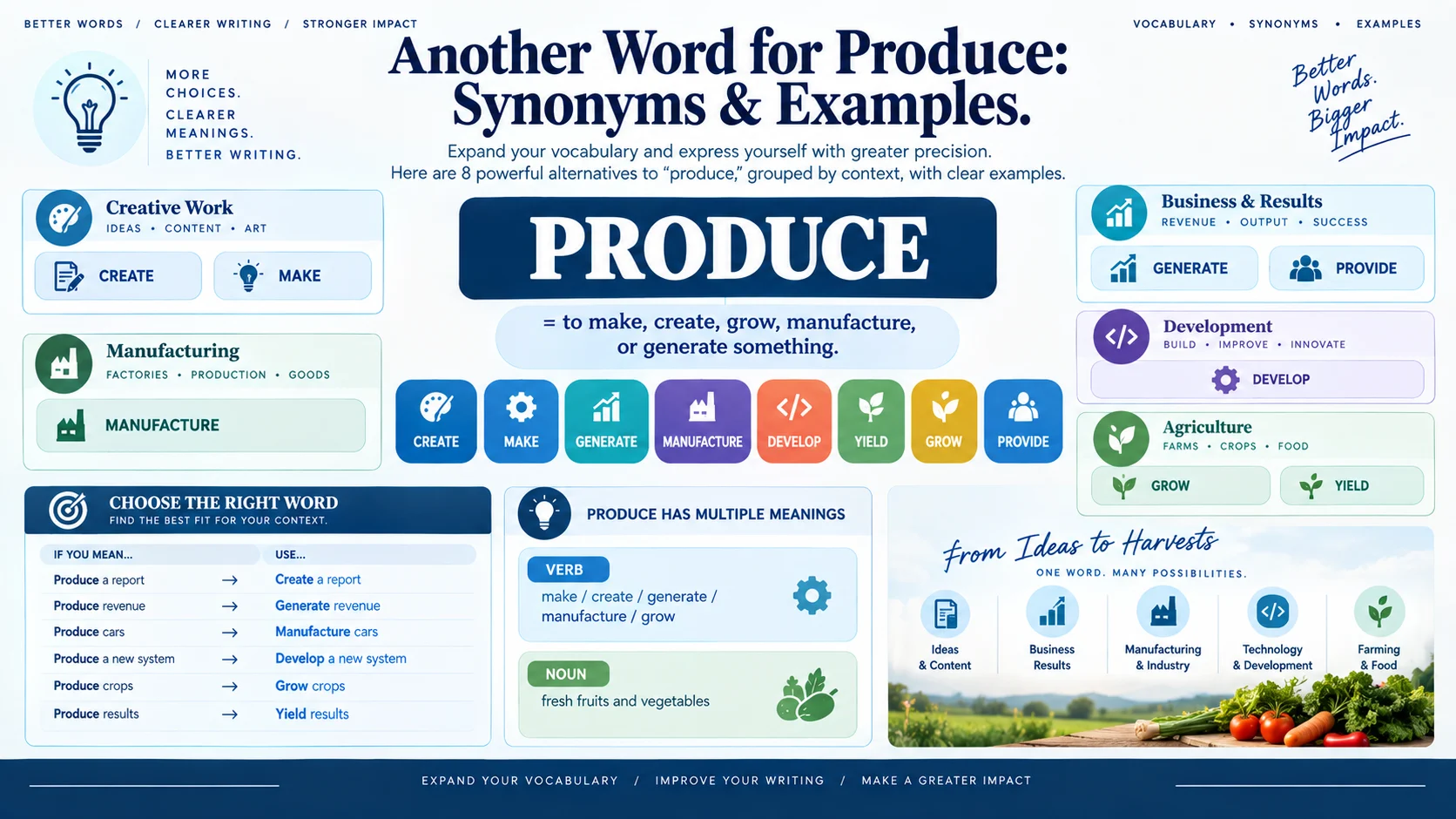
Another word for produce depends on the context. Common alternatives include create, make, generate, manufacture, develop, yield, grow, provide, and supply. For example, a company may manufacture products, a writer may create content, and a farm may grow crops.
What Does Produce Mean?
Definition
Produce has several meanings in American English, which is why its best synonym changes according to context.
As a verb, produce generally means to make, create, grow, generate, manufacture, or bring something into existence.
For example:
The company produces electric vehicles.
Here, produces means manufactures or makes.
Produce can also mean to cause a result:
The new strategy produced excellent results.
In this sentence, produced means generated or caused.
As a noun, produce usually refers to fresh agricultural products, especially fruits and vegetables.
The grocery store sells fresh produce.
In this meaning, produce is usually replaced by terms such as fruits and vegetables, farm products, or agricultural products, depending on the sentence.
Common Uses
The word produce commonly appears in several contexts:
- Manufacturing: produce goods or products
- Writing and media: produce content, films, or reports
- Business: produce results, revenue, or growth
- Science: produce an effect or reaction
- Agriculture: produce crops or food
- Everyday English: produce, make, or create something
- Retail: fresh produce such as fruits and vegetables
Because the word has multiple meanings, choosing a synonym requires attention to what produce means in the specific sentence.
Best Synonyms for Produce
| Synonym | Meaning | Best Used When | Example |
|---|---|---|---|
| Create | Bring something new into existence | Writing, design, art, ideas | She created a detailed marketing plan. |
| Make | Construct or form something | General and everyday situations | They make furniture by hand. |
| Generate | Cause or create an outcome | Results, energy, revenue, data | The campaign generated thousands of leads. |
| Manufacture | Make goods, usually commercially | Factories and industrial production | The company manufactures medical equipment. |
| Develop | Create or improve something over time | Products, systems, ideas, software | The team developed a new application. |
| Yield | Produce a result, amount, or crop | Agriculture, investment, research | The farm yielded a large harvest. |
| Grow | Cultivate or increase naturally | Plants, crops, businesses | The farm grows organic vegetables. |
| Provide | Make something available or give it | Services, resources, information | The program provides useful resources. |
| Supply | Provide something needed | Business, commerce, materials | The company supplies parts to retailers. |
Create
Meaning: To bring something new into existence.
Best used for: Ideas, content, designs, plans, art, documents, and digital products.
Tone: Neutral to professional
Difficulty: Easy
Usage Frequency: Very Common
Business example: The agency created a new brand strategy.
Academic example: Researchers created a model to explain the findings.
Daily conversation: I created a playlist for the trip.
Create is often the best replacement when produce refers to intellectual or creative work.
Generate
Meaning: To cause something to exist, appear, or develop.
Best used for: Revenue, energy, results, interest, leads, data, ideas, and responses.
Tone: Professional
Difficulty: Medium
Usage Frequency: Common
Business example: The website generated more customer inquiries.
Academic example: The experiment generated consistent results.
Daily conversation: That joke generated a lot of laughter.
Generate emphasizes the result or outcome rather than the physical act of making something.
Manufacture
Meaning: To make products, especially in a factory or industrial setting.
Best used for: Machines, electronics, vehicles, equipment, consumer goods, and other physical products.
Tone: Formal and professional
Difficulty: Medium
Usage Frequency: Common
Business example: The company manufactures automotive components.
Academic example: The paper examines how pharmaceutical products are manufactured.
Daily conversation: This factory manufactures kitchen appliances.
Use manufacture when produce specifically means industrial production.
Develop
Meaning: To create, improve, or advance something through a process.
Best used for: Products, software, strategies, systems, skills, programs, and ideas.
Tone: Professional
Difficulty: Medium
Usage Frequency: Very Common
Business example: The company developed a more efficient payment system.
Academic example: Researchers developed a new method for analyzing the data.
Daily conversation: We’re developing a plan for the weekend.
Develop suggests that something is created or improved over time, rather than simply made.
Yield
Meaning: To produce a result, quantity, profit, or crop.
Best used for: Crops, investments, experiments, research, and measurable results.
Tone: Formal
Difficulty: Advanced
Usage Frequency: Common
Business example: The investment yielded a strong annual return.
Academic example: The study yielded valuable insights.
Daily conversation: The garden yielded more tomatoes than expected.
Yield is especially useful when you want to emphasize what something produces as an outcome.
Synonyms by Context
Formal Writing
In formal writing, stronger alternatives to produce include:
- Generate
- Manufacture
- Develop
- Yield
- Create
- Formulate
- Construct
For example:
Basic: The study produced important findings.
More formal: The study generated important findings.
However, produce itself is not informal. It is perfectly acceptable in academic and professional writing when the meaning is precise.
Professional Writing
Business writing often benefits from a more specific verb.
Instead of:
Our company produces software solutions.
Consider:
Our company develops software solutions.
For physical goods:
Our company manufactures industrial equipment.
For measurable business outcomes:
The campaign generated significant revenue.
For resources:
The organization provides technical support.
Choosing the more specific verb can make professional writing clearer and more persuasive.
Academic Writing
Useful academic alternatives include generate, yield, create, develop, formulate, establish, and cause.
For example:
The experiment produced unexpected results.
can become:
The experiment yielded unexpected results.
Or:
The researchers produced a new framework.
can become:
The researchers developed a new framework.
The best choice depends on whether the sentence focuses on a result, creation process, or research contribution.
Daily Conversation
For everyday English, the simplest alternatives are usually make, create, grow, give, cause, or provide.
Instead of:
What does this machine produce?
You might say:
What does this machine make?
Instead of:
The garden produces tomatoes.
You might say:
The garden grows tomatoes.
Simple synonyms often sound more natural in casual conversation.
Professional Alternatives for Produce
If you need a professional replacement for produce, consider the intended meaning:
For products: manufacture, make, develop
For results: generate, yield, deliver
For content: create, develop, prepare
For services: provide, deliver, offer
For research: generate, yield, establish
For revenue: generate, earn, deliver
For resources: provide, supply, deliver
The most professional synonym is not necessarily the most complicated one. Specificity is usually more valuable than formality.
Simple Alternatives for Produce
If you want an easy word that most readers will immediately understand, use:
- Make
- Create
- Grow
- Give
- Cause
- Provide
- Supply
For example:
Produce a product → Make a product
Produce a report → Create a report
Produce crops → Grow crops
Produce results → Generate results
Produce an effect → Cause an effect
Stronger Alternatives for Produce
For more precise or sophisticated writing, consider:
- Manufacture for industrial goods
- Generate for results or outcomes
- Develop for something created progressively
- Yield for measurable results or crops
- Formulate for plans, policies, or formulas
- Construct for physical or conceptual structures
- Cultivate for crops, relationships, or growth
- Deliver for business outcomes or services
The stronger alternative should match the meaning rather than simply make the sentence sound more formal.
Difference Between Similar Synonyms
Produce vs. Create:
Create emphasizes bringing something new into existence. Produce is broader and can refer to manufacturing, generating results, or growing crops.
Produce vs. Make:
Make is more conversational and general. Produce often sounds more precise or professional.
Produce vs. Generate:
Generate usually focuses on causing a result, such as revenue, energy, data, or interest.
Produce vs. Manufacture:
Manufacture specifically suggests commercial or industrial production.
Produce vs. Develop:
Develop implies a process of creation, refinement, or improvement over time.
Produce vs. Yield:
Yield focuses on the result or amount obtained from something, such as a crop, investment, or experiment.
Produce vs. Grow:
Grow is particularly appropriate for plants, crops, and living things, although it can also describe business growth.
Opposite Words
The opposite of produce depends on its meaning.
When produce means make or create, possible opposites include:
- Destroy
- Eliminate
- Remove
- Consume
- Demolish
When produce means generate a result, possible opposites include:
- Prevent
- Suppress
- Reduce
- Stop
- Avoid
When produce refers to agricultural goods, an opposite concept may be waste, processed goods, or non-agricultural products, depending on the context.
FAQs
What is another word for produce?
Common synonyms for produce include make, create, generate, manufacture, develop, yield, grow, provide, and supply. The best option depends on whether you are talking about products, results, crops, content, or services.
What is a formal synonym for produce?
Generate, manufacture, develop, yield, formulate, and construct can serve as formal alternatives, depending on the context. Manufacture is especially appropriate for industrial goods, while yield works well for results and research findings.
What is a professional alternative for produce?
Professional alternatives include manufacture, develop, generate, provide, supply, deliver, and create. Choose the word that precisely describes what is being produced.
What word can replace produce in an essay?
In an essay, useful alternatives include create, generate, develop, yield, cause, formulate, and establish. For example, “The experiment produced significant results” can become “The experiment yielded significant results.”
What is another word for produce in business?
Depending on the sentence, business alternatives include manufacture, create, develop, generate, deliver, provide, and supply. “Generate” is particularly common for revenue, leads, and results.
What is another word for produce food?
For agricultural food, grow, cultivate, harvest, or raise may be appropriate. For manufactured food products, make or manufacture may be more accurate.
What is another word for produce results?
The strongest alternatives include generate, yield, deliver, achieve, cause, and create. “Generate” and “yield” are particularly natural in professional and academic writing.
What is another word for produce content?
For digital or written material, create, develop, prepare, publish, or generate may work. “Create content” is the most common everyday expression.
Conclusion
The best synonym for produce depends on what you mean. Use make for simple everyday situations, create for creative work, generate for results and outcomes, manufacture for industrial products, develop for things created over time, yield for measurable results or crops, and grow for agricultural products.
Rather than replacing produce automatically, choose the word that communicates the exact action. A precise synonym makes writing clearer, more natural, and more effective.
Language note: Produce is also a noun meaning fresh fruits and vegetables. In that sense, alternatives include fresh fruits and vegetables, farm products, and agricultural products, depending on the context.
