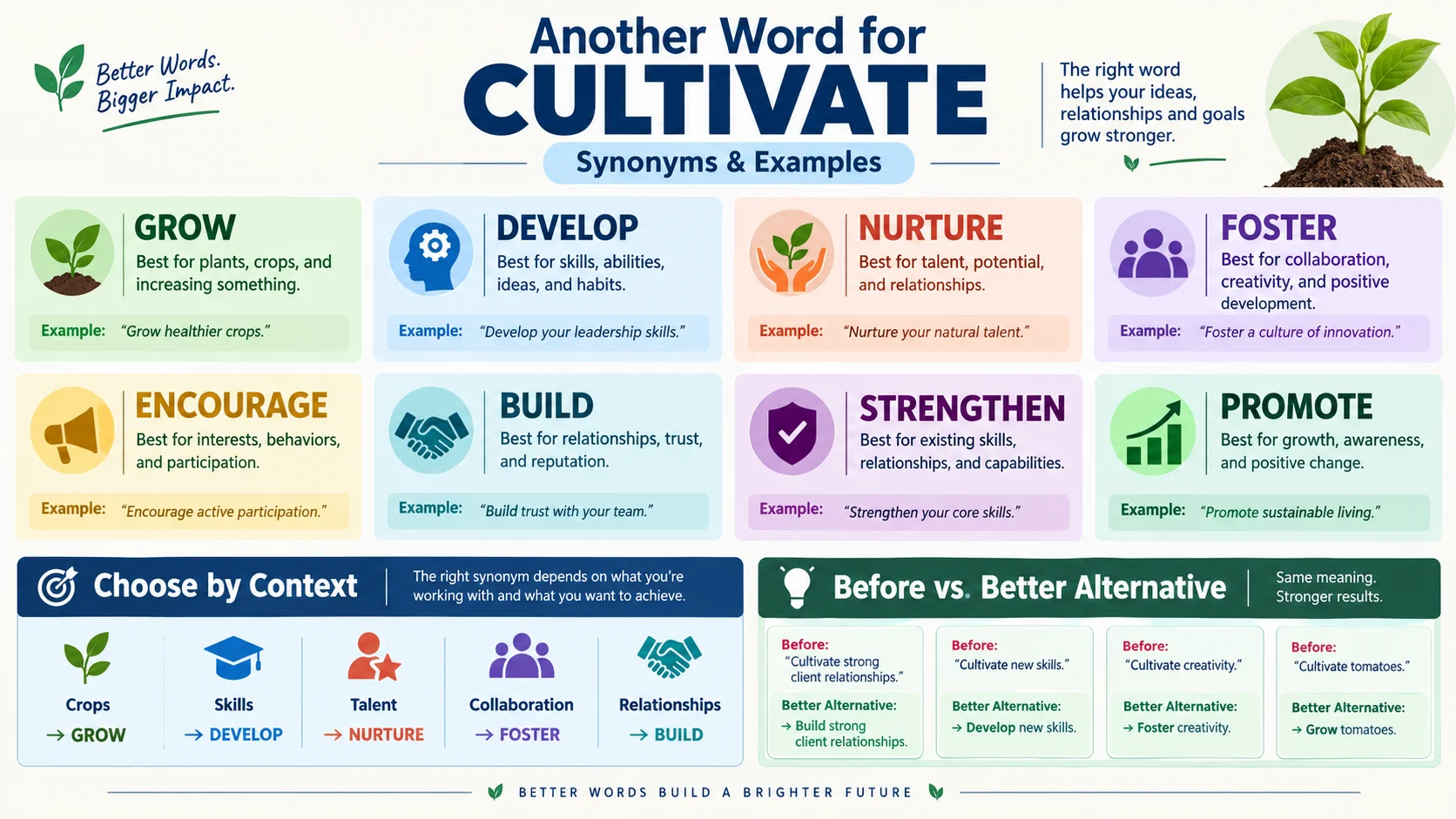
If you need another word for cultivate, the best choice depends on context. Grow works well for plants and crops, while develop, nurture, foster, encourage, and build are useful when talking about skills, qualities, ideas, or relationships. For professional writing, develop and foster are often natural alternatives.
What Does Cultivate Mean?
Definition
Cultivate is a verb with several related meanings. In its literal sense, it means to prepare land and grow crops or plants. In a figurative sense, it means to deliberately develop or improve something, such as a skill, quality, relationship, reputation, or interest.
For example:
- Farmers cultivate wheat and corn.
- Students cultivate useful study habits.
- Companies cultivate customer relationships.
- Professionals cultivate a strong reputation.
The word often suggests intentional, sustained effort rather than something happening automatically.
Common Uses
“Cultivate” commonly appears in four contexts:
- Growing plants: cultivate crops, cultivate vegetables, cultivate rice
- Developing qualities: cultivate patience, cultivate confidence, cultivate discipline
- Building relationships: cultivate friendships, cultivate partnerships, cultivate business contacts
- Developing an image or interest: cultivate a reputation, cultivate an interest, cultivate an image
Oxford and Cambridge both recognize these agricultural and figurative meanings, including the deliberate development of relationships, qualities, skills, and images.
Best Synonyms for Cultivate
| Synonym | Meaning | Best Used When | Example |
|---|---|---|---|
| Grow | To produce or increase naturally or through care | Plants, crops, abilities, audiences | Farmers grow corn in the region. |
| Develop | To build, improve, or advance something over time | Skills, ideas, habits, careers | She developed strong leadership skills. |
| Nurture | To support something as it grows | People, talents, relationships, ideas | The program nurtures young talent. |
| Foster | To encourage development or growth | Relationships, cooperation, skills, ideas | The program fosters creativity. |
| Encourage | To give support or confidence | Behaviors, interests, participation | Teachers encourage curiosity. |
| Build | To create or strengthen gradually | Relationships, trust, reputation | The company built strong customer relationships. |
| Promote | To actively support or advance something | Ideas, growth, awareness, development | The campaign promotes healthy habits. |
| Strengthen | To make something stronger or more effective | Relationships, skills, organizations | The training strengthened her communication skills. |
No single synonym replaces cultivate in every sentence. For example, grow is particularly natural for crops, while foster and nurture are usually better for abstract things such as creativity or relationships.
Synonyms by Context
Formal Writing
In formal writing, choose a synonym that communicates the exact type of development you mean.
Develop is one of the most versatile choices:
The university aims to develop critical-thinking skills among students.
Foster works especially well when something is being encouraged:
The policy is designed to foster collaboration among departments.
Nurture is appropriate when the emphasis is on sustained support:
The organization seeks to nurture emerging talent.
Cultivate itself remains useful in formal writing when deliberate, gradual development is important.
Professional Writing
For resumes, reports, business documents, and workplace communication, these alternatives are particularly useful:
- Develop skills and expertise
- Build relationships and trust
- Foster collaboration and teamwork
- Strengthen partnerships and capabilities
- Promote growth and engagement
- Grow a customer base or business
For example, instead of:
Cultivated strong client relationships.
You could write:
Built strong client relationships.
Or:
Developed lasting relationships with key clients.
“Cultivate” can sound polished, but the more specific alternative may communicate the achievement more directly.
Academic Writing
In academic writing, develop, foster, encourage, and promote are often useful depending on the subject.
Examples:
Researchers developed a framework for evaluating student performance.
The teaching method fosters independent thinking.
Classroom discussion encourages critical analysis.
The curriculum promotes interdisciplinary learning.
When discussing intellectual or personal development, develop is generally clearer than simply replacing “cultivate” with a more sophisticated-sounding word.
Daily Conversation
In everyday conversation, simpler alternatives usually sound more natural.
Instead of:
I want to cultivate better habits.
You could say:
I want to develop better habits.
Instead of:
She cultivated a friendship with her neighbor.
You could say:
She built a friendship with her neighbor.
Instead of:
They cultivate tomatoes.
You could say:
They grow tomatoes.
Professional Alternatives for Cultivate
If you need a professional alternative, consider the object of the verb.
Cultivate skills → Develop skills
She cultivated her presentation skills.
Professional alternative:
She developed her presentation skills.
Cultivate relationships → Build or strengthen relationships
The manager cultivated relationships with major clients.
Professional alternative:
The manager built strong relationships with major clients.
Cultivate collaboration → Foster collaboration
The initiative cultivated collaboration between teams.
Professional alternative:
The initiative fostered collaboration between teams.
Cultivate a reputation → Build or establish a reputation
The company cultivated a reputation for reliability.
Professional alternative:
The company built a reputation for reliability.
Simple Alternatives for Cultivate
If your goal is clear, accessible American English, these words are often easier:
- Grow
- Develop
- Build
- Encourage
- Improve
- Support
- Strengthen
For example:
The teacher cultivated an interest in science.
A simpler version is:
The teacher encouraged an interest in science.
Or:
The teacher helped students develop an interest in science.
Stronger Alternatives for Cultivate
Some alternatives emphasize a particular aspect of development.
Nurture emphasizes care and sustained support.
Foster emphasizes creating conditions that encourage growth.
Develop emphasizes progress or improvement.
Build emphasizes gradual creation or strengthening.
Strengthen emphasizes making something that already exists more effective.
Promote emphasizes actively supporting or advancing something.
Synonym Profile: Develop
Meaning: To grow, improve, or advance something.
Best Used For: Skills, abilities, ideas, habits, careers, products, and strategies.
Tone: Neutral to professional
Difficulty: Easy
Usage Frequency: Very Common
Best For: Resume writing, email writing, essay writing, business writing
Business example:
She developed strong relationships with enterprise clients.
Academic example:
Students developed advanced research skills.
Daily conversation:
I’m trying to develop better study habits.
Synonym Profile: Foster
Meaning: To encourage or support the development of something.
Best Used For: Collaboration, creativity, relationships, trust, communication, and learning.
Tone: Professional and formal
Difficulty: Medium
Usage Frequency: Common
Best For: Business writing, academic writing, marketing copy, professional communication
Business example:
The company fosters a culture of innovation.
Academic example:
The course fosters independent thinking.
Daily conversation:
Good communication can foster trust.
Synonym Profile: Nurture
Meaning: To carefully support something while it develops.
Best Used For: Talent, children, skills, relationships, ideas, and potential.
Tone: Warm, supportive, professional
Difficulty: Medium
Usage Frequency: Common
Best For: Marketing copy, business writing, education, personal writing
Business example:
The mentorship program nurtures emerging leaders.
Academic example:
The curriculum nurtures students’ creative abilities.
Daily conversation:
Parents can nurture a child’s curiosity.
Difference Between Similar Synonyms
The most important distinction is that these words emphasize different kinds of effort.
Cultivate vs. Grow:
“Grow” is broader and more natural for plants and crops. “Cultivate” can specifically suggest deliberate agricultural work, but it also has figurative meanings.
Cultivate vs. Develop:
“Develop” is one of the best general replacements when something is improving over time. It is especially natural for skills, abilities, ideas, and careers.
Cultivate vs. Nurture:
“Nurture” emphasizes care and support. It often has a warmer tone than “cultivate.”
Cultivate vs. Foster:
“Foster” emphasizes encouraging conditions that allow something to develop. It is common in professional and academic writing.
Cultivate vs. Encourage:
“Encourage” focuses on giving support or motivation. It does not always imply the sustained, deliberate development associated with “cultivate.”
Cultivate vs. Build:
“Build” is especially natural with relationships, trust, reputation, teams, and organizations.
A useful rule is:
Use “grow” for crops, “develop” for skills, “nurture” for potential, “foster” for collaboration, and “build” for relationships.
Opposite Words
Depending on the context, possible opposites of cultivate include:
- Neglect
- Ignore
- Abandon
- Destroy
- Damage
- Suppress
- Discourage
- Uproot
The best opposite depends on the meaning. For example, neglect is a natural opposite when talking about relationships or skills, while uproot can contrast with cultivating plants.
FAQs
What is another word for cultivate?
The best alternative depends on context. Grow, develop, nurture, foster, encourage, build, strengthen, and promote are common alternatives. For crops, grow is often the simplest choice; for skills, develop is usually more natural.
What is a formal synonym for cultivate?
Develop, foster, and nurture can work as formal alternatives, depending on the sentence. Foster is particularly common in formal discussions of collaboration, innovation, and development.
What is a professional alternative for cultivate?
In professional writing, develop, build, foster, and strengthen are useful alternatives. For example, “cultivate client relationships” can become “build client relationships.”
What word can replace cultivate?
Possible replacements include grow, develop, nurture, foster, encourage, build, promote, and strengthen. The correct choice depends on what is being cultivated.
What is another word for cultivate relationships?
Useful alternatives include build, develop, strengthen, and foster relationships. “Build relationships” is especially natural in business writing.
What is another word for cultivate skills?
Develop is usually the clearest replacement. Depending on the meaning, you can also use improve, strengthen, hone, or build.
What is another word for cultivate crops?
Grow is the simplest alternative. Depending on the agricultural context, plant, raise, or farm may also work, although these words do not have exactly the same meaning.
Conclusion
The best synonym for cultivate depends on what you are describing. Use grow for crops, develop for skills and abilities, nurture for potential, foster for collaboration and positive conditions, and build for relationships and trust. When precision matters, choose the synonym that describes the specific type of growth rather than simply choosing the most sophisticated-sounding word.
