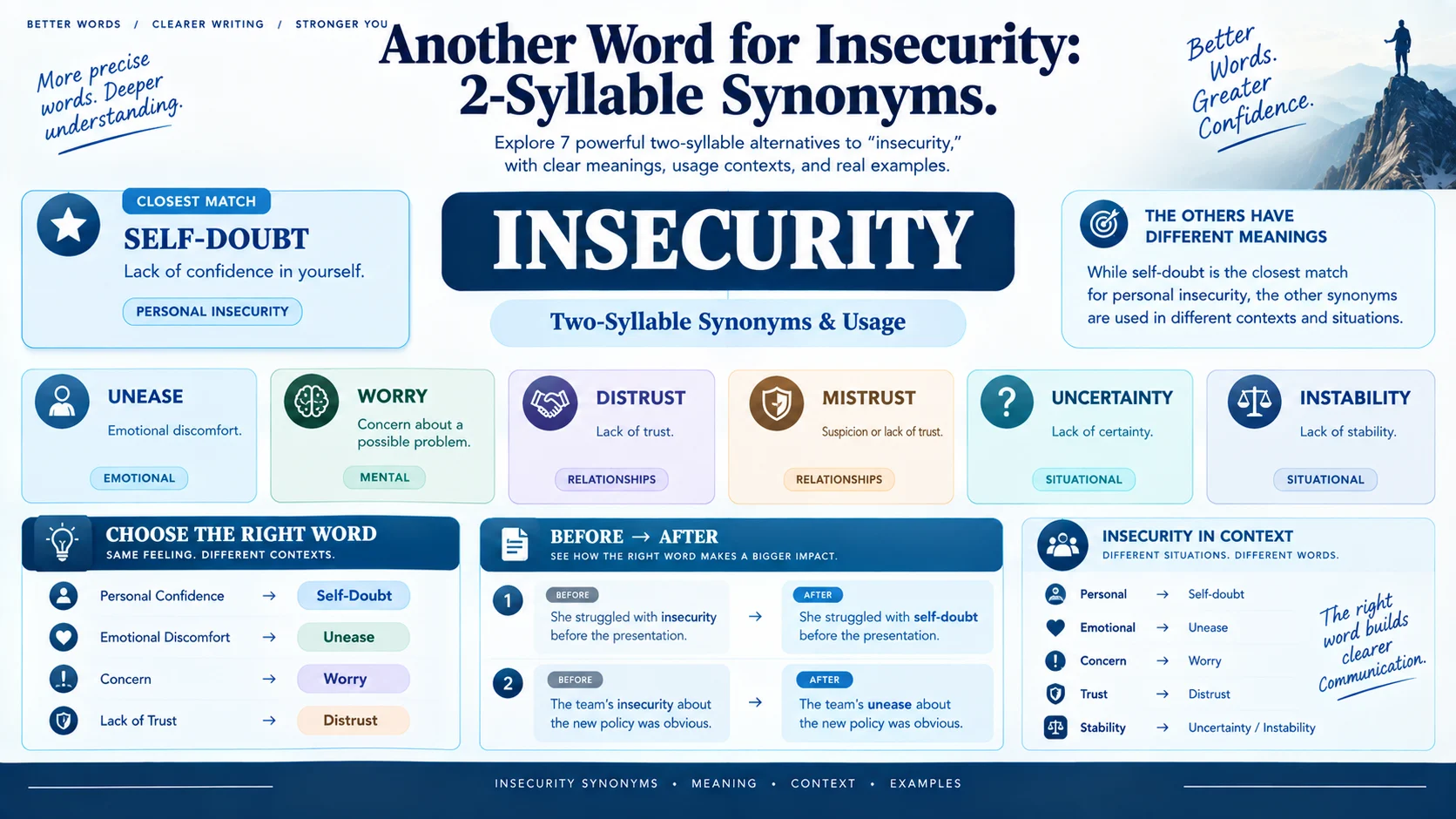
If you need another word for insecurity with two syllables, self-doubt is usually the closest choice when you mean a lack of confidence in yourself. Depending on context, unease, worry, distrust, and mistrust can also work, but each emphasizes a different kind of insecurity.
What Does Insecurity Mean?
Definition
Insecurity is a feeling of uncertainty, vulnerability, or lack of confidence. It commonly describes doubts about your abilities, appearance, relationships, decisions, or personal worth. It can also describe a lack of safety or stability, as in job insecurity or financial insecurity.
The word has several related meanings, so the best synonym depends on what kind of insecurity you are describing.
For example:
- Personal insecurity: self-doubt
- Emotional discomfort: unease
- Concern about an outcome: worry
- Lack of trust: distrust or mistrust
- Lack of certainty: doubt
- Lack of stability: instability
- Exposure to harm: vulnerability
Common Uses
“Insecurity” is commonly used in phrases such as:
- insecurity about appearance
- insecurity about performance
- relationship insecurity
- job insecurity
- financial insecurity
- feelings of insecurity
- deep insecurity
- emotional insecurity
Because these expressions describe different situations, replacing “insecurity” with a random synonym can change the meaning.
Best Two-Syllable Synonyms for Insecurity
If the requirement is specifically two syllables, the following words are useful alternatives. Syllable counts can vary slightly by pronunciation, but these are generally treated as two-syllable words or compounds in standard American English.
| Synonym | Meaning | Best Used When | Example |
|---|---|---|---|
| Self-doubt | Lack of confidence in yourself | Personal confidence | Her self-doubt kept her from applying for the position. |
| Unease | Mild worry or discomfort | Emotional discomfort | He felt unease before the interview. |
| Worry | Concern about something negative | General concern | Her worry about the results grew throughout the day. |
| Distrust | Lack of trust | Relationships or people | His distrust made it difficult to work with the new manager. |
| Mistrust | Suspicion or lack of confidence in someone | Relationships and institutions | Years of conflict created mistrust between the two groups. |
| Doubtful | Uncertain or lacking confidence | Uncertainty about an outcome | She was doubtful about her chances of success. |
| Nervousness | Feeling worried or tense | Performance or social situations | His nervousness was obvious during the presentation. |
Self-Doubt
Meaning: A lack of confidence in your own abilities, decisions, appearance, or worth.
Best Used For: Personal or emotional insecurity.
Tone: Neutral and direct.
Difficulty: Easy
Usage Frequency: Very Common
Best For: Resume writing, emails, essays, personal writing, and everyday conversation.
Business example:
Her self-doubt prevented her from speaking confidently during the presentation.
Academic example:
Self-doubt can affect a student’s willingness to participate in class discussions.
Daily conversation:
I sometimes struggle with self-doubt before trying something new.
Why it works:
For the personal sense of “insecurity,” self-doubt is one of the closest two-syllable alternatives. Thesaurus sources specifically group self-doubt with insecurity when the meaning is lack of confidence or low self-esteem.
Unease
Meaning: A feeling of discomfort, nervousness, or mild worry.
Best Used For: Situations that make someone uncomfortable rather than specifically damaging their self-confidence.
Tone: Neutral to slightly formal.
Difficulty: Easy
Usage Frequency: Common
Best For: Essays, business writing, storytelling, and conversation.
Business example:
Employees expressed unease about the company’s sudden policy changes.
Academic example:
The uncertainty surrounding the experiment created a sense of unease among participants.
Daily conversation:
I felt a little unease when I walked into the unfamiliar building.
Important difference:
“Unease” is broader and softer than “self-doubt.” Someone can feel unease without questioning their own abilities.
Worry
Meaning: Concern or anxiety about a possible problem or undesirable result.
Best Used For: Future problems, consequences, decisions, or outcomes.
Tone: Simple and conversational.
Difficulty: Easy
Usage Frequency: Very Common
Best For: Everyday conversation, emails, and accessible writing.
Business example:
Job cuts were a major worry for employees.
Academic example:
Financial pressure can become a significant worry for university students.
Daily conversation:
My biggest worry is that I will miss the deadline.
“Worry” is not a perfect synonym for insecurity. It focuses on concern, while insecurity often focuses on lack of confidence, certainty, safety, or stability.
Distrust
Meaning: A lack of trust or confidence in another person, organization, or system.
Best Used For: Relationships, institutions, leadership, or credibility.
Tone: Neutral and somewhat formal.
Difficulty: Medium
Usage Frequency: Common
Best For: Business writing, academic writing, journalism, and formal discussion.
Business example:
Poor communication created distrust between employees and management.
Academic example:
Repeated failures can contribute to public distrust of institutions.
Daily conversation:
Her distrust of him made the relationship difficult.
Use distrust when insecurity comes from questioning whether someone or something can be trusted.
Mistrust
Meaning: A lack of trust, often accompanied by suspicion.
Best Used For: Relationships, groups, organizations, or situations involving suspected unreliability.
Tone: Neutral to formal.
Difficulty: Medium
Usage Frequency: Common
Best For: Academic writing, professional writing, and formal discussion.
Business example:
The unexplained decision created mistrust among investors.
Academic example:
Historical conflict can produce long-term mistrust between communities.
Daily conversation:
There was obvious mistrust between the two friends.
“Mistrust” and “distrust” are very close. Neither should normally replace “insecurity” when you mean low self-confidence.
Synonyms by Context
Formal Writing
For formal writing, choose the word that identifies the exact source of the insecurity.
Good options include:
- self-doubt for lack of personal confidence
- unease for discomfort
- uncertainty for lack of certainty
- vulnerability for exposure to harm
- instability for lack of stability
- precariousness for an uncertain or risky condition
For example:
The employee’s self-doubt affected her willingness to accept greater responsibility.
This is more precise than simply saying:
The employee’s insecurity affected her willingness to accept greater responsibility.
Professional Writing
In business writing, insecurity can describe both personal feelings and organizational conditions.
Use:
- self-doubt for an individual’s confidence
- uncertainty for unclear decisions or outcomes
- instability for unstable business conditions
- unease for employee or customer discomfort
- distrust for damaged confidence in a person or organization
Example:
Rising job insecurity affected employee morale.
Possible alternatives include:
Rising uncertainty affected employee morale.
or:
Concerns about job stability affected employee morale.
The best replacement depends on what the original sentence actually means.
Academic Writing
Academic writing benefits from precise distinctions.
Use self-doubt when discussing confidence, uncertainty when discussing knowledge or outcomes, vulnerability when discussing exposure to risk, and instability when discussing changing or unreliable conditions.
Example:
Students experiencing self-doubt may be less willing to participate in unfamiliar academic activities.
Daily Conversation
For everyday speech, simpler choices are usually more natural:
- self-doubt
- unease
- worry
- doubt
- nerves
Example:
I felt insecure before the interview.
could become:
I had some self-doubt before the interview.
or:
I felt uneasy before the interview.
The first emphasizes confidence; the second emphasizes discomfort.
Professional Alternatives for Insecurity
When writing professionally, avoid replacing “insecurity” automatically. First determine its meaning.
| If you mean… | Consider using… |
|---|---|
| Lack of personal confidence | Self-doubt |
| Unclear outcome | Uncertainty |
| Unstable conditions | Instability |
| Exposure to risk | Vulnerability |
| Employee concerns | Job uncertainty / job instability |
| Lack of trust | Distrust |
| Mild discomfort | Unease |
This approach makes professional writing more precise.
Simple Alternatives for Insecurity
For readers who prefer plain American English, the easiest alternatives are:
- Self-doubt
- Doubt
- Unease
- Worry
- Nerves
For example:
Original:
Her insecurity made her hesitate.
Simpler:
Her self-doubt made her hesitate.
Or:
Original:
He felt insecurity about the decision.
Simpler:
He felt uneasy about the decision.
Stronger Alternatives for Insecurity
The strongest replacement depends on the intended meaning.
For severe personal confidence problems:
- deep self-doubt
- lack of confidence
- feelings of inadequacy
- inferiority
For serious uncertainty:
- instability
- vulnerability
- precariousness
- uncertainty
For serious distrust:
- mistrust
- suspicion
- distrust
Avoid using a stronger word simply to make writing sound more impressive. Precision is more important than intensity.
Difference Between Similar Synonyms
Self-Doubt vs. Insecurity
Self-doubt specifically emphasizes questioning yourself or your abilities.
Insecurity is broader. It can involve self-confidence, relationships, safety, stability, or uncertainty.
Unease vs. Insecurity
Unease describes discomfort or mild worry.
Insecurity often suggests a deeper lack of confidence, certainty, or safety.
Worry vs. Insecurity
Worry focuses on concern about something that may happen.
Insecurity can involve worry, but it also includes uncertainty, vulnerability, or lack of confidence.
Distrust vs. Insecurity
Distrust is specifically about lacking trust in another person, group, or institution.
It is therefore appropriate only when the insecurity involves trust.
Instability vs. Insecurity
Instability refers to something that is not stable or dependable.
For example:
The company faces financial instability.
This is different from:
She struggles with personal insecurity.
Opposite Words
The opposite of insecurity depends on the sense being used.
For personal insecurity, useful opposites include:
- confidence
- assurance
- self-confidence
- certainty
For safety-related insecurity:
- security
- safety
- protection
For instability:
- stability
- reliability
- certainty
The exact antonym should therefore match the original meaning.
FAQs
What is another word for insecurity with two syllables?
Self-doubt is usually the closest two-syllable alternative when insecurity means a lack of confidence in yourself. Unease, worry, distrust, and mistrust can also work in specific contexts.
What is a formal synonym for insecurity?
Formal alternatives include uncertainty, vulnerability, instability, precariousness, and diffidence, depending on the intended meaning. For personal lack of confidence, diffidence is more formal than self-doubt.
What is a professional alternative for insecurity?
In professional writing, uncertainty, instability, vulnerability, or self-doubt may be more precise than insecurity. The correct choice depends on whether you are describing an outcome, condition, risk, or person’s confidence.
What word can replace insecurity?
Use self-doubt for personal confidence, unease for discomfort, worry for concern, distrust for lack of trust, uncertainty for lack of certainty, and instability for lack of stability.
Is self-doubt the same as insecurity?
Not exactly. Self-doubt is a specific type of insecurity involving uncertainty about yourself, your abilities, or your decisions. Insecurity has a broader range of meanings, including personal confidence and external safety or stability.
What is a two-syllable word for lack of confidence?
Self-doubt is the most natural two-syllable expression. Unease can sometimes fit when the lack of confidence produces discomfort, but it is not an exact replacement in every sentence.
Conclusion
If you need another word for insecurity with two syllables, self-doubt is generally the strongest match for personal insecurity or lack of confidence. However, context matters.
Choose self-doubt for personal confidence, unease for discomfort, worry for concern, distrust or mistrust for lack of trust, and uncertainty or instability when the insecurity concerns circumstances rather than feelings.
The most accurate synonym is not necessarily the word that looks closest in a thesaurus. It is the word that preserves the meaning of the original sentence. Thesaurus sources similarly divide “insecurity” into distinct senses involving confidence, uncertainty, danger, instability, and trust.
