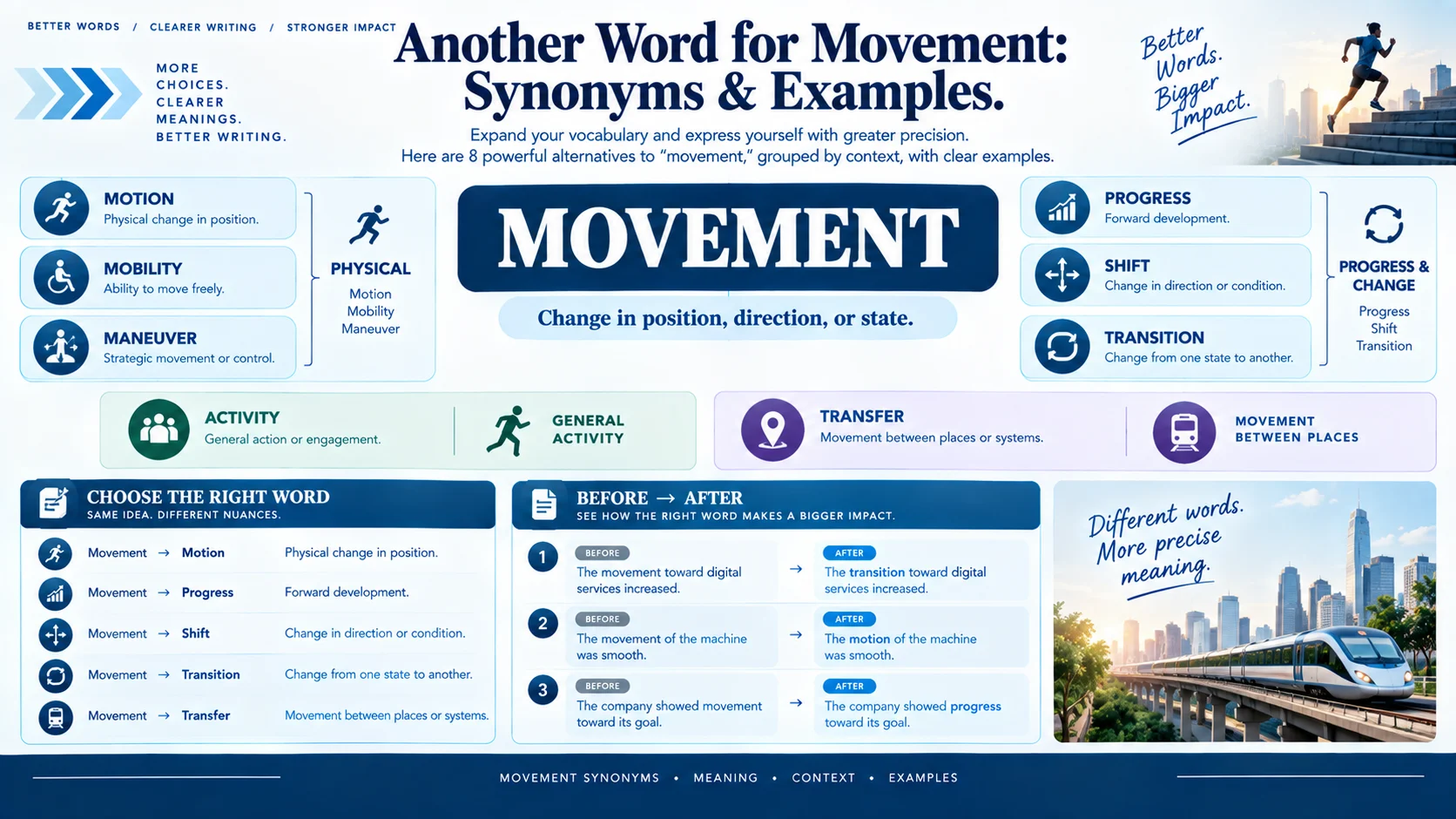
Another word for movement is motion, especially when referring to a change in position. Depending on context, alternatives include action, motion, mobility, progress, activity, maneuver, shift, transfer, campaign, and initiative. The best synonym depends on whether you mean physical movement, progress, a social movement, or another specialized meaning.
What Does Movement Mean?
Definition
Movement is a noun with several meanings. In its most common sense, it refers to a change in position, place, or posture. For example, the movement of a person, vehicle, machine, or body part describes a change from one position to another. Cambridge Dictionary identifies “motion,” “change of position,” and “locomotion” among related terms.
The word can also describe a group of people organized around shared ideas or goals, as in “the environmental movement.” It can refer to progress or change, such as movement toward a new policy, and it has specialized meanings in music, watches, finance, and medicine.
Because of these different meanings, no single synonym works in every sentence.
Common Uses
Movement can describe:
- Physical motion: “The movement of the car was sudden.”
- Body motion: “Her movements were graceful.”
- Transportation: “The movement of goods was delayed.”
- Progress or change: “There has been movement toward an agreement.”
- A social or cultural group: “The movement attracted thousands of supporters.”
- Military activity: “The army monitored troop movements.”
- Music: “The symphony contains four movements.”
- A clock mechanism: “The watch has a mechanical movement.”
Best Synonyms for Movement
| Synonym | Meaning | Best Used When | Example |
|---|---|---|---|
| Motion | Change in position or physical movement | Describing physical action | “The motion of the waves was constant.” |
| Action | Something done or performed | Describing purposeful activity | “The manager took immediate action.” |
| Mobility | Ability or capacity to move | Physical ability, transportation, or workforce contexts | “The new design improves mobility.” |
| Progress | Forward development or advancement | Describing improvement or development | “The project is finally making progress.” |
| Shift | A change from one position, condition, or direction to another | Trends, opinions, policies, or situations | “There was a shift in consumer preferences.” |
| Activity | Something happening or being done | General or ongoing movement | “The area showed increased economic activity.” |
| Maneuver | A deliberate movement or tactical action | Military, sports, driving, or strategic contexts | “The driver made a careful maneuver.” |
| Campaign | Organized effort toward a goal | Social, political, marketing, or fundraising contexts | “The organization launched a public campaign.” |
| Initiative | A planned effort intended to achieve something | Business, education, and organizational contexts | “The company introduced a new sustainability initiative.” |
| Transfer | Movement from one place, person, or system to another | Money, property, people, data, or goods | “The transfer of funds was completed.” |
Cambridge’s thesaurus groups motion, locomotion, stirring, progress, agitation, and action among words related to movement, while other senses require different alternatives.
Synonyms by Context
Formal Writing
For formal writing, choose a word that specifies the type of movement rather than automatically replacing it with a general synonym.
Good choices include:
- Motion — physical movement
- Transition — movement from one state or stage to another
- Shift — a change in position, policy, attitude, or trend
- Progress — forward development
- Displacement — movement from an original position
- Transfer — movement between locations or systems
Example:
Instead of:
“The movement of employees between departments increased.”
You could write:
“The transfer of employees between departments increased.”
“Transfer” is more precise because it identifies movement from one organizational position to another.
Professional Writing
In business writing, the best alternative depends on what is moving.
Use activity for general business activity, shift for changes in trends or strategy, progress for advancement, transfer for movement between systems, and transition for a change from one stage or condition to another.
Business example:
“The company has made significant progress toward its expansion goals.”
Academic Writing
Academic writing often benefits from precise terms such as motion, displacement, transition, progression, shift, and change.
Academic example:
“The study examines the shift in consumer behavior following the introduction of digital payment systems.”
Here, “shift” is more precise than “movement” because the sentence describes a change in behavior rather than physical motion.
Daily Conversation
In everyday English, motion, move, action, and activity are often natural alternatives.
Daily example:
- “I noticed some movement outside.”
- “I noticed some motion outside.”
“Motion” works particularly well when referring to visible physical movement.
Professional Alternatives for Movement
If you need a more polished word for professional or workplace writing, consider:
Progress — when something is advancing toward a goal.
“The project is showing steady progress.”
Transition — when something is changing from one state to another.
“The company is undergoing a major transition.”
Shift — when describing a notable change in direction, preference, or strategy.
“The industry has experienced a significant shift.”
Activity — when referring broadly to things happening within an organization, market, or sector.
“Market activity increased during the quarter.”
Transfer — when something or someone is moved between locations, departments, accounts, or systems.
“The transfer was completed successfully.”
Simple Alternatives for Movement
For simple, everyday writing, these words are usually easier to understand:
- Move
- Motion
- Action
- Change
- Activity
- Progress
- Shift
For example:
Original: “The movement of the vehicle was slow.”
Simpler: “The motion of the vehicle was slow.”
Or:
Original: “There was movement in public opinion.”
Simpler: “There was a change in public opinion.”
Stronger Alternatives for Movement
A stronger alternative should add meaning rather than simply sound more sophisticated.
- Maneuver — emphasizes deliberate or tactical movement.
- Displacement — emphasizes being moved from an original position.
- Transition — emphasizes movement between states or stages.
- Progression — emphasizes development through stages.
- Mobilization — emphasizes organizing people or resources for action.
- Advancement — emphasizes forward development.
- Transformation — emphasizes substantial change.
For example, “movement toward digital services” can become “the transition toward digital services” when the sentence describes a change in operating model.
Difference Between Similar Synonyms
Movement vs. Motion
Movement is the broader everyday term. Motion often emphasizes the act or process of moving.
- “The movement of the crowd was difficult to control.”
- “The motion of the machine was smooth.”
Movement vs. Action
Action focuses on something being done, while movement can simply describe physical motion.
- “The athlete’s movement was fast.”
- “The athlete took action to defend the goal.”
Movement vs. Progress
Progress means development or advancement toward a desired result. It is not normally a substitute for physical movement.
- “The project is making progress.”
- “The machine is making movement.” ❌
Movement vs. Shift
Shift suggests a change from one position, condition, opinion, or direction to another.
- “There was a movement in the crowd.”
- “There was a shift in consumer preferences.”
Movement vs. Mobility
Mobility generally refers to the ability or capacity to move, rather than one specific act of movement.
- “The device provides greater mobility.”
- “The device made one sudden movement.”
Movement vs. Campaign
When movement refers to an organized group pursuing shared aims, campaign, organization, or initiative may sometimes work, but they are not interchangeable in every sentence. Cambridge specifically defines this sense of movement as a group of people sharing particular aims or ideas.
Specialized Meanings of Movement
The context can completely change the appropriate replacement.
Social or cultural movement:
Possible alternatives include campaign, cause, organization, initiative, or collective, depending on the sentence.
Financial movement:
Use change, fluctuation, shift, or variation when discussing changes in prices, currencies, or market figures. Cambridge’s Business English Dictionary uses movement for changes in financial numbers and prices.
Transportation:
Use transportation, transfer, transit, or displacement when describing the movement of people or goods.
Music:
A movement is a major section of a larger classical composition. In this context, section or part may work as a contextual alternative.
Clock or watch:
A movement can mean the mechanism that drives a clock or watch. In that specialized sense, mechanism or works can be appropriate alternatives.
Best Synonym by Intended Meaning
If you are choosing a replacement quickly, use this guide:
- Physical movement → motion
- Ability to move → mobility
- Forward development → progress
- Change in direction → shift
- Change between stages → transition
- Deliberate physical action → maneuver
- General activity → activity
- Movement between places or systems → transfer
- Organized effort → campaign or initiative
- Group sharing ideas → organization or movement
- Musical section → part or section
- Watch mechanism → mechanism
The key lesson is that movement is a broad word, while many synonyms are narrower. A precise synonym is usually better than a more complicated one.
Opposite Words
Depending on the meaning, possible opposites of movement include:
- Stillness
- Inactivity
- Inertia
- Stasis
- Stagnation
- Immobility
For physical movement, stillness or inactivity may be appropriate. For progress, stagnation may provide the contrast. Cambridge lists inertia, stasis, and quiescence as antonyms in relevant senses.
FAQs
What is another word for movement?
The most common alternative is motion when movement means a change in physical position. Other alternatives include action, mobility, activity, progress, shift, transition, and maneuver, depending on context.
What is a formal synonym for movement?
Formal alternatives include motion, transition, displacement, progression, transfer, and advancement. The appropriate choice depends on what kind of movement you are describing.
What is a professional alternative for movement?
In professional writing, progress, transition, shift, activity, transfer, or initiative can replace movement when they accurately describe the intended meaning.
What word can replace movement in an essay?
For an academic essay, consider motion, change, shift, transition, progression, displacement, or development. Choose the word that most precisely expresses the relationship being discussed.
What is another word for physical movement?
Motion is the closest general synonym. Depending on the situation, locomotion, mobility, movement, displacement, or maneuver may be more precise.
What is another word for movement toward a goal?
Use progress, advancement, progression, development, or transition, depending on the sentence.
What is another word for a social movement?
Depending on the meaning, alternatives include campaign, cause, organization, initiative, collective, or movement itself. These words differ in scope and should not be treated as exact substitutes.
Conclusion
The best synonym for movement depends on what you mean. Motion is the closest general replacement for physical movement, while mobility describes the ability to move, progress describes advancement, shift describes change, and transition describes movement from one state to another. For organized social activity, words such as campaign or initiative may be more precise.
Rather than replacing “movement” automatically, identify the exact meaning first. A precise synonym makes writing clearer, more natural, and more effective.
