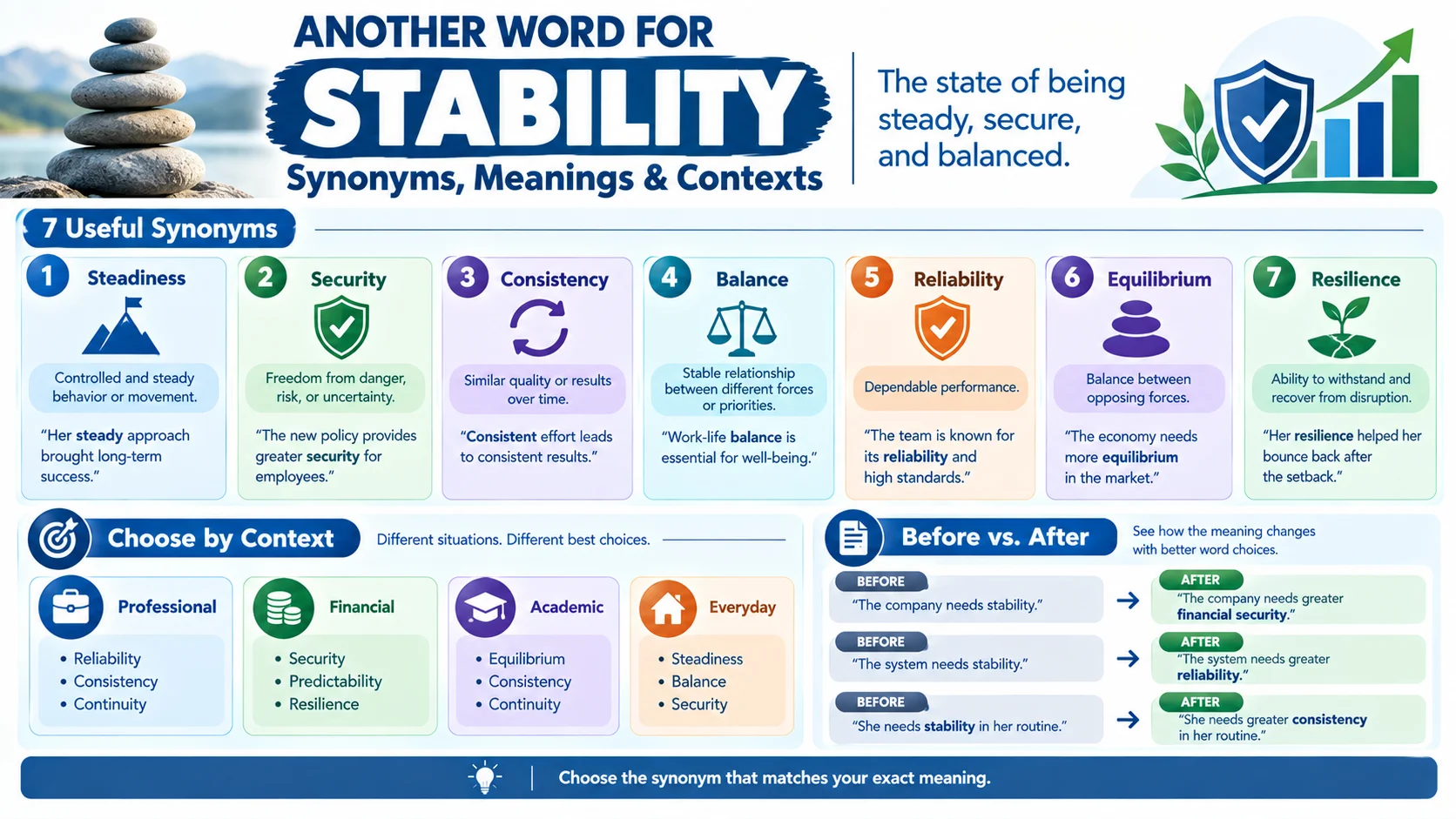
If you need another word for stability, good alternatives include steadiness, security, consistency, balance, reliability, equilibrium, permanence, and resilience. The best choice depends on what kind of stability you mean. For example, security works well for financial or personal safety, while consistency fits performance and results. Balance is better for physical, emotional, or competing forces.
What Does Stability Mean?
Definition
Stability means the condition of being steady, secure, balanced, or unlikely to change suddenly. It can describe physical objects, emotions, relationships, finances, businesses, governments, systems, or performance.
For example:
- The table needs greater stability.
- The company has achieved financial stability.
- Emotional stability can help people handle stressful situations.
- The economy showed signs of stability.
- The athlete maintained stability while landing.
Because stability has several meanings, the most accurate synonym depends on the context.
Common Uses
The word stability commonly refers to:
- Physical steadiness: the ability to remain balanced or upright
- Financial security: dependable income or economic conditions
- Emotional steadiness: calm and controlled emotions
- Business reliability: predictable operations and performance
- Political or social order: continuity and absence of major disruption
- System reliability: the ability of a system to function consistently
- Long-term continuity: the ability to remain established over time
Best Synonyms for Stability
| Synonym | Meaning | Best Used When | Example |
|---|---|---|---|
| Steadiness | The quality of being steady and controlled | Physical, emotional, or behavioral contexts | Her steadiness helped her complete the task. |
| Security | Freedom from danger, uncertainty, or financial risk | Money, safety, employment, relationships | The new job provided greater financial security. |
| Consistency | The ability to remain similar or dependable over time | Performance, behavior, results | His consistency improved the team’s performance. |
| Balance | A stable relationship between opposing or competing forces | Physical, emotional, or lifestyle contexts | She maintains a healthy balance between work and family. |
| Reliability | The quality of being dependable | People, products, systems, and services | The reliability of the equipment is essential. |
| Equilibrium | A state in which opposing forces are balanced | Scientific, technical, economic, or formal writing | The market eventually reached equilibrium. |
| Permanence | The quality of lasting or remaining unchanged | Long-term situations or conditions | The agreement was intended to provide permanence. |
| Resilience | The ability to recover from difficulty or disruption | People, organizations, and systems | The business demonstrated resilience after the setback. |
Steadiness
Meaning: Steadiness describes the quality of remaining stable, controlled, or consistent without sudden movement or change.
Tone: Neutral
Difficulty: Easy
Usage Frequency: Common
Best used for: Physical control, emotions, behavior, voice, hands, or performance.
- Business: The manager’s steadiness helped the team navigate uncertainty.
- Academic: The experiment required steadiness in temperature and pressure.
- Daily conversation: Her steadiness made everyone feel calmer.
Security
Meaning: Security emphasizes protection, safety, certainty, or freedom from serious risk.
Tone: Neutral to professional
Difficulty: Easy
Usage Frequency: Very Common
Best used for: Financial, personal, employment, and physical situations.
- Business: The company offers employees greater financial security.
- Academic: Economic security can influence household decision-making.
- Daily conversation: A stable income gives the family more security.
Consistency
Meaning: Consistency refers to maintaining a similar level, quality, behavior, or result over time.
Tone: Neutral to professional
Difficulty: Easy
Usage Frequency: Very Common
Best used for: Work performance, quality, habits, writing, and results.
- Business: Consistency in customer service builds trust.
- Academic: The study examined the consistency of the results.
- Daily conversation: Her consistency is one of her greatest strengths.
Balance
Meaning: Balance describes a stable relationship between different or opposing elements.
Tone: Neutral
Difficulty: Easy
Usage Frequency: Very Common
Best used for: Physical movement, work-life situations, emotions, priorities, and competing interests.
- Business: The company needs a balance between growth and risk.
- Academic: The ecosystem depends on a delicate balance.
- Daily conversation: I’m trying to find a better balance between work and rest.
Reliability
Meaning: Reliability means that someone or something can be trusted to perform as expected.
Tone: Professional
Difficulty: Easy
Usage Frequency: Common
Best used for: Employees, products, technology, services, systems, and information.
- Business: Product reliability is important for customer satisfaction.
- Academic: Researchers evaluated the reliability of the measurement.
- Daily conversation: I chose the car because of its reliability.
Equilibrium
Meaning: Equilibrium is a state of balance between opposing forces, influences, or conditions.
Tone: Formal
Difficulty: Advanced
Usage Frequency: Less Common
Best used for: Science, economics, mathematics, medicine, and formal writing.
Example: The two forces eventually reached equilibrium.
Synonyms by Context
Formal Writing
For formal or sophisticated writing, consider:
- Equilibrium
- Continuity
- Permanence
- Steadiness
- Consistency
Example:
The policy was designed to promote economic stability.
Possible alternatives include:
The policy was designed to promote economic equilibrium.
However, equilibrium changes the meaning slightly. It suggests balance among forces rather than general economic stability.
Professional Writing
In business communication, useful alternatives include:
- Reliability
- Consistency
- Security
- Continuity
- Predictability
Example:
The company needs financial stability.
A professional alternative could be:
The company needs greater financial security.
Or:
The company needs greater financial predictability.
Academic Writing
Academic contexts often benefit from precise words such as:
- Equilibrium
- Consistency
- Continuity
- Steadiness
- Resilience
Choose the word according to the specific concept being discussed rather than replacing stability automatically.
Daily Conversation
For everyday American English, the simplest alternatives are:
- Steadiness
- Balance
- Security
- Consistency
- Reliability
Example:
I need more stability in my life.
Depending on the intended meaning, you could say:
I need more security in my life.
or:
I need more balance in my life.
The first emphasizes safety or certainty, while the second emphasizes competing priorities.
Professional Alternatives for Stability
If you are writing a resume, cover letter, business email, or professional report, consider these alternatives:
Reliability works well when discussing dependable performance.
“Known for reliability and consistent project delivery.”
Consistency works well when discussing repeated quality or performance.
“Demonstrated consistency in meeting quarterly objectives.”
Security is useful for financial or employment contexts.
“The organization provides long-term financial security.”
Continuity emphasizes uninterrupted operation.
“The transition plan ensures business continuity.”
Predictability is appropriate when outcomes or conditions remain reasonably consistent.
“Improved forecasting provides greater predictability.”
Simple Alternatives for Stability
If your audience prefers plain language, use:
- Steadiness
- Balance
- Security
- Consistency
- Reliability
- Calmness
- Firmness
For example:
“The new policy brought stability to the organization.”
Could become:
“The new policy brought consistency to the organization.”
This is clearer if the intended meaning is predictable processes rather than general organizational stability.
Stronger Alternatives for Stability
There is no single “stronger” synonym for stability because each word emphasizes a different quality. However, these alternatives can communicate a more specific or powerful idea:
Resilience emphasizes the ability to withstand and recover from problems.
Permanence emphasizes lasting for a long period.
Security emphasizes protection from risk or uncertainty.
Reliability emphasizes dependable performance.
Equilibrium emphasizes balance between competing forces.
For example:
“The organization needs stability.”
A more precise statement might be:
“The organization needs resilience to withstand future disruptions.”
That sentence communicates more than simply remaining stable; it highlights recovery from adversity.
Difference Between Similar Synonyms
Stability vs. Steadiness
Stability is broader and can describe an overall condition. Steadiness usually emphasizes controlled movement, behavior, or performance.
Stability vs. Security
Stability means a condition is steady or unlikely to change suddenly. Security emphasizes protection from danger, loss, or uncertainty.
Stability vs. Consistency
Stability suggests an absence of major change. Consistency suggests that something repeatedly remains at a similar level or produces similar results.
Stability vs. Reliability
Stability describes a condition or state. Reliability describes how dependably a person, product, system, or process performs.
Stability vs. Balance
Stability can mean general steadiness. Balance specifically suggests that different forces, priorities, or elements are maintained in a stable relationship.
Stability vs. Resilience
Stability focuses on remaining steady. Resilience focuses on the ability to withstand disruption and recover afterward.
Opposite Words
Common antonyms for stability include:
- Instability
- Uncertainty
- Volatility
- Imbalance
- Insecurity
- Unreliability
- Disruption
- Changeability
The best opposite depends on the context.
For example:
- Financial stability ↔ financial insecurity
- Emotional stability ↔ emotional volatility
- Physical stability ↔ physical instability
- Market stability ↔ market volatility
- System stability ↔ system unreliability
FAQs
What is another word for stability?
Common alternatives include steadiness, security, consistency, balance, reliability, continuity, equilibrium, permanence, and resilience. The correct choice depends on the type of stability being described.
What is a formal synonym for stability?
Equilibrium, continuity, permanence, and steadiness can work in formal writing, depending on the context. Equilibrium is particularly appropriate when discussing a balance between opposing forces.
What is a professional alternative for stability?
Reliability, consistency, continuity, security, and predictability are useful professional alternatives. For business operations, continuity can be more precise when referring to uninterrupted activity.
What word can replace stability on a resume?
Depending on the intended meaning, use reliability, consistency, resilience, dependability, or continuity. For example, “demonstrated reliability” is often more specific than simply saying “demonstrated stability.”
What is another word for financial stability?
Possible alternatives include financial security, financial strength, economic security, financial consistency, and financial resilience. Each emphasizes a different aspect of a strong financial position.
What is another word for emotional stability?
Depending on the intended meaning, alternatives include emotional steadiness, composure, calmness, emotional balance, and self-control.
What is another word for stability in business?
Useful choices include reliability, continuity, consistency, predictability, security, and resilience. The most appropriate word depends on whether you mean operations, finances, performance, or the ability to withstand disruption.
Conclusion
The best synonym for stability depends on the exact meaning you want to communicate. Use steadiness for controlled behavior or movement, security for safety and financial certainty, consistency for dependable results, reliability for trustworthy performance, balance for competing elements, equilibrium for formal or technical balance, and resilience for the ability to withstand disruption.
Choosing a context-specific synonym makes your writing more precise and natural than simply replacing stability with the first word that appears in a thesaurus.
