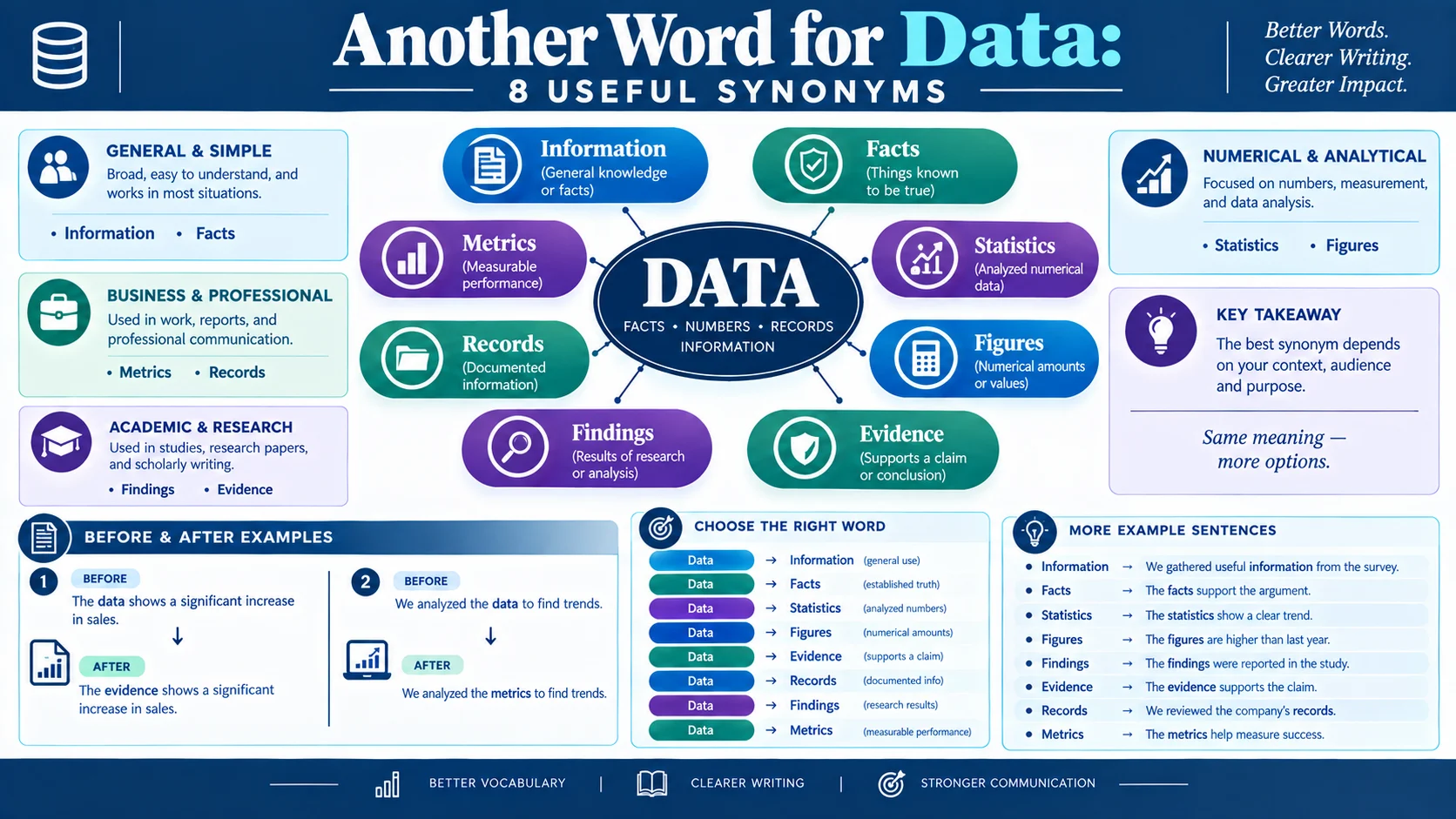
If you need another word for data, the best choice depends on what you mean. Common alternatives include information, facts, figures, statistics, records, findings, evidence, details, measurements, and results. “Information” is the most general replacement, while “statistics,” “evidence,” and “figures” are better when the context is more specific.
What Does Data Mean?
Definition
Data refers to facts, measurements, observations, numbers, records, or other pieces of information collected for analysis, communication, or decision-making.
The word can describe both numerical and non-numerical material. For example, a company may collect sales data, a researcher may gather experimental data, and a website may analyze user data.
In everyday writing, information is often the closest general substitute for data. However, the two words are not always identical. Data usually refers to collected or recorded facts, whereas information often refers to data that has been organized, interpreted, or communicated in a meaningful way.
Common Uses
“Data” is frequently used in:
- Business reports and analytics
- Scientific and academic research
- Market research
- Technology and computing
- Statistics
- Financial analysis
- Surveys and studies
- Government reports
- Healthcare research
- Journalism
For example:
The company analyzed customer data to identify purchasing trends.
Depending on the intended meaning, you could replace “data” with information, statistics, findings, records, or figures.
Best Synonyms for Data
| Synonym | Meaning | Best Used When | Example |
|---|---|---|---|
| Information | Knowledge or facts about something | You need a broad, natural alternative | We collected information from customers. |
| Facts | Things known or proven to be true | Referring to established details | The report contains important facts. |
| Figures | Numerical facts or amounts | Discussing financial or numerical data | The latest figures show higher sales. |
| Statistics | Numerical data analyzed or summarized | Discussing measurable trends | The statistics reveal a decline in unemployment. |
| Records | Stored information or documented history | Referring to collected documentation | The company reviewed its financial records. |
| Findings | Results discovered through research or investigation | Academic, scientific, or investigative writing | The findings support the original hypothesis. |
| Evidence | Information supporting a conclusion or claim | Proving or supporting something | The evidence suggests that the strategy worked. |
| Details | Individual pieces of information | Everyday or explanatory writing | Please provide more details about the project. |
| Measurements | Quantified observations | Scientific, engineering, or technical contexts | The measurements were recorded every hour. |
| Results | Outcomes produced by research, testing, or analysis | Discussing what an analysis revealed | The results were consistent with previous studies. |
Information
Meaning: Facts or knowledge communicated about a subject.
Best used for: General business, professional, educational, and everyday writing.
Tone: Neutral and versatile.
Difficulty: Easy
Usage frequency: Very Common
Best for: Resumes, emails, essays, marketing copy, and business writing.
Business example:
“We used customer information to improve our service.”
Academic example:
“The study provides valuable information about consumer behavior.”
Daily conversation example:
“Can you send me more information about the event?”
Information is usually the safest replacement when you want a natural word that works in many situations.
Facts
Meaning: Pieces of information that are known or established to be true.
Best used for: Statements, explanations, journalism, and general communication.
Tone: Direct and factual.
Difficulty: Easy
Usage frequency: Very Common
Business example:
“The presentation should include the key facts about the market.”
Academic example:
“Researchers examined historical facts before developing the theory.”
Daily conversation example:
“Let me give you the facts before you decide.”
Use facts when you want to emphasize truth rather than simply collected information.
Figures
Meaning: Numerical information, especially amounts, totals, or measurements.
Best used for: Business, finance, economics, and reports.
Tone: Professional.
Difficulty: Easy
Usage frequency: Common
Business example:
“The latest sales figures exceeded expectations.”
Academic example:
“The figures indicate a significant increase in participation.”
Daily conversation example:
“Do you have the final figures for this month?”
Figures is particularly useful when “data” refers primarily to numbers.
Statistics
Meaning: Numerical data, especially data that has been collected, analyzed, and presented to show patterns or trends.
Best used for: Research, business analysis, economics, journalism, and academic writing.
Tone: Technical or analytical.
Difficulty: Medium
Usage frequency: Very Common
Business example:
“Recent statistics show that online purchases are increasing.”
Academic example:
“The statistics support the study’s central conclusion.”
Daily conversation example:
“The statistics on housing prices were surprising.”
Do not automatically replace every use of “data” with “statistics.” Raw data can become statistics after it is organized or analyzed.
Records
Meaning: Information preserved in written, digital, or documented form.
Best used for: Historical information, financial documentation, customer information, and administrative contexts.
Tone: Professional.
Difficulty: Easy
Usage frequency: Common
Business example:
“We reviewed the company’s financial records.”
Academic example:
“Historical records provided valuable information about the region.”
Daily conversation example:
“The doctor checked my previous records.”
Findings
Meaning: Results or conclusions discovered through research, investigation, or analysis.
Best used for: Research papers, reports, investigations, and studies.
Tone: Academic and professional.
Difficulty: Medium
Usage frequency: Common
Business example:
“Our findings suggest that customers prefer the new design.”
Academic example:
“The findings indicate a strong relationship between the two variables.”
Daily conversation example:
“The investigation’s findings were released yesterday.”
Findings is stronger than “data” when you are talking about what the data revealed.
Evidence
Meaning: Information, facts, or observations used to support a conclusion or claim.
Best used for: Academic arguments, legal contexts, research, journalism, and analytical writing.
Tone: Formal.
Difficulty: Medium
Usage frequency: Very Common
Business example:
“There is evidence that the campaign increased brand awareness.”
Academic example:
“The evidence supports the researchers’ hypothesis.”
Daily conversation example:
“Do you have any evidence to support that claim?”
Use evidence when the information is being used to establish or support something.
Synonyms by Context
Formal Writing
For formal writing, strong alternatives include:
information, evidence, findings, statistics, records, figures, and measurements.
Instead of:
The data shows that the policy was successful.
You could write:
The evidence indicates that the policy was successful.
Or:
The findings indicate that the policy was successful.
The second versions can sound more precise because they explain the role the data plays in the argument.
Professional Writing
In business and workplace communication, the best alternatives often include information, figures, statistics, records, metrics, insights, and findings.
For example:
We analyzed the data to improve customer retention.
Could become:
We analyzed customer insights to improve retention.
Or:
We reviewed the latest metrics to identify opportunities for improvement.
Metrics is especially useful when discussing measurable business performance, such as conversion rate, revenue, traffic, or customer retention.
Academic Writing
Academic writing commonly uses evidence, findings, statistics, observations, measurements, results, and information.
For example:
The data supports the hypothesis.
Could become:
The evidence supports the hypothesis.
Or:
The findings support the hypothesis.
Choose evidence when emphasizing support for an argument and findings when emphasizing what the research discovered.
Daily Conversation
In everyday conversation, simpler alternatives usually sound more natural:
information, facts, details, numbers, results, or figures.
Instead of:
Can you send me the data?
You might say:
Can you send me the information?
Or:
Can you send me the details?
Professional Alternatives for Data
If you are writing a report, resume, business email, or presentation, consider these alternatives:
- Information — broad and natural
- Metrics — measurable performance indicators
- Statistics — analyzed numerical information
- Figures — numerical amounts
- Findings — research discoveries
- Insights — useful conclusions drawn from information
- Records — stored documentation
- Results — outcomes of analysis or testing
- Evidence — information supporting a conclusion
For example, a resume might say:
“Analyzed customer data to identify market trends.”
A stronger professional version could be:
“Analyzed customer metrics and insights to identify emerging market trends.”
The best replacement depends on what you actually analyzed.
Simple Alternatives for Data
If your audience prefers plain English, use:
information, facts, details, numbers, results, or records.
For example:
“Please review the data before the meeting.”
Simple alternative:
“Please review the information before the meeting.”
“Information” is usually the easiest substitute because most readers immediately understand it.
Stronger Alternatives for Data
Sometimes “data” is too general. A more specific word can make your writing stronger.
Use evidence when the information supports a claim.
Use findings when research produced a conclusion.
Use statistics when you are discussing analyzed numerical information.
Use metrics when discussing measurable performance.
Use insights when the information has produced a useful business or strategic understanding.
Use measurements when values were obtained through measurement.
Use records when referring to documented or stored information.
Specific language generally communicates more effectively than repeatedly using the broad term “data.”
Difference Between Similar Synonyms
Data vs. Information
Data is collected facts, observations, measurements, or records. Information is a broader term for knowledge or facts that communicate something meaningful.
Data vs. Statistics
Data can be raw or processed. Statistics generally refers to numerical data that has been analyzed, summarized, or interpreted.
Data vs. Facts
Facts are statements or pieces of information considered true. Data can include raw observations that still require analysis.
Data vs. Evidence
Evidence is information used to support a conclusion or claim. Data can serve as evidence, but not every piece of data is necessarily evidence for a particular argument.
Data vs. Findings
Findings are conclusions or discoveries produced from research or analysis. Data is often the material used to reach those findings.
Data vs. Metrics
Metrics are specific measurements used to evaluate performance or progress. They are a particular type of data rather than a complete synonym for it.
Opposite Words
“Data” does not have one perfect opposite, but depending on the context, possible contrasts include:
- Opinion
- Assumption
- Guess
- Speculation
- Interpretation
- Theory
These words are not true antonyms in every situation. For example, data can be interpreted into an opinion, but an opinion is not necessarily the opposite of data.
FAQs
What is another word for data?
The most general alternative is information. Other options include facts, figures, statistics, records, findings, evidence, details, measurements, results, metrics, and insights, depending on the context.
What is a formal synonym for data?
Formal alternatives include information, evidence, findings, statistics, measurements, records, and results. The best choice depends on whether you mean raw information, research outcomes, numerical values, or supporting evidence.
What is a professional alternative for data?
In professional writing, useful alternatives include information, metrics, statistics, figures, insights, findings, records, and results. “Metrics” is particularly appropriate for measurable business performance.
What word can replace data in an essay?
For an academic essay, evidence, findings, statistics, information, observations, or results may work better than “data,” depending on your sentence.
What is another word for data in research?
Common research alternatives include findings, evidence, observations, measurements, results, statistics, and information. “Findings” is especially useful when referring to conclusions produced by a study.
What is another word for data in business?
Business alternatives include metrics, figures, statistics, information, insights, records, results, and findings. Use “metrics” for measurable performance indicators and “insights” for conclusions that inform business decisions.
What is a simple word for data?
Information is the simplest and most broadly understood alternative to “data.” Depending on the sentence, facts or details may also work.
Conclusion
The best synonym for data depends on what you are trying to communicate. Information is the safest general replacement, while statistics works well for analyzed numbers, figures for numerical amounts, evidence for supporting a claim, findings for research discoveries, records for documented material, and metrics for measurable performance.
Rather than replacing “data” automatically, choose the word that describes the information’s exact role. That small distinction can make business reports, academic papers, resumes, emails, and everyday writing much clearer and more precise.
