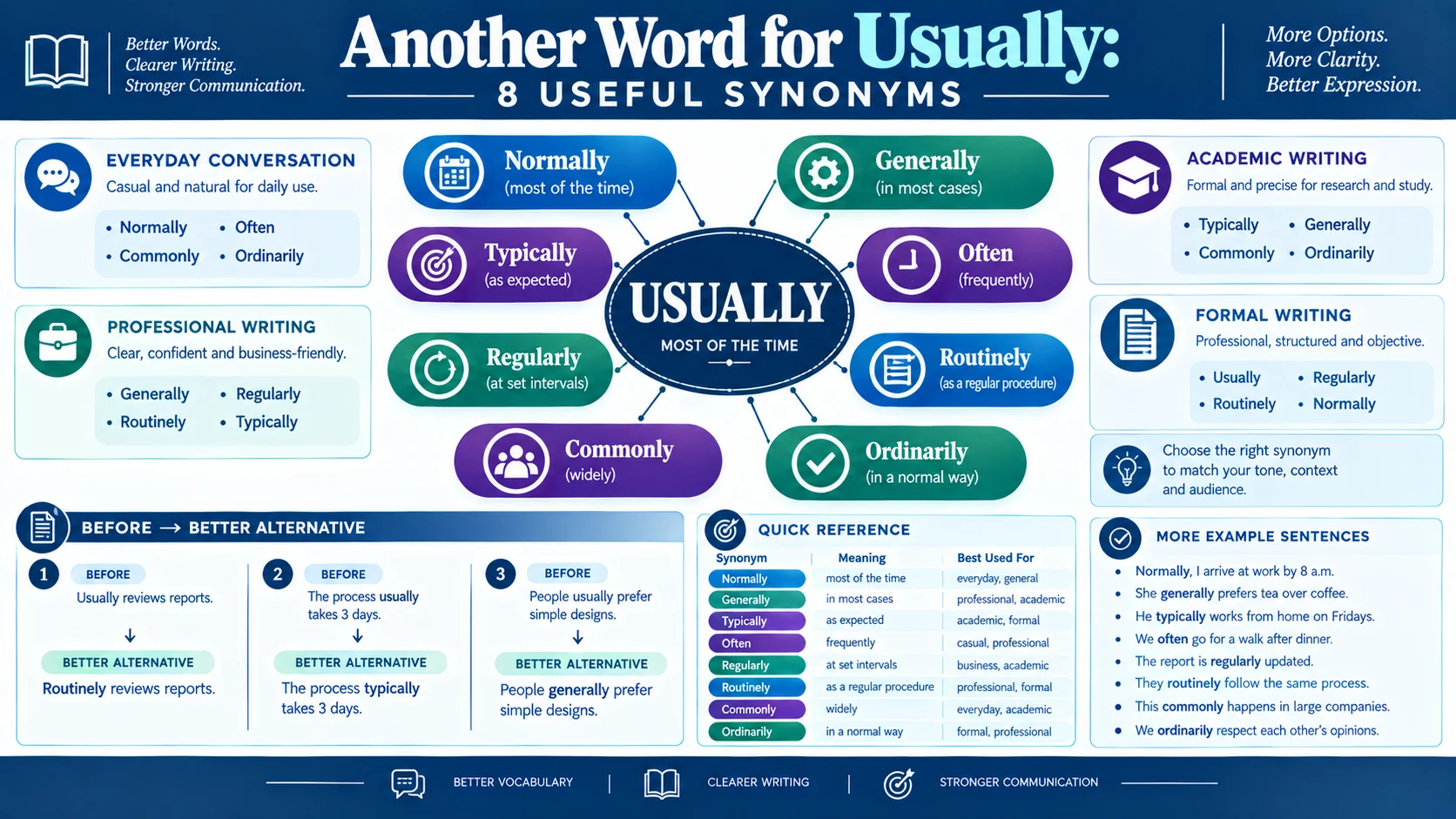
If you need another word for usually, the best choices include normally, generally, typically, ordinarily, commonly, routinely, regularly, and customarily. The right synonym depends on what you mean. For example, normally suggests what happens under ordinary conditions, while typically describes what is characteristic or expected. For formal writing, generally and ordinarily are often effective choices.
What Does Usually Mean?
Definition
Usually is an adverb meaning most of the time, in most cases, or under normal circumstances. It describes something that happens regularly or is generally true, but not necessarily every time.
For example:
She usually arrives at work before 9 a.m.
This means she arrives before 9 a.m. most of the time, although there may be exceptions.
The word usually indicates a high frequency without claiming something is always true. That distinction is important when choosing a synonym.
Common Uses
Usually can describe:
- A repeated action: He usually walks to work.
- A common situation: These stores are usually busy on weekends.
- A typical characteristic: The weather is usually mild in spring.
- A normal expectation: The meeting usually lasts an hour.
Best Synonyms for Usually
| Synonym | Meaning | Best Used When | Example |
|---|---|---|---|
| Normally | Under ordinary conditions | Describing what generally happens | She normally works from home. |
| Generally | In most cases | Formal, professional, or broad statements | Customers generally prefer simple designs. |
| Typically | In a characteristic or expected way | Describing patterns or common characteristics | The process typically takes three days. |
| Ordinarily | Under normal circumstances | Formal writing | The office is ordinarily closed on Sundays. |
| Commonly | Frequently or by many people | General facts or widespread practices | This method is commonly used in research. |
| Regularly | At repeated or consistent intervals | Habits and recurring actions | He regularly checks his email. |
| Routinely | As part of a regular procedure or habit | Professional and operational contexts | Staff routinely review the reports. |
| Customarily | According to established custom or practice | Formal or traditional contexts | Employees customarily submit reports on Friday. |
| Frequently | Often | When emphasizing how often something occurs | She frequently travels for work. |
| Often | Many times or on many occasions | Natural everyday speech | We often eat dinner together. |
| As a rule | Generally or in most cases | Rules, habits, and general statements | As a rule, the store closes at 8 p.m. |
| For the most part | Mostly, with some exceptions | Qualifying a broad statement | The project was, for the most part, successful. |
Synonyms by Context
Formal Writing
For formal writing, generally, ordinarily, typically, and customarily are useful alternatives.
Generally is especially versatile:
The policy generally applies to full-time employees.
Ordinarily is more formal and works well when referring to normal conditions:
Applications are ordinarily reviewed within five business days.
Typically is useful when describing an expected pattern:
The procedure typically requires several stages.
Customarily is best when an action follows an established convention:
The documents are customarily submitted at the end of the fiscal year.
Avoid replacing usually with an unusually sophisticated word simply to sound formal. The clearest word is normally the strongest choice.
Professional Writing
In business writing, generally, typically, normally, routinely, and regularly are particularly useful.
Compare these examples:
- Usually: Employees usually receive a response within 48 hours.
- Typically: Employees typically receive a response within 48 hours.
- Normally: Employees normally receive a response within 48 hours.
- Routinely: Employees routinely receive updates from management.
The differences are subtle. Typically emphasizes an expected pattern, normally emphasizes ordinary conditions, and routinely emphasizes a repeated procedure.
Academic Writing
Academic writers often benefit from generally, typically, commonly, ordinarily, and frequently.
For example:
This type of behavior is commonly observed among younger participants.
Or:
The results generally support the proposed hypothesis.
Generally is often preferable when making a qualified claim because it avoids suggesting that a statement is universally true.
Daily Conversation
For casual communication, the most natural replacements are:
- Normally
- Often
- Usually
- Regularly
- Most of the time
- As a rule
Examples:
I normally get up at 7.
We often go out on Friday nights.
She regularly calls her parents.
In everyday conversation, often can sound more natural than a formal alternative such as ordinarily.
Professional Alternatives for Usually
If you’re writing an email, report, resume, proposal, or business document, consider these alternatives:
Generally
Meaning: In most cases or broadly speaking.
Tone: Professional and neutral
Difficulty: Easy
Usage Frequency: Very Common
Best For: Business writing, academic writing, reports, emails
Business example:
Customers generally expect a response within one business day.
Academic example:
Participants generally reported positive results.
Daily conversation:
People generally know how the system works.
Typically
Meaning: In the way that is characteristic or expected.
Tone: Professional and precise
Difficulty: Easy
Usage Frequency: Very Common
Best For: Reports, business writing, academic writing, explanations
Business example:
The onboarding process typically takes two weeks.
Academic example:
The species typically lives in temperate environments.
Daily conversation:
I typically leave work around five.
Normally
Meaning: Under ordinary or expected circumstances.
Tone: Neutral
Difficulty: Easy
Usage Frequency: Very Common
Best For: Emails, conversation, business writing, instructions
Business example:
Orders normally arrive within five business days.
Academic example:
The reaction normally occurs at higher temperatures.
Daily conversation:
I normally take the bus to work.
Simple Alternatives for Usually
If you want a word that is easy to understand, choose:
Often, normally, generally, regularly, or most of the time.
For example:
She usually studies at night.
can become:
She often studies at night.
or:
She studies at night most of the time.
The phrase most of the time is especially useful when you want to make the meaning completely clear.
Stronger Alternatives for Usually
There is no perfect “stronger” synonym for usually, because the words differ in meaning rather than simply intensity.
However, routinely and consistently can suggest a more established pattern.
The team usually reviews the data.
This simply says the review happens most of the time.
The team routinely reviews the data.
This suggests that reviewing the data is an established and repeated part of the team’s process.
Similarly, frequently emphasizes frequency:
The company frequently updates its website.
This can imply more frequent activity than usually, depending on the context.
Difference Between Similar Synonyms
Usually vs. Normally
These words are often interchangeable.
Usually focuses on what happens most of the time.
Normally focuses more on what happens under ordinary conditions.
I usually work until 6 p.m.
I normally work until 6 p.m.
Both are natural. Normally can also imply that something has changed from its ordinary state:
I normally work until 6, but today I’m leaving early.
Usually vs. Generally
Usually commonly describes repeated actions or events.
Generally is broader and is often used for general statements.
She usually takes the train.
People generally prefer convenient options.
The first describes one person’s recurring behavior. The second makes a broader observation.
Usually vs. Typically
Typically emphasizes what is characteristic or expected.
The store usually closes at 9 p.m.
The store typically closes at 9 p.m.
Both work, but typically can sound slightly more analytical or descriptive.
Usually vs. Often
Often means many times or frequently, while usually means in most cases or on most occasions.
I often drink coffee.
This means coffee drinking happens frequently.
I usually drink coffee in the morning.
This indicates a normal or predominant pattern.
Usually vs. Routinely
Routinely suggests a regular procedure or established habit.
The manager usually checks the report.
The manager routinely checks the report.
The second sentence makes the activity sound more systematic.
Choosing the Right Word
Use this quick guide:
- Usually → most of the time
- Normally → under ordinary circumstances
- Generally → in most cases or broadly
- Typically → characteristically or as expected
- Often → many times
- Regularly → repeatedly or at consistent intervals
- Routinely → as part of a regular procedure
- Commonly → frequently or widely
- Ordinarily → normally; formal
- Customarily → according to established practice
The best synonym is therefore determined by meaning and context, not by vocabulary difficulty.
Opposite Words
Words that express the opposite or a contrasting idea include:
- Rarely
- Seldom
- Infrequently
- Occasionally
- Never
- Unusually
- Exceptionally
For example:
She usually works on Saturdays.
Opposite or contrasting versions might be:
She rarely works on Saturdays.
or:
She never works on Saturdays.
Be careful: occasionally is not a direct opposite of usually. It simply describes something that happens from time to time.
FAQs
What is another word for usually?
Common alternatives for usually include normally, generally, typically, ordinarily, commonly, regularly, routinely, and often. The best choice depends on the sentence and intended meaning.
What is a formal synonym for usually?
Generally, ordinarily, typically, and customarily can work as formal alternatives. Generally is usually the most versatile option for professional and academic writing.
What is a professional alternative for usually?
In professional writing, typically, generally, normally, routinely, and regularly are strong choices. Use typically when describing an expected pattern and routinely when describing a standard procedure.
What word can replace usually?
You can replace usually with normally, generally, typically, often, regularly, commonly, or ordinarily, depending on the context.
What is another word for usually in an essay?
For an essay, generally, typically, commonly, or ordinarily may be appropriate. Generally is especially useful for broad claims that are true in most cases.
What is another word for usually in a resume?
For a resume, it is often better to avoid usually altogether and use a more precise description. Words such as regularly, consistently, routinely, or frequently can communicate professional habits more clearly.
For example:
Usually reviewed monthly reports.
is weaker than:
Regularly reviewed monthly reports.
Is “typically” the same as “usually”?
They are closely related but not identical. Usually emphasizes what happens most of the time, while typically emphasizes what is characteristic or expected.
Is “generally” a synonym for “usually”?
Yes, in many contexts. However, generally is broader and often describes a general truth, while usually more directly describes frequency.
Conclusion
The best another word for usually depends on what you want to communicate. Normally is ideal for ordinary circumstances, generally works well for broad or formal statements, and typically is excellent for describing expected patterns. For repeated professional activities, regularly and routinely can be more precise.
When in doubt, keep usually. A synonym is only an improvement when it expresses the intended meaning more accurately or fits the tone of the sentence better.

1 thought on “Another Word for Usually| 20+ Synonyms & Alternatives For 2026”