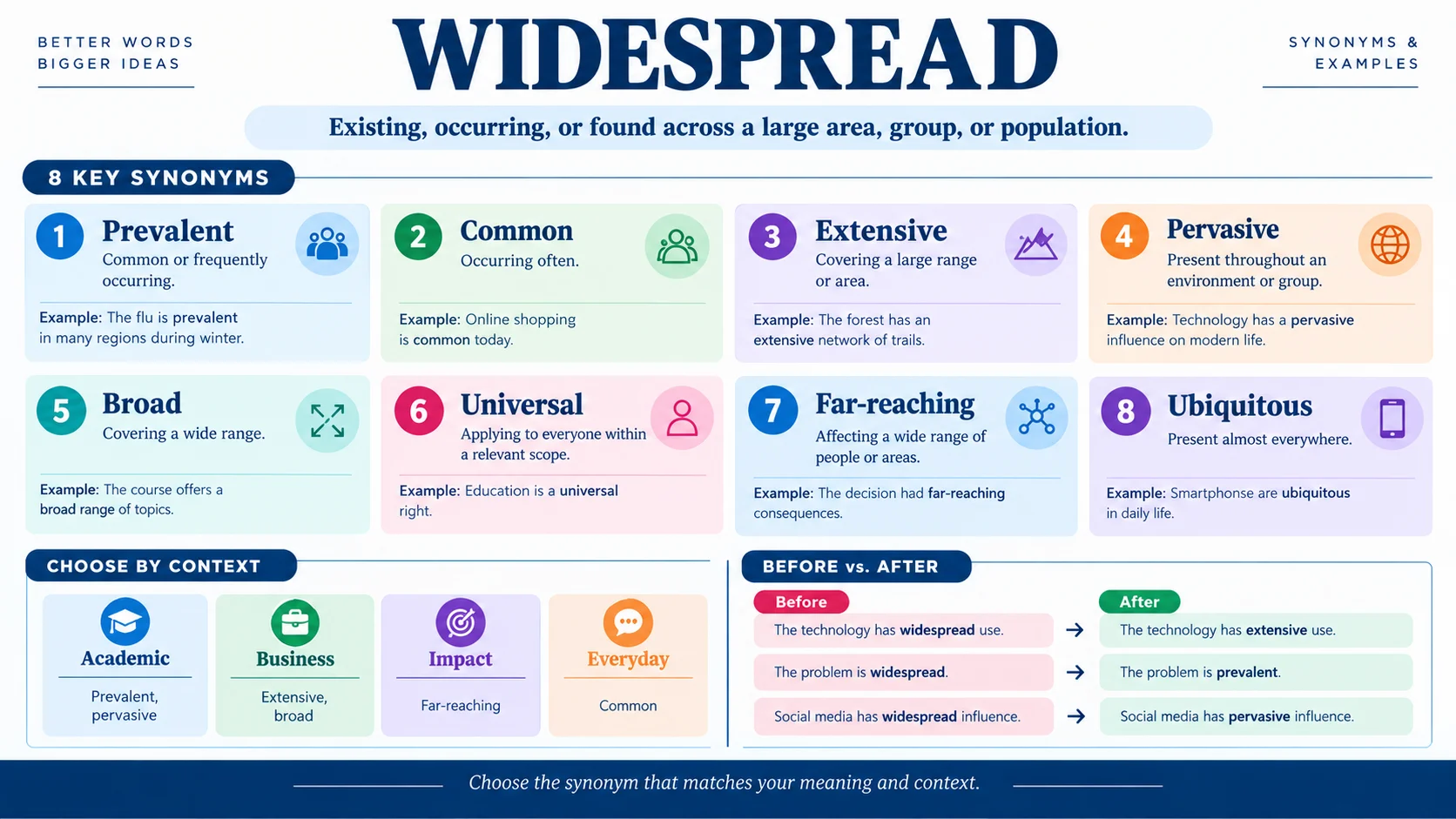
Another word for widespread is prevalent, especially when something exists or occurs commonly across a place, group, or situation. Other alternatives include common, extensive, pervasive, prevalent, universal, broad, far-reaching, and ubiquitous. The best choice depends on whether you are describing popularity, geographic reach, influence, or frequency.
What Does Widespread Mean?
Definition
Widespread is an adjective meaning existing, occurring, or found across a large area, among many people, or in many places.
It can describe something that is geographically extensive, commonly experienced, broadly accepted, or found among a large population.
For example:
Smartphone use is widespread among college students.
Here, widespread means that smartphone use is common among a large number of students.
Common Uses
The word widespread commonly describes:
- Ideas and opinions
- Problems and diseases
- Technologies and practices
- Behaviors and trends
- Knowledge and awareness
- Geographic conditions
- Social or cultural phenomena
- Business practices
The meaning can shift slightly depending on context. For example, prevalent emphasizes how commonly something occurs, while extensive emphasizes its size or reach.
Best Synonyms for Widespread
| Synonym | Meaning | Best Used When | Example |
|---|---|---|---|
| Prevalent | Common or frequently occurring | Something occurs among many people or places | Remote work is prevalent in the technology industry. |
| Common | Happening or existing often | You want a simple, everyday alternative | This problem is common among new users. |
| Extensive | Covering a large area or range | Emphasizing size, scope, or reach | The company has an extensive distribution network. |
| Pervasive | Spread throughout an area or group | Something is deeply or broadly present | Digital technology has become pervasive in modern life. |
| Universal | Applying to everyone or nearly everyone | Referring to very broad applicability | There is no universal solution to the problem. |
| Broad | Covering a wide range or area | General or wide-ranging contexts | The policy received broad support. |
| Far-reaching | Having a wide range of effects or influence | Emphasizing impact or consequences | The reform had far-reaching effects. |
| Ubiquitous | Present almost everywhere | Something seems to be found everywhere | Smartphones are ubiquitous in many cities. |
Prevalent
Meaning: Common, widespread, or frequently occurring.
Best Used For: Trends, conditions, behaviors, beliefs, problems, and diseases.
Tone: Formal and professional.
Difficulty: Medium
Usage Frequency: Common
Best For: Academic writing, business writing, reports, and essays.
Examples:
- Business: Remote collaboration tools are prevalent in modern workplaces.
- Academic: The practice is prevalent among younger participants.
- Daily: This type of restaurant is prevalent in the city.
Prevalent is often one of the closest formal replacements for widespread.
Common
Meaning: Existing frequently or experienced by many people.
Best Used For: Everyday situations and straightforward explanations.
Tone: Neutral and conversational.
Difficulty: Easy
Usage Frequency: Very Common
Best For: Emails, conversations, general writing, and simple explanations.
Example:
Traffic congestion is common in large cities.
Use common when you want clarity rather than a sophisticated vocabulary choice.
Extensive
Meaning: Large in size, scope, range, or coverage.
Best Used For: Networks, research, resources, experience, damage, coverage, and operations.
Tone: Professional and formal.
Difficulty: Medium
Usage Frequency: Common
Best For: Business writing, academic writing, reports, and resumes.
Example:
The organization has extensive experience in international markets.
Extensive is not always interchangeable with widespread. It focuses more strongly on scale or scope.
Pervasive
Meaning: Present throughout an area, group, system, or environment.
Best Used For: Influences, problems, technologies, attitudes, and social conditions.
Tone: Formal and analytical.
Difficulty: Advanced
Usage Frequency: Common
Best For: Academic writing, analytical essays, research, and professional reports.
Example:
Social media has a pervasive influence on modern communication.
Pervasive can suggest that something is deeply established or difficult to avoid.
Universal
Meaning: Applying to everyone or existing everywhere within a particular scope.
Best Used For: Principles, experiences, rules, solutions, or characteristics shared by all or nearly all.
Tone: Formal and strong.
Difficulty: Medium
Usage Frequency: Common
Example:
There is no universal agreement on the issue.
Be careful with universal because it is stronger than widespread. Something can be widespread without being universal.
Far-Reaching
Meaning: Affecting a large area, range, number of people, or set of consequences.
Best Used For: Effects, consequences, policies, decisions, reforms, and influence.
Tone: Professional and formal.
Difficulty: Medium
Usage Frequency: Common
Example:
The new regulations could have far-reaching consequences.
This is particularly useful when widespread describes impact rather than physical distribution.
Ubiquitous
Meaning: Found or encountered almost everywhere.
Best Used For: Technology, products, cultural features, advertising, and objects that appear nearly everywhere.
Tone: Formal and sophisticated.
Difficulty: Advanced
Usage Frequency: Less Common
Example:
Internet-connected devices have become ubiquitous.
Ubiquitous is stronger than widespread because it suggests near-universal presence.
Synonyms by Context
Formal Writing
For formal writing, useful alternatives include:
- Prevalent
- Pervasive
- Extensive
- Universal
- Ubiquitous
- Far-reaching
Example:
Widespread concerns have been reported.
More formal:
Pervasive concerns have been reported.
However, the replacement should match the intended meaning rather than simply making the sentence sound more sophisticated.
Professional Writing
In business and workplace writing, consider:
- Extensive
- Broad
- Prevalent
- Far-reaching
- Common
- Well-established
Example:
The company has widespread operations across North America.
Possible alternative:
The company has extensive operations across North America.
For business writing, extensive is often preferable when describing scale, while broad works well for coverage or support.
Academic Writing
Academic alternatives include:
- Prevalent
- Pervasive
- Extensive
- Common
- Ubiquitous
Example:
Widespread use of artificial intelligence has changed research practices.
Academic alternative:
The prevalent use of artificial intelligence has changed research practices.
Choose prevalent when emphasizing frequency and pervasive when emphasizing how deeply something has spread through a system or environment.
Daily Conversation
The simplest alternatives are:
- Common
- Everywhere
- Popular
- Frequent
- Broad
For example:
This problem is widespread.
Natural conversational version:
This problem is common.
Professional Alternatives for Widespread
If you need a stronger professional vocabulary choice, consider the exact meaning:
| Instead of Widespread | Use | Why |
|---|---|---|
| Widespread knowledge | Broad knowledge | Emphasizes range |
| Widespread use | Extensive use | Emphasizes scale |
| Widespread problem | Pervasive problem | Emphasizes broad presence |
| Widespread belief | Prevalent belief | Emphasizes common acceptance |
| Widespread effects | Far-reaching effects | Emphasizes impact |
| Widespread availability | Broad availability | Emphasizes accessibility |
| Widespread technology | Ubiquitous technology | Emphasizes near-everywhere presence |
Simple Alternatives for Widespread
If you’re writing for a general audience, these words are usually easier to understand:
Common, broad, popular, frequent, extensive, everywhere, widely used, widely known.
For example:
Widespread adoption of the software occurred within two years.
Simpler:
The software was widely adopted within two years.
Sometimes the best replacement isn’t a single synonym. The phrase widely used, widely known, or found in many places may sound more natural.
Stronger Alternatives for Widespread
When you need a stronger word, choose according to the intended meaning:
- Pervasive: spread throughout a system or environment
- Ubiquitous: found almost everywhere
- Universal: applicable to everyone or everything within the relevant scope
- Far-reaching: affecting many areas or producing extensive consequences
For example:
Social media has a widespread influence.
Stronger and more specific:
Social media has a pervasive influence on modern communication.
Difference Between Similar Synonyms
Widespread vs. Prevalent
Widespread emphasizes broad distribution or presence.
Prevalent emphasizes how common something is.
Widespread use of electric vehicles is increasing.
Electric vehicles are increasingly prevalent in urban areas.
Widespread vs. Extensive
Widespread focuses on distribution across many places or people.
Extensive focuses on size, range, or scope.
The disease caused widespread disruption.
The organization conducted extensive research.
Widespread vs. Pervasive
Widespread means broadly distributed or occurring.
Pervasive suggests that something is present throughout an environment or system and may be difficult to avoid.
Widespread vs. Ubiquitous
Ubiquitous is stronger. It suggests that something is found virtually everywhere.
Smartphones are widespread.
Smartphones are ubiquitous.
The second sentence makes a stronger claim.
Widespread vs. Universal
Universal suggests that something applies to everyone or everything in the relevant category.
Something can be widespread without being universal.
Opposite Words
Common antonyms of widespread include:
- Rare
- Limited
- Localized
- Uncommon
- Restricted
- Scarce
- Isolated
- Narrow
The best opposite depends on the meaning.
For example:
Widespread damage occurred.
Possible opposite:
Localized damage occurred.
But for widespread popularity, unpopular may be a more appropriate contrast.
FAQs
What is another word for widespread?
The best general alternatives include prevalent, common, extensive, pervasive, broad, universal, far-reaching, and ubiquitous. Prevalent is particularly useful when you mean something is common.
What is a formal synonym for widespread?
Prevalent, pervasive, extensive, ubiquitous, and far-reaching can work in formal contexts. The appropriate choice depends on whether you mean frequency, distribution, scope, or influence.
What is a professional alternative for widespread?
Extensive, broad, prevalent, pervasive, and far-reaching are useful professional alternatives. For business writing, extensive often works well when describing scale or coverage.
What word can replace widespread in an essay?
For academic essays, prevalent, pervasive, extensive, or common may replace widespread depending on the sentence. Prevalent is especially useful when describing something that occurs frequently.
What is another word for widespread knowledge?
Possible alternatives include broad knowledge, extensive knowledge, common knowledge, and widely known information. The correct choice depends on whether you mean knowledge held by many people or knowledge covering a large subject area.
What is another word for widespread use?
Good alternatives include extensive use, broad adoption, prevalent use, and wide adoption.
Is ubiquitous stronger than widespread?
Generally, yes. Ubiquitous suggests that something is present almost everywhere, whereas widespread simply indicates broad distribution or occurrence.
Conclusion
Widespread describes something that exists, occurs, or affects many people or places. The closest replacement depends on the intended meaning.
Use prevalent for something common, extensive for broad scope or scale, pervasive for something deeply present throughout an environment, far-reaching for broad effects, ubiquitous for near-everywhere presence, and common for simple everyday writing.
For most formal and academic contexts, prevalent is a strong alternative when the intended meaning is “commonly occurring.” When the focus is geographical or organizational scope, extensive or broad may be more precise.
