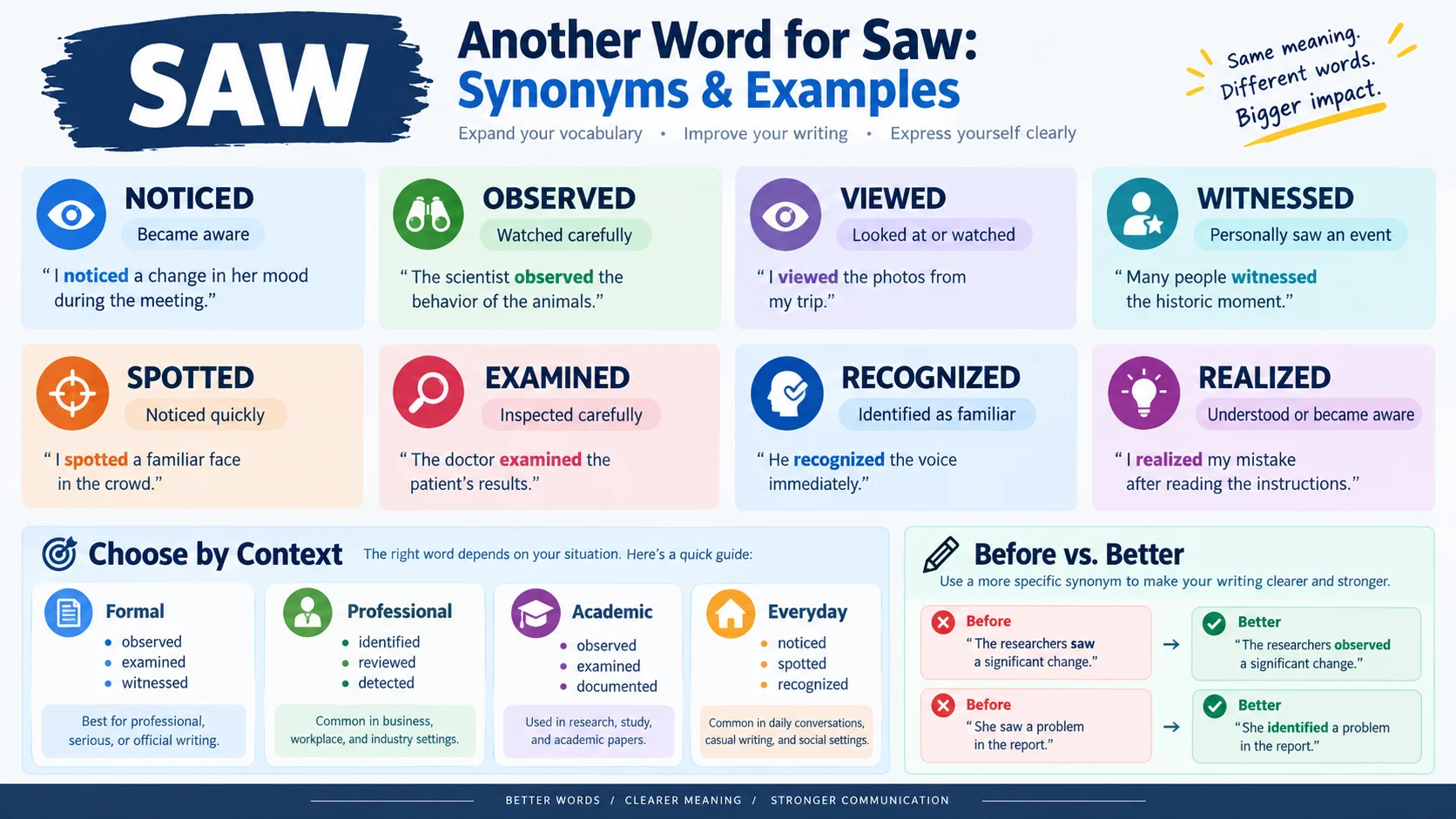
A good another word for “saw” is noticed, especially when you mean becoming aware of something. Other alternatives include observed, viewed, witnessed, spotted, examined, recognized, and realized, depending on the context.
What Does “Saw” Mean?
Definition
Saw is the past tense of see. It means to perceive someone or something with your eyes, but it can also mean to notice, observe, witness, or understand something depending on the context.
For example: “I saw a bird outside” means you visually perceived the bird. In “I saw what he meant,” saw means understood or recognized.
Common Uses
The word saw is commonly used to describe:
- Looking at or visually noticing something
- Observing an event or situation
- Witnessing something happen
- Recognizing or realizing something
- Examining something carefully
- Encountering someone or something
Best Synonyms for “Saw”
| Synonym | Meaning | Best Used When | Example |
|---|---|---|---|
| Noticed | Became aware of something | Something catches your attention | I noticed a change in the report. |
| Observed | Watched or examined carefully | Formal, academic, or professional contexts | Researchers observed unusual behavior. |
| Viewed | Looked at or watched | Formal descriptions and media | We viewed the presentation online. |
| Witnessed | Personally saw an event happen | Events, incidents, and experiences | She witnessed the accident. |
| Spotted | Saw or noticed something quickly | Casual conversation | I spotted my friend across the room. |
| Examined | Looked at carefully | Detailed inspection | The technician examined the equipment. |
| Recognized | Identified something or someone | Familiarity or identification | I recognized him immediately. |
| Realized | Became aware of or understood something | Ideas, facts, or situations | I realized that I had made a mistake. |
Noticed
Meaning: Became aware of something through observation or attention.
Best used for: Everyday observations, changes, details, and things that attract attention.
Tone: Neutral
Difficulty: Easy
Usage Frequency: Very Common
Business example: I noticed an error in the quarterly report.
Academic example: The researchers noticed a significant change in the results.
Daily conversation: I noticed your new haircut.
Observed
Meaning: Watched, examined, or noticed something carefully.
Best used for: Academic writing, research, professional reports, and formal descriptions.
Tone: Formal
Difficulty: Medium
Usage Frequency: Common
Business example: The manager observed improved productivity after the training.
Academic example: Researchers observed a significant increase in temperature.
Daily conversation: I observed that he seemed unusually quiet.
Viewed
Meaning: Looked at, watched, or considered something.
Best used for: Videos, images, documents, presentations, websites, and formal descriptions.
Tone: Neutral to formal
Difficulty: Easy
Usage Frequency: Common
Business example: The client viewed the proposal before the meeting.
Academic example: Participants viewed a series of images during the experiment.
Daily conversation: I viewed the movie last night.
Witnessed
Meaning: Personally saw an event or situation happen.
Best used for: Accidents, events, important moments, incidents, and historical situations.
Tone: Neutral to formal
Difficulty: Medium
Usage Frequency: Common
Business example: Several employees witnessed the incident.
Academic example: The study documented how participants witnessed the event.
Daily conversation: I witnessed the whole thing.
Spotted
Meaning: Saw or noticed something, usually quickly or from a distance.
Best used for: Casual conversation and situations where something is noticed suddenly.
Tone: Informal
Difficulty: Easy
Usage Frequency: Common
Business example: The supervisor spotted a problem in the inventory records.
Academic example: Scientists spotted an unexpected pattern in the data.
Daily conversation: I spotted Sarah at the store.
Examined
Meaning: Looked at something carefully to understand or evaluate it.
Best used for: Reports, documents, objects, evidence, data, and professional investigations.
Tone: Formal
Difficulty: Medium
Usage Frequency: Common
Business example: The auditor examined the company’s financial records.
Academic example: The researchers examined the collected samples.
Daily conversation: The doctor examined my arm.
Recognized
Meaning: Identified someone or something because it was familiar or previously known.
Best used for: People, objects, patterns, places, and familiar information.
Tone: Neutral
Difficulty: Easy
Usage Frequency: Very Common
Business example: The recruiter recognized the candidate from a previous conference.
Academic example: Students recognized the pattern after reviewing the examples.
Daily conversation: I recognized him as soon as he walked in.
Realized
Meaning: Became aware of, understood, or recognized a fact or situation.
Best used for: Ideas, discoveries, mistakes, consequences, and changes in understanding.
Tone: Neutral
Difficulty: Easy
Usage Frequency: Very Common
Business example: We realized that the original strategy needed revision.
Academic example: The student realized that the hypothesis was incorrect.
Daily conversation: I realized I had left my phone at home.
Synonyms by Context
Formal Writing
In formal writing, observed, witnessed, examined, and identified are often more precise than saw.
Instead of:
The scientists saw a change in the results.
Write:
The scientists observed a change in the results.
Use observed when the focus is careful observation, examined when detailed investigation is involved, and identified when something has been specifically recognized.
Professional Writing
For business communication, the best replacement depends on what “saw” means.
- Noticed → discovered or became aware of something
- Observed → monitored something
- Reviewed → looked through information or documents
- Identified → recognized a problem or opportunity
- Examined → investigated something carefully
For example:
We identified several issues during the review.
is more precise than:
We saw several issues during the review.
Academic Writing
Academic writing generally benefits from precise verbs.
Consider:
- Observed a phenomenon
- Examined the evidence
- Identified a pattern
- Detected a change
- Documented an occurrence
- Recorded an observation
Instead of “The researchers saw a difference,” you might write:
The researchers observed a significant difference between the two groups.
Daily Conversation
In everyday American English, noticed, spotted, saw, and recognized are especially natural.
Examples:
- “I noticed your new shoes.”
- “I spotted him at the mall.”
- “I recognized her from school.”
- “I saw your message.”
Professional Alternatives for “Saw”
If you are replacing saw in a resume, report, email, or business document, choose a verb that explains what actually happened.
| Instead of “saw” | Use |
|---|---|
| Saw a problem | Identified a problem |
| Saw an opportunity | Recognized an opportunity |
| Saw a trend | Observed a trend |
| Saw the data | Reviewed the data |
| Saw the evidence | Examined the evidence |
| Saw an increase | Observed an increase |
| Saw an error | Detected an error |
| Saw the results | Analyzed the results |
This approach is stronger because the replacement communicates the specific action rather than simply changing one word for another.
Simple Alternatives for “Saw”
For easy, everyday English, consider:
noticed, looked at, watched, spotted, viewed, recognized, witnessed
Examples:
- I noticed the sign.
- We watched the game.
- She spotted her friend.
- They recognized the building.
- He witnessed the event.
Stronger Alternatives for “Saw”
When you need a more precise or sophisticated verb, consider:
observed, examined, identified, detected, recognized, witnessed, analyzed, documented
The right choice depends on the intended meaning. Observed suggests careful watching, while examined implies closer investigation. Detected emphasizes finding something that may not have been immediately obvious.
Difference Between Similar Synonyms
Saw vs. Noticed
Saw simply indicates visual perception. Noticed suggests that something attracted your attention.
- I saw a car outside.
- I noticed that the car was damaged.
Saw vs. Observed
Observed is more formal and often suggests deliberate or careful attention.
- I saw the experiment.
- The researcher observed the experiment.
Saw vs. Witnessed
Witnessed usually refers to personally seeing an event take place.
- I saw the building.
- I witnessed the accident.
Saw vs. Spotted
Spotted often suggests quickly noticing something, especially when searching for or recognizing it.
- I saw my brother.
- I spotted my brother in the crowd.
Saw vs. Realized
These words are not interchangeable in every situation. Saw concerns perception, while realized concerns understanding or becoming aware of a fact.
- I saw the problem.
- I realized there was a problem.
Opposite Words
Depending on the meaning, possible opposites of saw include:
- Missed
- Overlooked
- Ignored
- Failed to notice
- Was unaware of
- Did not recognize
The best opposite depends on the intended meaning. For example, missed works when something was not seen, while ignored suggests that something was deliberately disregarded.
FAQs
What is another word for “saw”?
Common alternatives include noticed, observed, viewed, witnessed, spotted, examined, recognized, and realized. The best choice depends on whether “saw” refers to visual perception, careful observation, witnessing an event, or understanding something.
What is a formal synonym for “saw”?
Observed is one of the most useful formal alternatives to “saw.” Other choices include examined, witnessed, identified, detected, and documented, depending on the context.
What is a professional alternative for “saw”?
Professional alternatives include observed, identified, reviewed, examined, detected, recognized, and analyzed. For business writing, choose the verb that describes the actual action you performed.
What word can replace “saw” in an essay?
For an academic essay, observed, examined, identified, detected, witnessed, or recognized may work better than “saw.” The correct replacement depends on the sentence.
What is another word for “saw” in a resume?
Useful resume alternatives include identified, recognized, detected, analyzed, evaluated, reviewed, and observed. These verbs can communicate the specific action behind the original word.
Is “noticed” the same as “saw”?
Not exactly. Saw means visually perceived something, while noticed emphasizes becoming aware of it. You can see something without particularly noticing it.
Conclusion
The best another word for “saw” depends on what you mean. Use noticed for becoming aware of something, observed for careful or formal observation, witnessed for seeing an event happen, spotted for quickly seeing something, examined for close inspection, and realized when “saw” means understood.
For professional and academic writing, choosing a more precise verb can make your sentence clearer and more informative.
