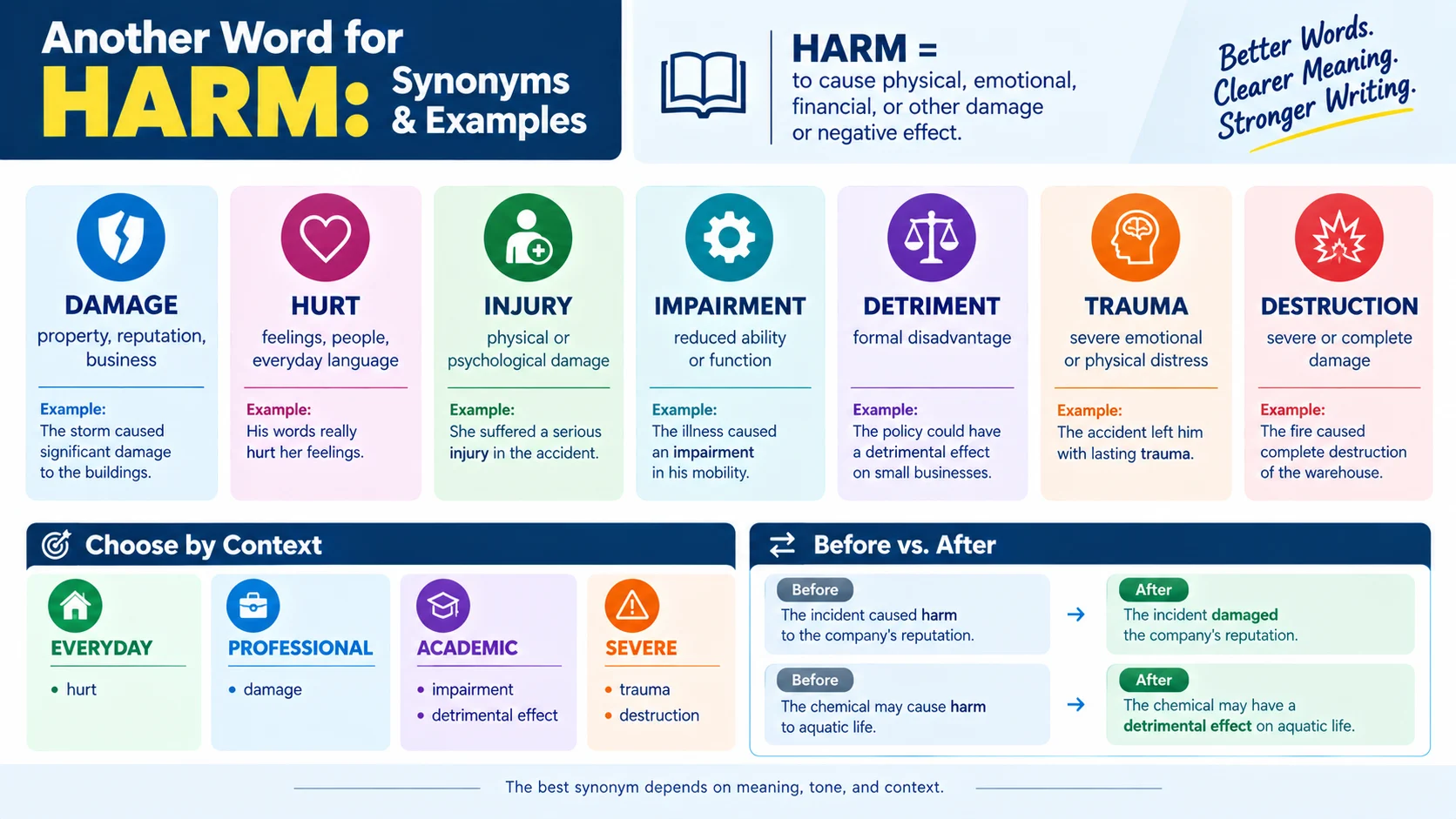
If you need another word for harm, the best choice depends on what kind of harm you mean. Common alternatives include damage, injury, hurt, impairment, detriment, trauma, abuse, and destruction. For professional or academic writing, damage, impairment, detrimental effect, injury, and adverse effect can sound more precise. For everyday conversation, hurt and damage are often the most natural choices.
What Does Harm Mean?
Definition
Harm means physical or other injury, damage, or a negative effect caused to a person, animal, object, reputation, environment, or situation. As a verb, harm means to hurt someone or damage something.
For example:
- Noun: The accident caused serious harm to several people.
- Verb: Pollution can harm marine life.
- Figurative: The controversy harmed the company’s reputation.
Major English dictionaries define harm broadly enough to cover both physical injury and nonphysical damage. Oxford also notes its use for health, happiness, chances of success, interests, and reputation.
Common Uses
The word harm commonly appears with:
- physical harm
- emotional harm
- financial harm
- environmental harm
- economic harm
- reputational harm
- serious harm
- cause harm
- prevent harm
- reduce harm
It can describe both direct injury and broader negative consequences. Cambridge, for example, lists business uses such as financial, economic, and environmental harm.
Best Synonyms for Harm
Not every synonym works in every sentence. The most appropriate replacement depends on whether you are discussing physical injury, financial loss, emotional suffering, deterioration, or deliberate mistreatment.
| Synonym | Meaning | Best Used When | Example |
|---|---|---|---|
| Damage | Physical or nonphysical deterioration or loss | Property, reputation, business, environment | The storm damaged the building. |
| Injury | Physical or psychological damage | People, bodies, health | The player suffered a serious injury. |
| Hurt | Cause physical or emotional pain or a negative effect | Everyday conversation | His comments hurt her feelings. |
| Impairment | Reduced ability, function, or quality | Academic, medical, professional contexts | Sleep deprivation can cause cognitive impairment. |
| Detriment | A disadvantage or harmful effect | Formal and academic writing | The policy operated to the detriment of small businesses. |
| Trauma | Severe physical or emotional distress resulting from an event | Serious emotional or physical experiences | The accident caused lasting trauma. |
| Abuse | Harmful or improper treatment | People, authority, substances, systems | The report documented abuse of vulnerable residents. |
| Destruction | Severe damage that ruins or eliminates something | Buildings, ecosystems, property, communities | The wildfire caused widespread destruction. |
Cambridge’s thesaurus also identifies words such as suffering, pain, agony, trauma, impairment, detriment, destruction, abuse, and deterioration among terms related to harm.
Synonym: Damage
Meaning: Physical or nonphysical harm that reduces something’s condition, value, usefulness, or effectiveness.
Best Used For: Property, businesses, reputations, economies, environments, and relationships.
Tone: Neutral to formal.
Difficulty: Easy.
Usage Frequency: Very Common.
Best For: Resume, email writing, essay writing, marketing copy, and business writing.
Examples:
- Business: The misleading advertisement damaged the company’s reputation.
- Academic: Air pollution can damage ecosystems.
- Daily conversation: The leak damaged the kitchen floor.
Oxford distinguishes damage from harm by noting that damage often emphasizes physical deterioration or a negative effect on usefulness, value, health, or success.
Synonym: Injury
Meaning: Physical or psychological damage to a person.
Best Used For: Accidents, sports, medicine, safety, and bodily harm.
Tone: Neutral and professional.
Difficulty: Easy.
Usage Frequency: Very Common.
Best For: Academic writing, professional writing, reports, and everyday conversation.
Examples:
- Business: Workplace safety procedures help prevent employee injuries.
- Academic: The study examined the long-term effects of traumatic brain injuries.
- Daily conversation: She suffered an injury during the game.
Use injury when the harm involves an identifiable physical or psychological wound or condition.
Synonym: Hurt
Meaning: To cause pain or emotional distress, or to have a negative effect.
Best Used For: Casual conversation, feelings, relationships, and general negative effects.
Tone: Informal to neutral.
Difficulty: Easy.
Usage Frequency: Very Common.
Best For: Emails, daily conversation, personal writing, and simple explanations.
Oxford describes hurt as somewhat less formal than damage or harm, particularly in negative statements.
Example: The criticism really hurt his feelings.
Synonym: Impairment
Meaning: A reduction in ability, function, quality, or effectiveness.
Best Used For: Health, abilities, performance, research, and technical writing.
Tone: Formal.
Difficulty: Advanced.
Usage Frequency: Common in specialized writing.
Best For: Academic writing, professional reports, research, and technical content.
Example: The researchers investigated the effects of hearing impairment on classroom learning.
Synonym: Detriment
Meaning: A condition or effect that causes disadvantage or loss.
Best Used For: Formal arguments, business writing, academic writing, and legal-style language.
Tone: Formal.
Difficulty: Advanced.
Usage Frequency: Less Common.
Best For: Essays, reports, business writing, and formal analysis.
Example: The change could be to the detriment of smaller businesses.
Synonyms by Context
Formal Writing
For formal writing, consider:
- damage
- injury
- impairment
- detriment
- adverse effect
- negative impact
- deterioration
Example:
Basic: The policy caused harm to local businesses.
More formal: The policy had a detrimental effect on local businesses.
The choice should match the specific meaning. Detriment emphasizes disadvantage, while impairment emphasizes reduced function.
Professional Writing
In business communication, damage, negative impact, adverse effect, and loss are often clearer than simply repeating harm.
Basic: The incident harmed our reputation.
Professional: The incident damaged our reputation.
More analytical: The incident had a negative impact on customer confidence.
Academic Writing
Academic writing benefits from specificity. Instead of repeatedly using harm, identify the particular effect:
- physical injury
- psychological trauma
- cognitive impairment
- environmental damage
- adverse effect
- detrimental effect
- negative consequence
Example:
Instead of: The chemical may cause harm to aquatic organisms.
Write: The chemical may have detrimental effects on aquatic organisms.
Daily Conversation
For everyday American English, hurt and damage are usually natural replacements.
- “I didn’t mean to hurt you.”
- “The storm damaged our roof.”
- “Smoking can harm your health.”
- “The accident caused serious injury.”
Professional Alternatives for Harm
When writing a resume, report, email, or business document, choose the word that describes the actual consequence.
| Instead of “harm” | Professional alternative |
|---|---|
| Harm the company’s reputation | Damage the company’s reputation |
| Harm productivity | Reduce productivity |
| Harm performance | Impair performance |
| Harm business growth | Hinder growth |
| Harm customer trust | Undermine customer trust |
| Harm the environment | Damage the environment |
| Harm financial results | Negatively affect financial results |
Specific verbs often communicate more clearly than a generic word such as harm.
Simple Alternatives for Harm
If you want an easy synonym, use:
hurt, damage, injury, problem, loss, pain, or negative effect.
For example:
- The accident caused harm. → The accident caused injury.
- The storm harmed the house. → The storm damaged the house.
- His words harmed her. → His words hurt her.
Stronger Alternatives for Harm
When the situation involves severe consequences, stronger words may be appropriate:
- destruction
- devastation
- trauma
- severe injury
- abuse
- ruin
- impairment
Be careful with stronger alternatives. Destruction implies much more severe damage than ordinary harm, while abuse suggests harmful or improper treatment rather than simply an accidental negative effect.
Difference Between Similar Synonyms
Harm vs. Damage
Harm is broad and can refer to injury, suffering, or negative effects. Damage often emphasizes deterioration, loss, or reduced condition.
- Pollution can harm wildlife.
- Pollution can damage ecosystems.
Both work, but the emphasis differs.
Harm vs. Hurt
Hurt is generally more conversational. It can refer to physical pain, emotional pain, or a negative effect.
- That comment hurt me.
- The decision could hurt sales.
Harm sounds somewhat more formal and is common in discussions of health, safety, the environment, and consequences. Oxford specifically notes that hurt is somewhat less formal than harm or damage.
Harm vs. Injury
Injury normally refers to damage suffered by a person or living organism, especially physical injury.
- Harm: The medication may cause harm.
- Injury: The accident caused a serious leg injury.
Harm vs. Impairment
Impairment means reduced function or ability. It is particularly useful when discussing health, performance, or capabilities.
- Harm: The substance may harm the nervous system.
- Impairment: The substance may cause neurological impairment.
Harm vs. Abuse
Abuse implies improper, cruel, excessive, or harmful treatment. It is therefore not a general replacement for harm.
- The chemicals harmed the workers. ✓
- The chemicals abused the workers. ✗
Opposite Words
Common opposites of harm include:
- benefit
- help
- aid
- assistance
- improvement
- healing
- protection
- care
Cambridge lists benefit, help, aid, assistance, boon, and blessing among antonyms or contrasting terms for harm.
Examples:
- Harm the environment → protect the environment
- Cause harm → provide a benefit
- Damage health → improve health
- Hurt someone → help someone
FAQs
What is another word for harm?
Common alternatives include damage, hurt, injury, impairment, detriment, trauma, abuse, and destruction. The best synonym depends on the context.
What is a formal synonym for harm?
Impairment, detriment, adverse effect, detrimental effect, and injury can work in formal contexts, depending on the meaning.
What is a professional alternative for harm?
In professional writing, damage, negative impact, adverse effect, impair, undermine, or reduce may be more precise.
What word can replace harm in an essay?
For academic writing, consider damage, adverse effect, detrimental effect, impairment, negative consequence, or detriment. Choose the word that describes the specific effect rather than replacing harm automatically.
What is a stronger word for harm?
Depending on the situation, destruction, devastation, severe injury, trauma, abuse, or ruin may convey a stronger meaning. These words are not interchangeable with harm in every sentence.
What is the difference between harm and damage?
Harm is a broad term for injury or a negative effect. Damage commonly emphasizes physical deterioration, loss, or reduced value or effectiveness. Both can describe nonphysical consequences such as harm or damage to a reputation.
Conclusion
The best another word for harm depends on what you are describing. Use hurt for everyday emotional or physical pain, damage for property, reputation, business, or environmental effects, injury for physical or psychological damage, impairment for reduced function, and detriment for a formal disadvantage.
For strong writing, avoid replacing harm with a synonym simply because it appears in a thesaurus. Choose the word that preserves the exact meaning, tone, and context of your sentence. That approach makes your writing clearer, more precise, and more natural.
