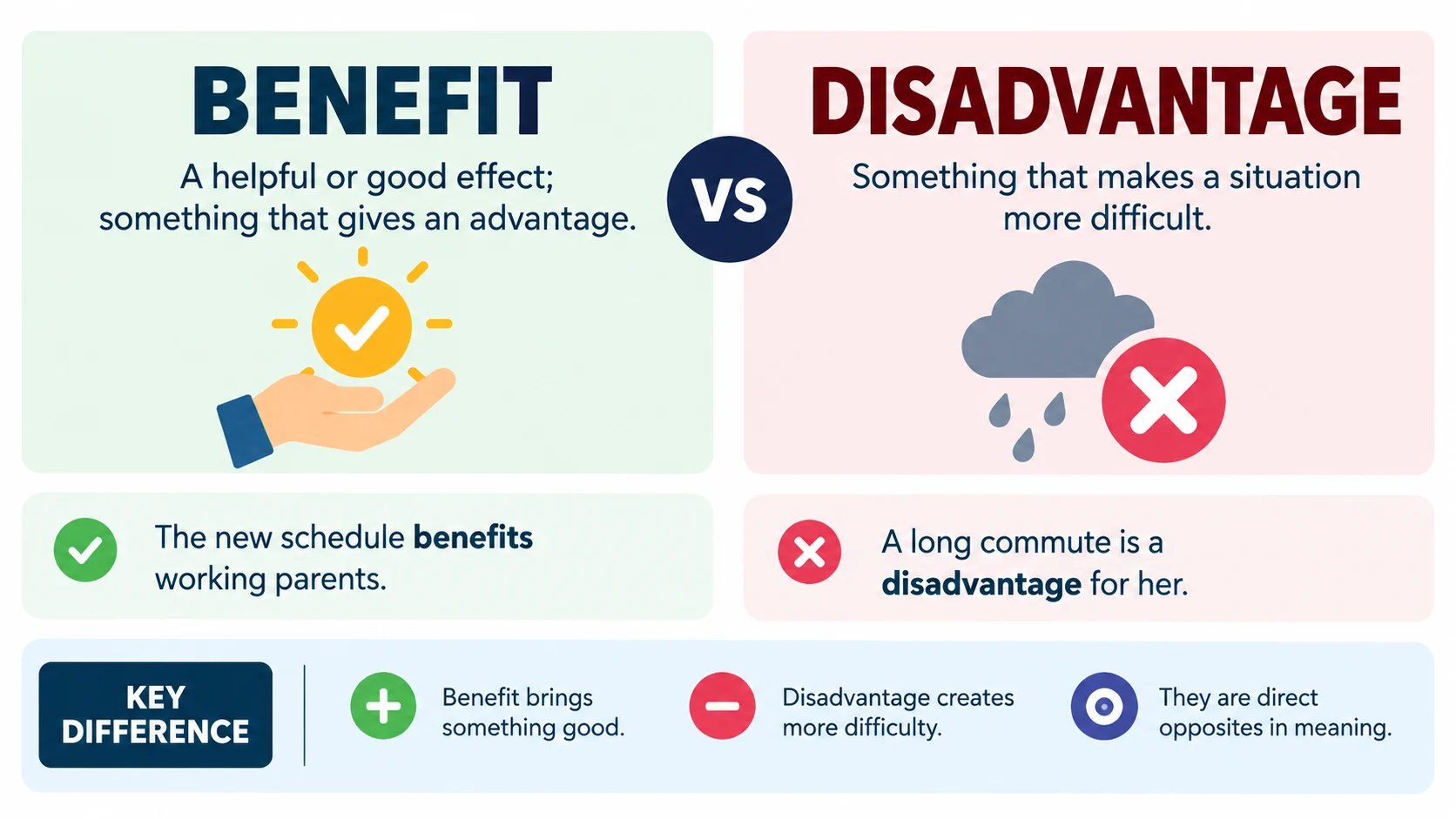
The strongest opposite of benefit is disadvantage when benefit means an advantage or helpful effect. Other opposites include harm, damage, loss, and disservice, depending on context. As a verb, benefit means to help or improve someone or something, so harm or damage can provide the clearest opposite.
Part of speech: Noun and verb
Primary opposite: Disadvantage for the noun benefit meaning an advantage or helpful effect.
The noun benefit refers to something helpful, useful, or advantageous. As a verb, benefit means to help someone or something or to gain help from something. Because the word has several meanings, its most precise opposite depends on the context.
When benefit means an advantage, disadvantage is the clearest direct opposite. Cambridge identifies disadvantage as the opposite of advantage, while its American thesaurus lists disadvantage, harm, damage, loss, and related terms among the antonyms of benefit.
Direct and Strong Antonyms
| Antonym | Tone or Nuance | Example Sentence |
|---|---|---|
| Disadvantage | Neutral and precise; emphasizes a condition that makes a situation less favorable | “The lack of public transportation is a major disadvantage of living there.” |
| Harm | Direct and broadly applicable; emphasizes a negative effect or injury | “Skipping regular maintenance can harm the equipment.” |
| Damage | Concrete and often stronger; emphasizes physical, financial, or functional deterioration | “The storm caused significant damage to the roof.” |
| Loss | Emphasizes something valuable being reduced, removed, or no longer available | “The company suffered a financial loss after the project failed.” |
| Disservice | Emphasizes an action or situation that works against someone’s interests | “Giving students incorrect information would do them a disservice.” |
These words are not interchangeable in every sentence. Disadvantage is usually the closest noun opposite when benefit means an advantage. Harm and damage work better when the meaning involves a negative effect or injury. Loss is appropriate when something valuable is forfeited, while disservice focuses on failing to help or actively working against someone’s interests. Cambridge’s American thesaurus lists these distinctions across the noun and verb senses of benefit.
For example, you would normally say, “The flexible schedule is a benefit to employees,” but “The unpredictable schedule is a disadvantage to employees.” If you want to emphasize a damaging effect, “The chemical can harm the environment” is more precise than disadvantage.
Contextual and Subtle Opposites
The best opposite changes with the meaning of benefit.
When benefit means an advantage
Best opposite: disadvantage
This is the clearest pairing when discussing the positive or negative features of a choice, situation, product, or circumstance.
Context: Choosing between two options
Best opposite: Disadvantage
Why it fits: A disadvantage is a condition that makes a situation less favorable or more difficult.
Example: “One benefit of remote work is flexibility. One disadvantage is that some employees may feel isolated.”
When benefit means a helpful effect
Best opposite: harm
Here, harm is more precise because the focus is on whether something produces a good or bad effect.
Example: “Regular exercise can benefit your health, while excessive training without recovery can harm it.”
When benefit means to help
Best opposite: harm
As a verb, benefit can mean to help someone or something. The strongest contextual opposite is often harm, particularly when the action produces a negative effect. Cambridge defines benefit as helping someone or being helped by something.
Example: “The new program benefited local families, while the earlier policy harmed small businesses.”
When benefit means an employee perk
Best opposite: loss or removal of a benefit
In American English, benefits can refer to employee compensation such as health insurance, retirement plans, or paid leave. In this sense, disadvantage is not always the natural opposite. A sentence may instead describe the loss, reduction, or removal of a benefit.
Example: “The company added health benefits this year but announced the loss of several other employee benefits.”
Words That Seem Opposite But Are Not
Cost
Cost is often contrasted with benefit, especially in phrases such as “costs and benefits,” but it is not an exact antonym.
A cost is something that requires money, time, effort, or another resource. A benefit is a helpful or advantageous result. A single decision can have both costs and benefits.
Example: “The renovation has a high cost, but its energy savings could provide a long-term benefit.”
Drawback
Drawback is very close to disadvantage, but it is usually a contextual contrast rather than a universal antonym of benefit. A drawback is an undesirable feature or limitation of something.
Example: “The lower price is a benefit, but limited storage is a drawback.”
In practical writing, drawback can work naturally when discussing the negative side of a product, plan, or decision, but disadvantage provides the more direct lexical opposition to benefit when benefit means an advantage.
Subtle Tone Differences
Choose disadvantage when you want a neutral, analytical term.
“Higher rent is a disadvantage of living downtown.”
Choose harm when you want to emphasize a negative effect on a person, organization, environment, or system.
“Poor sleep can harm concentration.”
Choose damage when something is physically, financially, or functionally affected.
“The leak damaged the ceiling.”
Choose loss when something valuable is lost or reduced.
“The cancellation resulted in a significant loss of revenue.”
Choose disservice when an action fails to help or actively works against someone’s interests.
“Leaving out that information would do readers a disservice.”
This distinction matters because replacing benefit with any negative word can change the sentence’s meaning. The right antonym should match the particular sense of the original word.
Frequently Asked Questions
What is the direct antonym of benefit?
The most direct noun antonym of benefit, when it means an advantage or helpful effect, is disadvantage. When benefit is used as a verb meaning to help, harm is often the more natural opposite.
What is the opposite of benefit in a sentence?
The correct opposite depends on the sentence. Use disadvantage for an unfavorable condition, harm for a negative effect, damage for deterioration, and loss when something valuable is lost or reduced.
Can I use disadvantage as the opposite of benefit?
Yes. Disadvantage is a natural opposite when benefit means an advantage. For example, “Flexible hours are a benefit, while unpredictable scheduling is a disadvantage.” The words describe opposing effects on a situation.
Practical Word Choice
- Identify the intended meaning first. Decide whether benefit means an advantage, helpful effect, help as a verb, or an employee perk.
- Match the context and tone. Use disadvantage for neutral comparison, harm for negative effects, damage for deterioration, and loss for something valuable being forfeited.
Final Thoughts
The strongest opposite of benefit is usually disadvantage when the word refers to an advantage or helpful feature. However, harm, damage, loss, and disservice can be more accurate when the context changes.
Good word choice depends on meaning, not simply on finding a word from an antonym list. If you match the antonym to the exact sense of benefit, your writing will sound clearer and more precise.
