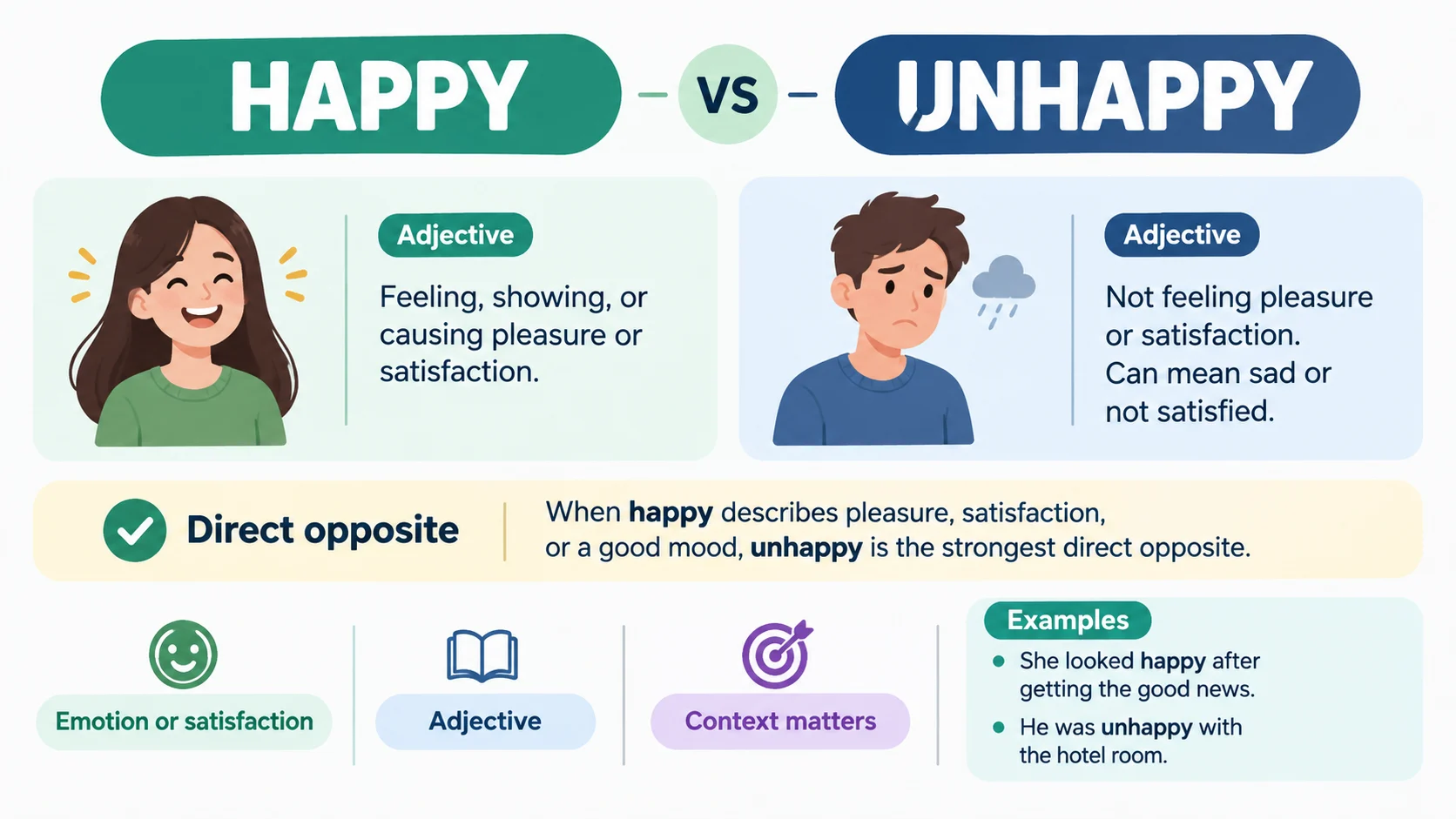
The strongest direct opposite of happy is unhappy, meaning not feeling pleasure or satisfaction. Sad is also a common antonym when happy describes an emotional state. In contexts involving satisfaction, dissatisfied or displeased may be more precise than unhappy. The best choice depends on the intended meaning.
The adjective happy describes feeling, showing, or causing pleasure or satisfaction. It can also describe someone who is satisfied with a situation or willing to do something. When happy refers to pleasure, satisfaction, or a positive emotional state, unhappy is its strongest direct opposite. Cambridge identifies unhappy as the opposite of happy in its American English dictionary.
For example:
She was happy with the results.
The direct opposite is:
She was unhappy with the results.
Direct and Strong Antonyms
| Antonym | Tone or Nuance | Example Sentence |
|---|---|---|
| Unhappy | The clearest general opposite; can mean sad or dissatisfied | He was unhappy with the decision. |
| Sad | Focuses more specifically on emotional sorrow or lack of happiness | She felt sad after saying goodbye to her friends. |
| Sorrowful | Stronger and more formal; associated with grief or deep sadness | The letter had a sorrowful tone. |
| Miserable | Strong, often suggesting intense unhappiness or discomfort | I felt miserable after losing my wallet. |
| Displeased | Focuses on dissatisfaction rather than sadness | The manager was displeased with the late report. |
| Dissatisfied | Best when happy means satisfied with a result, service, or situation | The customer was dissatisfied with the repair. |
Not all of these words are interchangeable in every sentence. Unhappy is the broadest direct opposite. Sad is more specifically emotional, while displeased and dissatisfied work especially well when happy means satisfied or content with something. Cambridge’s American thesaurus lists these among the antonyms associated with happy.
Contextual and Subtle Opposites
The best opposite can change according to meaning, tone, and context. Happy has several important uses in American English, so one antonym does not always communicate the intended contrast.
| Context | Best Opposite | Why It Fits |
|---|---|---|
| Feeling pleasure | Unhappy | Directly reverses the general emotional state |
| Feeling emotionally low | Sad | Emphasizes sorrow rather than general dissatisfaction |
| Satisfied with something | Dissatisfied | Directly contrasts satisfaction |
| Approving of something | Displeased | Shows that someone is not pleased with it |
| Experiencing strong emotional pain | Miserable | Conveys more intense unhappiness |
| Formal expression of grief | Sorrowful | More literary and emotionally serious |
Consider the difference between these examples:
I’m unhappy with my new schedule.
This usually means the speaker is dissatisfied with the arrangement.
I’m sad about my new schedule.
This suggests an emotional response and sounds less focused on whether the schedule is acceptable.
I’m dissatisfied with my new schedule.
This is more precise and somewhat more formal, especially in workplace or professional writing.
Context therefore matters more than simply choosing the strongest-looking antonym.
Words That Seem Opposite But Are Not
Angry
Angry is not an exact antonym of happy. Someone can be angry and happy at different times, or even experience mixed emotions. Anger describes a particular emotional response, while happy describes pleasure or satisfaction.
For example:
She was angry about the argument but happy that they finally talked.
The two emotions can coexist, so angry should not normally be presented as the direct opposite of happy.
Bored
Bored is another related contrast, but it is not a true antonym. Boredom means a lack of interest or stimulation. A person can be bored without being unhappy.
For example:
I was bored during the long meeting, but I was still happy about getting the promotion.
Here, bored and happy describe different dimensions of experience.
Subtle Tone Differences
Choosing the right antonym can make your writing more precise.
Unhappy is the safest general choice:
The child was unhappy about leaving the park.
Sad sounds more emotional:
The child was sad when it was time to leave the park.
Dissatisfied is better for products, services, results, decisions, or conditions:
Several customers were dissatisfied with the new return policy.
Displeased can sound more formal or restrained:
The director was displeased with the quality of the final report.
Miserable is stronger and should be used when the situation genuinely suggests significant unhappiness:
He felt miserable after spending the entire weekend alone.
These distinctions are important in professional writing. Saying that a client was sad about a service may suggest an emotional reaction, while saying the client was dissatisfied clearly communicates a problem with the service itself.
Frequently Asked Questions
What is the direct antonym of happy?
The direct antonym of happy is unhappy. It broadly means not feeling pleasure or satisfaction. Sad is also a common opposite when happy refers specifically to an emotional state, but unhappy is the more general direct counterpart.
What is the opposite of happy when talking about satisfaction?
When happy means satisfied with something, dissatisfied is often the most precise opposite. For example, “I’m happy with the service” contrasts naturally with “I’m dissatisfied with the service.” Displeased can also work in this context.
Which antonym of happy is best for formal writing?
For formal writing, choose the word that matches the intended meaning. Unhappy is broadly useful, dissatisfied works well for evaluations and services, and displeased can describe restrained disapproval. Sorrowful is appropriate when the context involves grief or deep sadness.
Practical Word Choice
- Identify the intended meaning. Decide whether happy describes an emotion, satisfaction, approval, or another sense before choosing an opposite.
- Match the context and tone. Use unhappy for a broad contrast, sad for emotional sorrow, and dissatisfied or displeased when the issue is satisfaction or approval.
Conclusion
The clearest antonym for happy is unhappy, especially when the word describes a general emotional state or satisfaction. However, sad, dissatisfied, displeased, miserable, and sorrowful can provide greater precision in specific contexts.
The most accurate word depends on what you are trying to contrast. A person can be sad without being dissatisfied, while someone can be dissatisfied without feeling deeply sad. Choosing the antonym that matches the exact meaning makes your American English clearer and more natural.
What example sentence would you use with happy and its opposite?
