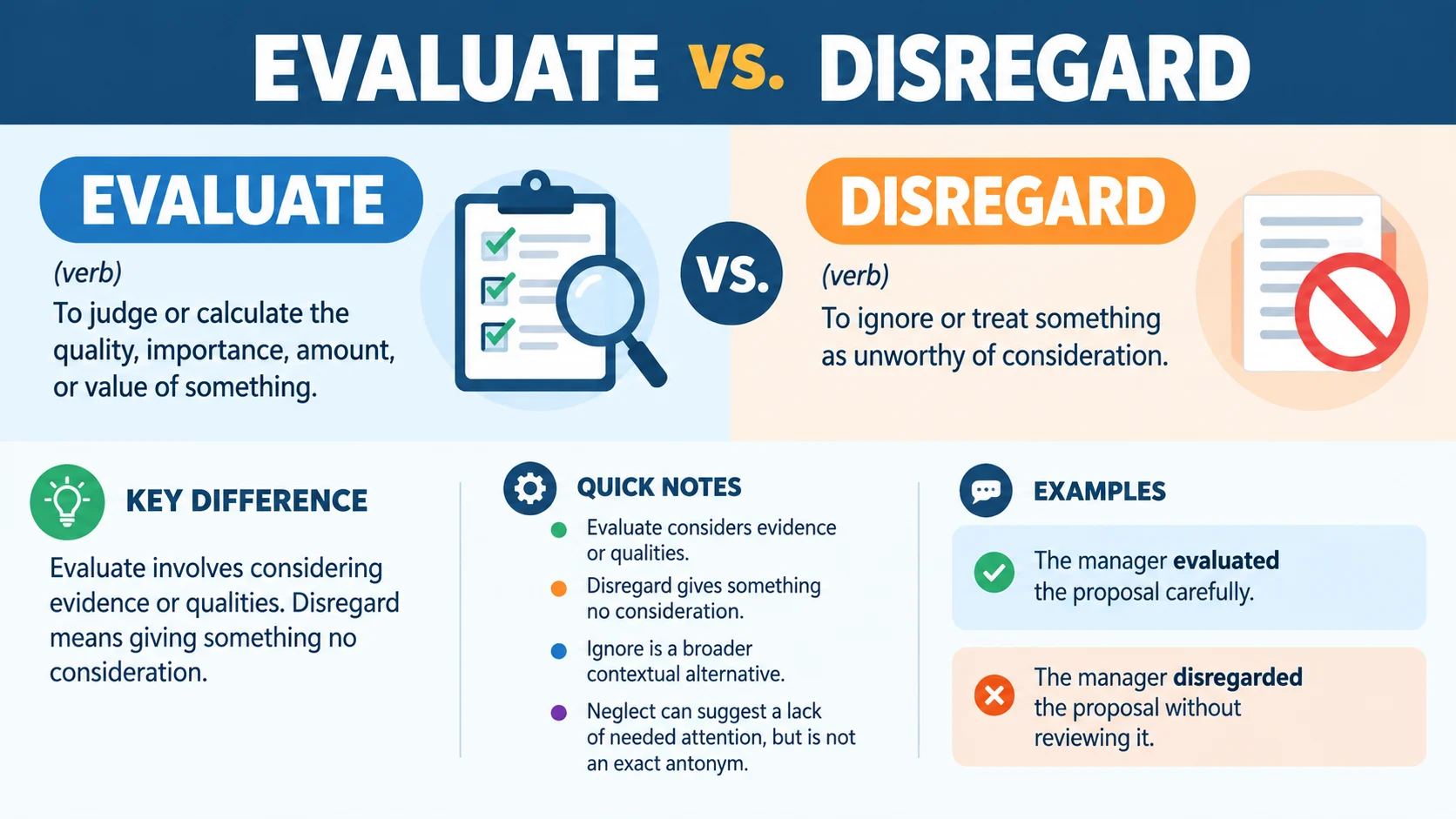
The strongest contextual opposite of evaluate is disregard, especially when evaluate means carefully judging or considering something. Evaluate means to judge or calculate its quality, importance, amount, or value. Depending on context, ignore or neglect may also express an opposite idea, but they are contextual rather than exact antonyms.
Part of speech: Verb
Primary contextual opposite: disregard
Evaluate means to judge or calculate the quality, importance, amount, or value of something. Because the action involves considering information and forming an assessment, disregard can express the opposite when it means treating something as unworthy of consideration. Cambridge Dictionary defines evaluate in terms of judging or calculating quality, importance, amount, or value.
There is an important qualification: English does not have one perfect, universal antonym for evaluate. The best opposite depends on what the sentence emphasizes. Disregard is a strong contextual opposite, while ignore and neglect can work in particular situations.
Direct and Strong Antonyms
Because evaluate describes an action of assessing something, its opposites generally describe failing or refusing to give that thing consideration. Dictionary thesaurus evidence also connects disregard and ignore with the opposite side of verbs involving judgment and consideration.
| Antonym | Tone or Nuance | Example Sentence |
|---|---|---|
| Disregard | Strong; deliberately give little or no consideration | The manager disregarded the warning instead of reviewing the evidence. |
| Ignore | Common and direct; pay no attention to something | She ignored the feedback and submitted the same proposal. |
| Neglect | Suggests failing to give needed attention, often through omission | The team neglected several important safety concerns. |
Disregard is the closest choice when the intended contrast is between considering something carefully and giving it no consideration. Ignore is broader and more conversational. Neglect often suggests that attention was required but not provided.
Contextual and Subtle Opposites
The best opposite changes according to meaning, tone, and intended emphasis.
| Context | Best Opposite | Why It Fits |
|---|---|---|
| Careful judgment of quality or value | Disregard | Contrasts consideration with treating something as unworthy of consideration. |
| Paying attention to information | Ignore | Contrasts examining information with paying no attention to it. |
| Failing to give something necessary attention | Neglect | Emphasizes omission rather than deliberate dismissal. |
| Making an informed assessment | Act without considering | A contextual contrast when the issue is proceeding without assessment. |
For example, The committee evaluated the proposal before voting means the members considered its qualities or value. The committee disregarded the proposal means they gave it no meaningful consideration.
The distinction becomes clearer with ignore. Saying The committee ignored the proposal emphasizes lack of attention. It does not necessarily communicate the deliberate evaluative rejection implied by disregard.
Similarly, neglect is useful when attention was expected or necessary. The researcher neglected to evaluate the limitations of the study means the evaluation was omitted. It does not mean neglect is a perfect dictionary opposite of evaluate.
Words That Seem Opposite But Are Not
Accept
Accept is not an exact antonym of evaluate. Evaluation can lead to acceptance, rejection, revision, or further investigation. Someone can evaluate a proposal and then accept it.
For example:
The board evaluated the proposal and accepted it.
Here, evaluate describes the assessment process, while accept describes the decision that followed. They are different actions rather than opposites.
Reject
Reject is another commonly confused choice. It can be an outcome of evaluation, but it is not the opposite process. A reviewer may evaluate an application and reject it after considering its merits.
The editor evaluated the manuscript before rejecting it.
Replacing evaluate with reject would change the meaning rather than reverse it.
Common Grammatical or Semantic Confusions
One useful distinction is between evaluate and ignore. Both are verbs, but they describe fundamentally different relationships with information. Evaluate requires consideration of something’s qualities, importance, amount, or value. Ignore describes paying no attention to it.
Another important distinction is between evaluate and decide. Evaluation involves examining information and judging value or quality. A decision is a choice or conclusion that may come after that evaluation.
The hiring team evaluated the candidates before deciding whom to interview.
The two verbs work together naturally because they describe different stages of a process.
Subtle Tone Differences
Disregard is relatively formal and can imply a conscious refusal to consider something. It works well in professional, academic, and formal writing.
Ignore is more common in everyday American English and usually sounds less formal:
Please don’t ignore the instructions.
Neglect carries a different emphasis. It can suggest that something was overlooked or failed to receive the attention it required:
The report neglected to evaluate the potential costs.
This makes neglect particularly useful when describing an omission rather than an intentional dismissal.
In formal writing, choose the word that identifies the actual problem. If evidence was consciously dismissed, disregard may be appropriate. If someone simply paid no attention, ignore is clearer. If necessary work was left undone, neglect may communicate the situation more precisely.
Frequently Asked Questions
What is the direct antonym of evaluate?
There is no single perfect antonym for evaluate in every context. Disregard is a strong contextual opposite when evaluate means carefully considering something’s quality, importance, amount, or value. Ignore is another common contextual opposite.
What is the opposite of evaluate in a sentence?
The best opposite depends on the sentence. Use disregard when something is deliberately given no consideration, ignore when it receives no attention, and neglect when necessary attention or evaluation is omitted.
Is ignore the opposite of evaluate?
Ignore can function as a contextual opposite of evaluate, but it is not a perfect lexical antonym. Evaluate involves judging or calculating value or quality, while ignore means giving something no attention. The words contrast through their treatment of information.
Practical Word Choice
- Identify the intended meaning. Decide whether you mean refusing consideration, paying no attention, or failing to provide necessary attention.
- Match tone and strength. Use disregard for a more deliberate or formal contrast, ignore for ordinary situations, and neglect when omission or insufficient attention is the main idea.
Final Thoughts
The most useful opposite of evaluate depends on what kind of contrast you need. Disregard is especially effective when evaluation means carefully considering evidence, quality, importance, or value and the opposite action is giving that matter no consideration.
Ignore and neglect can also work, but their meanings are more specific. Choosing among them requires attention to whether the situation involves deliberate dismissal, lack of attention, or failure to provide needed consideration.
When replacing evaluate in your writing, focus on the exact action you want to describe rather than choosing an antonym from a general word list. What sentence are you trying to write with an opposite of evaluate?
