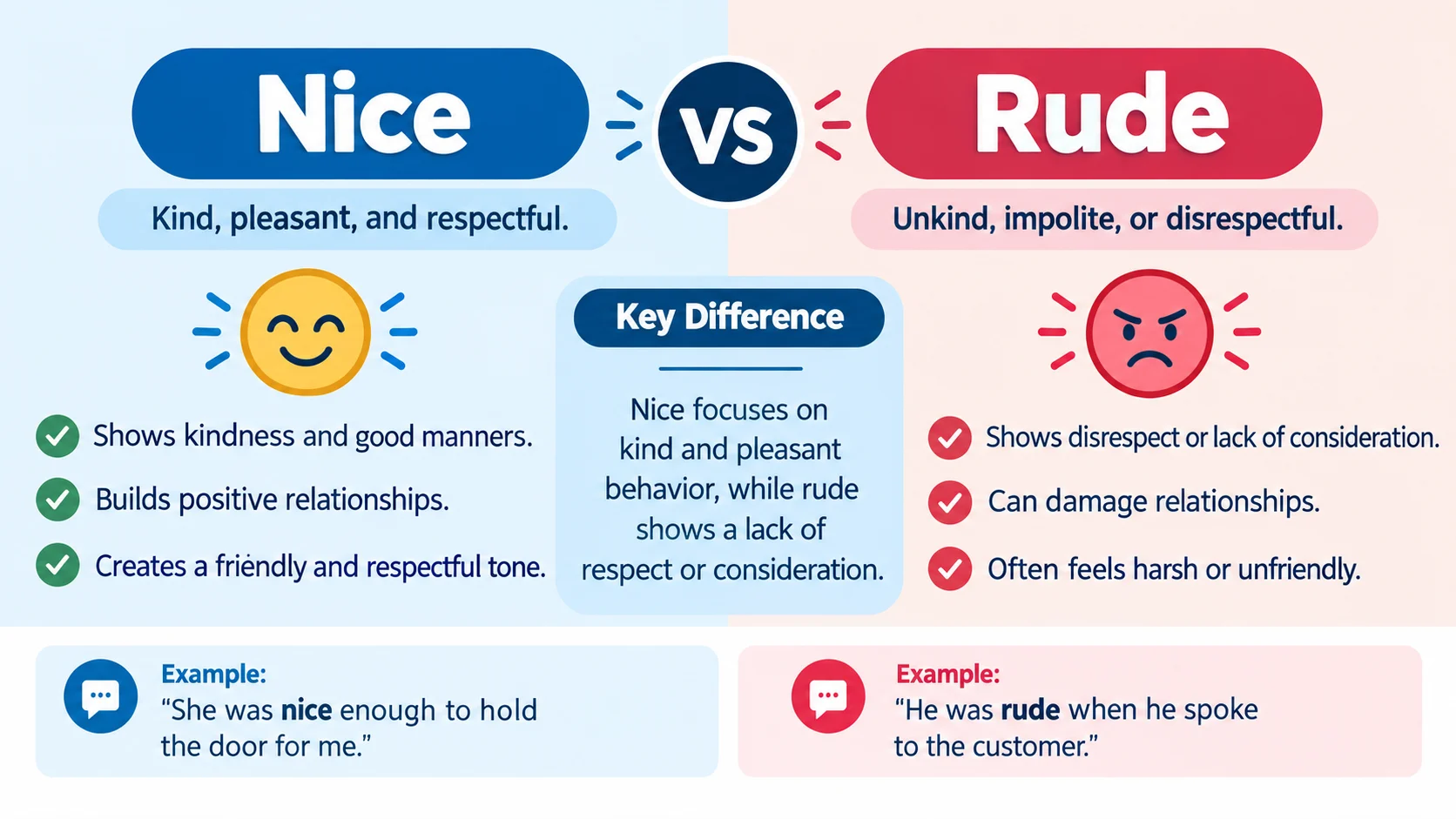
The strongest opposite of nice is often rude when nice means kind, friendly, or polite. However, because nice has several meanings, other antonyms such as unkind, unfriendly, and unpleasant may be more accurate in specific contexts. The best opposite depends on how the word is being used.
Direct and Strong Antonyms
| Antonym | Tone or Nuance | Example Sentence |
|---|---|---|
| Rude | Opposite of polite and respectful | “He was rude to the waiter during dinner.” |
| Unkind | Opposite of kind or caring | “It was unkind to laugh at her mistake.” |
| Unfriendly | Opposite of friendly and welcoming | “The receptionist seemed unfriendly.” |
| Mean | Deliberately hurtful or cruel | “The comment was mean and unnecessary.” |
| Unpleasant | Opposite of pleasant or enjoyable | “The meeting turned unpleasant very quickly.” |
| Disagreeable | Formal word for unpleasant or difficult | “He can be disagreeable when stressed.” |
These antonyms are well established in standard English usage and align with different senses of nice. (Cambridge Dictionary)
Contextual and Subtle Opposites
The best opposite of nice changes depending on what nice means.
1. Nice = Kind or Friendly
Best Opposites: Rude, Unkind, Mean, Unfriendly
Why They Fit:
These words directly oppose positive social behavior.
Examples:
- “She’s always nice to new employees.”
- “She’s often rude to new employees.”
- “That was a nice thing to do.”
- “That was an unkind thing to do.”
2. Nice = Pleasant or Enjoyable
Best Opposites: Unpleasant, Awful, Disagreeable
Why They Fit:
Here, nice describes an experience rather than a person.
Examples:
- “We had a nice weekend at the lake.”
- “We had an unpleasant weekend at the lake.”
- “The weather was nice all afternoon.”
- “The weather was awful all afternoon.”
3. Nice = Respectable or Well-Mannered
Best Opposites: Vulgar, Ill-Mannered, Coarse
Why They Fit:
In this less common sense, nice refers to social behavior or refinement. (Cambridge Dictionary)
Examples:
- “His parents raised him to be nice and respectful.”
- “His behavior was coarse and disrespectful.”
4. Nice = Precise or Careful
In formal English, nice can mean precise, subtle, or exact. (Dictionary.com)
| Context | Best Opposite | Why It Fits |
|---|---|---|
| Careful work | Careless | Lacks attention to detail |
| Precise measurement | Inaccurate | Opposite of exactness |
| Skilled handling | Clumsy | Opposite of precision |
Example:
- “The engineer made a nice adjustment to the design.”
- “The engineer made a careless adjustment to the design.”
Words That Seem Opposite But Are Not
Bad
Many people assume bad is always the opposite of nice.
While bad can oppose nice when nice means pleasant or enjoyable, it does not work well when nice means kind.
Compare:
- “She is a nice person.”
- “She is a bad person.”
This changes the meaning from manners to morality. In many situations, rude or unkind is more precise.
Serious
Some writers mistakenly contrast nice with serious.
These words describe different qualities.
- Nice = kind, pleasant, or friendly
- Serious = thoughtful, important, or not humorous
A serious person can still be very nice.
Common Grammatical or Semantic Confusions
Nice vs Good
These words overlap but are not identical.
- A nice neighbor is friendly and pleasant.
- A good neighbor may be reliable, responsible, or helpful.
Someone can be good without being especially nice, and vice versa.
Nice vs Polite
Politeness focuses on manners.
Niceness often includes warmth, kindness, and friendliness.
Example:
A customer service representative may sound polite while not being particularly nice. Another representative may be both polite and genuinely nice.
Subtle Tone Differences
Choosing the right antonym affects tone and precision.
- Rude focuses on behavior.
- Unkind focuses on compassion.
- Mean suggests intentional hurtfulness.
- Unfriendly suggests emotional distance.
- Unpleasant describes experiences, situations, or people who create discomfort.
Consider these examples:
- “The manager was rude during the meeting.”
- “The manager was unkind during the meeting.”
- “The manager was mean during the meeting.”
Each sentence conveys a different level of negativity.
Frequently Asked Questions
What is the direct antonym of nice?
The most common direct antonym is rude when nice means polite, friendly, or considerate. However, unkind, mean, and unfriendly may be more accurate depending on the context. (Cambridge Dictionary)
Is unkind the opposite of nice?
Yes. When nice means kind, caring, or thoughtful, unkind is one of its strongest direct opposites. It specifically contrasts compassionate behavior rather than manners alone. (Cambridge Dictionary)
Which antonym should I use in writing?
Choose the antonym that matches the intended meaning. Use rude for behavior, unkind for lack of compassion, unfriendly for social interactions, and unpleasant for experiences or situations.
Practical Word Choice
1. Identify the Intended Meaning
Before choosing an antonym, determine whether nice refers to kindness, friendliness, pleasantness, or precision.
2. Match the Tone and Context
Use stronger words such as mean only when intentional cruelty is involved. Use unpleasant when describing situations rather than people.
Conclusion
The word nice is surprisingly flexible, which is why it does not have a single antonym that works in every situation. For people, rude and unkind are usually the strongest opposites. For experiences, unpleasant is often the better choice.
Understanding the specific meaning of nice helps you choose a more accurate opposite. A precise antonym makes your writing clearer and more natural for readers.
When selecting an opposite, focus on context first and vocabulary second. Which antonym for nice do you use most often in everyday conversation?
