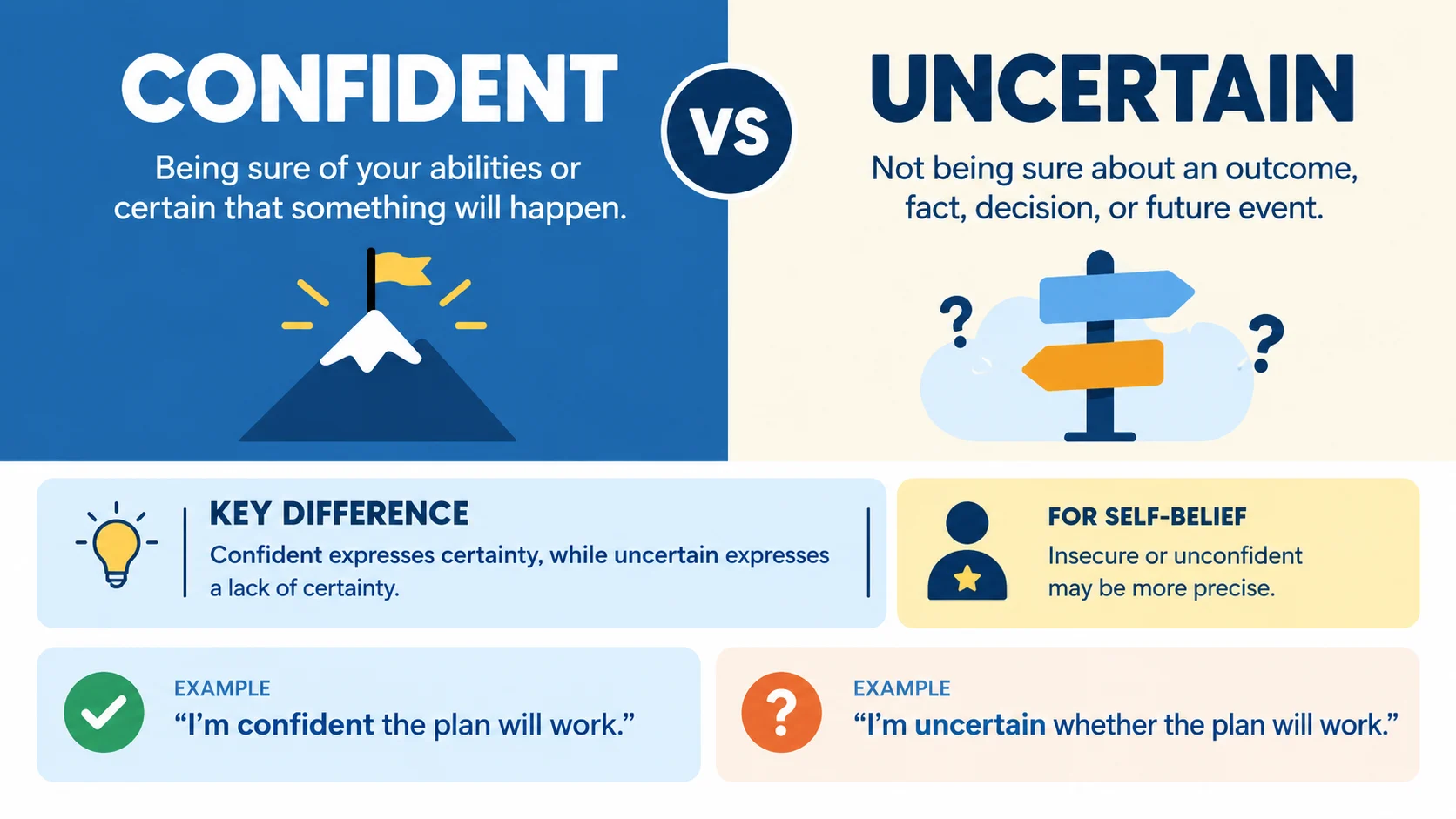
Part of speech: adjective. The strongest broad opposite of confident is uncertain when confident means being sure about an outcome, fact, decision, or future event. When confident describes belief in your own abilities, insecure or unconfident can be more precise. Context determines the best antonym.
Direct and Strong Antonyms
Uncertain
Tone or nuance: Neutral and broad.
Uncertain directly contrasts with confident when someone lacks certainty about an outcome, fact, decision, or future event.
Example: “I’m uncertain whether the client will approve the proposal.”
Unconfident
Tone or nuance: Direct and literal, especially when describing someone who lacks confidence in an ability or performance. It is less common in everyday American English than some alternatives.
Example: “She felt unconfident speaking in front of the entire class.”
Unsure
Tone or nuance: Common, conversational, and softer than uncertain. It often describes temporary hesitation or a lack of certainty.
Example: “I’m unsure which version of the report we should submit.”
Insecure
Tone or nuance: More personal and emotional. It commonly describes a lack of confidence in oneself, one’s abilities, appearance, or social standing.
Example: “He felt insecure about leading the meeting for the first time.”
Doubtful
Tone or nuance: Focuses on doubt about whether something is true, possible, or likely. It can also suggest skepticism about an expected outcome.
Example: “She was doubtful that the old computer could handle the new software.”
These words are not interchangeable in every sentence. Confident can describe certainty about something or belief in one’s own abilities. The appropriate antonym should match the particular meaning.
Contextual and Subtle Opposites
The best opposite can change depending on what confident means in a sentence.
| Context | Best Opposite | Why It Fits |
|---|---|---|
| Confidence in personal ability | Insecure or unconfident | The contrast is between believing in your abilities and lacking that self-assurance. |
| Certainty about an outcome | Uncertain or unsure | The contrast concerns not knowing whether something will happen or prove true. |
| Expectation that something will succeed | Doubtful | The emphasis is on questioning the likelihood of success. |
| Confidence in a person or plan | Doubtful or distrustful | These can work in particular contexts, although neither is a universal antonym of confident. |
For example, “I’m not confident about the interview” could mean the speaker doubts their own performance. In that situation, “I feel insecure about the interview” is more personal. If the speaker means they do not know whether the interview will go well, “I’m uncertain about the outcome” is more precise.
Words That Seem Opposite But Are Not
Shy is not an exact antonym of confident. A shy person may still feel confident about their skills while being uncomfortable in social situations.
For example:
“Maya is shy, but she is confident in her research.”
Here, shy describes social behavior, while confident describes belief in one’s abilities.
Humble is also not an exact antonym. Humility involves not overstating your importance, abilities, or achievements. A humble person can still be highly confident.
For example:
“The engineer was humble about her accomplishments but confident in her design.”
Words such as modest or diffident can contrast with confident in certain contexts, especially when confident means bold or self-assured. However, they should not automatically be treated as direct antonyms because their meanings are more specific.
Subtle Tone Differences
Uncertain is usually the safest general choice when the issue is certainty. It works especially well in professional and academic writing:
“The long-term effects remain uncertain.”
Unsure sounds more conversational and often suggests a temporary state:
“I’m unsure what time the store closes.”
Insecure is more emotionally personal. It can imply an underlying lack of self-belief:
“He became insecure after receiving repeated criticism.”
Doubtful can be stronger because it may communicate skepticism:
“I’m doubtful that the repair will last.”
Unconfident is grammatically direct, but many American English speakers naturally choose insecure, unsure, or not confident instead. Compare:
“She was not confident during the presentation.”
This often sounds more natural in everyday American English than:
“She was unconfident during the presentation.”
The distinction also matters in workplace writing. Compare “The team is uncertain about the deadline” with “The team is insecure about the deadline.” The first means the team lacks information or certainty. The second sounds as though the team has a personal or emotional concern. The word choice therefore changes the meaning.
Frequently Asked Questions
What is the most direct antonym of confident?
Uncertain is the strongest broad opposite when confident means certain or sure. For self-confidence, insecure or unconfident can be more precise. The correct choice depends on whether the sentence concerns certainty about something or belief in one’s own abilities.
What is the opposite of confident when talking about a person?
When describing someone who does not believe in their own abilities, insecure or unconfident may fit. If the person simply lacks certainty about a decision or outcome, unsure or uncertain is usually more accurate.
Can I use unsure as the opposite of confident?
Yes. Unsure is a natural conversational opposite when confident means certain about something. For example, “She was confident the plan would work” contrasts naturally with “She was unsure the plan would work.” In formal writing, uncertain may sound slightly more neutral.
Practical Word Choice
- Identify the intended meaning. Ask whether confident refers to self-belief, certainty, trust, or expectation.
- Match the tone and strength. Choose unsure for a softer conversational contrast, uncertain for a neutral one, insecure for personal self-doubt, and doubtful when skepticism is the focus.
Final Thoughts
Confident has two especially important uses: believing in your own abilities and feeling certain that something is true or will happen. Because those meanings overlap but are not identical, no single antonym works perfectly in every sentence.
Use uncertain when certainty is the main issue, and consider insecure or unconfident when self-belief is the focus. Unsure and doubtful can provide more specific shades of meaning depending on tone and context.
The most useful question is not simply “What is the opposite of confident?” but “What kind of confidence is being contrasted?” What example sentence would you use?
