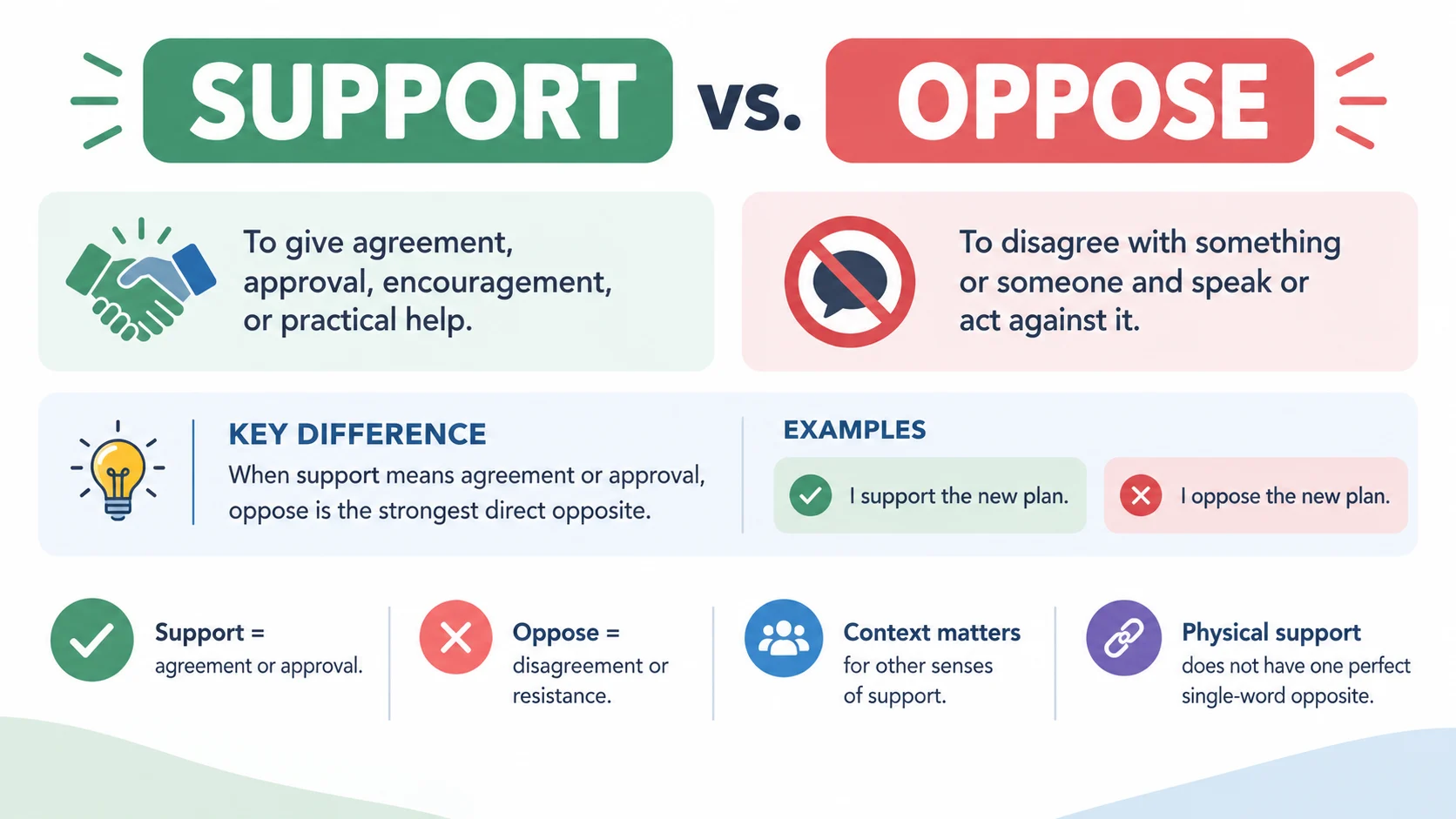
The strongest opposite of support depends on meaning. When support means agreeing with or approving an idea, oppose is the clearest direct antonym. In other contexts, such as emotional help, financial assistance, or physical support, phrases like withhold help, withdraw funding, or leave unsupported may express the opposite more precisely.
Direct and Strong Antonyms
| Antonym | Tone or Nuance | Example Sentence |
|---|---|---|
| Oppose | Direct, neutral, and widely applicable | “Several employees opposed the proposed schedule.” |
| Reject | Stronger emphasis on refusing to accept something | “The committee rejected the revised proposal.” |
| Disapprove | Focuses on negative judgment rather than active resistance | “Her parents disapproved of the decision.” |
Oppose is the closest general antonym when support means agreement or approval. Cambridge specifically lists reject as an antonym in the sense of saying yes to an idea or suggestion. (Cambridge Dictionary)
Reject is not always interchangeable with oppose. Someone can oppose an idea without formally rejecting it. For example, a manager may oppose a proposal while allowing employees to continue discussing it.
Disapprove is also narrower. It communicates a negative opinion, but it does not necessarily mean someone will actively resist or prevent something.
Contextual and Subtle Opposites
Because support has several meanings, there is no single opposite that works in every sentence. The appropriate contrast changes with meaning.
| Context | Best Opposite | Why It Fits |
|---|---|---|
| Agreement or approval | Oppose | Directly contrasts with backing an idea or position |
| Accepting an idea | Reject | Emphasizes refusal to accept or approve |
| Emotional or practical help | Withhold help | Describes intentionally not providing assistance |
| Financial assistance | Withdraw funding | Contrasts with providing financial resources |
| Physical support | Leave unsupported | Describes something no longer being held or stabilized |
| Proof or evidence | Undermine | Can weaken the evidence or argument rather than support it |
For example, support in “My coworkers supported me during a difficult week” means emotional or practical help. Oppose would not be the natural opposite. A more precise contrast would be “My coworkers withheld support” or “My coworkers did not help me.”
Similarly, in “The grant supports the research,” the opposite is not necessarily opposes the research. If the intended meaning is financial, “The grant does not fund the research” or “The organization withdrew its funding” is more precise.
Physical support works differently again. “The beams support the roof” describes carrying weight. The opposite idea is that the roof is unsupported, not that the beams “oppose” it.
Words That Seem Opposite But Are Not
Ignore is a common mistaken choice. Ignoring someone means failing to give attention or consideration. It does not necessarily mean disagreeing with or resisting that person. Someone can ignore a proposal without supporting or opposing it.
Abandon can also appear to be an opposite of support, especially in emotional contexts. However, abandoning someone means leaving or giving up on them. It does not simply mean disagreeing with them. A person might oppose a friend’s decision while continuing to provide emotional support.
Common Grammatical or Semantic Confusions
One important distinction is between oppose and object. Both can communicate disagreement, but oppose usually expresses a stronger position against something, while object often means expressing disagreement or raising a concern. “I oppose the plan” is a direct statement of resistance. “I object to the plan” can emphasize protest or disagreement.
Another distinction is between reject and oppose. Reject usually focuses on refusing to accept, approve, or choose something. Oppose focuses on disagreement or resistance. A hiring manager might reject an application, but that does not mean the manager actively opposed the applicant.
Subtle Tone Differences
Word choice can change the strength and tone of a sentence.
Oppose is usually the clearest neutral choice when you want to describe a position against an idea:
“Several residents oppose the proposed development.”
Reject sounds more final when something has been refused:
“The editor rejected the revised manuscript.”
Disapprove is more evaluative and can sound less confrontational:
“Her supervisor disapproved of the way she handled the complaint.”
For writing, choose the word that describes the actual action. If someone simply disagrees, oppose may be appropriate. If they formally refuse something, reject may be better. If they express a negative judgment, disapprove may be more accurate.
Frequently Asked Questions
What is the direct antonym of support?
When support means agreeing with or approving an idea, person, plan, or cause, oppose is the clearest direct antonym. It describes disagreement or active resistance toward the thing being supported.
What is the opposite of support when it means help?
There is no single perfect one-word antonym in every situation. Depending on context, useful contrasts include withhold help, deny assistance, or leave unsupported. The most precise choice depends on what kind of support is being withheld.
Is reject the opposite of support?
Sometimes, but not in every context. Reject means refusing to accept, approve, or choose something, while oppose means disagreeing with or acting against it. When describing a general opposing position, oppose is usually more precise.
Practical Word Choice
- Identify the intended meaning first. Decide whether support means approval, emotional help, money, evidence, or physical stability.
- Match the contrast to the context. Use oppose for disagreement, reject for refusal, and a more specific phrase when the meaning involves help, funding, evidence, or physical support.
Conclusion
The most important distinction is that oppose is the strongest direct antonym of support when support means agreement, approval, or backing. Other meanings require more specific contextual contrasts.
Choosing an antonym accurately means looking beyond the dictionary headword and considering what support means in the sentence. A precise opposite makes writing clearer and prevents subtle changes in meaning.
