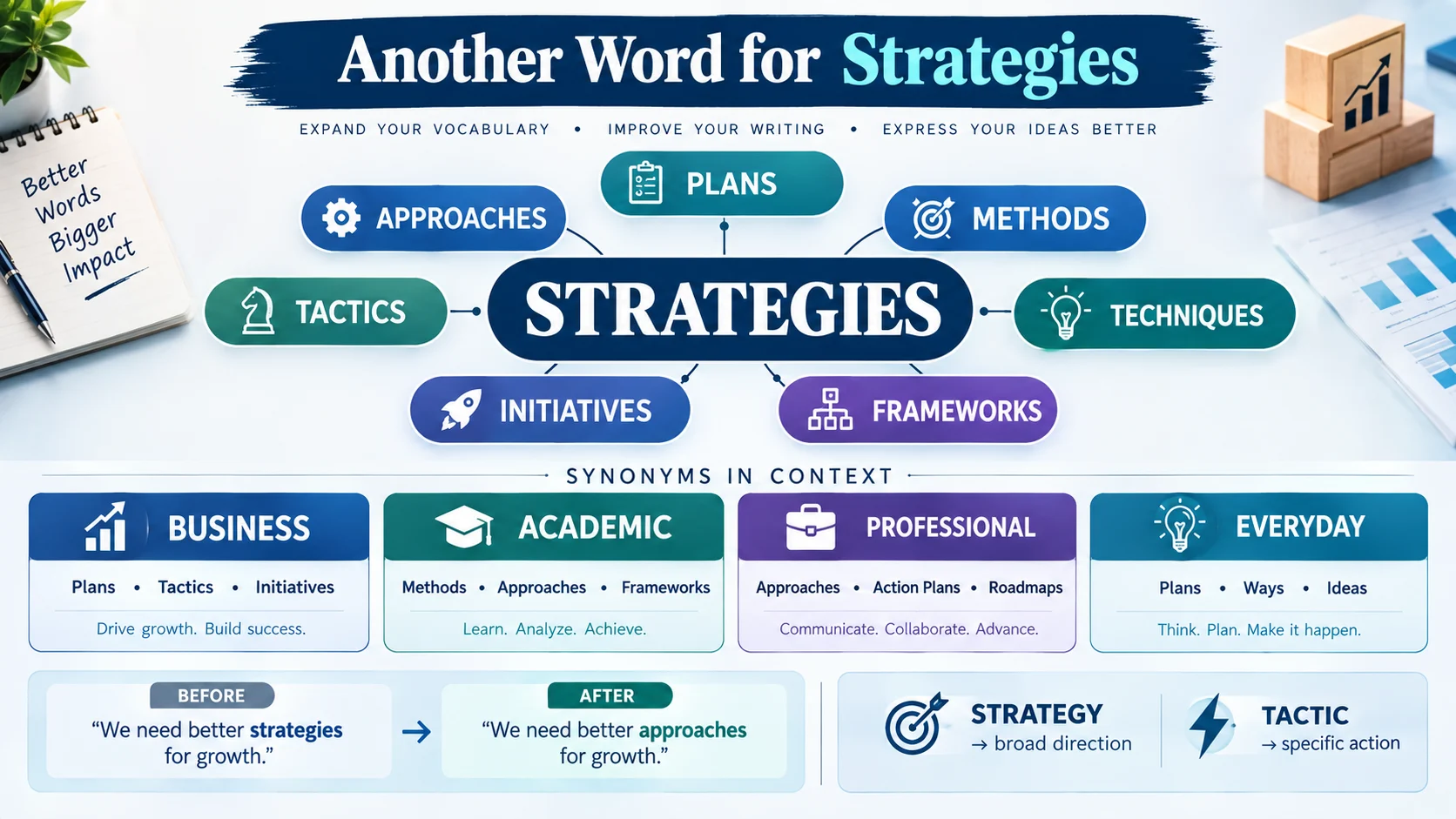
If you need another word for strategies, the best alternatives include plans, approaches, methods, tactics, techniques, game plans, policies, and frameworks. The right synonym depends on context. For example, “strategies” often works best in business and academic writing, while “plans” is simpler and “tactics” usually refers to specific actions used to achieve a larger goal.
What Does Strategies Mean?
Definition
Strategies is the plural form of strategy. A strategy is a carefully considered plan or approach designed to achieve a particular goal or solve a problem.
The word usually suggests deliberate thinking, long-term planning, and a clear objective. In business, companies develop strategies to increase sales, enter new markets, or outperform competitors. In education, students may use learning strategies to improve their performance.
The most appropriate synonym depends on whether you are describing a broad plan, a specific action, a process, a technique, or an overall approach.
Common Uses
“Strategies” is commonly used in:
- Business and management
- Marketing and advertising
- Academic writing
- Education
- Sports
- Personal development
- Finance
- Politics and public policy
- Technology
- Problem-solving
For example:
The company developed new strategies to increase customer retention.
Possible replacements include:
The company developed new approaches to increase customer retention.
or:
The company developed new plans to increase customer retention.
Both are grammatically correct, but the nuance changes slightly.
Best Synonyms for Strategies
| Synonym | Meaning | Best Used When | Example |
|---|---|---|---|
| Plans | Organized ideas for achieving a goal | General or simple writing | We created plans for business growth. |
| Approaches | Ways of dealing with a situation | Professional or academic writing | Several approaches were considered. |
| Methods | Specific ways of doing something | Academic, technical, or practical contexts | Researchers tested several methods. |
| Tactics | Specific actions used to achieve an objective | Marketing, competition, sports, or business | The team changed its tactics. |
| Techniques | Particular skills or procedures | Education, writing, sports, and technical work | She learned new techniques. |
| Game plans | Detailed plans for reaching a goal | Informal business or sports contexts | The team developed a game plan. |
| Approaches | Different ways to handle a problem | Professional and analytical writing | We need a new approach. |
| Policies | Official principles or rules guiding decisions | Government and organizations | The company introduced new policies. |
| Frameworks | Structures used to organize decisions or actions | Business, research, and technology | The framework supports strategic planning. |
| Roadmaps | Plans showing stages toward a goal | Business, technology, and projects | The team created a product roadmap. |
| Programs | Organized sets of activities designed to achieve an objective | Organizations and institutions | The school introduced new programs. |
| Initiatives | Planned efforts intended to create a result | Business, government, and nonprofits | The company launched several initiatives. |
Synonym: Plans
Meaning: Organized steps or ideas intended to accomplish something.
Best used for: General writing, business, personal goals, and everyday communication.
Tone: Neutral and straightforward.
Difficulty: Easy
Usage frequency: Very Common
Best for: Resume, email writing, essay writing, business writing.
“Plans” is probably the simplest replacement for “strategies.” However, it can sound less sophisticated because a strategy often involves broader thinking and long-term direction.
Business example:
“Our marketing plans focus on improving customer engagement.”
Academic example:
“Students can develop effective study plans before examinations.”
Daily conversation example:
“What are your plans for the weekend?”
Synonym: Approaches
Meaning: Ways of dealing with or thinking about a particular situation.
Best used for: Professional, academic, analytical, and business writing.
Tone: Professional and flexible.
Difficulty: Medium
Usage frequency: Common
Best for: Essays, reports, business writing, and professional emails.
“Approaches” is an excellent choice when you want to emphasize how something is handled rather than the complete plan behind it.
Business example:
“The company is exploring new approaches to customer service.”
Academic example:
“Researchers examined several approaches to solving the problem.”
Daily conversation example:
“We need a different approach to this situation.”
Synonym: Tactics
Meaning: Specific actions or techniques used to achieve a particular objective.
Best used for: Marketing, competition, negotiations, sports, and business.
Tone: Strategic and action-oriented.
Difficulty: Medium
Usage frequency: Common
Best for: Marketing copy, business writing, sports writing, and analysis.
A useful distinction is that strategy is generally broader than tactics. A strategy describes the overall direction, while tactics are the individual actions used to execute it.
Business example:
“The marketing strategy included several social media tactics.”
Academic example:
“The study examined negotiation tactics used by experienced professionals.”
Daily conversation example:
“That sales tactic worked surprisingly well.”
Synonyms by Context
Formal Writing
For formal writing, strong alternatives to “strategies” include:
- Approaches
- Methods
- Frameworks
- Plans
- Policies
- Measures
- Procedures
“Approaches” is especially useful when discussing different ways of addressing a problem.
Example:
Original: “The researchers evaluated several strategies for reducing costs.”
Improved: “The researchers evaluated several approaches for reducing costs.”
“Methods” may be better when the focus is on a specific procedure or process.
Professional Writing
In business and workplace communication, useful alternatives include:
- Approaches
- Plans
- Initiatives
- Tactics
- Roadmaps
- Frameworks
- Action plans
Example:
“Our new strategies will improve customer retention.”
could become:
“Our new approaches will improve customer retention.”
Or, if discussing specific actions:
“Our new tactics will improve customer retention.”
Academic Writing
Academic writers often benefit from words such as:
- Methods
- Approaches
- Techniques
- Frameworks
- Models
- Procedures
- Practices
The choice should reflect the exact meaning.
Use methods for specific ways of conducting research or completing a task.
Use approaches for broader ways of addressing a subject.
Use frameworks for structured systems that organize analysis or decision-making.
Daily Conversation
For everyday communication, simpler alternatives are usually better:
- Plans
- Ideas
- Ways
- Methods
- Approaches
- Game plans
Instead of saying:
“What strategies are you using to prepare for the trip?”
you might naturally say:
“What plans are you making for the trip?”
Professional Alternatives for Strategies
If you are writing a resume, business proposal, report, or professional email, consider these alternatives:
Approaches: Best for describing different ways of solving a problem.
Plans: Best when referring to organized future actions.
Initiatives: Best for major organized efforts.
Tactics: Best for specific actions that support a larger objective.
Roadmaps: Best for phased plans, especially in technology and project management.
Frameworks: Best for structured systems or models.
Action plans: Best when the focus is on specific steps and implementation.
For example, a resume bullet saying:
“Developed marketing strategies to increase brand awareness.”
could become:
“Developed marketing approaches to increase brand awareness.”
Or:
“Designed marketing initiatives that increased brand awareness.”
The second version emphasizes concrete projects rather than simply planning.
Simple Alternatives for Strategies
If your audience prefers plain American English, use:
- Plans
- Ideas
- Ways
- Steps
- Methods
- Actions
“Plans” is generally the strongest simple substitute.
For example:
“We need better strategies for saving money.”
can become:
“We need better plans for saving money.”
In some contexts, ways is even more conversational:
“We need better ways to save money.”
Stronger Alternatives for Strategies
If you want a more precise or sophisticated word, consider:
- Frameworks
- Initiatives
- Roadmaps
- Methodologies
- Game plans
- Tactics
- Approaches
However, a more advanced word is not automatically a better word. The best replacement is the one that preserves your intended meaning.
For example, methodology is not always interchangeable with strategy. A methodology generally describes an organized system of methods or principles, while a strategy focuses on achieving a goal.
Difference Between Similar Synonyms
Strategies vs. Plans
A plan usually describes what you intend to do. A strategy often explains the broader direction or thinking behind those actions.
Strategies vs. Tactics
A strategy is usually broad and goal-oriented. A tactic is a specific action used to support the strategy.
Example:
Strategy: Increase online sales.
Tactics: Run paid ads, publish product videos, and offer promotional discounts.
Strategies vs. Methods
A method is a particular way of doing something. A strategy is generally more concerned with achieving an overall objective.
Strategies vs. Approaches
An approach describes a way of dealing with something. It is often the closest replacement when “strategies” sounds repetitive.
Strategies vs. Techniques
A technique is usually a specific skill or procedure. It is narrower than a strategy.
Strategies vs. Initiatives
An initiative is a planned effort or project designed to produce a particular result. Several initiatives can form part of a larger strategy.
Quick Word Selection Guide
Choose plans when you want a simple, everyday word.
Choose approaches when describing different ways of handling a problem.
Choose methods when discussing specific procedures.
Choose tactics when describing individual actions supporting a larger goal.
Choose techniques when discussing particular skills or procedures.
Choose initiatives when referring to organized projects or efforts.
Choose roadmaps when describing stages toward a future objective.
Choose frameworks when referring to a structured system for planning or analysis.
Choose policies when the “strategy” actually consists of official rules or guiding principles.
Opposite Words
Depending on context, possible opposites of “strategies” include:
- Improvisation
- Randomness
- Disorganization
- Aimlessness
- Inaction
- Unplanned actions
There is no single perfect antonym because “strategies” can refer to different types of plans and approaches.
FAQs
What is another word for strategies?
Common alternatives for strategies include plans, approaches, methods, tactics, techniques, initiatives, roadmaps, frameworks, and game plans. The best choice depends on the context.
What is a formal synonym for strategies?
Approaches, methods, frameworks, methodologies, and plans can work as formal alternatives. “Approaches” is often the most natural choice in professional and academic writing.
What is a professional alternative for strategies?
Professional alternatives include approaches, initiatives, action plans, roadmaps, frameworks, tactics, and methodologies. Select the word based on whether you mean a broad plan, specific action, or structured system.
What word can replace strategies?
The simplest replacement is plans. Other options include approaches, methods, tactics, techniques, initiatives, and frameworks.
What is another word for business strategies?
Depending on meaning, use business plans, approaches, initiatives, tactics, growth plans, action plans, or business frameworks.
What is another word for marketing strategies?
Useful alternatives include marketing approaches, marketing plans, marketing tactics, promotional methods, campaigns, and marketing initiatives.
What is another word for strategies in an essay?
For academic writing, approaches, methods, techniques, frameworks, and plans are useful alternatives. “Approaches” is often the closest natural substitute.
Are strategies and tactics the same?
No. A strategy is generally a broader plan for achieving a goal, while tactics are specific actions used to implement that strategy.
Conclusion
The best synonym for strategies depends on what you are trying to communicate. Plans is the simplest alternative, approaches works well in professional and academic writing, methods emphasizes specific procedures, and tactics refers to individual actions supporting a larger objective.
For business writing, consider approaches, initiatives, roadmaps, or action plans. For academic writing, approaches, methods, and frameworks are often more precise. For everyday conversation, plans, ways, or ideas usually sound more natural.
The goal is not simply to replace “strategies” with a more complicated word. The strongest writing uses the synonym that communicates the intended meaning clearly and naturally.
