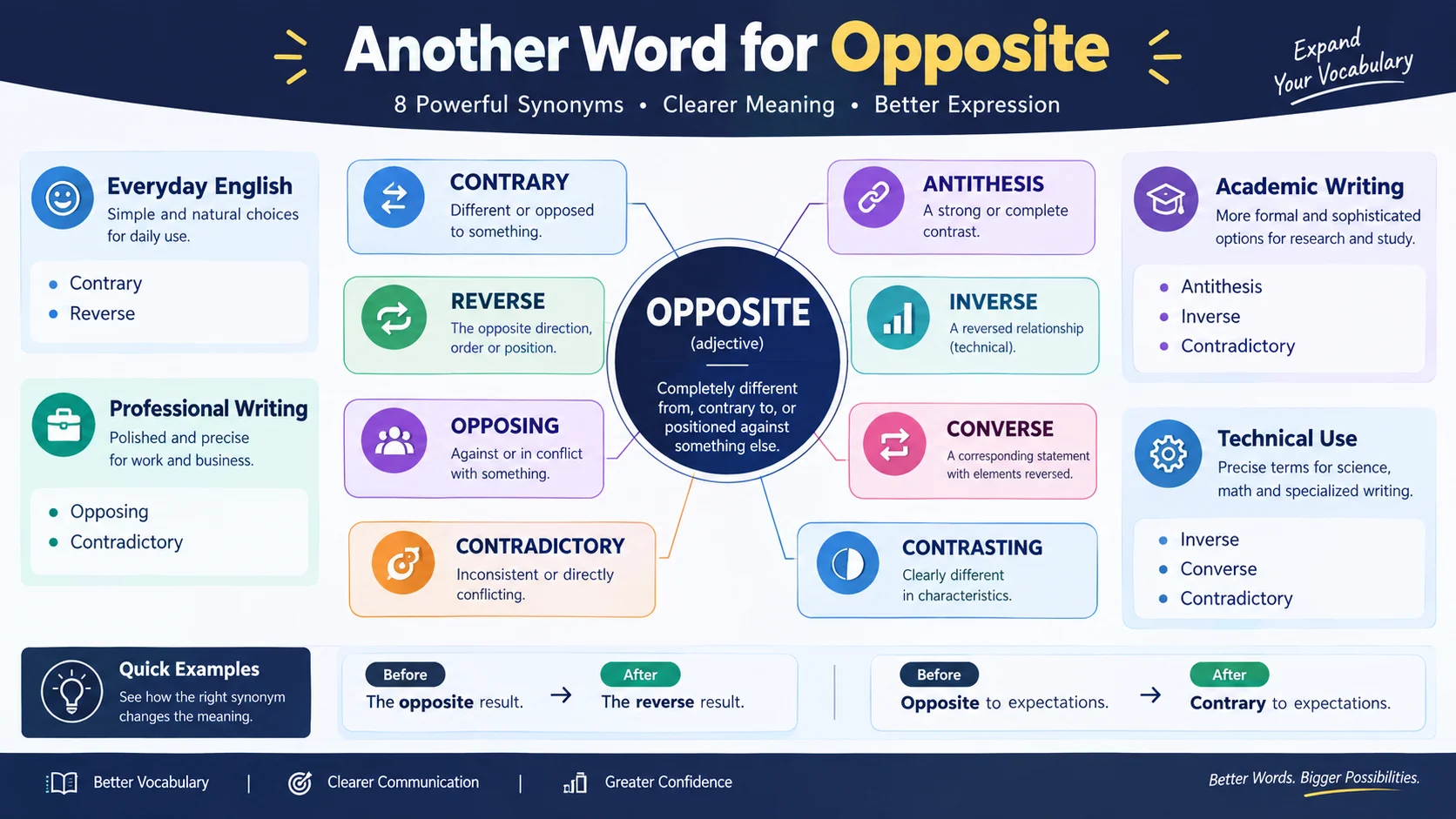
Another word for opposite is contrary. Depending on context, useful alternatives include reverse, antithesis, opposing, contradictory, inverse, converse, and contrasting. “Contrary” works well as a general replacement, while “antithesis” is stronger and more formal, and “inverse” or “converse” is better for technical and logical relationships.
What Does Opposite Mean?
Definition
Opposite describes something that is completely different from, contrary to, or positioned against something else. It can refer to meaning, direction, position, opinion, behavior, or characteristics.
For example:
- Hot is the opposite of cold.
- North is opposite to south.
- Her opinion was the opposite of mine.
- The store is on the opposite side of the street.
The best replacement depends on what you mean by opposite. In everyday writing, contrary and reverse are useful alternatives. In formal writing, antithesis can provide a stronger contrast. For technical or mathematical contexts, inverse may be more precise.
Common Uses
The word opposite commonly appears in four situations:
- Contrasting meanings: “Generous is the opposite of selfish.”
- Different positions or directions: “The pharmacy is opposite the bank.”
- Conflicting opinions or actions: “They took opposite positions.”
- Complete contrast: “The result was the opposite of what we expected.”
Because these meanings are slightly different, there is no single synonym that works perfectly in every sentence.
Best Synonyms for Opposite
| Synonym | Meaning | Best Used When | Example |
|---|---|---|---|
| Contrary | Different from or opposed to something | General and formal writing | His actions were contrary to expectations. |
| Reverse | The contrary direction, order, or condition | Direction, sequence, or position | The reverse situation produced different results. |
| Antithesis | The direct or strongest contrast | Formal and academic writing | Her approach was the antithesis of traditional methods. |
| Opposing | Actively against something | Opinions, groups, positions, or forces | The opposing teams prepared for the final match. |
| Contradictory | Inconsistent or directly conflicting | Statements, evidence, claims, or ideas | The two reports contained contradictory information. |
| Inverse | Having a reversed or opposite relationship | Mathematics, science, and technical writing | There is an inverse relationship between the two variables. |
| Converse | A corresponding statement or relationship with elements reversed | Logic and formal contexts | The converse of the original statement was also examined. |
| Contrasting | Clearly different in characteristics | Describing noticeable differences | The two designs use contrasting colors. |
1. Contrary
Meaning: Different from, opposed to, or inconsistent with something.
Tone: Neutral to formal
Difficulty: Easy
Usage Frequency: Common
Best used for: Professional writing, essays, formal documents, and general communication.
“Contrary” is one of the closest alternatives to opposite, especially when discussing an idea, action, expectation, or position.
Business example: The final decision was contrary to the original recommendation.
Academic example: The findings were contrary to the researchers’ initial hypothesis.
Daily conversation: That’s contrary to what I heard yesterday.
2. Reverse
Meaning: The opposite direction, order, position, or condition.
Tone: Neutral
Difficulty: Easy
Usage Frequency: Very Common
Best used for: Directions, processes, sequences, positions, and situations.
Use reverse when something has been turned around or placed in the opposite direction or order.
Business example: The company experienced the reverse effect after changing its pricing strategy.
Academic example: The reverse pattern appeared in the second group.
Daily conversation: Try the reverse order and see if it works.
3. Antithesis
Meaning: A person, idea, or thing that represents a complete or striking contrast.
Tone: Formal
Difficulty: Advanced
Usage Frequency: Less Common
Best used for: Academic writing, sophisticated essays, literature, and formal analysis.
Antithesis is stronger than ordinary contrast. It suggests that two things represent fundamentally opposing ideas or qualities.
Business example: A rigid management style can be the antithesis of an employee-centered workplace.
Academic example: The theory presents individualism as the antithesis of collective responsibility.
Daily conversation: His personality is the antithesis of his brother’s.
4. Opposing
Meaning: Being against or in conflict with something.
Tone: Neutral to formal
Difficulty: Easy
Usage Frequency: Common
Best used for: Opinions, arguments, teams, groups, policies, and competing positions.
Business example: The company considered several opposing proposals.
Academic example: Researchers presented opposing interpretations of the evidence.
Daily conversation: We have opposing views on the issue.
5. Contradictory
Meaning: Containing statements, ideas, or information that cannot easily agree with each other.
Tone: Formal
Difficulty: Medium
Usage Frequency: Common
Best used for: Reports, evidence, claims, statements, arguments, and academic writing.
Use contradictory when the focus is on information or statements that conflict rather than simply being different.
Business example: The customer provided contradictory information about the order.
Academic example: The study produced contradictory results.
Daily conversation: His answers were contradictory.
Synonyms by Context
Formal Writing
For formal documents, reports, and professional communication, the strongest choices are:
- Contrary
- Antithesis
- Opposing
- Contradictory
- Inverse
Example:
The proposed policy is contrary to the organization’s established guidelines.
For sophisticated analysis:
The new philosophy represents the antithesis of the traditional approach.
Professional Writing
In business writing, choose a synonym based on what is being contrasted.
Use opposing for competing positions:
The committee considered two opposing proposals.
Use contrary for actions or outcomes that differ from expectations:
The results were contrary to the forecast.
Use reverse when describing a reversed process or outcome:
The revised strategy produced the reverse effect.
Academic Writing
Academic writing often benefits from precise terminology.
Use antithesis for a strong conceptual contrast:
The author’s argument presents cooperation as the antithesis of competition.
Use contradictory when evidence or claims conflict:
The researchers identified contradictory findings across the studies.
Use inverse when describing a mathematical, statistical, or scientific relationship:
The data indicate an inverse relationship between the two variables.
Daily Conversation
For everyday English, keep the wording simple.
Good choices include:
- Contrary
- Reverse
- Opposing
- Different
- Contrasting
Example:
I expected a positive response, but I got the opposite.
You could also say:
I expected a positive response, but I got the reverse result.
Professional Alternatives for Opposite
If you’re writing an email, report, resume, proposal, or business document, these alternatives can sound more precise:
Contrary — best general professional alternative.
Opposing — best for competing views, positions, or groups.
Contradictory — best when facts, claims, or statements conflict.
Antithesis — best for a strong conceptual contrast.
Inverse — best for technical or analytical relationships.
For example, instead of:
The results were the opposite of our expectations.
A professional version could be:
The results were contrary to our expectations.
Simple Alternatives for Opposite
If your goal is easy-to-understand American English, consider:
- Reverse
- Different
- Contrary
- Opposing
- Contrasting
For students and general readers, reverse and contrary are usually easier than antithesis or inverse.
Stronger Alternatives for Opposite
When you want to emphasize a complete or significant contrast, use:
- Antithesis
- Contradictory
- Opposing
- Direct contrast
- Complete reversal
For example:
Her leadership style was the antithesis of the previous manager’s approach.
This communicates a stronger contrast than simply saying the two approaches were “different.”
Difference Between Similar Synonyms
The words related to opposite are not interchangeable in every situation.
Opposite vs. Contrary:
“Opposite” is broader and more common. “Contrary” often describes something that conflicts with an expectation, statement, rule, or position.
Opposite vs. Reverse:
“Reverse” is especially useful for direction, order, sequence, or a reversed condition.
Opposite vs. Antithesis:
“Antithesis” indicates a particularly strong or fundamental contrast and is more formal.
Opposite vs. Contradictory:
“Contradictory” applies primarily when ideas, statements, evidence, or claims conflict.
Opposite vs. Inverse:
“Inverse” is more specialized and often describes a reversed mathematical, logical, or scientific relationship.
Opposite vs. Converse:
“Converse” is a technical term commonly used when the elements of a statement or relationship are reversed. It should not be treated as a universal synonym for “opposite.”
Opposite Words
If you are looking for the opposite of “opposite,” the answer depends on the intended meaning.
Possible related words include:
- Same
- Similar
- Identical
- Matching
- Corresponding
- Equivalent
- Alike
For example:
The two answers are opposite.
The contrasting idea would be:
The two answers are similar.
However, same is usually the clearest antonym when “opposite” means completely different.
FAQs
What is another word for opposite?
The best general alternative is contrary. Other choices include reverse, antithesis, opposing, contradictory, inverse, converse, and contrasting, depending on the sentence and intended meaning.
What is a formal synonym for opposite?
Antithesis is a strong formal synonym when describing a fundamental contrast. Contrary and contradictory are also useful in formal writing when their specific meanings fit the context.
What is a professional alternative for opposite?
Contrary, opposing, contradictory, and reverse are useful professional alternatives. Choose contrary for general business writing and contradictory when discussing conflicting information or statements.
What word can replace opposite?
Possible replacements include contrary, reverse, opposing, antithesis, contradictory, inverse, and contrasting. The best choice depends on whether you are discussing direction, opinion, evidence, position, or meaning.
What is another word for the opposite of something?
You can say contrary, reverse, or antithesis, depending on the context. For example, “the opposite of traditional” could be described as “contrary to traditional” or “the antithesis of traditional.”
Is “contrary” the same as “opposite”?
Not always. Contrary often means conflicting with or going against something, while opposite can describe a direct contrast in meaning, position, direction, or characteristics.
Is “antithesis” a synonym for “opposite”?
Yes, in contexts involving a strong or fundamental contrast. However, antithesis is more formal and should not replace “opposite” in every everyday sentence.
Is “inverse” another word for opposite?
Sometimes. Inverse is appropriate when two things have a reversed relationship, especially in mathematics, science, statistics, or technical writing. It is not a universal replacement for “opposite.”
Conclusion
The best synonym for opposite depends on the context. Contrary is the strongest general-purpose alternative, while reverse works well for direction or sequence. Antithesis expresses a powerful formal contrast, opposing describes competing positions, contradictory fits conflicting statements or evidence and inverse is best for specialized technical relationships.
For everyday American English, start with contrary or reverse. For academic or professional writing, choose the word that most precisely describes the type of contrast you mean.

1 thought on “Another Word for Opposite | 8 Powerful Synonyms”