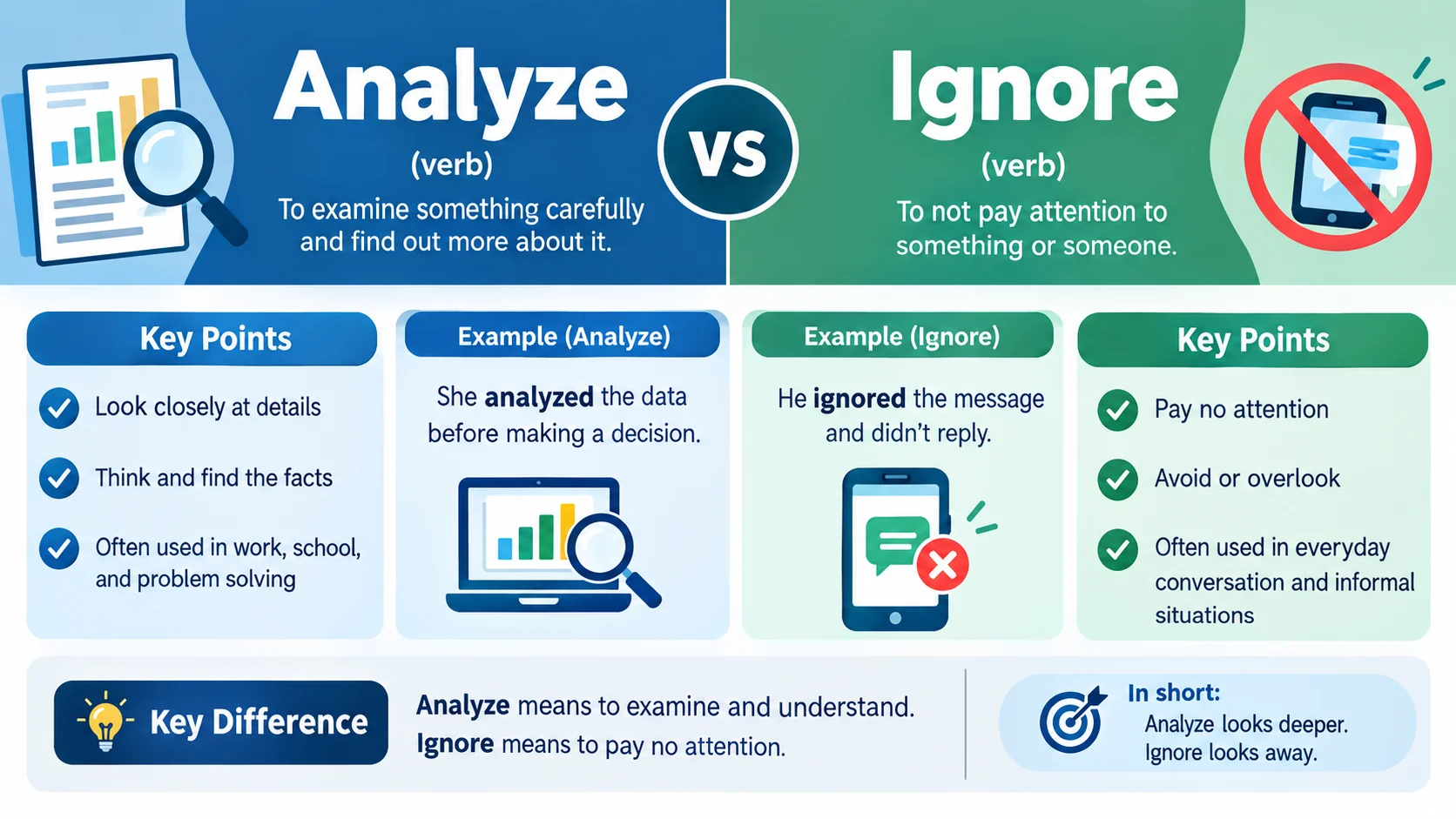
The strongest opposite of analyze is often ignore when analyze means to examine something carefully and in detail. In some contexts, synthesize serves as an opposite because analysis breaks something into parts, while synthesis combines parts into a whole. The best antonym depends on the intended meaning and context.
Direct and Strong Antonyms
| Antonym | Tone or Nuance | Example Sentence |
|---|---|---|
| Ignore | Most common everyday opposite | The team ignored the survey results instead of analyzing them. |
| Neglect | Suggests failing to give needed attention | The company neglected customer feedback for months. |
| Overlook | Often accidental rather than deliberate | She overlooked several important details in the report. |
| Disregard | More formal; intentionally dismissing information | The manager disregarded the warning signs. |
| Synthesize | Technical or academic opposite | Researchers synthesized their findings into one conclusion. |
Among these options, ignore is usually the clearest answer when someone asks for the opposite of analyze in ordinary American English.
Contextual and Subtle Opposites
The best opposite can change depending on how analyze is being used.
Meaning: Examine Carefully
When analyze means studying information closely, these contextual opposites fit best:
| Context | Best Opposite | Why It Fits |
|---|---|---|
| Reviewing data | Ignore | No detailed examination occurs. |
| Reading evidence | Disregard | The evidence is dismissed. |
| Evaluating feedback | Neglect | Important information receives insufficient attention. |
Example:
- The analyst carefully analyzed the sales figures.
- The analyst ignored the sales figures and made a guess.
Meaning: Break Into Parts
In scientific, mathematical, or academic writing, analyze can mean separating something into components.
| Context | Best Opposite | Why It Fits |
|---|---|---|
| Research writing | Synthesize | Combines information into a unified whole. |
| Academic discussion | Integrate | Brings separate parts together. |
| Problem solving | Assemble | Focuses on building rather than breaking down. |
Example:
- Students analyzed each argument separately.
- Students synthesized the arguments into a single conclusion.
Meaning: Psychoanalyze
In psychology, analyze can refer to psychoanalytic treatment.
Contextual Opposite: Leave untreated or avoid examination.
This use is much less common in everyday conversation.
Words That Seem Opposite But Are Not
Examine
Many learners confuse examine and analyze because they are closely related.
- Examine means to inspect or look at something carefully.
- Analyze means to examine and break down details to understand them.
Because the two words are similar rather than opposite, examine is not an antonym.
Example:
- The doctor examined the X-ray.
- The specialist analyzed the X-ray results.
Evaluate
Another common confusion involves evaluate.
- Analyze focuses on understanding.
- Evaluate focuses on judging value, quality, or effectiveness.
Evaluation often happens after analysis, so the words are related rather than opposite.
Example:
- First, the committee analyzed the proposal.
- Then, it evaluated whether the proposal should be approved.
Subtle Tone Differences
Choosing the right opposite affects tone and meaning.
Ignore vs. Neglect
Ignore often suggests a conscious decision not to pay attention.
Neglect suggests failing to provide proper care or attention.
Example:
- He ignored the email because he was busy.
- The organization neglected employee concerns for years.
Ignore vs. Disregard
Disregard sounds more formal and often implies intentional dismissal.
Example:
- The student ignored the advice.
- The company disregarded expert recommendations.
Synthesize vs. Analyze
These words are especially important in academic writing.
Analyze breaks information apart.
Synthesize combines information into a broader understanding.
Example:
- The researcher analyzed each study individually.
- The researcher synthesized the studies into one report.
Frequently Asked Questions
What is the direct antonym of analyze?
The most common direct antonym of analyze is ignore when analyze means examining something carefully. If someone does not study, investigate, or consider information, they are effectively ignoring it rather than analyzing it.
Is synthesize the opposite of analyze?
In many academic and technical contexts, yes. Analyze involves breaking something into parts for study, while synthesize involves combining separate parts into a coherent whole. Both processes are important and often work together.
Which antonym should I use in writing?
Choose the antonym based on context. Use ignore, overlook, or disregard when discussing attention or consideration. Use synthesize when discussing research, learning, science, or analytical thinking.
Conclusion
The opposite of analyze is not always the same word in every situation. In everyday American English, ignore is usually the strongest and most natural antonym because it directly contrasts with careful examination.
Context matters. Academic, scientific, and professional writing may call for synthesize, while workplace or conversational situations often favor ignore, neglect, or disregard.
Understanding the specific meaning of analyze helps you choose the most accurate opposite and communicate more clearly. What sentence are you trying to use with the word analyze?
