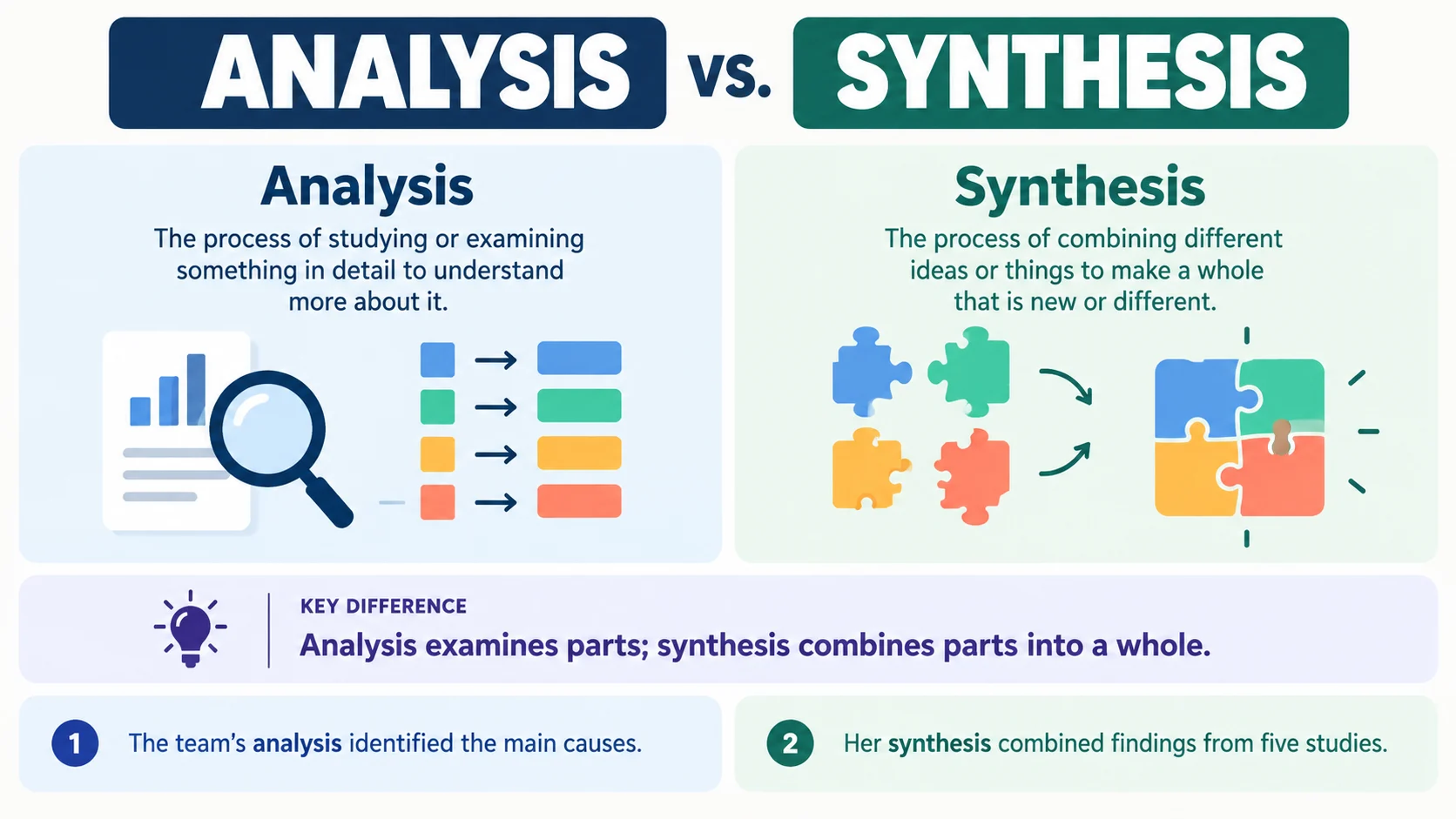
The strongest opposite of analysis is synthesis when analysis means examining parts in detail and synthesis means combining those parts into a whole. Analysis breaks information down to understand it, while synthesis brings separate ideas, findings, or elements together to form a unified understanding.
Part of speech: Noun
Primary opposite: Synthesis
Analysis is the process of studying or examining something in detail to understand it better. In its most common academic, professional, and general meaning, synthesis provides the clearest direct contrast because it involves combining different ideas or things into a whole. Cambridge specifically lists synthesis among the antonyms of analysis.
The distinction is straightforward: analysis moves from a whole toward its parts, while synthesis moves from separate parts toward a whole.
For example, a researcher might analyze five studies by examining their methods and findings individually. A later synthesis could combine those findings into one broader conclusion.
Direct and Strong Antonyms
| Antonym | Tone or Nuance | Example Sentence |
|---|---|---|
| Synthesis | Formal, academic, precise | Her synthesis combined findings from five studies. |
| Combining | General and practical | Combining the separate reports gave the manager a clearer picture. |
| Combination | Neutral noun referring to the act or result of joining things | The combination of the findings revealed a consistent pattern. |
| Uniting | Emphasizes bringing separate things together | The final section focuses on uniting several ideas into one framework. |
Synthesis is the strongest lexical antonym because it directly contrasts with the process of examining components separately. Cambridge’s thesaurus lists synthesis, uniting, union, combining, and combination as antonyms of analysis.
However, these words are not interchangeable in every sentence. Synthesis is especially appropriate in academic and professional writing when separate ideas, findings, or elements are brought together. Combining is more general and conversational.
Consider the difference:
The report provides a detailed analysis of the survey responses.
This emphasizes examination and separation of information.
The report provides a synthesis of the survey findings.
This emphasizes bringing the findings together into a larger understanding.
Contextual and Subtle Opposites
The best opposite depends on which sense of analysis is intended.
When analysis means detailed examination
Best opposite: synthesis
This is the clearest contrast in academic writing, research, business analysis, and critical thinking. Analysis examines components, relationships, or details. Synthesis combines information into a coherent whole.
Example:
The first chapter offers an analysis of individual arguments, while the final chapter provides a synthesis of those arguments.
When analysis refers to separating a substance into components
Best opposite: synthesis
This contrast is particularly relevant in chemistry and scientific contexts. Analysis can involve examining a substance to determine what it contains, while synthesis can involve producing a substance from simpler materials through a chemical reaction.
Example:
The laboratory performed a chemical analysis of the sample, while a separate experiment focused on chemical synthesis.
When analysis means a particular interpretation or judgment
There is no single perfect opposite. In this sense, words such as combining or synthesis may describe a contrasting process, but they are not necessarily direct grammatical replacements.
Example:
Her analysis focused on individual market trends.
The team’s synthesis brought those trends together into one broader assessment.
This distinction matters because an antonym should oppose the relevant meaning, not merely describe a different activity.
Words That Seem Opposite But Are Not
Ignoring
Ignoring can appear to oppose analysis because someone who analyzes something pays attention to it, while someone who ignores it does not. However, ignoring is not a direct antonym of the noun analysis.
The verb analyze, rather than the noun analysis, has established contextual opposites such as ignore, overlook, neglect, and brush aside. Cambridge lists these as antonyms of analyze.
For example:
The scientist analyzed the results carefully.
The contextual opposite could be:
The scientist ignored the results.
But this does not make ignoring a direct noun-to-noun antonym of analysis.
Summary
A summary is also not an antonym of analysis. A summary condenses the main points of information, while analysis examines information in detail. The two processes can occur together.
For example:
The report begins with a summary and follows with a detailed analysis.
The words contrast in function, but summary is better classified as a related contrast, not a direct antonym.
Subtle Tone Differences
Synthesis sounds more formal and specialized than combining. It is particularly natural in academic, scientific, and professional writing.
Compare:
The researcher combined the results from several experiments.
with:
The researcher synthesized the results from several experiments.
The first sentence is plain and direct. The second emphasizes an intellectual process of integrating findings into a coherent whole.
Combination usually refers to the joining itself or the resulting group:
The combination of survey results produced a clearer picture.
Uniting emphasizes bringing separate elements together and can sound more rhetorical:
The final section focuses on uniting several perspectives.
Choose synthesis when precision matters in research or academic writing. Choose combining when you want a simpler, more accessible expression.
Frequently Asked Questions
What is the direct antonym of analysis?
Synthesis is the clearest direct antonym of analysis when analysis means examining something by considering its parts. Synthesis means combining separate ideas, findings, or elements into a whole. This opposition is especially common in academic, scientific, and professional contexts.
What is the opposite of analysis in academic writing?
In academic writing, synthesis is generally the strongest opposite when the intended contrast is between examining individual components and integrating information into a unified understanding. For example, a paper may analyze individual sources before synthesizing their main findings.
Is ignoring the opposite of analysis?
Ignoring can be a contextual opposite of the verb analyze, because analysis requires examining something while ignoring means not paying attention to it. It is not, however, the direct noun antonym of analysis. Synthesis is the more precise lexical opposite.
Practical Word Choice
- Identify the intended meaning. If analysis means detailed examination, synthesis is usually the strongest opposite.
- Match the context and tone. Use synthesis for academic or technical writing, while combining may sound more natural in everyday or less formal prose.
Final Thoughts
Synthesis is the clearest opposite of analysis when the contrast involves examining parts versus combining them into a whole. The two concepts frequently work together, especially in research and academic writing.
Context still matters. Analysis can refer to detailed examination, chemical examination, or an interpretation based on information, so the most natural contrast can change with the intended meaning.
When choosing an antonym, focus first on the relationship you want to express rather than simply choosing a word from a thesaurus. What sentence are you trying to write with analysis or its opposite?
