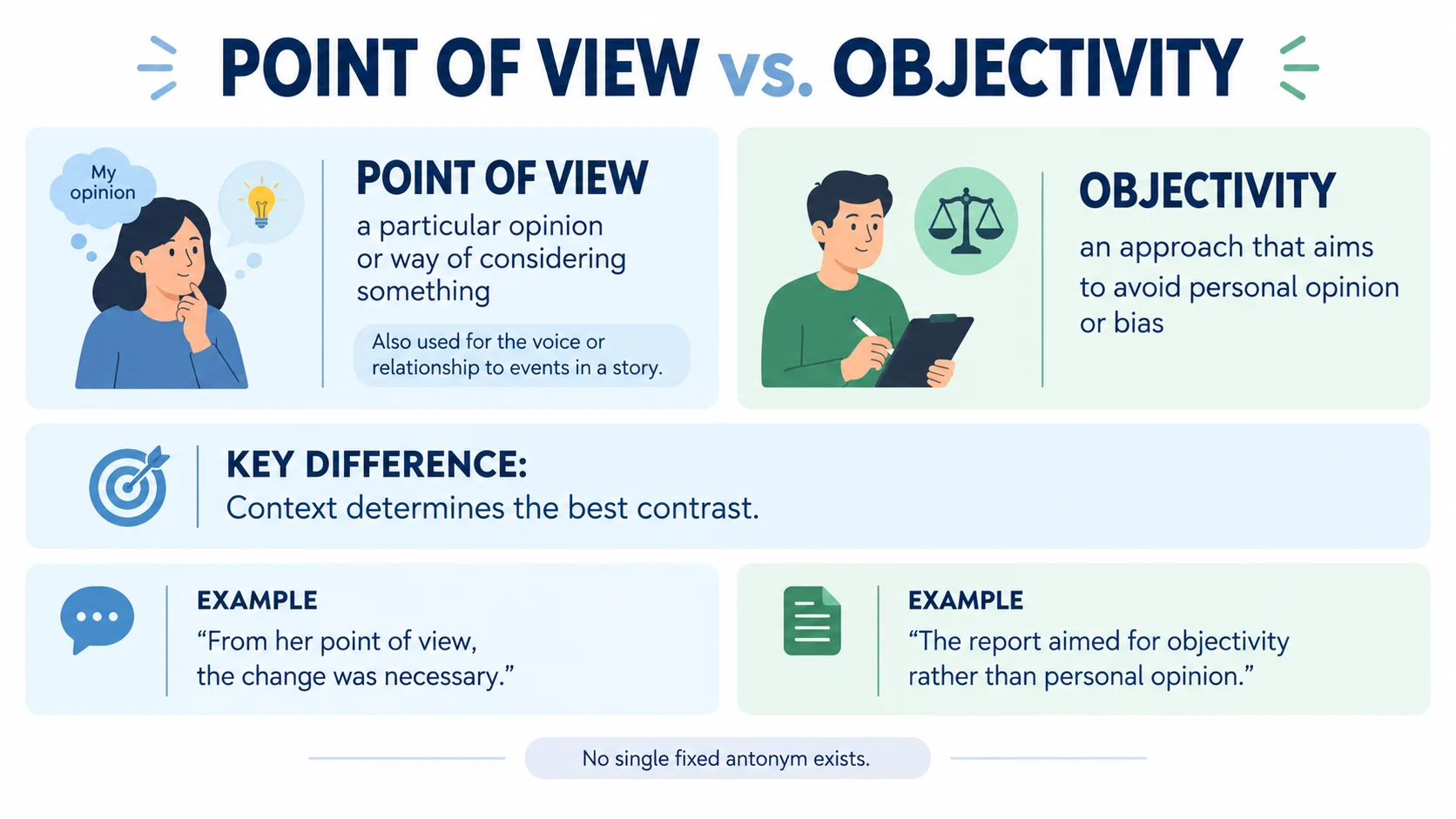
There is no single exact antonym for point of view. The phrase means a way of considering something or a person’s opinion. Depending on context, a contrasting expression may be neutral or impersonal description, especially when the focus shifts from personal perspective to detached presentation.
Part of speech: Noun phrase
Primary opposite: No single exact antonym
Point of view means a particular way of considering something, or a person’s opinion or way of thinking about an issue. Because the phrase describes a perspective rather than a quality that naturally has two opposing states, English does not have one standard word that serves as its direct opposite.
When the intended contrast is between a personal perspective and detached presentation, neutral or impersonal description can function as the strongest contextual opposite. However, that is a contextual contrast, not a dictionary-level antonym.
Direct and Strong Antonyms
There is no genuine direct antonym for point of view in its ordinary American English meanings. Dictionaries define it as a way of considering something or an opinion, and they treat terms such as perspective, viewpoint, standpoint, and outlook as related words rather than opposites.
| Antonym | Tone or Nuance | Example Sentence |
|---|---|---|
| None established | No single lexical opposite exists | “The two writers have different points of view.” |
This distinction matters because a thesaurus-style list can make words such as objectivity, fact, or neutrality look like antonyms. They may contrast with a particular use of point of view, but they do not mean the semantic opposite of the phrase.
Contextual and Subtle Opposites
Because point of view has several related uses, the best contrasting expression depends on what you mean.
| Context | Best Contextual Contrast | Why It Fits |
|---|---|---|
| Personal opinion versus detached presentation | Neutral or impersonal description | Shifts from someone’s perspective to a less personalized presentation |
| One person’s perspective versus broader consideration | Multiple perspectives | Contrasts a single viewpoint with several viewpoints, though it is not an antonym |
| Subjective interpretation versus stated information | Objective description | Can contrast personal interpretation with detached description in appropriate contexts |
| Literary character’s perspective versus broader narration | Omniscient narration | A useful literary contrast, but not a general antonym |
For example, compare these sentences:
“From my point of view, the project needs another month.”
“The report provides a neutral description of the project’s timeline.”
The second sentence does not contain an antonym for point of view. Instead, it changes the communicative approach from personal judgment to detached description.
Words That Seem Opposite But Are Not
Objectivity is one of the most common words mistaken for an antonym of point of view. Objectivity can contrast with a subjective point of view, but everyone who communicates can still have a point of view. The two concepts are therefore not simple lexical opposites.
For example:
“The editor tried to maintain objectivity while considering several points of view.”
Here, objectivity and points of view coexist in the same sentence. That would be unusual if one were the straightforward antonym of the other.
Fact is another common confusion. A fact can be presented from a particular point of view, and different people can interpret the same facts from different perspectives. Therefore, fact is not the opposite of point of view.
Subtle Tone Differences
Choosing a contextual contrast requires attention to what you want to emphasize.
Neutral description works when you want to stress that information is being presented without centering one person’s perspective:
“Instead of explaining the dispute from the manager’s point of view, the memo gives a neutral description of what happened.”
Objective description is useful when the emphasis is on minimizing personal interpretation:
“The article separates the author’s point of view from the objective description of the documented events.”
Multiple perspectives works when the contrast concerns breadth rather than neutrality:
“The first paragraph presents the customer’s point of view, while the full report considers multiple perspectives.”
Notice that multiple perspectives does not mean the opposite of point of view. It means more than one perspective.
In literary writing, the situation is different again. Point of view can refer to the voice or perspective through which a story is told. Cambridge specifically recognizes this literary meaning. In that context, a change to another narrative perspective may be more useful than searching for an antonym.
Frequently Asked Questions
What is the direct antonym of point of view?
There is no single established direct antonym for point of view. The phrase describes a way of considering something or an opinion. Depending on context, neutral description or objective description may provide a useful contrast, but neither is a strict lexical antonym.
What is the opposite of point of view in writing?
In writing, the appropriate contrast depends on the meaning. If point of view means a personal perspective, neutral or impersonal description may contrast with it. If it refers to narrative perspective, a different narrative approach may be the relevant contrast.
Is objectivity the opposite of point of view?
No. Objectivity can contrast with a subjective point of view, but it is not the direct antonym of point of view. A writer can discuss multiple points of view while still aiming for an objective presentation of those perspectives.
Practical Word Choice
- Identify the intended meaning first. Decide whether point of view means an opinion, a way of considering an issue, or a literary narrative perspective.
- Match the contrast to the context. Use neutral description, objective description, or another contextual contrast only when it accurately expresses the distinction you want to make.
Conclusion
The key fact about point of view antonyms is that the phrase has no single established direct opposite. It describes perspective, opinion, or a particular way of considering something, so its contrast depends heavily on the situation.
For precise American English, avoid forcing objectivity, fact, or multiple perspectives into the role of a direct antonym. Instead, identify the specific contrast you need and choose the expression that communicates it accurately. What sentence are you trying to write with the opposite of point of view?
