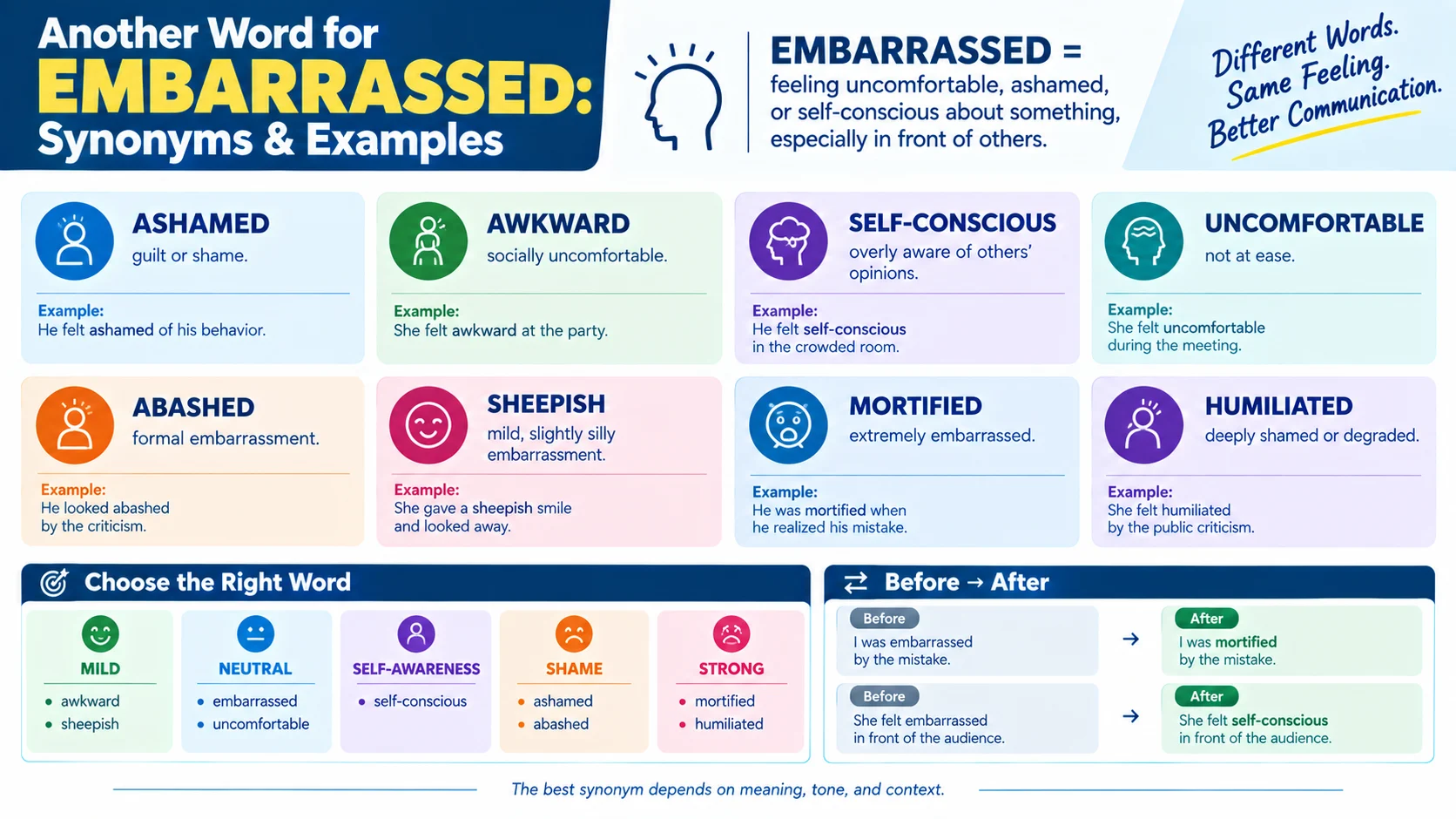
If you need another word for embarrassed, good choices include ashamed, awkward, self-conscious, uncomfortable, abashed, sheepish, mortified, humiliated, chagrined, and disconcerted. The best replacement depends on the situation. For everyday writing, awkward, uncomfortable, and self-conscious are useful; stronger situations may call for mortified or humiliated.
What Does Embarrassed Mean?
Definition
Embarrassed is an adjective describing a feeling of being shy, awkward, uncomfortable, or ashamed, especially when other people are present. It commonly describes a reaction to making a mistake, receiving unexpected attention, saying something inappropriate, or finding yourself in an uncomfortable social situation.
For example:
I felt embarrassed when I forgot my colleague’s name.
The word does not always imply serious wrongdoing. You can be embarrassed by a small social mistake, an awkward moment, excessive attention, or an uncomfortable conversation.
Common Uses
Embarrassed commonly appears in patterns such as:
- embarrassed about something
- embarrassed by something
- embarrassed at something
- embarrassed to do something
- too embarrassed to admit something
For example:
- She was embarrassed about her mistake.
- He felt embarrassed by the unexpected compliment.
- I was embarrassed to ask for help.
Oxford specifically distinguishes embarrassed from ashamed: embarrassment often comes from an awkward mistake or uncomfortable situation in front of others, while ashamed more strongly involves guilt or disapproval about something considered wrong.
Best Synonyms for Embarrassed
| Synonym | Meaning | Best Used When | Example |
|---|---|---|---|
| Ashamed | Feeling shame or guilt | You believe you did something wrong | She was ashamed of her behavior. |
| Awkward | Uncomfortable or socially difficult | A situation feels uncomfortable | I felt awkward after the mistake. |
| Self-conscious | Excessively aware of how others see you | Attention makes you uncomfortable | He felt self-conscious about speaking publicly. |
| Uncomfortable | Not physically or emotionally at ease | You want a neutral alternative | She was uncomfortable discussing the issue. |
| Abashed | Embarrassed and somewhat ashamed | Formal or literary writing | He looked abashed after being corrected. |
| Sheepish | Embarrassed in a slightly silly or guilty way | Minor mistakes or awkward moments | She gave a sheepish smile. |
| Mortified | Extremely embarrassed | The embarrassment is intense | He was mortified by the mistake. |
| Humiliated | Made to feel deeply ashamed or degraded | Someone’s dignity has been seriously affected | She felt humiliated in front of her coworkers. |
| Chagrined | Disappointed or embarrassed by your own failure | Formal writing | He was chagrined by the oversight. |
| Disconcerted | Disturbed, unsettled, or thrown off | Something makes you lose composure | She looked disconcerted by the question. |
Cambridge’s American thesaurus groups abashed, ashamed, chagrined, mortified, humiliated, self-conscious, and disconcerted among words related to embarrassed, while also identifying sheepish and awkward as related choices.
Ashamed
Meaning: Feeling shame or guilt about something you have done or something associated with you.
Best Used For: Serious mistakes, wrongdoing, or moral regret.
Tone: Stronger and more serious than embarrassed.
Difficulty: Easy
Usage Frequency: Very Common
Best For: Essays, professional writing, personal writing, everyday conversation.
Examples:
- Business: The manager was ashamed of the way the customer was treated.
- Academic: The student was ashamed of plagiarizing the assignment.
- Daily conversation: I felt ashamed after being rude to my friend.
Do not automatically replace embarrassed with ashamed. Forgetting someone’s name may be embarrassing without being something morally wrong. Oxford makes this distinction explicitly.
Awkward
Meaning: Uncomfortable, socially difficult, or lacking ease.
Best Used For: Social situations, conversations, silences, and moments that feel uncomfortable.
Tone: Neutral and conversational.
Difficulty: Easy
Usage Frequency: Very Common
Best For: Emails, conversations, blogs, business writing, and general writing.
Examples:
- Business: There was an awkward silence after the announcement.
- Academic: The interview created an awkward situation for the participants.
- Daily conversation: It was awkward when nobody knew what to say.
Cambridge notes that awkward and uncomfortable can describe situations in which someone feels rather embarrassed or anxious.
Self-Conscious
Meaning: Uncomfortably aware of yourself, your appearance, behavior, or how others perceive you.
Best Used For: Appearance, public attention, speaking, social situations, and insecurity.
Tone: Neutral.
Difficulty: Medium
Usage Frequency: Common
Best For: Essays, personal writing, professional communication, and everyday conversation.
Examples:
- Business: She felt self-conscious while presenting to senior executives.
- Academic: Participants reported feeling self-conscious during the presentation.
- Daily conversation: I always feel self-conscious when everyone looks at me.
Abashed
Meaning: Embarrassed, ashamed, or visibly uncomfortable after doing something wrong or being corrected.
Best Used For: Formal, literary, or polished writing.
Tone: Formal.
Difficulty: Advanced
Usage Frequency: Less Common
Best For: Essays, narrative writing, literary writing, and formal prose.
Example: He looked abashed after realizing that he had interrupted the speaker.
Cambridge defines abashed directly in relation to being embarrassed and gives it as a synonym associated with ashamed and embarrassed.
Sheepish
Meaning: Embarrassed in a slightly silly, guilty, or self-conscious way.
Best Used For: Small mistakes and mildly embarrassing situations.
Tone: Informal and often lighthearted.
Difficulty: Medium
Usage Frequency: Common
Best For: Conversations, stories, blogs, and casual writing.
Example: He gave me a sheepish grin after realizing he had sent the email to the wrong person.
Mortified
Meaning: Extremely embarrassed or deeply ashamed.
Best Used For: Strong emotional embarrassment.
Tone: Strong and dramatic.
Difficulty: Medium
Usage Frequency: Common
Best For: Personal writing, storytelling, conversations, and expressive prose.
Examples:
- Business: She was mortified when the presentation file failed in front of the client.
- Academic: The student was mortified after giving the wrong answer during the presentation.
- Daily conversation: I was mortified when I realized everyone had heard me.
Cambridge lists mortified among the stronger words related to embarrassed.
Humiliated
Meaning: Made to feel deeply ashamed, especially because of public criticism, failure, or loss of dignity.
Best Used For: More severe experiences than ordinary embarrassment.
Tone: Strong and serious.
Difficulty: Medium
Usage Frequency: Common
Best For: Serious personal, workplace, academic, or social situations.
Example: He felt humiliated when his manager criticized him in front of the entire team.
Humiliated should not be used for every minor awkward moment. It suggests a deeper blow to a person’s dignity.
Synonyms by Context
Formal Writing
For formal writing, consider:
- abashed
- chagrined
- disconcerted
- self-conscious
- ashamed
Example:
Basic: He was embarrassed by the criticism.
More formal: He appeared chagrined by the criticism.
Chagrined is particularly useful when the embarrassment is connected with disappointment over your own mistake or failure.
Professional Writing
In workplace communication, neutral alternatives are usually clearer than highly emotional words.
Use:
- uncomfortable
- awkward
- self-conscious
- concerned
- chagrined
Example:
Basic: The employee was embarrassed by the mistake.
Professional: The employee was uncomfortable discussing the mistake.
For business writing, avoid unnecessarily dramatic terms such as mortified or humiliated unless the situation genuinely calls for that level of intensity.
Academic Writing
Academic writing benefits from precise wording.
Useful choices include:
- self-conscious
- uncomfortable
- ashamed
- chagrined
- embarrassed
Example:
Basic: Students felt embarrassed during the presentation.
More precise: Students reported feeling self-conscious while presenting their findings.
Daily Conversation
Natural conversational alternatives include:
- awkward
- uncomfortable
- sheepish
- self-conscious
- mortified
Example:
I was so awkward after I realized I had called her by the wrong name.
Professional Alternatives for Embarrassed
If you are writing a resume, email, report, or workplace message, these alternatives can provide more precision:
Uncomfortable works when you want to sound neutral.
I felt uncomfortable discussing the issue in front of the entire team.
Self-conscious works when the attention is focused on you.
She became self-conscious while presenting the results.
Chagrined works in formal prose when you regret a mistake.
The director was chagrined by the oversight.
Concerned can work when the main issue is worry rather than embarrassment.
He was concerned about how the error would affect the client.
The last example is not a direct synonym in every context. It is a context-based replacement when embarrassed actually means worried about the consequences.
Simple Alternatives for Embarrassed
For everyday English, these are easy replacements:
- awkward
- uncomfortable
- ashamed
- shy
- self-conscious
- sheepish
For example:
Original: I felt embarrassed when everyone looked at me.
Simple: I felt self-conscious when everyone looked at me.
Original: She was embarrassed after making the mistake.
Simple: She felt awkward after making the mistake.
Stronger Alternatives for Embarrassed
When ordinary embarrassment is not strong enough, consider:
Mortified
Use this for very intense embarrassment.
I was mortified when my mistake appeared on the presentation screen.
Humiliated
Use this when the situation involves serious public shame or loss of dignity.
He felt humiliated after being criticized publicly.
Deeply ashamed
Use this when embarrassment is mixed with significant guilt or moral shame.
She was deeply ashamed of what she had done.
These words carry stronger meanings than ordinary embarrassed. Cambridge includes mortified and humiliated among related terms but distinguishes them within the broader group of shame-related vocabulary.
Difference Between Similar Synonyms
Embarrassed vs. Ashamed
Embarrassed usually describes social discomfort, awkwardness, or self-consciousness.
Ashamed more strongly suggests guilt or a belief that something was wrong.
I was embarrassed when I forgot her name.
I was ashamed of the way I treated her.
Embarrassed vs. Awkward
Embarrassed primarily describes a person’s feeling.
Awkward can describe both a person’s experience and the situation itself.
I felt embarrassed.
The conversation became awkward.
Embarrassed vs. Self-Conscious
Self-conscious focuses on being overly aware of how others see you.
She felt self-conscious about her appearance.
Embarrassed is broader and can result from a mistake, unexpected attention, or an uncomfortable event.
Embarrassed vs. Mortified
Mortified means extremely embarrassed.
I was embarrassed by the mistake.
I was mortified when the mistake was announced publicly.
Embarrassed vs. Humiliated
Humiliated generally implies a more serious loss of dignity or public shame.
He was embarrassed by the typo.
He felt humiliated when his supervisor mocked him in front of the team.
Opposite Words
Depending on context, opposites of embarrassed include:
- confident
- comfortable
- self-assured
- relaxed
- poised
- unashamed
- unabashed
- proud
The exact opposite depends on the meaning. For example, confident contrasts with being self-conscious, while unashamed contrasts more directly with feeling shame. Cambridge lists confident, poised, proud, and unashamed among antonym-related terms for embarrassed and its related senses.
FAQs
What is another word for embarrassed?
Common alternatives include ashamed, awkward, self-conscious, uncomfortable, abashed, sheepish, mortified, and humiliated. The best word depends on the intensity and cause of the embarrassment.
What is a formal synonym for embarrassed?
Abashed, chagrined, and disconcerted can work in formal writing. Chagrined is especially useful when someone is embarrassed or disappointed because of a mistake.
What is a professional alternative for embarrassed?
In professional writing, uncomfortable, self-conscious, awkward, or chagrined may be more precise depending on the context.
What word can replace embarrassed?
For ordinary situations, awkward, uncomfortable, or self-conscious are natural replacements. For stronger embarrassment, use mortified or humiliated.
Is ashamed the same as embarrassed?
No. The words overlap, but they are not identical. Embarrassed often refers to social awkwardness or discomfort, while ashamed generally carries a stronger sense of guilt or disapproval about something wrong or foolish.
What is a stronger word for embarrassed?
Mortified is a common stronger alternative. Humiliated can also be stronger when the situation involves a serious loss of dignity.
What is a casual word for embarrassed?
Awkward and sheepish are natural casual choices. Sheepish often suggests a mild, slightly amusing embarrassment.
Conclusion
The best synonym for embarrassed depends on exactly what you want to communicate. Use awkward for an uncomfortable situation, self-conscious when someone is overly aware of others’ opinions, ashamed when guilt or wrongdoing is involved, sheepish for mild embarrassment, abashed for formal prose, mortified for intense embarrassment, and humiliated when someone’s dignity has been seriously affected.
Choosing the precise synonym makes your writing more natural and communicates the emotional intensity more accurately. Dictionaries and thesauruses agree that these words overlap, but their shades of meaning differ significantly.
