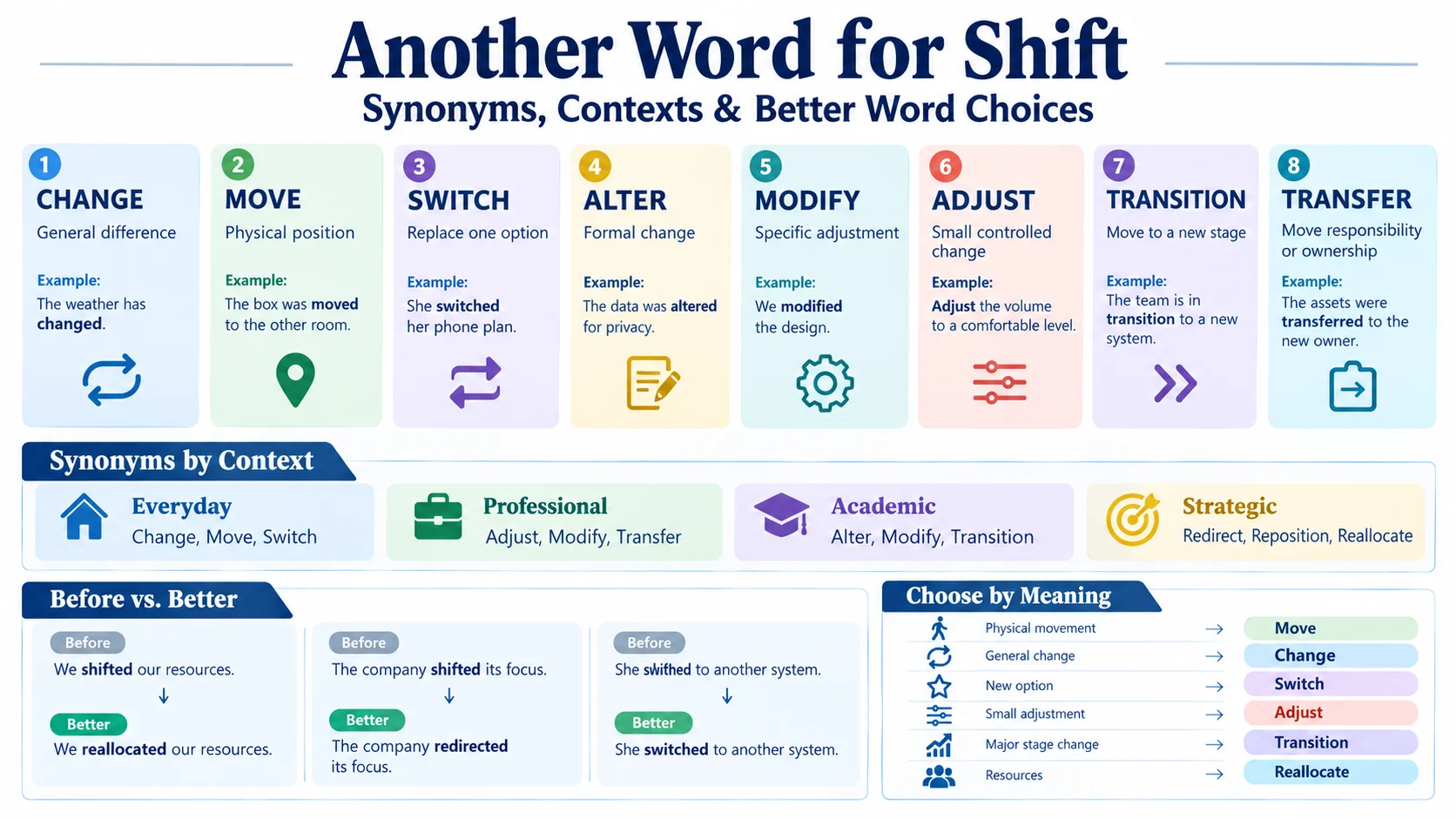
Another word for shift depends on the context. Common alternatives include change, move, switch, alter, transfer, transition, adjust, vary, relocate, and modify. For professional writing, transition, adjust, modify, or transfer may be more precise, while change and move are simple everyday alternatives.
What Does Shift Mean?
Definition
The word shift has several meanings because it can function as both a verb and a noun.
As a verb, shift commonly means to move something, change its position, alter a situation, or move from one idea, activity, or condition to another.
For example:
The company decided to shift its marketing strategy.
Here, shift means change or adjust.
As a noun, shift can refer to a change, movement, transfer, or a scheduled period of work.
She works the night shift.
In this sentence, shift means a scheduled period of work.
Common Uses
The best synonym depends heavily on what shift means in a particular sentence.
| Meaning of “shift” | Useful alternatives |
|---|---|
| Change something | change, alter, modify, adjust |
| Move position | move, relocate, reposition |
| Change direction | turn, redirect, switch |
| Change responsibility | transfer, hand over, reassign |
| Move from one condition to another | transition, transform, evolve |
| Change attention | redirect, switch, refocus |
| Work period | duty, work period, rotation |
| Change in opinion or policy | change, transition, adjustment |
This is why simply replacing shift with one synonym can sometimes make a sentence less precise.
Best Synonyms for Shift
The following alternatives cover the most common meanings of shift.
| Synonym | Meaning | Best Used When | Example |
|---|---|---|---|
| Change | Make or become different | General situations | The company changed its strategy. |
| Move | Change physical position | Physical movement | Move the chair closer to the desk. |
| Switch | Change from one option to another | Choices, systems, or activities | We switched to a different provider. |
| Alter | Make a partial change | Formal writing | The researchers altered the procedure. |
| Modify | Make a specific adjustment | Technical or professional contexts | The team modified the design. |
| Adjust | Make a small or careful change | Settings, plans, methods | We adjusted the schedule. |
| Transition | Move from one state or stage to another | Professional or formal writing | The business transitioned to digital operations. |
| Transfer | Move responsibility, ownership, or something from one place/person to another | Business and administrative contexts | The manager transferred the account. |
| Relocate | Move to a different place | People, offices, companies, or objects | The company relocated its headquarters. |
| Reposition | Change the position or strategic placement | Marketing, business, and physical contexts | The brand repositioned itself for younger customers. |
Change
Meaning: To make something different or become different.
Best used for: General-purpose writing.
Tone: Neutral.
Difficulty: Easy.
Usage Frequency: Very Common.
Best for: Resume writing, email writing, essays, business writing, and everyday conversation.
Business example:
The company changed its pricing strategy after reviewing customer feedback.
Academic example:
The researchers changed the experimental conditions to test the hypothesis.
Daily conversation:
I need to change my plans for tonight.
Why choose it: Change is the safest broad alternative when shift simply means becoming different.
Move
Meaning: To change physical location or position.
Best used for: Physical movement.
Tone: Neutral and conversational.
Difficulty: Easy.
Usage Frequency: Very Common.
Business example:
The company moved its operations to a larger facility.
Academic example:
The sample was moved to a controlled environment.
Daily conversation:
Can you move your car?
Why choose it: Use move when the idea involves physical position rather than an abstract change.
Switch
Meaning: To change from one person, thing, option, method, or activity to another.
Best used for: Choices, technologies, providers, tasks, and preferences.
Tone: Neutral and moderately conversational.
Difficulty: Easy.
Usage Frequency: Very Common.
Business example:
The organization switched to a cloud-based system.
Academic example:
Participants switched between the two experimental conditions.
Daily conversation:
I switched to a different phone plan.
Why choose it: Switch usually suggests replacing one option with another.
Alter
Meaning: To make a change to something without necessarily replacing it completely.
Best used for: Formal and academic writing.
Tone: Formal.
Difficulty: Medium.
Usage Frequency: Common.
Business example:
The company altered its recruitment process.
Academic example:
The researchers altered the methodology to improve reliability.
Daily conversation:
We had to alter our plans because of the weather.
Why choose it: Alter is useful when you want a more formal alternative to change.
Modify
Meaning: To make specific changes to improve, adapt, or suit something.
Best used for: Technical, academic, business, and professional writing.
Tone: Formal and precise.
Difficulty: Medium.
Usage Frequency: Common.
Business example:
The team modified the product based on customer feedback.
Academic example:
The researchers modified the questionnaire before collecting data.
Daily conversation:
I modified the recipe slightly.
Why choose it: Modify often implies a deliberate adjustment rather than a complete transformation.
Synonyms by Context
Formal Writing
For formal writing, avoid automatically using the most obvious synonym. Choose a word that communicates the exact type of change.
Good options include:
alter, modify, transition, adjust, transfer, reposition, redirect, and transform.
Example:
The organization shifted its focus toward sustainability.
Possible formal alternatives:
The organization redirected its focus toward sustainability.
The organization transitioned toward a more sustainable operating model.
The second version describes a broader movement from one state to another, while redirected emphasizes a change in direction.
Professional Writing
In business writing, useful alternatives include:
adjust, modify, transition, transfer, redirect, reposition, and switch.
For example:
We shifted our resources toward customer retention.
A more precise professional version could be:
We reallocated our resources toward customer retention.
Here, reallocated is more specific because the sentence concerns the distribution of resources.
Academic Writing
Academic writing benefits from precision.
Depending on the meaning, consider:
alter, modify, transition, vary, adjust, change, or redirect.
Instead of:
The study shifted its focus.
You could write:
The study redirected its focus toward environmental factors.
This makes the nature of the change clearer.
Daily Conversation
Simple alternatives are usually best:
change, move, switch, adjust, and turn.
For example:
Can you shift your chair?
Natural alternatives include:
Can you move your chair?
or:
Can you adjust your chair?
The best choice depends on whether you mean changing its location or making a small positional adjustment.
Professional Alternatives for Shift
If you are replacing shift in a resume, report, email, or business document, consider the exact meaning:
- Transition for moving to a new stage or system
- Reallocate for moving resources
- Transfer for moving responsibility or ownership
- Redirect for changing focus or direction
- Reposition for changing strategic placement
- Adjust for making a controlled change
- Modify for making specific improvements
- Transform for a substantial change
For example:
Shifted company resources toward high-performing channels.
A more specific resume phrase is:
Reallocated company resources toward high-performing channels.
Precision can make professional writing stronger because the reader immediately understands what action took place.
Simple Alternatives for Shift
If you want an easy word that most readers will understand, use:
change, move, switch, adjust, or turn.
Examples:
- Shift the meeting → Change the meeting
- Shift the chair → Move the chair
- Shift to another plan → Switch to another plan
- Shift the settings → Adjust the settings
- Shift direction → Turn or change direction
Stronger Alternatives for Shift
Sometimes shift is too general. A stronger alternative can communicate exactly what happened.
- Transform = make a major change
- Revolutionize = introduce a dramatic or fundamental change
- Redirect = deliberately change direction or focus
- Reposition = deliberately establish a new position
- Reallocate = distribute resources differently
- Transfer = move something to another person, place, or system
- Relocate = move to another physical location
Choose these only when their stronger or more specific meaning is accurate.
Difference Between Similar Synonyms
Shift vs. Change
Change is broader. Almost any difference can be described as a change.
Shift often suggests movement from one position, condition, focus, or direction to another.
Public opinion changed.
Public opinion shifted toward the new proposal.
The second sentence emphasizes movement in a particular direction.
Shift vs. Switch
Switch usually involves replacing one option with another.
She switched to a different software program.
Shift can describe a gradual or strategic change.
The company shifted its focus toward international markets.
Shift vs. Adjust
Adjust generally implies a relatively small, controlled change.
We adjusted the temperature.
Shift can describe a broader movement.
The company shifted its long-term strategy.
Shift vs. Transition
Transition emphasizes movement from one stage, condition, or system to another.
The organization transitioned to remote operations.
Shift can express the same general idea but is usually broader and less specific.
Shift vs. Move
Move is particularly useful for physical movement.
Move the table.
Shift can also describe physical movement, but it often implies a smaller repositioning.
Shift the table slightly to the left.
Opposite Words
The appropriate opposite of shift depends on its meaning.
Possible opposites include:
- Stay
- Remain
- Maintain
- Keep
- Stabilize
- Preserve
- Retain
- Hold
For example:
The company shifted its strategy.
A contextual opposite might be:
The company maintained its existing strategy.
For physical movement:
Shift the chair.
The opposite could be:
Keep the chair in place.
FAQs
What is another word for shift?
Common alternatives for shift include change, move, switch, alter, modify, adjust, transition, transfer, and redirect. The correct choice depends on whether shift refers to movement, change, direction, responsibility, strategy, or a work period.
What is a formal synonym for shift?
Formal alternatives include alter, modify, transition, adjust, redirect, transfer, reallocate, and reposition. The best option depends on the specific meaning of the sentence.
What is a professional alternative for shift?
Professional alternatives include transition, adjust, modify, transfer, redirect, reposition, and reallocate. For example, “shift resources” can often become “reallocate resources.”
What word can replace shift in an essay?
In an essay, possible replacements include change, alter, modify, transition, redirect, and transform. Choose based on whether you are describing a minor adjustment, a change in direction, or a major transformation.
What is another word for shift in a resume?
Resume-friendly alternatives include transitioned, redirected, reallocated, transferred, modified, adjusted, and repositioned. Use the most specific verb that accurately describes your accomplishment.
What is another word for a work shift?
Depending on the context, alternatives include work period, duty period, rotation, tour, or schedule. However, shift is often the most natural term in American English.
What is another word for shift in direction?
Useful alternatives include redirect, turn, change course, alter direction, and change trajectory.
Conclusion
The best synonym for shift depends on what kind of change or movement you mean. Change is the broadest everyday alternative, while move works well for physical position and switch suggests replacing one option with another. In professional and academic writing, modify, adjust, transition, redirect, transfer, and reallocate can provide greater precision.
Rather than replacing shift automatically, identify the exact action first. The most effective synonym is the one that preserves the original meaning while making the sentence clearer and more natural.
