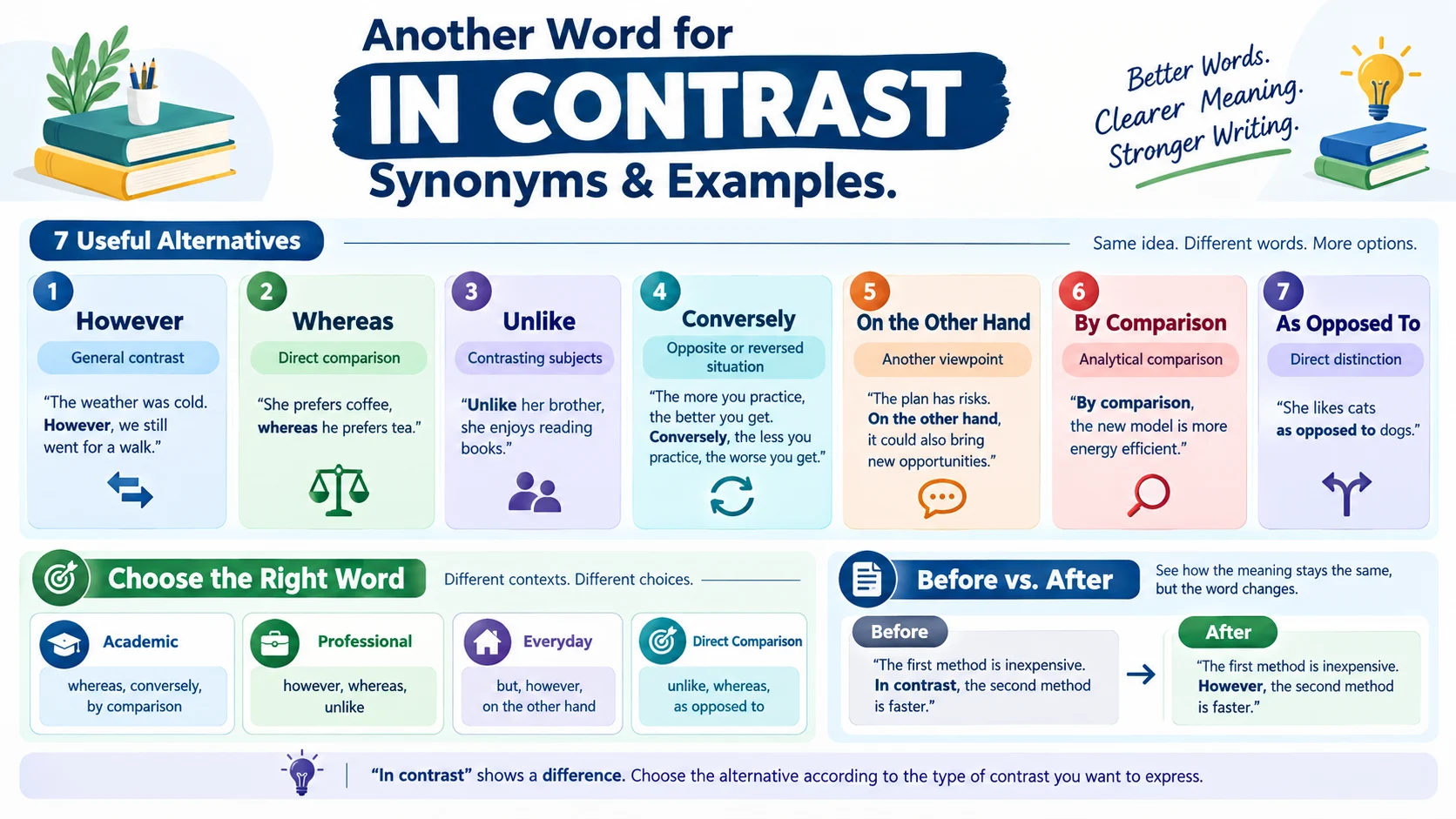
If you need another word for “in contrast,” useful alternatives include however, whereas, unlike, conversely, on the other hand, by comparison, in comparison, alternatively, and in opposition. The best choice depends on whether you are contrasting two ideas, people, situations, results, or viewpoints. For formal and academic writing, whereas, conversely, and by comparison are especially useful.
What Does “In Contrast” Mean?
Definition
In contrast is a phrase used to show a difference between two people, things, ideas, situations, or results. It tells the reader that the second point differs from or is opposite to the first point.
Example:
The first proposal focuses on reducing costs. In contrast, the second proposal emphasizes improving quality.
Here, “in contrast” signals that the two proposals have different priorities.
The phrase can appear at the beginning of a sentence, between clauses, or in the expression “in contrast to” or “in contrast with.”
Common Uses
“In contrast” is common in:
- Academic essays
- Business reports
- Research papers
- Comparisons
- Analytical writing
- News and informational writing
- Professional communication
- Everyday conversation
The phrase is particularly useful when you want to make a difference clear without necessarily saying that one option is better than the other.
Best Synonyms for “In Contrast”
The following alternatives are not all exact replacements. Some introduce a contrasting clause, while others compare two subjects directly.
| Synonym / Alternative | Meaning | Best Used When | Example |
|---|---|---|---|
| However | Introduces a contrasting point | General and formal writing | The plan is expensive. However, it may be effective. |
| Whereas | Shows a direct difference between two clauses | Academic and formal comparisons | Sarah prefers working alone, whereas Mark enjoys teamwork. |
| Unlike | Shows that one person or thing differs from another | Direct comparisons | Unlike the previous model, this version uses less energy. |
| Conversely | Introduces an opposite or reversed situation | Formal and analytical writing | Higher demand increased prices. Conversely, lower demand reduced them. |
| On the other hand | Presents a different side or viewpoint | General and professional writing | The job offers flexibility. On the other hand, the salary is lower. |
| By comparison | Highlights a difference through comparison | Academic and analytical writing | The new system is faster. By comparison, the old system was inefficient. |
| In comparison | Shows how something differs when compared with another thing | Formal and academic writing | In comparison, the second method requires fewer resources. |
| In opposition | Indicates direct disagreement or opposition | Stronger contrasts | The two groups stood in opposition to each other. |
| As opposed to | Directly distinguishes one option from another | Business and everyday writing | We chose digital advertising as opposed to print advertising. |
| While | Introduces a contrasting clause | Flexible general writing | While the first option is cheaper, the second is more durable. |
1. However
Meaning: Introduces a statement that contrasts with something previously mentioned.
Tone: Neutral to formal
Difficulty: Easy
Usage Frequency: Very Common
Best for: Essays, emails, reports, business writing, and general communication.
Business example:
The campaign generated significant traffic. However, sales remained unchanged.
Academic example:
The study produced promising results. However, additional research is necessary.
Daily conversation:
I wanted to go. However, I was too tired.
“However” is one of the most flexible alternatives to “in contrast,” although it can express a broader type of contradiction rather than a direct comparison.
2. Whereas
Meaning: Shows a clear difference between two clauses or subjects.
Tone: Formal
Difficulty: Medium
Usage Frequency: Common
Best for: Academic writing, essays, reports, and professional comparisons.
Business example:
The first department prioritizes growth, whereas the second focuses on efficiency.
Academic example:
Urban populations increased, whereas rural populations declined.
Daily conversation:
I like coffee, whereas my brother prefers tea.
“Whereas” is especially useful when you want to compare two things within the same sentence.
3. Unlike
Meaning: Shows that one person or thing differs from another.
Tone: Neutral
Difficulty: Easy
Usage Frequency: Very Common
Best for: Everyday language, essays, descriptions, and professional writing.
Business example:
Unlike traditional advertising, digital campaigns can be measured in real time.
Academic example:
Unlike mammals, most reptiles are ectothermic.
Daily conversation:
Unlike my old phone, this one has a much better camera.
Unlike “however,” this word normally connects a subject directly to something it differs from.
4. Conversely
Meaning: Indicates an opposite or reversed relationship.
Tone: Formal
Difficulty: Advanced
Usage Frequency: Common
Best for: Academic writing, research, reports, and analytical content.
Business example:
Customer demand increased during the summer. Conversely, demand declined during the winter.
Academic example:
Some variables had a positive relationship. Conversely, others were negatively correlated.
Use “conversely” when the second point is not merely different but represents an opposing or reversed condition.
5. On the Other Hand
Meaning: Introduces another side, consideration, or viewpoint.
Tone: Neutral
Difficulty: Easy
Usage Frequency: Very Common
Best for: Essays, conversations, business writing, and balanced discussions.
Business example:
The software is expensive. On the other hand, it offers advanced features.
Academic example:
The approach saves time. On the other hand, it may reduce accuracy.
Daily conversation:
The restaurant is far away. On the other hand, the food is excellent.
This phrase is particularly useful when presenting two sides of an issue.
Synonyms by Context
Formal Writing
For formal writing, consider:
- However
- Whereas
- Conversely
- By comparison
- In comparison
- In opposition
- As opposed to
Example:
The first method requires substantial preparation. Conversely, the second method can be implemented with minimal preparation.
Professional Writing
In business emails, reports, presentations, and workplace documents, these options work naturally:
- However
- Whereas
- Unlike
- On the other hand
- By comparison
- As opposed to
Example:
The first supplier offers lower prices. By comparison, the second supplier provides faster delivery.
Academic Writing
Academic writing often benefits from precise contrast words:
- Whereas
- Conversely
- However
- In comparison
- By comparison
- Unlike
Example:
Group A showed consistent improvement, whereas Group B showed little change during the study period.
Daily Conversation
For casual communication, simpler expressions are usually more natural:
- But
- However
- Unlike
- On the other hand
- While
Example:
I like the design, but the price is too high.
Although “but” can replace “in contrast” in many informal situations, it does not always create the same emphasis on comparison.
Professional Alternatives for “In Contrast”
If you are writing a resume, cover letter, report, proposal, or business document, choose an alternative based on the relationship you want to express.
For a direct comparison:
Use whereas, unlike, or as opposed to.
For an opposing result:
Use however or conversely.
For presenting another consideration:
Use on the other hand.
For analytical comparison:
Use by comparison or in comparison.
For example:
Original: In contrast, the new process requires less manual work.
Professional: By comparison, the new process requires less manual work.
Or:
Original: In contrast to the previous system, the new system is more flexible.
Professional: Unlike the previous system, the new system is more flexible.
Simple Alternatives for “In Contrast”
When writing for a general audience, use straightforward alternatives such as:
- But
- However
- Unlike
- While
- On the other hand
Example:
The first apartment is affordable. However, it is far from downtown.
These choices are easy to understand and work well in everyday communication.
Stronger Alternatives for “In Contrast”
When you need to emphasize a significant or direct difference, consider:
- Conversely
- In opposition
- As opposed to
- Unlike
- Whereas
Example:
The first strategy increased short-term revenue. Conversely, the second strategy reduced short-term revenue while focusing on long-term growth.
Be careful with stronger alternatives. A word such as “in opposition” can suggest a more direct conflict than simply saying “in contrast.”
Difference Between Similar Synonyms
“In Contrast” vs. “However”
In contrast emphasizes a difference between two things.
However generally introduces a contrasting or unexpected statement.
The two products are similar. In contrast, their prices are very different.
The product is expensive. However, customers continue to buy it.
“In Contrast” vs. “Whereas”
“In contrast” can function as a transition between ideas, while “whereas” usually connects two clauses.
The first method is inexpensive. In contrast, the second is costly.
The first method is inexpensive, whereas the second is costly.
“In Contrast” vs. “Unlike”
“Unlike” is normally followed by a noun or noun phrase.
Unlike the old system, the new system is automated.
“In contrast” can work more independently:
The old system is manual. In contrast, the new system is automated.
“In Contrast” vs. “Conversely”
“Conversely” is more specific. It often indicates that the second situation is the reverse of the first.
Prices increased as demand rose. Conversely, prices fell when demand declined.
If the ideas are simply different rather than reversed, “in contrast” may be more appropriate.
Opposite Words
Because “in contrast” expresses difference, possible contrasting concepts include words and phrases associated with similarity, agreement, and consistency.
Common related opposites include:
- Similarly
- Likewise
- In the same way
- Correspondingly
- Equally
- Consistently
- In agreement
Example:
The first study found a significant improvement. Similarly, the second study reported positive results.
Here, “similarly” signals a relationship of similarity rather than contrast.
FAQs
What is another word for “in contrast”?
Common alternatives include however, whereas, unlike, conversely, on the other hand, by comparison, in comparison, and as opposed to. The best choice depends on whether you are contrasting ideas, subjects, results, or viewpoints.
What is a formal synonym for “in contrast”?
Whereas, conversely, by comparison, in comparison, and in opposition can work well in formal writing. “Conversely” is particularly useful when the second point represents an opposite or reversed situation.
What is a professional alternative for “in contrast”?
For professional writing, however, whereas, unlike, by comparison, and on the other hand are useful alternatives. Choose the expression based on the exact relationship between the two ideas.
What word can replace “in contrast”?
The simplest replacements are however, unlike, whereas, and but. For a more formal alternative, use conversely or by comparison when appropriate.
What is another way to say “in contrast to”?
You can use unlike, as opposed to, compared with, in comparison with, or in opposition to, depending on the intended meaning.
Is “however” the same as “in contrast”?
Not always. “However” introduces a contrasting statement, while “in contrast” more directly emphasizes a difference between two subjects, ideas, or situations.
Is “conversely” a synonym for “in contrast”?
“Conversely” can serve a similar function, but it is more specific. It usually indicates an opposite or reversed relationship rather than any simple difference.
Conclusion
The best alternative to “in contrast” depends on what kind of difference you want to communicate. Use whereas for a direct comparison, unlike when contrasting subjects, however for a general contrasting point, conversely for an opposite or reversed situation, and on the other hand when presenting another side of an issue.
For academic and professional writing, precision matters more than simply choosing a word that looks like a synonym. Understanding the relationship between the two ideas will help you select the most natural and accurate alternative.
