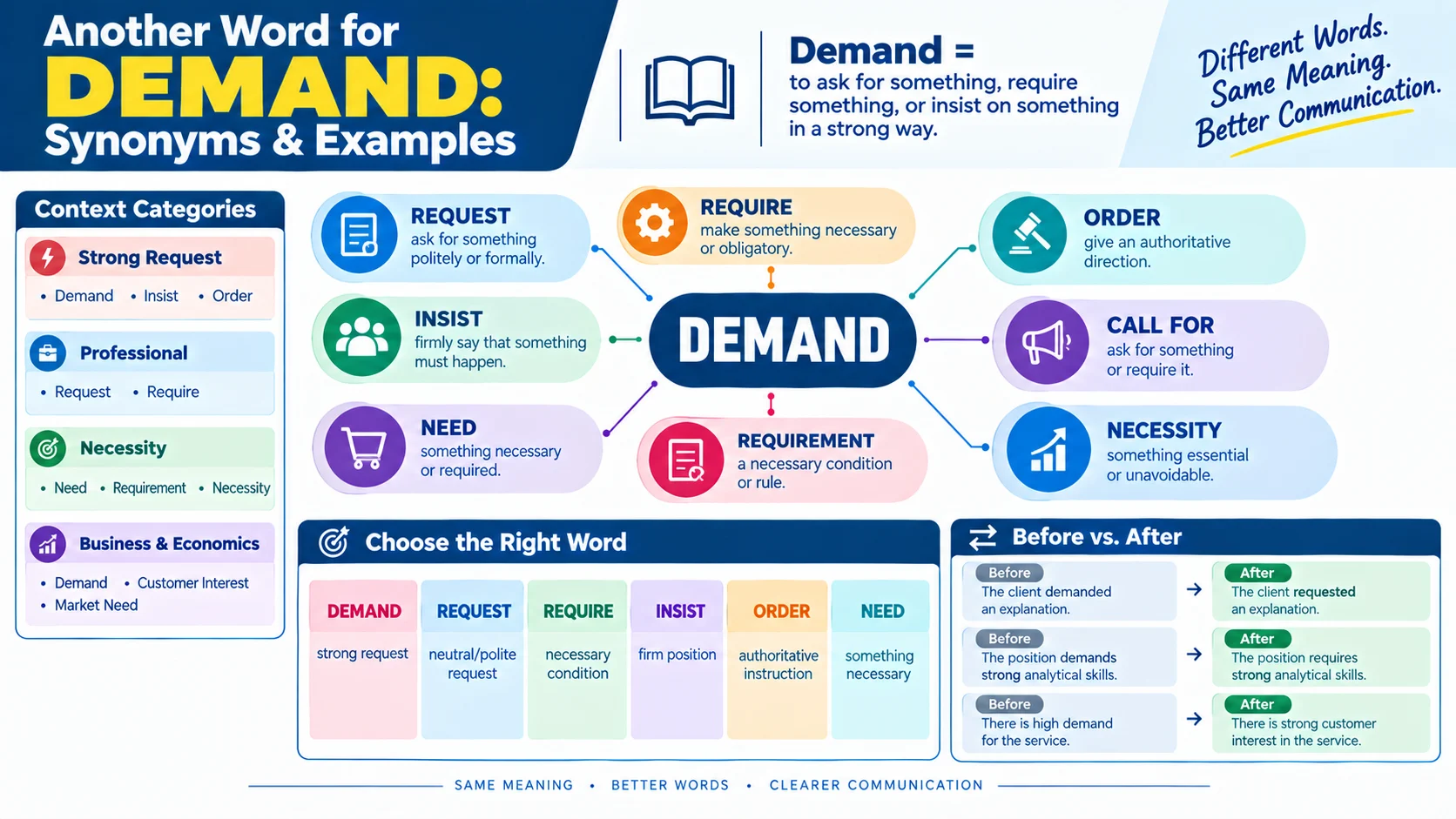
Another word for demand depends on the context. For a strong request, use request, insist, require, order, or call for. For a need, use requirement, necessity, or need. In business and economics, demand can mean customer interest or the desire for goods and services.
What Does Demand Mean?
Definition
Demand can function as both a noun and a verb. As a noun, it commonly means a strong request, a need or requirement, or the amount of interest customers have in goods or services. As a verb, it means to ask for something forcefully or to require something because it is necessary.
For example:
- Strong request: The employee made a demand for better working conditions.
- Need: The project places significant demands on the team.
- Consumer interest: Demand for electric vehicles has increased.
- Forceful request as a verb: The customer demanded an explanation.
- Requirement as a verb: The assignment demands careful research.
Because demand has several meanings, the best synonym depends on what you are trying to communicate.
Common Uses
The word demand is especially common in four situations:
- Asking forcefully: “The customer demanded a refund.”
- Describing a requirement: “The position demands strong communication skills.”
- Describing consumer interest: “There is strong demand for affordable housing.”
- Describing difficult obligations: “The demands of the job can be substantial.”
Best Synonyms for Demand
| Synonym | Meaning | Best Used When | Example |
|---|---|---|---|
| Request | An act of asking for something | You want a more polite or neutral alternative | She submitted a request for additional information. |
| Require | To need something or make it necessary | Describing a condition, rule, or necessity | The position requires strong writing skills. |
| Insist | To state firmly that something should happen | Emphasizing determination | She insisted on receiving a written response. |
| Order | To tell someone to do something | Giving a direct instruction | The manager ordered the team to stop the work. |
| Requirement | Something that is necessary | Formal, professional, or academic writing | A degree is a basic requirement for the position. |
| Need | Something necessary or wanted | Simple, natural communication | The project has a need for additional funding. |
| Call for | To require, request, or publicly advocate for something | Reports, formal statements, and professional writing | The situation calls for immediate action. |
| Necessity | Something essential or unavoidable | Formal writing | Additional training is a necessity for the role. |
No single synonym replaces demand in every sentence. For example, request is generally less forceful than demand, while order can suggest authority. Require emphasizes necessity rather than force.
Synonyms by Context
Formal Writing
For formal writing, useful alternatives include:
- require
- requirement
- necessity
- insist
- call for
- request
Example:
Original:
“The organization demanded immediate action.”
More formal alternatives:
- “The organization called for immediate action.”
- “The organization requested immediate action.”
- “The circumstances required immediate action.”
Choose required when something is necessary, requested when the tone should be neutral, and called for when describing a need for action.
Professional Writing
In business communication, demand can sometimes sound confrontational. Depending on the situation, request, require, expect, or need may create a more appropriate tone.
Business example:
Instead of:
“We demand a response by Friday.”
You might write:
“We request a response by Friday.”
If the deadline is mandatory:
“A response is required by Friday.”
This distinction matters because demand communicates a strong expectation, whereas request is generally more neutral.
Academic Writing
Academic writing often benefits from precise alternatives such as require, necessitate, necessity, need, and call for.
Academic example:
Original:
“The problem demands further investigation.”
Possible alternatives:
“The problem requires further investigation.”
“The findings necessitate further investigation.”
“The results call for further investigation.”
Requires is usually the clearest choice when explaining that additional work is necessary.
Daily Conversation
For everyday English, the simplest alternatives are usually:
- ask for
- request
- need
- want
- insist
- require
For example:
“She demanded an explanation.”
can become:
“She asked for an explanation.”
The meaning changes slightly. Demanded suggests a forceful request, while asked for sounds much more neutral. Cambridge identifies ask for and request among related alternatives to demand.
Professional Alternatives for Demand
If you are writing an email, report, proposal, resume, or business document, consider these alternatives:
Request
Meaning: To ask for something.
Best used for: Emails, customer service, workplace communication.
Tone: Professional and neutral.
Difficulty: Easy
Usage frequency: Very Common
Best for: Resume, email writing, business writing.
Example:
“We request additional documentation before proceeding.”
Require
Meaning: To need something or make something necessary.
Best used for: Policies, procedures, qualifications, and formal explanations.
Tone: Professional and precise.
Difficulty: Easy
Usage frequency: Very Common
Best for: Resume, academic writing, business writing.
Example:
“The position requires advanced analytical skills.”
Insist
Meaning: To state firmly that something should happen.
Best used for: Situations where firmness is important.
Tone: Strong and assertive.
Difficulty: Easy
Usage frequency: Common
Best for: Business writing, essays, narrative writing.
Example:
“The client insisted on reviewing the final version.”
Call For
Meaning: To require or strongly indicate that something is needed.
Best used for: Reports, recommendations, professional communication, and formal commentary.
Tone: Formal and measured.
Difficulty: Medium
Usage frequency: Common
Best for: Academic writing, business writing, reports.
Example:
“The findings call for a broader review of the process.”
Simple Alternatives for Demand
If your goal is clearer and easier English, use:
ask for, need, want, require, request, or insist.
The best choice depends on the meaning.
- Demand → strong request
- Ask for → ordinary request
- Request → polite or formal request
- Need → something necessary
- Require → something necessary or officially expected
- Insist → firm determination
For students and general readers, ask for, need, and require are often easier alternatives than more formal vocabulary.
Stronger Alternatives for Demand
When you want to preserve or increase the force of demand, consider:
- insist
- order
- command
- require
- press for
- call for
However, these words are not interchangeable in every situation.
Order normally implies authority.
Command is even more strongly associated with authority.
Insist emphasizes determination.
Require emphasizes necessity.
Call for often describes a need for action rather than a direct personal command.
Cambridge lists exact, order, require, and insist upon among related alternatives for the verb demand.
Difference Between Similar Synonyms
Demand vs. Request
Demand is forceful and suggests that refusal is not expected.
Request is more neutral or polite.
- “The customer demanded a refund.”
- “The customer requested a refund.”
Use request when you want a professional or diplomatic tone.
Demand vs. Require
Demand can describe a forceful request. Require focuses on necessity, rules, conditions, or standards.
- “The customer demanded an explanation.”
- “The position requires five years of experience.”
Oxford specifically distinguishes require as a word often used when something is necessary because of a rule, standard, or other condition.
Demand vs. Insist
Both can communicate firmness.
- Demand: strongly ask for something.
- Insist: firmly maintain that something should happen or be accepted.
Example:
“She demanded an apology.”
“She insisted on an apology.”
The difference is subtle, but demand often places more emphasis on the forcefulness of the request.
Demand vs. Need
Need is much broader and usually less forceful.
- “The company needs more staff.”
- “The company demanded more staff.”
The first describes a requirement. The second suggests a strong request or insistence.
Demand vs. Requirement
A demand can be a request someone makes. A requirement is something necessary for a particular purpose.
- “The customer made several demands.”
- “A college degree is a job requirement.”
Demand in Business and Economics
In business and economics, demand has a specialized meaning. It can refer to the amount of goods or services that customers want to buy or use. Expressions such as consumer demand, market demand, rising demand, and declining demand are common.
In this context, replacing demand with request would usually be incorrect.
For example:
“There is strong demand for affordable housing.”
Here, suitable related terms might include consumer interest, market need, or customer demand, depending on the intended meaning.
This is an important distinction for business writers because demand does not always mean that someone is making a forceful request.
Opposite Words
Possible opposites of demand depend on its meaning.
When demand means a forceful request, contrasting concepts include:
- offer
- give
- grant
- yield
- decline
When demand refers to consumer interest, possible contrasting concepts include:
- lack of interest
- low demand
- limited demand
- surplus
These are contextual opposites rather than perfect dictionary antonyms.
Real-World Examples
Business Example
Original:
“The company is experiencing high demand for its new service.”
Alternative:
“The company is experiencing strong customer interest in its new service.”
Here, demand refers to market interest rather than a forceful request.
Academic Example
Original:
“The research demands careful analysis.”
Alternative:
“The research requires careful analysis.”
Require works well because the sentence describes something that is necessary.
Daily Conversation Example
Original:
“He demanded an explanation.”
Alternative:
“He insisted on an explanation.”
Both communicate firmness, although the exact emphasis differs.
FAQs
What is another word for demand?
Common alternatives include request, require, insist, order, need, requirement, call for, and necessity. The best synonym depends on whether demand means a forceful request, a necessary condition, or consumer interest.
What is a formal synonym for demand?
Require, requirement, necessity, and call for can work well in formal writing. Choose based on the intended meaning rather than simply replacing demand with the longest or most sophisticated word.
What is a professional alternative for demand?
Request is often a useful professional alternative when you want a more neutral tone. Require is better when you mean that something is necessary or mandatory.
What word can replace demand?
Depending on context, you can replace demand with request, require, insist, order, need, requirement, call for, or necessity.
What is a synonym for demand in business?
In business and economics, need, requirement, customer interest, or market need may express related ideas, but demand is often the most precise term for customers’ desire or need for goods and services.
Is “request” the same as “demand”?
No. A request is generally more neutral, while a demand is stronger and can imply that the speaker expects compliance. Cambridge describes demand as asking forcefully in a way that indicates refusal is not expected.
Is “require” stronger than “demand”?
They emphasize different ideas. Demand emphasizes a strong request, while require emphasizes necessity, rules, standards, or conditions.
Conclusion
The best word to replace demand depends on what you mean. Use request for a neutral or professional alternative, require for necessity, insist for firmness, order when authority is involved, and need for simple everyday language. In business and economics, demand often refers specifically to customer interest in goods or services, so alternatives must be chosen carefully.
