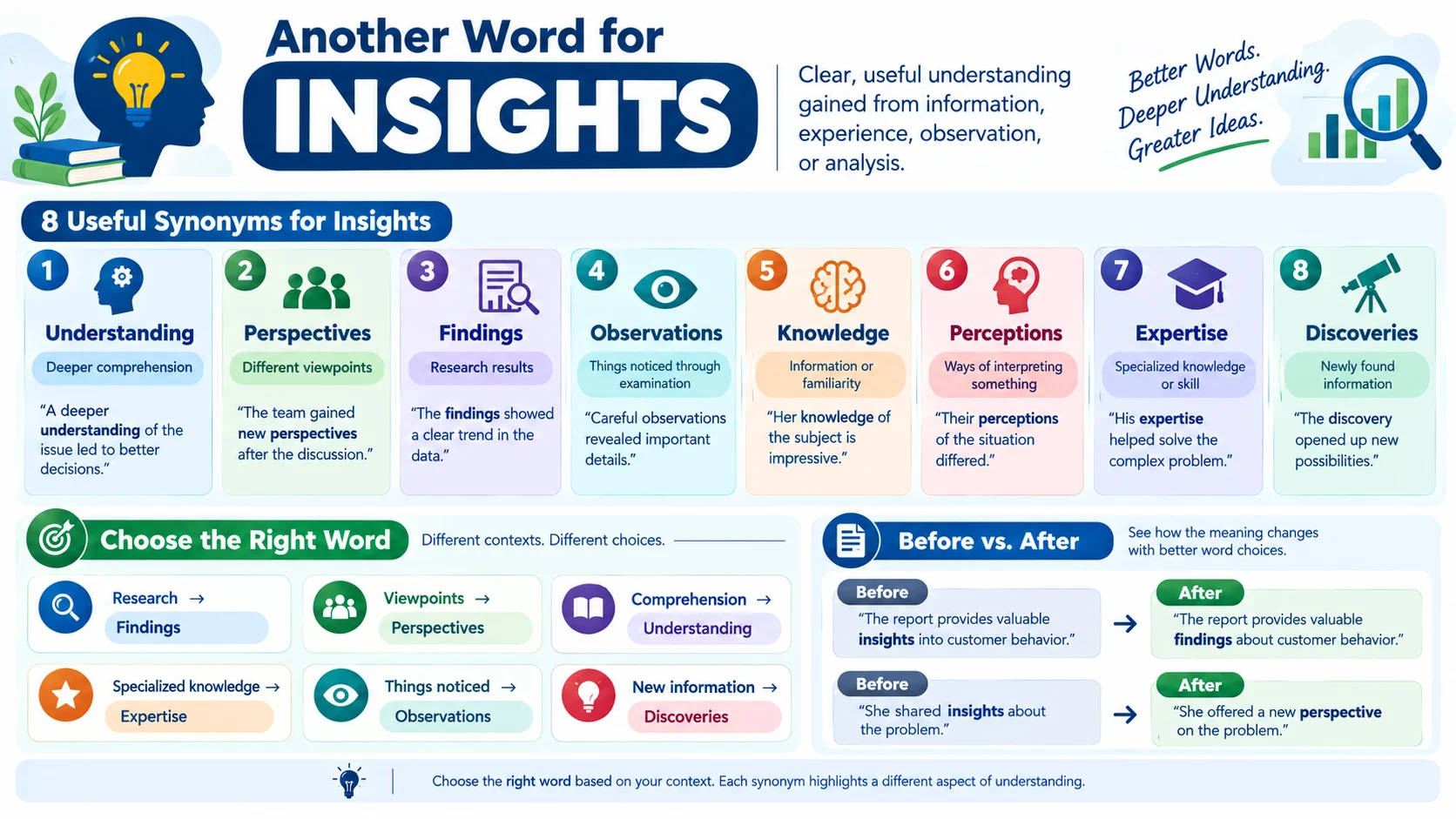
Another word for “insights” is understanding, perspectives, observations, findings, revelations, or perceptions. The best synonym depends on context: understanding refers to deeper knowledge, perspectives express different ways of viewing a subject, findings describe results from research or analysis, and observations highlight things noticed or identified. Other alternatives include discoveries, interpretations, awareness, and takeaways. These synonyms work well in academic writing, business reports, research, professional communication, and everyday English.
What Does “Insights” Mean?
Definition
Insights are clear, useful understandings or perceptions about a person, situation, subject, problem, or set of information. An insight often goes beyond basic facts by helping someone understand why something happens, what it means, or what should happen next.
For example:
The survey provided valuable insights into customer behavior.
Here, “insights” means useful understanding gained from analyzing the survey.
Common Uses
The word insights is common in business, education, research, marketing, psychology, journalism, and everyday conversation. Depending on the context, it can refer to knowledge, understanding, perspectives, observations, findings, interpretations, or expertise.
The best replacement depends on what kind of “insights” you mean.
Best Synonyms for Insights
| Synonym | Meaning | Best Used When | Example |
|---|---|---|---|
| Understanding | Knowledge of how or why something works | Explaining comprehension | The report provides a deeper understanding of customer needs. |
| Perspectives | Particular ways of viewing an issue | Different viewpoints or opinions | The discussion offered new perspectives on the problem. |
| Knowledge | Information or familiarity gained through learning or experience | General information | Her knowledge of the industry is extensive. |
| Findings | Results discovered through research or analysis | Reports and research | The study revealed several important findings. |
| Observations | Things noticed through careful examination | Analysis and description | His observations helped explain the trend. |
| Perceptions | Ways people understand or interpret something | Attitudes and viewpoints | The survey examined consumer perceptions of the brand. |
| Interpretations | Explanations of the meaning of information | Data, texts, or events | Several interpretations of the results are possible. |
| Awareness | Knowledge or recognition of something | Understanding a condition or issue | The campaign increased awareness of the problem. |
| Expertise | Specialized knowledge or skill | Professional knowledge | Her expertise provided valuable guidance. |
| Conclusions | Judgments reached after considering evidence | Research and analysis | The researchers drew several conclusions from the data. |
| Discoveries | New information that has been found | New or unexpected information | The investigation led to important discoveries. |
| Revelations | Previously unknown information that becomes known | Dramatic or significant discoveries | The interview contained several surprising revelations. |
1. Understanding
Meaning: A clear comprehension of a subject, situation, or process.
Tone: Professional and neutral
Difficulty: Easy
Usage Frequency: Very Common
Best for: Business writing, essays, reports, emails, and general communication.
“Understanding” is one of the most natural replacements when insights refers to deeper comprehension.
Business example:
The customer interviews gave us a better understanding of purchasing behavior.
Academic example:
The research contributes to our understanding of social development.
Daily conversation:
Talking with her gave me a better understanding of what happened.
2. Perspectives
Meaning: Particular ways of thinking about or viewing something.
Tone: Neutral to professional
Difficulty: Easy
Usage Frequency: Very Common
Use perspectives when “insights” refers to different viewpoints rather than factual discoveries.
Business example:
The meeting brought together perspectives from sales, marketing, and product teams.
Academic example:
The article presents several perspectives on the issue.
Daily conversation:
Traveling gave him new perspectives on life.
3. Findings
Meaning: Results or information discovered through research, investigation, or analysis.
Tone: Formal and professional
Difficulty: Easy
Usage Frequency: Common
Findings is particularly effective in academic, scientific, business, and research writing.
Business example:
Our findings indicate that customers prefer a simpler checkout process.
Academic example:
The study’s findings support the original hypothesis.
Daily conversation:
What were your findings after looking into the issue?
4. Observations
Meaning: Things noticed or identified through careful examination.
Tone: Professional and analytical
Difficulty: Easy
Usage Frequency: Common
Use observations when the information comes from watching, examining, or noticing something.
Business example:
The consultant shared several observations about employee productivity.
Academic example:
The researcher recorded observations during the experiment.
Daily conversation:
Her observations about the neighborhood were interesting.
5. Knowledge
Meaning: Information, facts, or understanding acquired through learning or experience.
Tone: Neutral
Difficulty: Easy
Usage Frequency: Very Common
Knowledge is broader than “insights.” It works when you mean accumulated information rather than a particular realization.
Business example:
His industry knowledge helped the company make better decisions.
Academic example:
The course develops students’ knowledge of economics.
Daily conversation:
She has a lot of knowledge about computers.
6. Perceptions
Meaning: The ways individuals or groups understand, interpret, or view something.
Tone: Professional and analytical
Difficulty: Medium
Usage Frequency: Common
Choose perceptions when discussing attitudes, impressions, or beliefs.
Example:
The survey examined customer perceptions of the company’s new brand.
7. Expertise
Meaning: Specialized knowledge or skill developed through education or experience.
Tone: Professional
Difficulty: Easy
Usage Frequency: Common
Use expertise when the “insights” come from someone’s specialized ability or experience.
Example:
Her financial expertise helped the team identify potential risks.
Synonyms by Context
Formal Writing
For formal reports, research papers, and professional documents, strong alternatives include:
- Findings
- Observations
- Interpretations
- Conclusions
- Analysis
- Understanding
- Perspectives
Before:
The report provides important insights into the issue.
After:
The report presents important findings about the issue.
Professional Writing
In business communication, these alternatives are often more precise:
- Findings
- Understanding
- Perspectives
- Expertise
- Analysis
- Observations
- Knowledge
Before:
The presentation gave us useful insights into customer behavior.
After:
The presentation gave us a deeper understanding of customer behavior.
Academic Writing
For essays, dissertations, research papers, and scholarly writing, consider:
- Findings
- Observations
- Interpretations
- Conclusions
- Understanding
- Perspectives
- Analysis
Before:
The study offers valuable insights into social behavior.
After:
The study offers valuable findings about social behavior.
Daily Conversation
In casual English, natural alternatives include:
- Understanding
- Knowledge
- Perspective
- Ideas
- Observations
- Thoughts
Before:
She gave me some useful insights.
After:
She gave me a useful perspective.
Professional Alternatives for Insights
If you’re writing a report, presentation, resume, LinkedIn profile, or business document, consider replacing “insights” with a more specific word.
Instead of:
Provided insights into customer behavior.
You could write:
Analyzed customer behavior and identified purchasing trends.
Instead of:
Shared insights with senior management.
You could write:
Presented key findings to senior management.
Instead of:
Developed insights from market data.
You could write:
Identified market trends from customer and sales data.
Specific wording is often stronger than repeatedly using the broad word “insights.”
Simple Alternatives for Insights
If your audience prefers plain English, use:
- Understanding
- Ideas
- Knowledge
- Thoughts
- Views
- Findings
- Observations
For example:
The survey provided useful insights.
can become:
The survey provided useful information.
Or:
The survey improved our understanding of customer needs.
Stronger Alternatives for Insights
When you want to emphasize discovery, analysis, or expertise, consider:
- Findings
- Discoveries
- Revelations
- Conclusions
- Expertise
- Analysis
- Interpretations
The strongest choice depends on the meaning.
For example, findings suggests research results, while expertise describes specialized knowledge. Revelations suggests information that was previously unknown or surprising.
Difference Between Similar Synonyms
Insights vs. Understanding
Insights usually suggests a valuable realization or deeper perception. Understanding is broader and simply means comprehension.
The interview provided insights into customer motivation.
The training improved employees’ understanding of the software.
Insights vs. Findings
Findings usually refers to results discovered through research or investigation. Insights can be broader and may include interpretations or strategic implications.
Insights vs. Perspectives
Perspectives are viewpoints or ways of seeing something. Insights are generally deeper understandings that may help explain or solve a problem.
Insights vs. Observations
Observations are things noticed or recorded. Insights often involve interpreting those observations and recognizing their significance.
Insights vs. Knowledge
Knowledge refers to information or understanding accumulated over time. Insights often represent a specific realization derived from information or experience.
Insights vs. Expertise
Expertise means specialized knowledge or skill. An expert may provide insights, but the two words are not interchangeable in every sentence.
How to Choose the Right Synonym
Ask what you mean by “insights” before selecting a replacement.
- If you mean research results, use findings.
- If you mean deeper comprehension, use understanding.
- If you mean viewpoints, use perspectives.
- If you mean things noticed, use observations.
- If you mean specialized knowledge, use expertise.
- If you mean general information, use knowledge.
- If you mean interpretations, use perceptions or interpretations.
- If you mean new information, use discoveries or revelations.
This approach produces more precise writing than replacing “insights” with the same synonym every time.
Opposite Words
There is no single perfect antonym for insights, because the opposite depends on the intended meaning. Possible contrasts include:
- Ignorance
- Unawareness
- Confusion
- Misunderstanding
- Uncertainty
- Lack of knowledge
For example:
The research increased awareness of the issue.
The opposite concept could be unawareness or lack of knowledge.
FAQs
What is another word for insights?
Common alternatives for insights include understanding, perspectives, findings, observations, knowledge, perceptions, interpretations, expertise, and discoveries. The best choice depends on whether you mean research results, viewpoints, knowledge, or deeper understanding.
What is a formal synonym for insights?
Findings, observations, interpretations, conclusions, and analyses are formal alternatives to “insights,” particularly in academic and professional writing.
What is a professional alternative for insights?
In professional writing, useful alternatives include findings, analysis, understanding, perspectives, expertise, and observations. Choose the word that most precisely describes the information being communicated.
What word can replace insights in a resume?
For resumes, consider specific words such as findings, analysis, expertise, recommendations, discoveries, or results. The best choice depends on what you actually accomplished.
For example:
Provided insights into customer behavior.
can become:
Analyzed customer behavior and identified key purchasing trends.
What is another word for valuable insights?
Depending on the context, alternatives include valuable findings, useful observations, meaningful understanding, important discoveries, strategic knowledge, or actionable information.
What is another word for customer insights?
Possible alternatives include customer understanding, customer findings, consumer perspectives, customer behavior analysis, consumer knowledge, and customer intelligence.
What is another word for insights in an essay?
For an essay, useful choices include understanding, perspectives, findings, observations, interpretations, analysis, and conclusions. “Findings” is particularly suitable when discussing research results.
What is another word for insights in business?
In business writing, common alternatives include findings, analysis, customer understanding, market knowledge, observations, perspectives, and strategic information.
Conclusion
The best synonym for insights depends on the exact meaning you want to communicate. Understanding works well for deeper comprehension, findings for research results, perspectives for viewpoints, observations for things noticed, and expertise for specialized knowledge.
For precise writing, don’t simply replace “insights” with the first synonym you find. Identify the source and purpose of the information, then choose the word that communicates that meaning most accurately.
