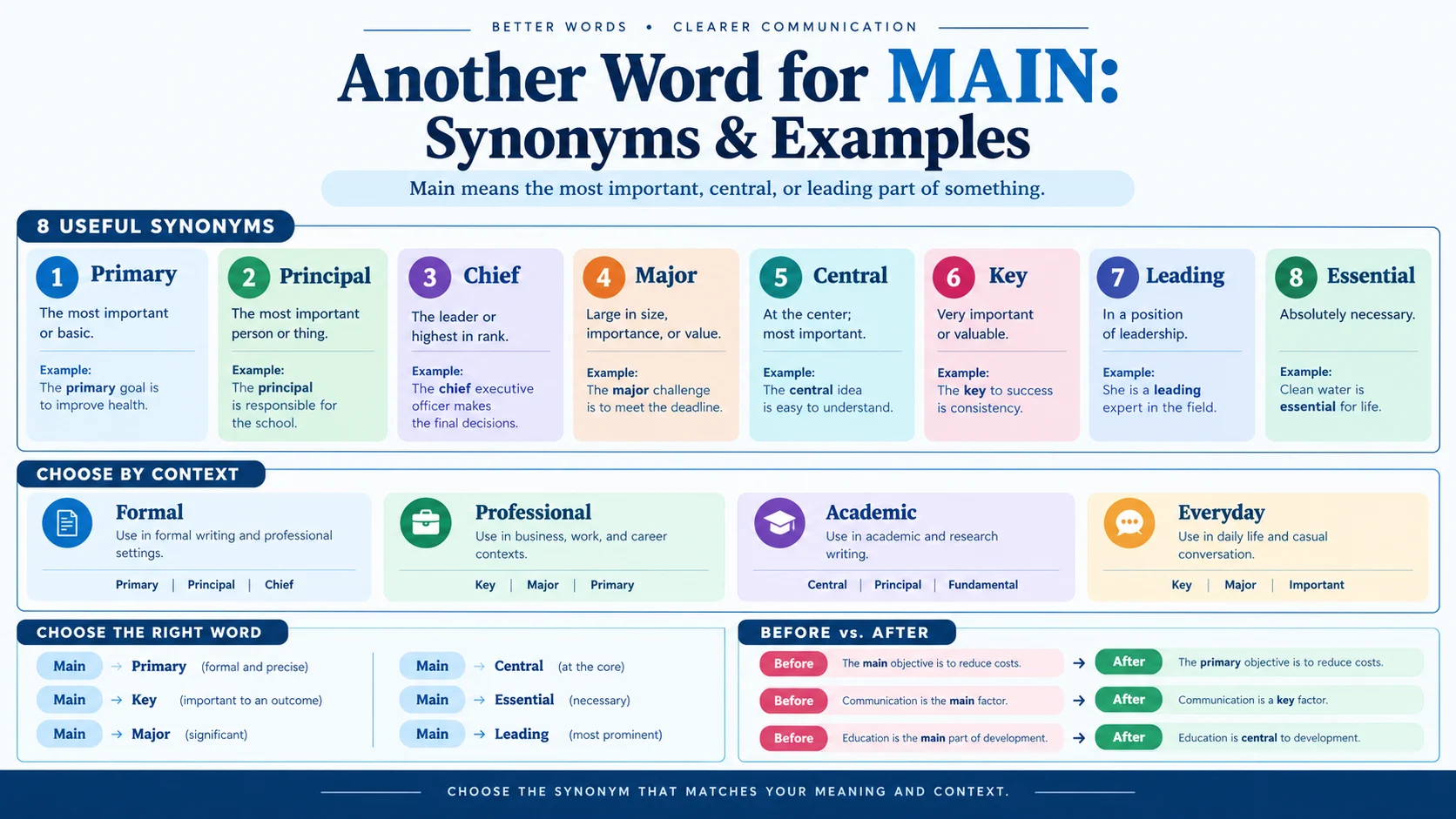
If you need another word for main, the best choice depends on context. Common alternatives include primary, principal, chief, major, central, key, leading, and essential. For professional or academic writing, primary and principal are often strong choices, while key and major work naturally in everyday and business communication.
What Does Main Mean?
Definition
Main is an adjective meaning most important, central, primary, or principal. It identifies the person, thing, idea, place, or part that has the greatest importance or prominence within a particular situation.
For example:
The main reason for the delay was heavy traffic.
Here, main means the primary or most important reason.
Common Uses
The word main can describe:
- The most important idea: the main point
- The primary cause: the main reason
- The central location: the main office
- The most important person: the main speaker
- The principal part: the main section
- The largest or principal route: the main road
Because main is broad and flexible, the best synonym changes according to the sentence.
Best Synonyms for Main
| Synonym | Meaning | Best Used When | Example |
|---|---|---|---|
| Primary | First in importance | Formal, academic, and professional writing | Safety is our primary concern. |
| Principal | Most important or influential | Formal and academic contexts | The principal objective is to reduce costs. |
| Chief | Greatest in importance or authority | Formal, professional, or descriptive writing | The chief reason was a lack of funding. |
| Major | Important or significant | Business, news, and everyday writing | Cost is a major consideration. |
| Central | At the center of importance or attention | Ideas, themes, issues, and discussions | Trust is central to the relationship. |
| Key | Extremely important to an outcome | Business and everyday communication | Communication is key to success. |
| Leading | Most prominent or successful | People, companies, products, or positions | She is a leading researcher in the field. |
| Essential | Absolutely necessary or fundamental | Requirements, qualities, and conditions | Accuracy is essential to the study. |
Primary
Primary is one of the closest formal alternatives to main. It means first in importance, order, or priority.
Best used for: academic writing, reports, business documents, and professional communication.
- Tone: Formal
- Difficulty: Easy
- Usage frequency: Very Common
- Best for: Resume, email writing, essay writing, business writing
Business example:
Customer satisfaction is our primary goal.
Academic example:
The primary objective of the study was to examine consumer behavior.
Daily conversation:
What was your primary reason for choosing this option?
Principal
Principal means most important or influential. It is particularly useful when discussing objectives, causes, people, or factors.
- Tone: Formal
- Difficulty: Medium
- Usage frequency: Common
- Best for: Academic writing, business writing, reports
Business example:
The principal challenge facing the company is rising operating costs.
Academic example:
The principal aim of this research is to evaluate the proposed method.
Daily conversation:
The principal reason I left was the long commute.
Chief
Chief refers to something that ranks highest in importance, authority, or influence.
- Tone: Formal
- Difficulty: Medium
- Usage frequency: Common
- Best for: Professional writing, reports, formal descriptions
Example:
The chief concern among employees was job security.
Major
Major means very important, significant, or substantial. It does not always mean the single most important thing, so it can be less precise than primary.
- Tone: Neutral
- Difficulty: Easy
- Usage frequency: Very Common
- Best for: Business writing, essays, news, everyday conversation
Example:
The company experienced a major increase in sales.
Central
Central emphasizes something that occupies a core or fundamental position.
- Tone: Neutral to formal
- Difficulty: Easy
- Usage frequency: Common
- Best for: Essays, academic writing, discussions, analysis
Example:
Education plays a central role in economic development.
Key
Key is a concise and highly natural alternative to main when referring to something particularly important.
- Tone: Neutral
- Difficulty: Easy
- Usage frequency: Very Common
- Best for: Business writing, presentations, emails, marketing, everyday communication
Example:
Time management is a key factor in completing the project successfully.
Leading
Leading is appropriate when main means prominent, influential, or ahead of others.
Example:
The company is a leading provider of renewable-energy solutions.
Essential
Essential is stronger than main because it suggests something is necessary rather than merely important.
Example:
Clear communication is essential for effective teamwork.
Synonyms by Context
Formal Writing
For formal writing, consider:
- Primary
- Principal
- Chief
- Central
- Fundamental
Example:
Instead of:
The main objective of this report is to analyze the results.
Write:
The primary objective of this report is to analyze the results.
Primary sounds precise and professional without being unnecessarily complicated.
Professional Writing
In business communication, the most natural alternatives include primary, key, major, principal, and leading.
Before:
Our main priority is customer satisfaction.
After:
Our primary priority is customer satisfaction.
However, in this particular sentence, top priority or simply priority may sound more natural because primary priority can be repetitive.
A better revision is:
Customer satisfaction is our top priority.
Academic Writing
Academic writing often benefits from primary, principal, central, fundamental, and major.
Before:
The main purpose of this study is to investigate the relationship.
After:
The primary purpose of this study is to investigate the relationship.
For discussing ideas:
The central argument of the paper is that early intervention improves outcomes.
Daily Conversation
In casual speech, key, important, major, primary, and main are usually more natural than highly formal alternatives.
Example:
What’s the main problem?
Possible alternatives include:
What’s the key problem?
or
What’s the major problem?
The original main remains the most conversational choice.
Professional Alternatives for Main
If you are writing a resume, report, email, proposal, or business document, these alternatives can make your wording more precise:
| Instead of | Consider |
|---|---|
| main responsibility | primary responsibility |
| main objective | primary objective |
| main goal | principal goal or primary goal |
| main concern | key concern |
| main reason | primary reason |
| main advantage | key advantage |
| main challenge | major challenge |
| main focus | central focus |
| main provider | leading provider |
| main requirement | essential requirement |
For resumes especially, choose the synonym based on what you actually mean rather than replacing main simply to sound more sophisticated.
Simple Alternatives for Main
If you want easy words that most readers immediately understand, use:
- Key
- Major
- Primary
- Important
- Central
- Top
For example:
The main issue is cost.
can become:
The key issue is cost.
or:
The major issue is cost.
Stronger Alternatives for Main
When you need stronger emphasis, consider:
- Essential
- Critical
- Fundamental
- Principal
- Central
- Vital
These words are not exact replacements in every sentence.
For example:
Communication is the main part of teamwork.
could become:
Communication is fundamental to effective teamwork.
Here, fundamental communicates a stronger idea than simply main.
Difference Between Similar Synonyms
Main vs. Primary
Both mean most important, but primary sounds more formal and often emphasizes priority.
The main reason was cost.
The primary reason was cost.
Both are correct, but primary is particularly suitable for reports and academic writing.
Main vs. Principal
Principal is more formal and can emphasize the highest-ranking or most important factor.
The main objective
The principal objective
The second expression is more formal.
Main vs. Major
Major means important or significant, but not necessarily the single most important.
The main cause of the problem was a software error.
A major cause of the problem was a software error.
The second sentence may suggest that there were several significant causes.
Main vs. Key
Key is a very natural modern alternative and often means especially important to achieving a result.
Planning is the main factor in success.
Planning is a key factor in success.
Key works particularly well in business and practical communication.
Main vs. Essential
Essential means necessary or indispensable. It is therefore stronger than main.
The main equipment was stored inside.
does not mean the same thing as:
The essential equipment was stored inside.
The second means the equipment was necessary.
Opposite Words
Depending on context, possible opposites of main include:
- Minor
- Secondary
- Unimportant
- Peripheral
- Additional
- Supporting
- Supplementary
For example:
The main issue was discussed first, followed by several secondary concerns.
Note that secondary is not always a true opposite. It often means lower in priority rather than unimportant.
FAQs
What is another word for main?
Common alternatives for main include primary, principal, chief, major, central, key, leading, and essential. The best choice depends on whether you mean most important, most prominent, central, or necessary.
What is a formal synonym for main?
Primary and principal are two of the most useful formal synonyms for main. Chief, central, and fundamental can also work depending on the sentence.
What is a professional alternative for main?
In professional writing, primary, key, principal, major, and central are common alternatives. For example, “main objective” can become “primary objective.”
What word can replace main?
You can replace main with primary, principal, chief, major, central, key, leading, or essential, depending on the intended meaning.
What is another word for main in an essay?
For essays, useful alternatives include primary, principal, central, major, fundamental, and key. Primary is especially useful for phrases such as “primary argument,” “primary objective,” and “primary cause.”
What is another word for main in a resume?
Depending on the sentence, use primary, key, leading, principal, or essential. For example, “main responsibilities” can become primary responsibilities.
What is a stronger word for main?
Words such as essential, critical, vital, and fundamental can express stronger importance, but they are not interchangeable with main in every context.
Conclusion
The best synonym for main depends on the exact meaning you want to communicate. Primary is an excellent formal replacement, principal works well in academic and professional contexts, key is concise and versatile, major emphasizes significance, central highlights importance to a subject, and essential indicates necessity.
For most formal writing, start with primary or principal. For everyday and business communication, key and major are often natural choices. Always consider the sentence’s meaning and tone before choosing a replacement.
