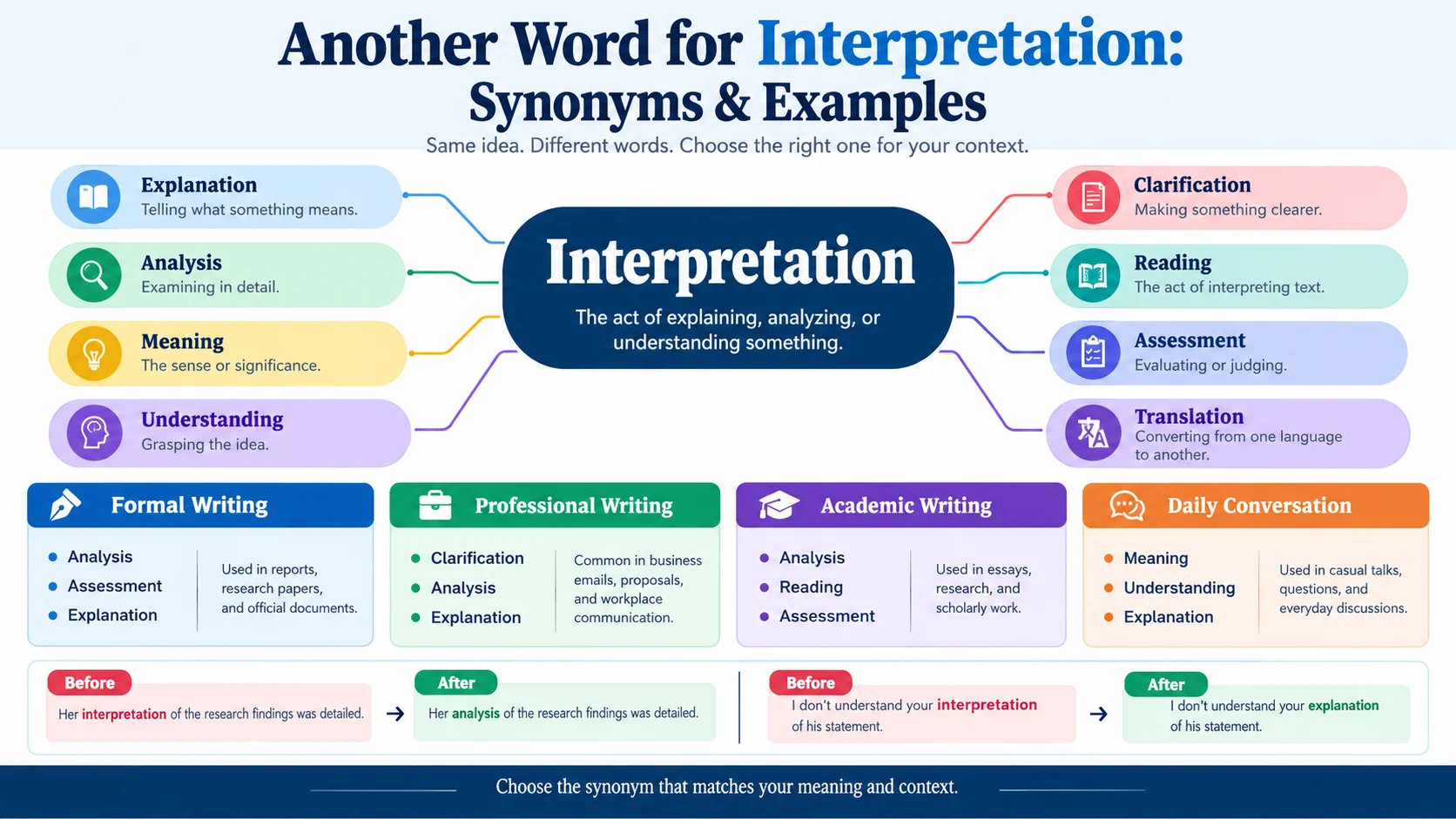
If you need another word for interpretation, the best choice depends on the context. Common alternatives include explanation, meaning, analysis, understanding, clarification, reading, translation, and assessment. For formal or academic writing, analysis or explanation often works well, while translation is appropriate when interpretation involves converting one language into another.
What Does Interpretation Mean?
Definition
Interpretation means the way someone explains, understands, or determines the meaning of something. It can refer to understanding words, analyzing information, explaining an event, translating spoken language, or forming an opinion about what something means.
For example:
Her interpretation of the poem focused on its symbolism.
Here, interpretation means her explanation or understanding of the poem’s meaning.
The word can have several related meanings, so the best synonym changes according to the situation.
Common Uses
Interpretation is commonly used when discussing:
- The meaning of a text, poem, or statement
- Analysis of data or research findings
- Understanding of events or behavior
- Translation between languages
- Explanation of laws, rules, or instructions
- Personal understanding of an idea
- Artistic or creative representations
Best Synonyms for Interpretation
| Synonym | Meaning | Best Used When | Example |
|---|---|---|---|
| Explanation | A statement that makes something clear | You are clarifying meaning | Her explanation of the results was clear. |
| Meaning | What something signifies or conveys | Referring directly to significance | What is the meaning of this phrase? |
| Analysis | Detailed examination to understand something | Academic, research, or professional contexts | His analysis of the data revealed a trend. |
| Understanding | The way someone comprehends something | Personal comprehension or perception | Her understanding of the issue changed. |
| Clarification | Information that makes something less confusing | Removing uncertainty or confusion | The manager provided clarification of the policy. |
| Reading | A particular way of understanding or viewing something | Texts, literature, and ideas | His reading of the novel was unconventional. |
| Translation | Conversion of meaning from one language to another | Languages and interpreting | The translation preserved the original meaning. |
| Assessment | Evaluation or judgment based on information | Reports, research, and professional settings | The assessment of the evidence was thorough. |
The most interchangeable synonym is not always the most accurate. Explanation emphasizes making something understandable, while analysis emphasizes examining it carefully. Meaning refers to what something signifies, whereas understanding focuses on how a person comprehends it.
Synonyms by Context
Formal Writing
In formal writing, useful alternatives include analysis, explanation, assessment, evaluation, understanding, and examination.
Example:
Original:
The report provides an interpretation of the survey findings.
Alternative:
The report provides an analysis of the survey findings.
In this example, analysis is more precise because the writer is examining research data.
Professional Writing
In business and workplace communication, explanation, analysis, clarification, assessment, and understanding are often appropriate.
Business example:
We need further clarification of the client’s requirements.
This can be preferable to:
We need further interpretation of the client’s requirements.
Clarification suggests that the information is unclear and needs to be explained.
Academic Writing
Academic contexts frequently use analysis, interpretation, explanation, reading, assessment, and understanding.
Academic example:
The study offers a new interpretation of the historical evidence.
Possible revision:
The study offers a new analysis of the historical evidence.
However, these words are not identical. Interpretation can describe the conclusion a researcher draws from evidence, while analysis usually describes the process of examining that evidence.
Daily Conversation
For everyday speech, simpler alternatives include meaning, explanation, understanding, and reading.
Daily example:
What’s your interpretation of what he said?
More naturally:
What do you think he meant?
Or:
How do you understand what he said?
These alternatives sound more conversational.
Professional Alternatives for Interpretation
If you are writing an email, report, presentation, or business document, consider the exact meaning you want to communicate.
Analysis
Meaning: A detailed examination of information.
Best used for: Research, data, reports, strategy, and evidence.
Tone: Formal and analytical.
Difficulty: Medium.
Usage frequency: Very Common.
Best for: Resume, essay writing, business writing, academic writing.
Business example:
Our analysis of customer feedback identified three major concerns.
Academic example:
The analysis of the experimental results supports the proposed hypothesis.
Explanation
Meaning: Information that makes an idea or situation understandable.
Best used for: Clarifying concepts, decisions, procedures, and results.
Tone: Neutral and professional.
Difficulty: Easy.
Usage frequency: Very Common.
Best for: Email writing, business writing, essays, daily communication.
Business example:
The manager provided an explanation for the change in procedure.
Daily example:
Thanks for the explanation. I understand it now.
Clarification
Meaning: Additional information that removes confusion or uncertainty.
Best used for: Questions, instructions, policies, contracts, and workplace communication.
Tone: Professional.
Difficulty: Medium.
Usage frequency: Common.
Best for: Email writing and business writing.
Example:
Could you provide clarification regarding the new deadline?
Understanding
Meaning: The way a person comprehends or perceives something.
Best used for: Ideas, situations, relationships, concepts, and personal viewpoints.
Tone: Neutral.
Difficulty: Easy.
Usage frequency: Very Common.
Example:
Our understanding of the problem has improved significantly.
Simple Alternatives for Interpretation
If your goal is to make writing easier to understand, consider:
- Meaning
- Explanation
- Understanding
- View
- Reading
- Idea
- Sense
For example:
The interpretation of the statement was unclear.
A simpler version is:
The meaning of the statement was unclear.
Similarly:
Her interpretation of the situation differed from mine.
Can become:
Her understanding of the situation differed from mine.
The simpler alternative should preserve the original meaning rather than merely replacing the word.
Stronger Alternatives for Interpretation
For situations that require a more precise or sophisticated term, consider:
- Analysis
- Evaluation
- Assessment
- Examination
- Interpretive reading
- Critical analysis
For example:
The researcher’s interpretation of the evidence was detailed.
A more academic version could be:
The researcher’s analysis of the evidence was detailed.
However, evaluation implies judgment, while analysis emphasizes examination. Therefore, choosing a stronger-sounding word does not necessarily make a sentence more accurate.
Difference Between Similar Synonyms
Interpretation vs. Analysis
Interpretation focuses on the meaning or conclusion drawn from something.
Analysis focuses on examining something systematically.
Her interpretation of the poem emphasized its emotional themes.
Her analysis of the poem examined its structure, imagery, and symbolism.
Interpretation vs. Explanation
An interpretation presents an understanding of what something means.
An explanation makes something clear or understandable.
His interpretation of the evidence differed from mine.
His explanation of the procedure was easy to follow.
Interpretation vs. Understanding
Understanding is broader and more common in everyday language. Interpretation often suggests a particular meaning or viewpoint.
My understanding of the instructions was incomplete.
My interpretation of the author’s argument was different.
Interpretation vs. Translation
Translation specifically concerns transferring meaning between languages.
The interpreter provided a translation of the speaker’s remarks.
Not every interpretation is a translation, but translation can involve interpretation when meaning must be conveyed accurately across languages.
Interpretation vs. Meaning
Meaning refers to what something signifies.
Interpretation refers to someone’s understanding or explanation of that meaning.
What is the meaning of this sentence?
What is your interpretation of this sentence?
The first asks what the sentence signifies; the second asks how someone understands it.
Quick Synonym Guide
Choose the word based on what you mean:
- Explanation → when you make something clear
- Analysis → when you examine something in detail
- Meaning → when you refer to what something signifies
- Understanding → when you refer to comprehension
- Clarification → when you remove confusion
- Reading → when describing a particular view of a text or idea
- Assessment → when evaluating something
- Translation → when transferring meaning between languages
- Evaluation → when judging quality, value, or significance
Opposite Words
Depending on context, possible opposites of interpretation include:
- Misunderstanding
- Confusion
- Misinterpretation
- Literalness
- Ambiguity
There is no single universal opposite because interpretation has several meanings.
For example, the opposite of a correct interpretation may be misinterpretation, while the opposite of clear understanding may be confusion.
FAQs
What is another word for interpretation?
Common alternatives for interpretation include explanation, meaning, analysis, understanding, clarification, reading, assessment, and translation. The best synonym depends on the context.
What is a formal synonym for interpretation?
Analysis, assessment, evaluation, examination, and explanation can work as formal alternatives. Analysis is particularly common in academic and professional writing when examining evidence or information.
What is a professional alternative for interpretation?
In professional writing, analysis, assessment, clarification, explanation, and evaluation are useful alternatives. Choose the word that accurately reflects whether you are examining, explaining, or judging information.
What word can replace interpretation in an essay?
Analysis is often a strong replacement in academic writing, but explanation, reading, understanding, assessment, or meaning may be more accurate depending on the sentence.
What is another word for interpretation of data?
Common alternatives include data analysis, analysis of findings, assessment, evaluation, and understanding of the results. In research contexts, data analysis is usually more specific than simply saying interpretation.
What is another word for personal interpretation?
Possible alternatives include personal understanding, individual perspective, personal view, viewpoint, or reading. The appropriate choice depends on whether you mean comprehension, opinion, or perspective.
What is another word for interpretation in literature?
Common choices include reading, analysis, explanation, understanding, and critical analysis. In literary studies, reading can describe a particular way of understanding a text.
Conclusion
The best synonym for interpretation depends on what you want to express. Use analysis for detailed examination, explanation for making something clear, meaning for what something signifies, understanding for comprehension, clarification for removing confusion, and translation for language conversion.
When replacing interpretation, focus on the intended meaning rather than simply choosing a word that sounds more formal. The most effective synonym is the one that communicates the precise idea naturally and accurately.
