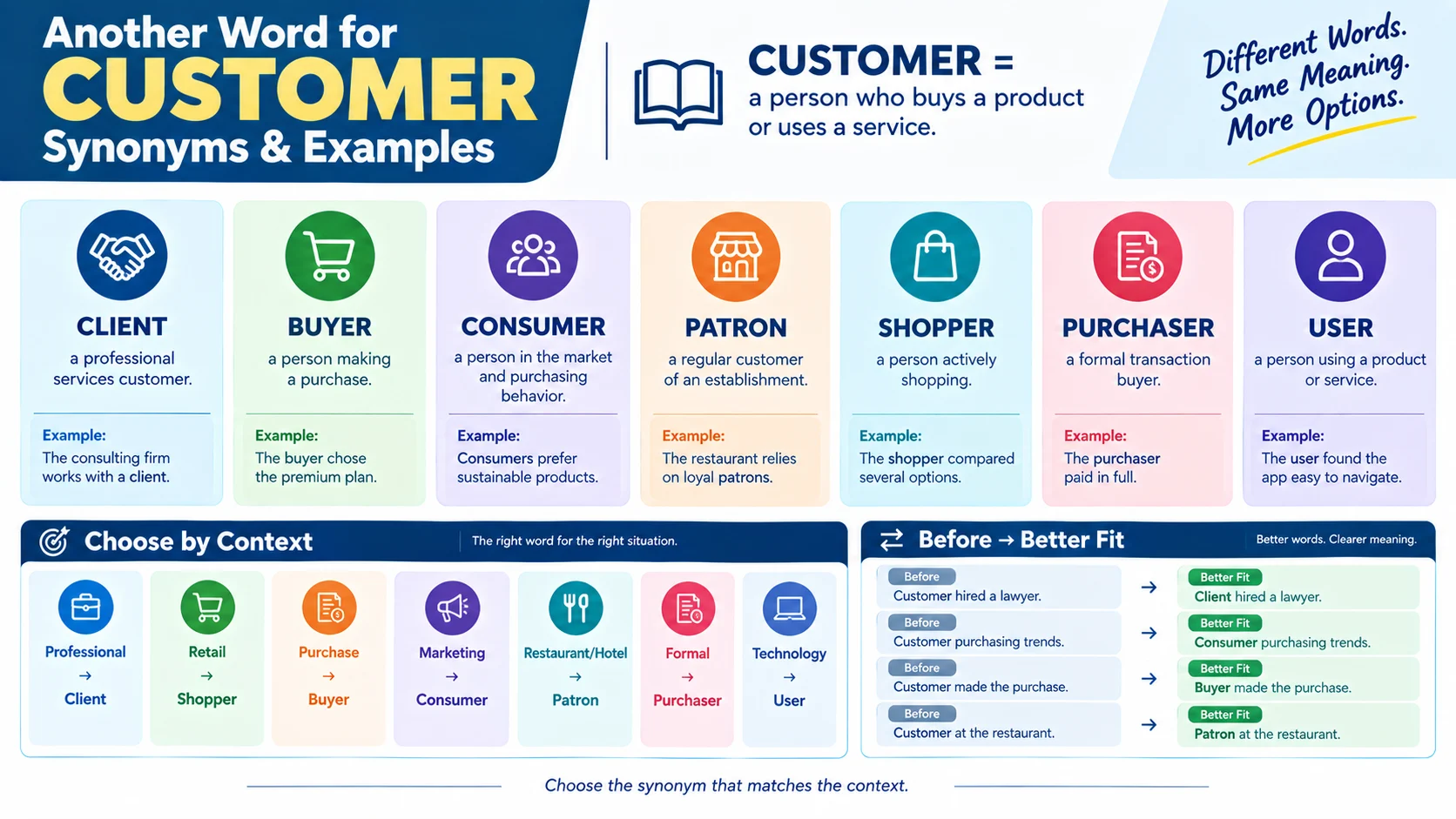
The best another word for customer depends on context. Common alternatives include client, buyer, consumer, patron, shopper, purchaser, and clientele. Use client for professional services, consumer for markets and purchasing behavior, buyer for someone making a purchase, and patron for a regular user of a store, restaurant, or similar business.
What Does Customer Mean?
Definition
A customer is a person or organization that buys a product or service. In business English, the word can refer to an individual consumer as well as a company or other organization that purchases goods or services.
For example:
- “The customer purchased a new laptop.”
- “The company has thousands of customers.”
- “We provide customer support after every purchase.”
Customer is a broad, neutral term, which makes it suitable for everyday conversation, business writing, marketing, and general communication.
Common Uses
You will commonly see customer in phrases such as:
- customer service
- customer satisfaction
- customer support
- customer experience
- customer feedback
- potential customer
- loyal customer
- existing customer
- repeat customer
- target customer
Because the word is so broad, replacing it with a synonym can make your writing more precise rather than simply more varied.
Best Synonyms for Customer
| Synonym | Meaning | Best Used When | Example |
|---|---|---|---|
| Client | A person or organization receiving services | Professional or service relationships | “The law firm welcomed a new client.” |
| Buyer | Someone who purchases something | A specific purchase or purchasing role | “The buyer compared several models.” |
| Consumer | Someone who buys goods or services, especially for use | Marketing, economics, and market analysis | “Consumers are becoming more price-conscious.” |
| Patron | A customer, especially a regular user of a business | Restaurants, stores, hotels, and cultural venues | “The restaurant thanked its loyal patrons.” |
| Shopper | Someone who is shopping or looking to buy | Retail and everyday situations | “Online shoppers can compare prices quickly.” |
| Purchaser | Someone who makes a purchase | Formal, legal, financial, or transactional writing | “The purchaser is responsible for the payment.” |
| Clientele | The customers of a business or professional | Referring to a group collectively | “The salon has an established clientele.” |
| User | Someone who uses a product, service, or platform | Software, technology, subscriptions, and services | “The app has millions of active users.” |
These distinctions are supported by major dictionary and thesaurus references. Cambridge identifies shopper, patron, consumer, buyer, and purchaser among words related to a person who buys something, while its American Thesaurus also includes client and habitué.
Synonyms by Context
Formal Writing
For formal writing, purchaser, client, consumer, and buyer are often more precise than customer.
Purchaser works particularly well when the emphasis is on the transaction itself.
“The purchaser must provide proof of payment.”
Client is preferable when a professional service or ongoing relationship is involved.
“The consultant met with the client to discuss the project.”
Consumer is useful when discussing purchasing behavior, markets, or groups of people rather than one specific person. Cambridge notes that consumer is commonly used in business writing for customers as a group and is less commonly used for one specific individual.
Professional Writing
In business writing, choose the replacement according to the relationship:
- Client: professional services and ongoing business relationships
- Customer: general commercial relationship
- Buyer: purchasing decisions or purchasing roles
- Consumer: market behavior and customer groups
- User: product or service usage
- Account holder: financial or subscription contexts
For example:
General:
“We value every customer.”
Professional:
“We value every client.”
Product-focused:
“We designed the software around the needs of its users.”
Market-focused:
“The study examines changing consumer preferences.”
Academic Writing
Academic writing often benefits from specific terminology.
Use consumer when discussing economics, marketing, purchasing behavior, or consumption.
“Consumer preferences influence demand.”
Use buyer when the research concerns purchasing decisions.
“The buyer evaluates price, quality, and brand reputation.”
Use client when discussing professional services, healthcare, legal services, counseling, or similar relationships.
The word customer remains appropriate when the source material or research specifically concerns customer service, retail, or business relationships.
Daily Conversation
For everyday conversation, customer, shopper, buyer, and client are usually the most natural choices.
Examples:
- “A customer asked for help.”
- “The shopper found a better price.”
- “The buyer made an offer.”
- “My client called this morning.”
Patron is also natural in certain settings, particularly restaurants, hotels, theaters, stores, libraries, and other establishments. Cambridge defines a patron as a customer of a store, restaurant, hotel, or similar place, especially a regular customer.
Professional Alternatives for Customer
If you need a professional alternative to customer, consider these choices:
Client
Meaning: A person or organization receiving professional services.
Tone: Professional
Difficulty: Easy
Usage Frequency: Very Common
Best for: Business writing, consulting, law, finance, agencies, professional services, resumes, and emails.
Business example:
“Our team works closely with each client to understand their goals.”
Cambridge specifically defines client as someone who receives services and gives professional and business examples involving firms and organizations.
Consumer
Meaning: A person who buys goods or services, particularly for their own use.
Tone: Professional and analytical
Difficulty: Easy
Usage Frequency: Very Common
Best for: Marketing, economics, research, reports, and academic writing.
Business example:
“The company tracks consumer preferences across several markets.”
Buyer
Meaning: A person who purchases something.
Tone: Neutral and professional
Difficulty: Easy
Usage Frequency: Very Common
Best for: Sales, real estate, retail, purchasing, and transactions.
Business example:
“The buyer requested additional product information.”
Purchaser
Meaning: Someone who purchases something.
Tone: Formal
Difficulty: Medium
Usage Frequency: Common
Best for: Contracts, legal documents, formal notices, and transactional writing.
Business example:
“The purchaser agrees to the terms listed in the contract.”
Simple Alternatives for Customer
If you want an easy replacement, use:
- Buyer
- Shopper
- Client
- Consumer
- User
Shopper
Shopper is especially useful in retail contexts.
“The store offers discounts to returning shoppers.”
It emphasizes the act of shopping rather than the broader relationship with a business.
Buyer
Buyer emphasizes the purchase itself.
“The buyer selected the blue model.”
User
User focuses on someone who uses a product or service rather than necessarily someone who paid for it.
“The platform has more than one million active users.”
This distinction matters because a user and a customer are not always the same person.
Stronger or More Specific Alternatives for Customer
There is no single “stronger” synonym for customer. A better replacement is usually a more precise word.
For example:
Customer
“The customer purchased the software.”
Buyer
“The buyer purchased the software.”
Here, buyer emphasizes the transaction.
Consumer
“Consumers are comparing software prices.”
Here, consumer shifts the focus to a broader market group.
Client
“The client requested additional software support.”
Here, client emphasizes an ongoing service relationship.
Patron
“The restaurant welcomed its regular patrons.”
Here, patron emphasizes a regular customer of an establishment.
Difference Between Similar Synonyms
Customer vs. Client
Customer is broader. Client usually suggests a service relationship, particularly a professional one.
Customer: “The customer bought a television.”
Client: “The client hired an attorney.”
A client can certainly be called a customer in some contexts, but client adds information about the nature of the relationship.
Customer vs. Consumer
A customer buys goods or services. A consumer generally refers to someone who buys or uses goods or services, particularly in discussions of markets and consumption.
“The customer contacted support.”
“Consumers are changing their spending habits.”
Cambridge notes that consumer is especially useful for discussing customers collectively in business contexts.
Customer vs. Buyer
A buyer emphasizes the act or role of purchasing.
“The customer asked about delivery.”
“The buyer negotiated the price.”
In business contexts, buyer can also refer to someone whose job involves purchasing products for a company.
Customer vs. Patron
A patron is often a regular customer of a particular establishment.
“The restaurant has many customers.”
“The restaurant thanked its longtime patrons.”
Patron can also mean someone who supports an organization or activity financially, so context matters.
Customer vs. Shopper
A shopper is someone who is shopping, while a customer can describe someone who has already purchased something or has an established relationship with a business.
“Shoppers browsed the new collection.”
“Customers received an email about the sale.”
Synonym Usage Guide
| If you mean… | Use… |
|---|---|
| General person buying something | Customer |
| Professional service recipient | Client |
| Person making a purchase | Buyer |
| Market participant | Consumer |
| Person shopping | Shopper |
| Formal purchaser | Purchaser |
| Regular business visitor | Patron |
| Person using a product or platform | User |
| Group of customers | Clientele |
Opposite Words
There is no single universal antonym for customer, because the opposite depends on the context.
Possible contrasting terms include:
- Seller
- Vendor
- Supplier
- Provider
- Manufacturer
- Producer
For example, in a simple transaction, the customer buys a product while the seller provides it. In a supply chain, however, a business can simultaneously be a customer to one company and a supplier to another.
Real-World Examples
Business Example
Original:
“We want to improve customer satisfaction.”
Alternative:
“We want to improve client satisfaction.”
Use client if the company provides professional services. If the business sells ordinary consumer products, customer satisfaction is generally more natural.
Academic Example
Original:
“The study examines customer purchasing behavior.”
Alternative:
“The study examines consumer purchasing behavior.”
Consumer is often a stronger academic choice when the subject is purchasing behavior across a market.
Daily Conversation Example
Original:
“There was a customer waiting at the counter.”
Alternative:
“There was a shopper waiting at the counter.”
Shopper works when the person is actively shopping, while customer is more general.
FAQs
What is another word for customer?
Common alternatives include client, buyer, consumer, patron, shopper, purchaser, user, and clientele. The best choice depends on the context.
What is a formal synonym for customer?
Purchaser is a formal alternative, particularly in contracts and transactional writing. Client is also more professional when referring to someone receiving professional services.
What is a professional alternative for customer?
Client is usually the most natural professional alternative when discussing services. Buyer, consumer, and purchaser can be better when the focus is on purchasing or market behavior.
What word can replace customer in a resume?
The best replacement depends on the job description. Client, customer, consumer, user, account holder, or buyer may work better when they accurately describe the responsibility.
For example:
“Managed customer accounts.”
can become:
“Managed client accounts.”
when the role involved professional clients.
What is another word for a loyal customer?
Useful choices include regular customer, repeat customer, loyal patron, or long-term client, depending on the context.
Is client a synonym for customer?
Yes, in many contexts. However, client usually suggests a service relationship, especially a professional one, while customer is broader.
Is consumer the same as customer?
Not always. A consumer is generally someone who buys goods or services for their own use, while customer is the broader term for someone who buys a product or service.
What is a sophisticated word for customer?
There is no universally better or more sophisticated replacement. Client, consumer, patron, purchaser, and buyer each add a different meaning. Choose the word that accurately describes the relationship or action.
Conclusion
The best synonym for customer depends on what you want to emphasize. Use client for professional services, consumer for markets and purchasing behavior, buyer for a purchasing role, shopper for someone shopping, purchaser for formal transactions, and patron for a regular customer of an establishment.
For general American English, customer remains the safest and most versatile choice. A synonym is most useful when it adds precision rather than simply replacing a familiar word.
