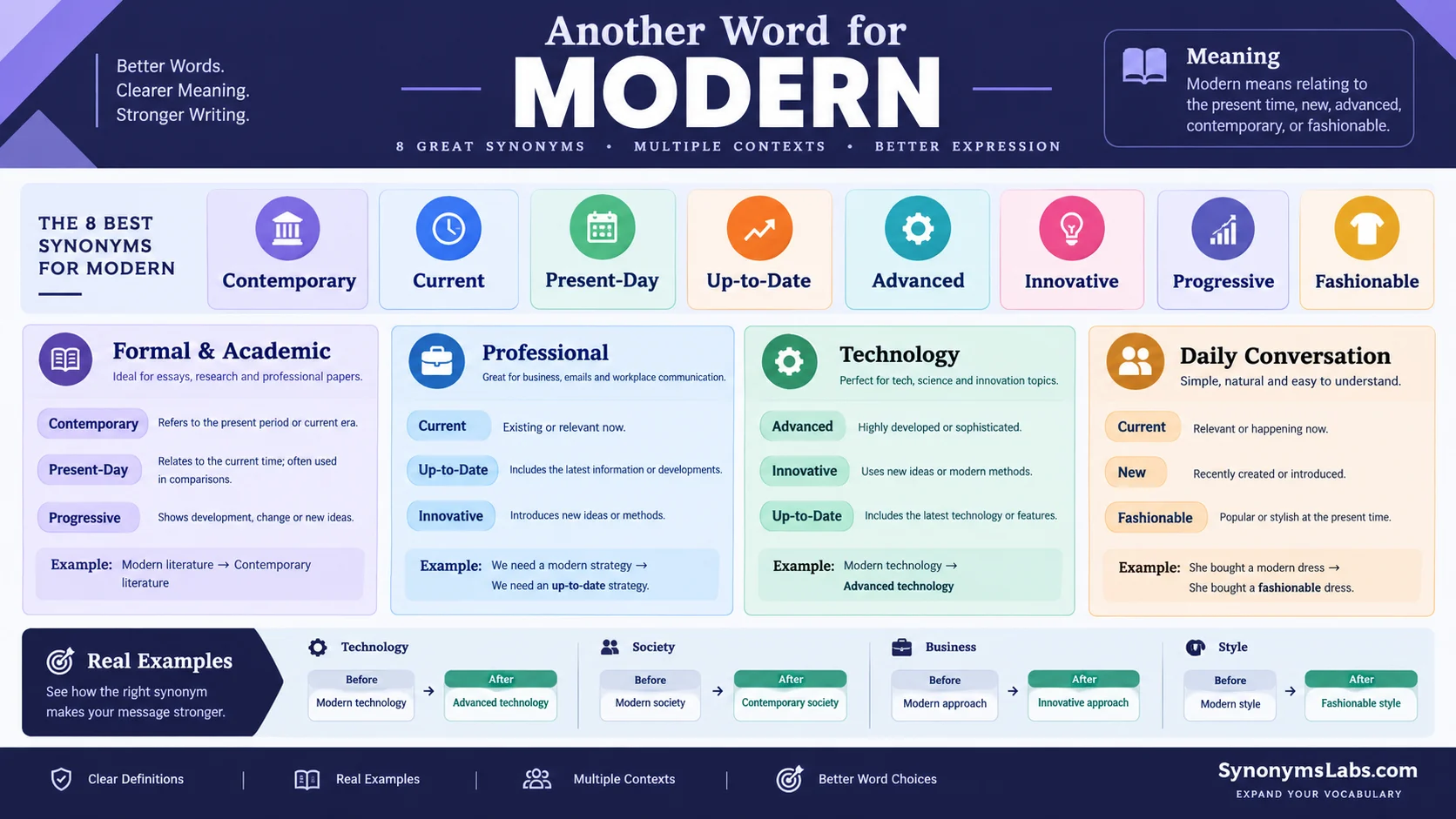
If you need another word for modern, the best choice depends on what you mean. Common alternatives include contemporary, current, present-day, up-to-date, recent, innovative, progressive, advanced, and fashionable. For general writing, contemporary is one of the closest replacements, while current works well when you mean something relevant or existing now.
What Does Modern Mean?
Definition
Modern generally means relating to the present time or to recent times. It can also describe something that is new, advanced, contemporary, fashionable, or influenced by current ideas and technology.
The meaning changes slightly depending on context. For example, a “modern building” may have a contemporary architectural style, while “modern technology” usually means current or advanced technology.
Because of these different meanings, there is no single synonym for modern that works in every sentence.
Common Uses
The word modern is commonly used to describe:
- Current ideas, practices, or attitudes
- New or recently developed technology
- Contemporary art, architecture, or design
- Present-day lifestyles and society
- Advanced methods or systems
- Fashionable or current styles
For example:
Original: The company uses modern technology.
Better alternatives: The company uses advanced technology or cutting-edge technology.
But:
Original: Modern society has changed significantly.
Better alternative: Contemporary society has changed significantly.
Choosing the right synonym depends on the exact meaning you want to communicate.
Best Synonyms for Modern
| Synonym | Meaning | Best Used When | Example |
|---|---|---|---|
| Contemporary | Existing or occurring in the present period | Formal, academic, and cultural writing | Contemporary architecture often emphasizes simplicity. |
| Current | Existing or relevant now | General and professional writing | We need to review the current policy. |
| Present-day | Relating to the present time | Comparisons with the past | Present-day technology is highly advanced. |
| Up-to-date | Incorporating the latest information or developments | Technology, information, and systems | Make sure your software is up-to-date. |
| Recent | Happening or developed not long ago | New developments or events | The company announced a recent update. |
| Advanced | Highly developed or sophisticated | Technology, systems, and methods | The hospital uses advanced equipment. |
| Innovative | Introducing new ideas or methods | Business, technology, and products | The startup developed an innovative solution. |
| Progressive | Favoring new ideas, development, or reform | Social, political, and organizational contexts | The organization has a progressive approach. |
| Cutting-edge | Extremely advanced and innovative | Technology and marketing | They developed cutting-edge software. |
| Fashionable | Popular or stylish at the present time | Clothing, design, and lifestyle | The restaurant has a fashionable interior. |
| Contemporary-style | Reflecting current design trends | Art, interiors, and architecture | The home features contemporary-style furniture. |
| New | Recently created or introduced | Simple everyday communication | We launched a new product. |
Contemporary
Meaning: Existing or occurring in the present period; also used for styles, art, culture, and design associated with the current era.
Best Used For: Academic writing, formal writing, architecture, art, culture, and professional communication.
Tone: Formal and polished
Difficulty: Medium
Usage Frequency: Very Common
Business Example: The company adopted a contemporary approach to customer service.
Academic Example: Contemporary research provides new perspectives on the issue.
Daily Conversation Example: I prefer contemporary furniture for my apartment.
Current
Meaning: Existing, happening, or relevant at the present time.
Best Used For: Business writing, emails, reports, policies, information, and everyday communication.
Tone: Neutral and professional
Difficulty: Easy
Usage Frequency: Very Common
Business Example: Please review the current pricing structure.
Academic Example: Current evidence suggests that the method is effective.
Daily Conversation Example: What’s the current price?
Advanced
Meaning: Highly developed, sophisticated, or technologically improved.
Best Used For: Technology, medicine, engineering, education, software, and technical writing.
Tone: Professional
Difficulty: Easy
Usage Frequency: Very Common
Business Example: Our company uses advanced analytics to understand customer behavior.
Academic Example: The laboratory relies on advanced research equipment.
Daily Conversation Example: This phone has some pretty advanced features.
Innovative
Meaning: Introducing new ideas, methods, products, or solutions.
Best Used For: Business writing, marketing copy, technology, product descriptions, and professional communication.
Tone: Positive and professional
Difficulty: Medium
Usage Frequency: Common
Business Example: The company introduced an innovative approach to employee training.
Academic Example: The researchers proposed an innovative method for collecting data.
Daily Conversation Example: That’s an innovative way to solve the problem.
Synonyms by Context
Formal Writing
For formal writing, the strongest alternatives to modern are usually:
Contemporary, current, present-day, advanced, progressive, and innovative.
“Contemporary” is especially useful when discussing society, literature, art, architecture, culture, or academic subjects.
Example:
Instead of:
Modern literature reflects changing social values.
Use:
Contemporary literature reflects changing social values.
The replacement sounds natural without changing the basic meaning.
Professional Writing
In business communication, current, up-to-date, advanced, and innovative are often more precise than modern.
Original: We need a modern business strategy.
More precise: We need an up-to-date business strategy.
If the strategy is based on new ideas rather than simply being current, use innovative instead.
Academic Writing
Academic writing benefits from precise terminology. Contemporary, current, and present-day are particularly useful.
Original: Modern studies examine the effects of technology.
Improved: Contemporary studies examine the effects of technology.
However, if “modern” refers to a historical period, replacing it with contemporary may change the meaning. Always consider the intended time period before choosing a synonym.
Daily Conversation
For casual communication, simple alternatives such as new, current, up-to-date, recent, and fashionable are usually easier to understand.
Original: She bought a modern dress.
Depending on the meaning, you could say:
- She bought a fashionable dress.
- She bought a new dress.
- She bought a contemporary-style dress.
Each option communicates something slightly different.
Professional Alternatives for Modern
If you are writing a resume, business proposal, report, website, or professional email, consider these alternatives:
- Contemporary — polished and formal
- Current — relevant to the present
- Advanced — technologically or technically developed
- Innovative — based on new ideas
- Progressive — focused on development or change
- Up-to-date — incorporating the latest information
- Cutting-edge — highly advanced
- State-of-the-art — using the newest available technology or methods
For example, instead of saying:
We use modern software.
A more informative professional sentence would be:
We use advanced software to improve workflow efficiency.
This gives the reader a clearer idea of what “modern” means.
Simple Alternatives for Modern
If your goal is clear, easy-to-understand writing, use:
New, current, recent, present-day, up-to-date, or latest.
These words are particularly useful for general audiences.
For example:
We offer modern solutions.
can become:
We offer new solutions.
Or, if the solutions reflect the latest developments:
We offer up-to-date solutions.
Simple wording is often stronger than a more complicated synonym when the context is straightforward.
Stronger Alternatives for Modern
When modern does not fully communicate the level of advancement, stronger alternatives include:
Advanced: emphasizes development and sophistication.
Cutting-edge: emphasizes very recent and highly advanced innovation.
State-of-the-art: suggests the best or most advanced technology or equipment currently available.
Innovative: emphasizes originality and new ideas.
Revolutionary: suggests a major change that significantly transforms an industry, system, or way of thinking.
For example:
The company uses modern technology.
is relatively vague.
A stronger version might be:
The company uses cutting-edge technology to automate its operations.
Use stronger terms only when the context supports them. Calling something “revolutionary” makes a much stronger claim than simply calling it “modern.”
Difference Between Similar Synonyms
Modern vs. Contemporary
Modern is broad and can mean current, new, advanced, or stylistically current. Contemporary more specifically refers to the present period or to something associated with the current era.
Modern vs. Current
Current primarily means existing or relevant now. Modern can also suggest a newer style, approach, or level of development.
Modern vs. Advanced
Advanced emphasizes sophistication or technical development. Something can be modern without being advanced.
Modern vs. Innovative
Innovative means introducing new ideas or methods. Something can be modern simply because it is current, without being innovative.
Modern vs. Fashionable
Fashionable means popular or stylish at a particular time. It is most appropriate for clothing, design, lifestyle, and aesthetics.
Modern vs. New
New usually means recently created, obtained, introduced, or experienced. Modern does not necessarily mean newly created.
For example, a building constructed decades ago may have a modern design, even though the building itself is not new.
Opposite Words
Depending on the meaning, common opposites of modern include:
- Old-fashioned
- Traditional
- Ancient
- Outdated
- Obsolete
- Antiquated
- Conventional
- Historical
The correct opposite depends on context.
For technology, obsolete or outdated may be appropriate.
For design or lifestyle, traditional or old-fashioned may be better.
For historical periods, ancient may provide the clearest contrast.
FAQs
What is another word for modern?
The best general synonym for modern is contemporary. Other alternatives include current, present-day, up-to-date, advanced, innovative, progressive, recent, fashionable, and new, depending on the intended meaning.
What is a formal synonym for modern?
Contemporary is one of the best formal synonyms for modern. Current, present-day, and progressive can also work in formal writing when their meanings fit the context.
What is a professional alternative for modern?
Professional alternatives include contemporary, current, advanced, innovative, up-to-date, and state-of-the-art. Choose advanced for technology, current for information, and innovative for new ideas or approaches.
What word can replace modern?
You can replace modern with contemporary, current, present-day, recent, new, advanced, innovative, progressive, up-to-date, or fashionable. The best replacement depends on what “modern” means in the sentence.
What is another word for modern technology?
Depending on the context, alternatives include advanced technology, cutting-edge technology, current technology, state-of-the-art technology, and next-generation technology.
What is another word for modern style?
Good alternatives include contemporary style, current style, fashionable style, contemporary design, and up-to-date design.
What is another word for modern society?
Contemporary society and present-day society are natural alternatives. In academic writing, contemporary society is often the more polished choice.
Conclusion
The best synonym for modern depends on the meaning you want to express. Contemporary is an excellent general replacement, particularly in formal and academic writing. Current works best when you mean something relevant or existing now, while advanced emphasizes development and sophistication. Innovative highlights new ideas, and up-to-date emphasizes the latest information or developments.
For stronger writing, avoid replacing modern automatically. First identify what you mean: current, new, advanced, fashionable, innovative, or contemporary. Then choose the synonym that communicates that specific idea.
