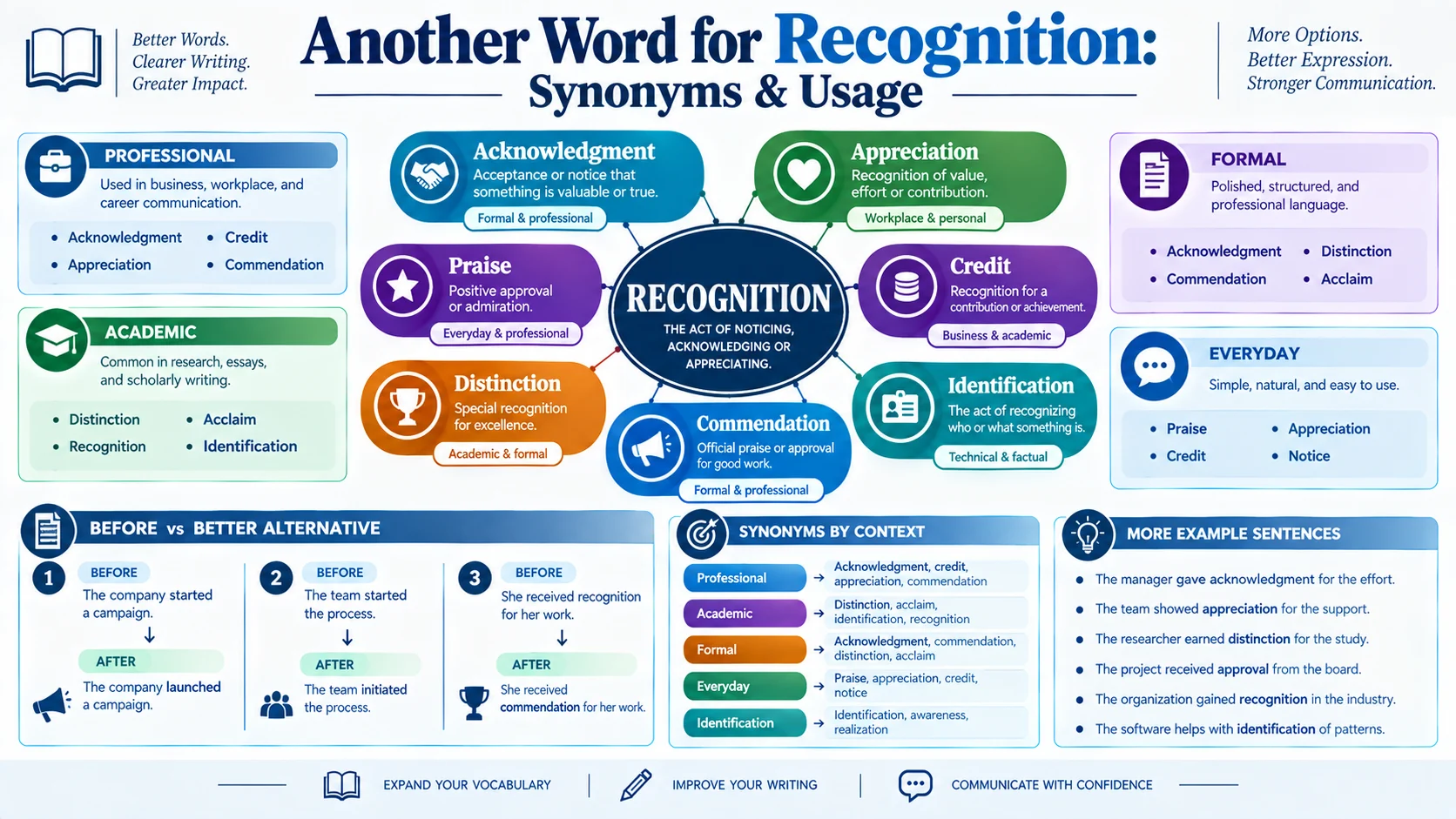
If you need another word for recognition, the best choice depends on your meaning. Common alternatives include acknowledgment, appreciation, praise, approval, credit, distinction, identification, awareness, and realization. For professional writing, acknowledgment or appreciation often works well, while identification is better when recognition means identifying someone or something.
What Does Recognition Mean?
Definition
Recognition is the act of noticing, identifying, acknowledging, or showing appreciation for someone or something. The exact meaning changes according to context.
For example:
- Recognition for achievement means praise, appreciation, or acknowledgment.
- Recognition of a person means identification.
- Recognition of a problem means awareness or realization.
- Professional recognition can mean acknowledgment, distinction, or credit for good work.
Because recognition has several meanings, there is no single synonym that works in every sentence. The strongest replacement depends on what you are trying to communicate.
Common Uses
Recognition commonly appears in four situations:
- Praise or appreciation: “She received recognition for her leadership.”
- Identification: “Facial recognition identified the person.”
- Awareness: “The recognition of the problem came too late.”
- Official acknowledgment: “The organization received recognition for its work.”
Understanding this distinction helps you choose a synonym that sounds natural rather than simply replacing the word mechanically.
Best Synonyms for Recognition
| Synonym | Meaning | Best Used When | Example |
|---|---|---|---|
| Acknowledgment | Public or personal acceptance that something deserves notice | Formal and professional writing | The employee received acknowledgment for her contribution. |
| Appreciation | Recognition of someone’s value or effort | Workplace and personal situations | The team showed appreciation for his hard work. |
| Praise | Expression of approval or admiration | Everyday and professional writing | She earned praise for her performance. |
| Credit | Recognition given for an achievement or contribution | Business and academic contexts | He deserves credit for the successful campaign. |
| Distinction | Special recognition for excellence | Academic and formal contexts | She graduated with distinction. |
| Approval | Positive acceptance or agreement | Decisions, ideas, and actions | The proposal received approval from management. |
| Identification | The act of recognizing what or who something is | Technical and factual contexts | Facial identification confirmed the person’s identity. |
| Awareness | Knowledge or understanding of something | Issues, risks, and conditions | Increased awareness of the problem is essential. |
| Realization | Becoming aware of or understanding something | Personal and analytical writing | His realization of the mistake came later. |
| Acclaim | Strong public praise or approval | Achievements and creative work | The film received critical acclaim. |
Acknowledgment
Meaning: Acceptance, notice, or recognition of a person, fact, contribution, or achievement.
Best Used For: Formal, professional, business, and academic writing.
Tone: Formal and neutral.
Difficulty: Medium
Usage Frequency: Common
Best For: Resumes, emails, essays, business writing, and professional documents.
Business Example:
“The manager received acknowledgment for improving team productivity.”
Academic Example:
“The study includes an acknowledgment of the researchers who contributed to the project.”
Daily Conversation Example:
“She gave me a quick acknowledgment when I arrived.”
Appreciation
Meaning: Recognition of someone’s value, effort, quality, or contribution.
Best Used For: Showing gratitude or valuing someone’s work.
Tone: Warm, positive, and professional.
Difficulty: Easy
Usage Frequency: Very Common
Best For: Emails, workplace communication, personal writing, and professional recognition.
Business Example:
“The company expressed its appreciation for employees who exceeded their annual goals.”
Academic Example:
“The professor showed appreciation for the student’s thoughtful research.”
Daily Conversation Example:
“I really appreciate your help.”
Praise
Meaning: Positive approval or admiration expressed toward someone or something.
Best Used For: Commending performance, behavior, work, or achievements.
Tone: Positive and direct.
Difficulty: Easy
Usage Frequency: Very Common
Best For: Daily conversation, emails, marketing copy, and general writing.
Business Example:
“The sales representative received praise for handling the client professionally.”
Academic Example:
“The student’s presentation earned praise from the faculty.”
Daily Conversation Example:
“She received a lot of praise for her cooking.”
Credit
Meaning: Recognition given to someone for a contribution or achievement.
Best Used For: Assigning responsibility or acknowledging someone’s role in success.
Tone: Neutral and professional.
Difficulty: Easy
Usage Frequency: Very Common
Best For: Business writing, academic writing, journalism, and everyday communication.
Business Example:
“The director gave the marketing team credit for the campaign’s success.”
Academic Example:
“The researchers gave credit to earlier studies that influenced their work.”
Daily Conversation Example:
“Give him credit for trying.”
Synonyms by Context
Formal Writing
For formal writing, the strongest alternatives are:
- Acknowledgment
- Appreciation
- Distinction
- Acclaim
- Commendation
For example:
“The organization received recognition for its contribution to the community.”
can become:
“The organization received acknowledgment for its contribution to the community.”
Or, when emphasizing excellence:
“The organization received distinction for its contribution to the community.”
Professional Writing
In workplace and business communication, use words such as acknowledgment, appreciation, credit, commendation, or praise.
For example:
“The employee received recognition for outstanding performance.”
A more specific professional version is:
“The employee received commendation for outstanding performance.”
If the purpose is to express gratitude rather than award status, appreciation may sound more natural.
Academic Writing
Academic contexts often require precise distinctions. Useful alternatives include acknowledgment, identification, awareness, distinction, credit, and realization.
For example:
“Recognition of the limitations is important.”
can become:
“Awareness of the limitations is important.”
But:
“The student received recognition for academic excellence.”
could become:
“The student received distinction for academic excellence.”
The appropriate synonym depends on whether recognition means awareness or an honor.
Daily Conversation
For everyday speech, choose simple words such as:
- Praise
- Appreciation
- Credit
- Approval
- Notice
Instead of:
“She received recognition for helping the neighbors.”
you could say:
“She received praise for helping the neighbors.”
Professional Alternatives for Recognition
If you are writing a resume, LinkedIn profile, cover letter, performance review, or business document, consider these alternatives:
Acknowledgment — professional and broadly applicable.
Appreciation — emphasizes gratitude or value.
Commendation — emphasizes formal praise.
Distinction — emphasizes exceptional achievement.
Acclaim — emphasizes strong public approval.
Credit — emphasizes contribution to a result.
Honor — emphasizes an award or respected status.
For example, instead of saying:
“Received recognition for improving customer satisfaction.”
a resume could say:
“Received commendation for improving customer satisfaction.”
Or:
“Earned distinction for improving customer satisfaction.”
The second version suggests a particularly high level of achievement.
Simple Alternatives for Recognition
When writing for a general audience, these words are easy to understand:
- Praise
- Notice
- Credit
- Approval
- Appreciation
- Honor
- Awareness
- Identification
Praise is usually the easiest replacement when recognition means positive feedback.
Identification is the better choice when recognition means determining who or what something is.
Stronger Alternatives for Recognition
When you want language that conveys a higher level of importance or achievement, consider:
- Acclaim
- Commendation
- Distinction
- Honor
- Prestige
- Celebration
For example:
“The author received recognition for the novel.”
is relatively neutral.
A stronger version might be:
“The author received critical acclaim for the novel.”
Here, acclaim communicates stronger and more public praise than the general word recognition.
Difference Between Similar Synonyms
Choosing the right synonym requires understanding the small differences between these words.
Recognition vs. Acknowledgment
Recognition is broader. It can mean identifying, noticing, appreciating, or honoring something.
Acknowledgment usually emphasizes openly admitting, accepting, or giving notice to something.
Recognition vs. Appreciation
Recognition can simply mean noticing an achievement.
Appreciation carries a stronger sense of valuing or being grateful for someone’s contribution.
Recognition vs. Praise
Praise specifically expresses approval or admiration.
Recognition may be formal and does not always involve enthusiastic praise.
Recognition vs. Identification
Identification is appropriate when recognition means determining who or what something is.
For example, facial recognition technology is essentially concerned with identifying a person based on visual characteristics.
Recognition vs. Distinction
Distinction suggests an honor or special status earned through excellence.
“Recognition” is more general, while “distinction” usually implies a higher level of achievement.
Recognition vs. Acclaim
Acclaim means enthusiastic public approval or praise.
It is a stronger and more expressive alternative to recognition when describing major success.
Opposite Words
The opposite of recognition depends on which meaning is intended.
When recognition means acknowledgment or praise, possible opposites include:
- Disregard
- Neglect
- Dismissal
- Criticism
- Rejection
When recognition means identification or awareness, possible opposites include:
- Unawareness
- Ignorance
- Misidentification
- Confusion
- Unfamiliarity
For example:
“The employee received recognition for her work.”
The opposite idea might be:
“The employee’s work was ignored.”
But if recognition means identifying someone:
“The system failed to identify the person.”
the opposite concept could be misidentification or failure to recognize the person.
FAQs
What is another word for recognition?
Common alternatives for recognition include acknowledgment, appreciation, praise, credit, distinction, approval, identification, awareness, realization, and acclaim. The best choice depends on whether recognition means praise, identification, awareness, or an honor.
What is a formal synonym for recognition?
Acknowledgment, commendation, distinction, and acclaim are strong formal alternatives. Acknowledgment is especially versatile in professional and academic writing.
What is a professional alternative for recognition?
For professional writing, use acknowledgment, appreciation, commendation, credit, distinction, or recognition of achievement, depending on the intended meaning.
What word can replace recognition on a resume?
Commendation, distinction, acknowledgment, honor, achievement, or acclaim can replace recognition on a resume. Choose a word that accurately describes what happened rather than simply choosing the strongest-sounding term.
For example:
“Received recognition for outstanding sales performance.”
could become:
“Received commendation for outstanding sales performance.”
What is another word for recognition of achievement?
Useful alternatives include acknowledgment, commendation, honor, distinction, praise, acclaim, and credit.
What is another word for recognition in the workplace?
Depending on the situation, use appreciation, acknowledgment, praise, commendation, credit, or reward. Appreciation works well for employee contributions, while commendation suggests formal praise.
What is another word for recognition of a problem?
Awareness, realization, identification, understanding, or acknowledgment may work. For example, “recognition of the problem” can often be rewritten as “awareness of the problem.”
What is another word for facial recognition?
In a technical context, facial identification or face identification may describe the identification aspect of facial recognition. However, “facial recognition” remains the standard term for the broader technology.
Conclusion
The best synonym for recognition depends on what you mean. Use acknowledgment for formal notice, appreciation for gratitude and value, praise for positive feedback, credit for someone’s contribution, distinction for exceptional achievement, and identification when recognition means determining who or what something is.
For everyday writing, praise, appreciation, and credit are usually natural choices. For professional or academic writing, acknowledgment, commendation, and distinction can provide greater precision. Always choose the synonym that preserves the original meaning rather than selecting a replacement based only on similarity.

1 thought on “Another Word for Recognition| 20+ Synonyms For 2026”