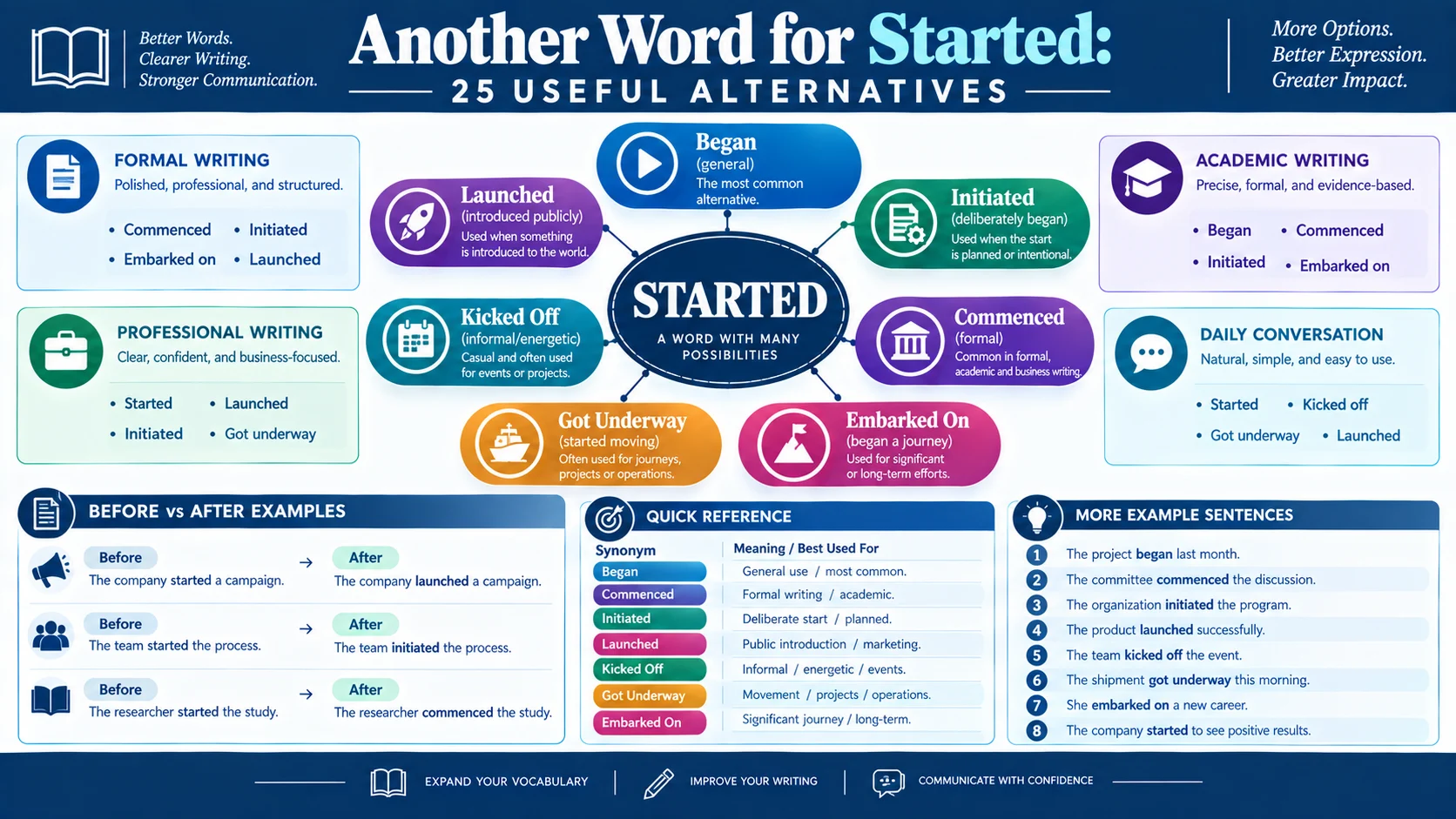
Another word for “started” is began, commenced, initiated, launched, opened, started off, got underway, or embarked on. The best synonym depends on context: began is natural for everyday English, commenced is more formal, initiated works well for actions or processes, launched suits projects or businesses, and got underway describes an event or activity that has begun. These alternatives can make academic, professional, formal, and everyday writing clearer and more precise.
What Does Started Mean?
Definition
Started means began, initiated, or caused something to begin. It can describe an action, event, process, activity, journey, career, business, machine, or conversation that has begun.
For example, “The meeting started at 9 a.m.” means the meeting began at 9 a.m. Depending on the context, better alternatives include began, commenced, initiated, launched, kicked off, activated, embarked on, and got underway.
Common Uses
The word started is extremely common and works in both casual and formal English. However, a more specific synonym can make your writing clearer or more professional.
For example:
- The company started a new project. → The company initiated a new project.
- The event started at noon. → The event began at noon.
- She started her career in finance. → She began her career in finance.
- The campaign started last month. → The campaign launched last month.
- The engine started immediately. → The engine ignited immediately.
Best Synonyms for Started
| Synonym | Meaning | Best Used When | Example |
|---|---|---|---|
| Began | Started or came into progress | General writing | The class began at 10 a.m. |
| Commenced | Began formally | Formal or official writing | Construction commenced in June. |
| Initiated | Caused something to begin | Business, technical, or formal contexts | The team initiated the review process. |
| Launched | Started something publicly or officially | Products, businesses, campaigns | The company launched a new service. |
| Kicked off | Started an event or activity | Conversational or business writing | The conference kicked off Monday. |
| Got underway | Began to happen or progress | Events and activities | The ceremony got underway at noon. |
| Embarked on | Began a journey, project, or undertaking | Formal and professional writing | She embarked on a new career. |
| Opened | Began an event, discussion, or session | Meetings and presentations | The director opened the meeting. |
| Introduced | Brought something new into use or discussion | Products, ideas, policies | The company introduced a new policy. |
| Activated | Made a system or device operational | Technology and equipment | The technician activated the system. |
| Ignited | Caused something to start, literally or figuratively | Fire, energy, enthusiasm | The speech ignited public interest. |
| Triggered | Caused an event or reaction to begin | Technical, analytical, or news contexts | The announcement triggered a debate. |
Began
Meaning: Started or entered into progress.
Best Used For: Everyday, academic, professional, and general writing.
Tone: Neutral.
Difficulty: Easy.
Usage Frequency: Very Common.
Best For: Resume writing, email writing, essays, business writing, and everyday conversation.
Business Example: The company began expanding into new markets in 2025.
Academic Example: The study began with a review of previous research.
Daily Conversation Example: I began working on my homework after dinner.
“Began” is usually the safest direct replacement for “started.”
Commenced
Meaning: Began in a formal or official sense.
Best Used For: Formal documents, announcements, legal writing, reports, and official communication.
Tone: Formal.
Difficulty: Advanced.
Usage Frequency: Common in formal contexts; less common in casual speech.
Business Example: The construction project commenced in January.
Academic Example: Data collection commenced after the participants provided consent.
Daily Conversation Example: The ceremony commenced at 7 p.m.
Although “commenced” is grammatically correct, it can sound unnecessarily formal in casual conversation.
Initiated
Meaning: Caused a process, action, or activity to begin.
Best Used For: Business, academic, technical, and professional writing.
Tone: Formal and precise.
Difficulty: Medium.
Usage Frequency: Common.
Business Example: The manager initiated a company-wide training program.
Academic Example: Researchers initiated a new phase of the experiment.
Daily Conversation Example: She initiated a conversation about the problem.
Use initiated when you want to emphasize the act of setting something in motion rather than simply observing that it began.
Launched
Meaning: Started or introduced something, usually with a deliberate or public purpose.
Best Used For: Businesses, products, websites, campaigns, services, initiatives, and marketing.
Tone: Professional and energetic.
Difficulty: Easy.
Usage Frequency: Very Common.
Business Example: The company launched its new software platform.
Academic Example: The university launched a new research initiative.
Daily Conversation Example: They launched a fundraiser for the community.
“Launch” is stronger and more specific than “start” when something is being introduced publicly or strategically.
Kicked Off
Meaning: Started an event, project, meeting, or activity.
Best Used For: Conversations, business communication, sports, events, and informal writing.
Tone: Casual and energetic.
Difficulty: Easy.
Usage Frequency: Very Common.
Business Example: The marketing team kicked off the campaign on Monday.
Academic Example: The workshop kicked off with a short presentation.
Daily Conversation Example: The party kicked off around eight.
For formal academic or professional documents, began or commenced may be preferable.
Synonyms by Context
Formal Writing
When replacing “started” in formal writing, choose a synonym that matches the seriousness and purpose of the sentence.
Strong choices include:
commenced, initiated, embarked on, inaugurated, launched, and got underway.
Examples:
- The investigation commenced in March.
- The organization initiated a comprehensive review.
- The committee embarked on a major reform program.
Commenced is particularly useful for official processes, while initiated emphasizes deliberate action.
Professional Writing
In workplace and business writing, the best alternative depends on what actually started.
Use launched for products and campaigns, initiated for processes, began for general activities, and kicked off for meetings or projects when a conversational tone is acceptable.
For example:
The company launched its new customer service program.
This is more precise than:
The company started its new customer service program.
Academic Writing
Academic writing generally benefits from precise, neutral language.
Useful alternatives include:
began, commenced, initiated, originated, and embarked on.
Examples:
- The experiment began in September.
- The researchers initiated a second phase of testing.
- The investigation commenced after preliminary approval.
Avoid replacing every instance of “started” with a more complicated word. In academic writing, began is often clearer and more natural.
Daily Conversation
For everyday speech, the most natural alternatives are:
began, kicked off, got underway, and got going.
Examples:
- “The movie started at eight.”
- “The movie began at eight.”
- “The movie got underway at eight.”
“Began” sounds natural in nearly every situation, while “kicked off” adds an informal, energetic tone.
Professional Alternatives for Started
If you are writing a resume, cover letter, LinkedIn profile, business report, or professional email, consider replacing “started” with a more precise verb.
Initiated — emphasizes taking action.
Launched — suggests introducing something new.
Established — suggests creating something that becomes ongoing or permanent.
Implemented — suggests putting a plan, policy, or system into operation.
Introduced — emphasizes bringing something new to people or an organization.
Commenced — appropriate for formal projects or procedures.
Embarked on — useful for describing the beginning of a major project, career, or undertaking.
For example:
Weak: “I started a customer retention program.”
Stronger: “I initiated a customer retention program.”
Even stronger when accurate: “I developed and implemented a customer retention program.”
The best replacement is not always a direct synonym. Choose the word that explains what you actually did.
Simple Alternatives for Started
If you want easy words that most readers immediately understand, use:
- Began
- Opened
- Launched
- Introduced
- Kicked off
- Got underway
- Got going
- Initiated
For most situations, began is the simplest one-word replacement.
Stronger Alternatives for Started
Some alternatives add meaning that “started” does not communicate by itself.
Launched suggests a deliberate public beginning.
Initiated suggests someone caused a process to begin.
Established suggests creating something that will continue.
Implemented suggests putting a plan or system into practice.
Ignited suggests creating excitement, energy, conflict, or interest.
Triggered suggests causing a reaction or event.
Embarked on suggests beginning a significant journey, project, or undertaking.
This distinction matters because synonyms are not always interchangeable. “The manager started a policy” is grammatically understandable, but “The manager implemented a policy” communicates a much more specific action.
Difference Between Similar Synonyms
Started vs. Began
These words are usually interchangeable. Began is slightly more polished in many forms of writing.
Started vs. Commenced
Commenced is more formal. It works well in official documents but can sound stiff in casual conversation.
Started vs. Initiated
Initiated emphasizes deliberately causing something to begin. It is particularly useful for processes, programs, investigations, and actions.
Started vs. Launched
Launched implies a deliberate introduction, often involving a product, service, campaign, company, or initiative.
Started vs. Kicked Off
Kicked off is informal and energetic. It is common in conversation, sports, meetings, projects, and marketing.
Started vs. Established
Established does not simply mean “began.” It often implies creating something that becomes recognized, functioning, or permanent.
Opposite Words
Depending on the context, opposites of started include:
- Ended
- Finished
- Stopped
- Completed
- Concluded
- Terminated
- Halted
- Ceased
- Closed
- Ended
For example:
Started the meeting → ended the meeting
Started the project → completed the project
Started the machine → stopped the machine
The correct opposite depends on what “started” means in the original sentence.
FAQs
What is another word for started?
The best general synonym for started is began. Other alternatives include commenced, initiated, launched, kicked off, got underway, embarked on, and opened, depending on the context.
What is a formal synonym for started?
Commenced is one of the most formal direct synonyms for “started.” Initiated is also highly useful in professional, academic, and official writing.
What is a professional alternative for started?
Professional alternatives include initiated, launched, established, implemented, introduced, commenced, and began. The best choice depends on the action being described.
What word can replace started?
Began can replace “started” in most general sentences. For more precise writing, consider initiated for processes, launched for new products or campaigns, and implemented for plans or systems.
What is another word for started in an essay?
For an essay, began is usually the safest alternative. Depending on context, commenced, initiated, originated, or embarked on may also work.
What is another word for started a project?
Good alternatives include initiated a project, launched a project, began a project, commenced a project, or embarked on a project.
What is another word for started a business?
Depending on the intended meaning, use founded, established, launched, created, or opened. These are often more precise than simply saying “started a business.”
What is another word for started working?
You can say began working, commenced work, started employment, began a position, or entered the workforce, depending on the context.
What is another word for started a conversation?
Useful alternatives include initiated a conversation, opened a conversation, began a discussion, or broached the subject.
Is “began” better than “started”?
Not always. Began is a direct, natural alternative and can sound slightly more polished, but started is completely correct and natural in American English. Choose based on context rather than replacing the word simply for variety.
Conclusion
The best synonym for started depends on what you are describing and the tone you want to create. Began is the most versatile replacement, while commenced works well in formal writing, initiated emphasizes deliberate action, launched fits products and campaigns, and kicked off is natural for informal or energetic contexts.
For stronger writing, focus on precision rather than simply choosing a more complicated word. A good synonym should preserve the original meaning while making the sentence clearer, more natural, or more specific.

1 thought on “Another Word for Started| 25 Useful Alternatives For 2026”