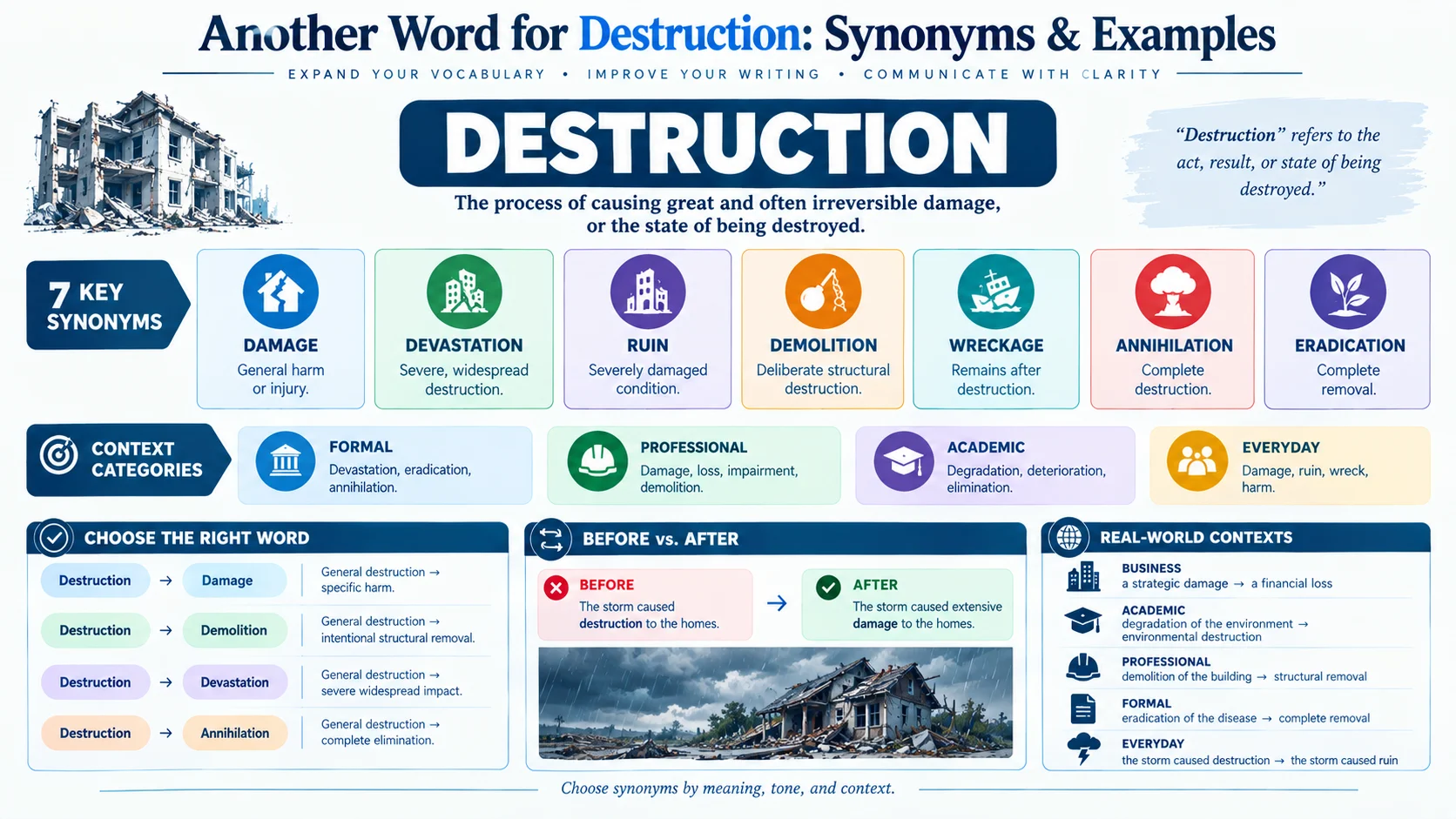
What is another word for destruction? Common alternatives for destruction include devastation, ruin, demolition, damage, devastation, annihilation, devastation, and wreckage. The best replacement depends on the context. For physical damage, damage or devastation may fit; for intentional structural removal, demolition is more precise; for complete destruction, annihilation is stronger.
What Does Destruction Mean?
Definition
Destruction means the act or process of damaging, ruining, breaking down, or completely eliminating something. It can describe physical objects, buildings, environments, systems, relationships, or abstract things such as hopes and plans.
For example:
The storm caused widespread destruction across the region.
The word can describe anything from limited damage to complete ruin, so the right synonym depends heavily on how severe the destruction is, whether it was intentional, and what was affected.
Common Uses
Destruction is commonly used in contexts involving:
- Natural disasters and severe weather
- War and conflict
- Buildings and structures
- Property damage
- Environmental harm
- Businesses and organizations
- Relationships and reputations
- Plans, hopes, or opportunities
- Complete elimination of something
Because these contexts differ, replacing destruction with a synonym requires attention to meaning and tone.
Best Synonyms for Destruction
| Synonym | Meaning | Best Used When | Example |
|---|---|---|---|
| Damage | Harm that reduces condition or value | Some harm has occurred but complete ruin is not implied | The flood caused significant damage to homes. |
| Devastation | Severe and widespread destruction | Describing extensive or emotionally significant damage | The hurricane left widespread devastation. |
| Ruin | A state of severe damage or collapse | Something has been badly damaged or rendered unusable | The fire left the building in ruins. |
| Demolition | Deliberate destruction of a structure | A building or structure is intentionally taken down | The old stadium was scheduled for demolition. |
| Wreckage | Remains left after destruction | Describing what remains after an accident or disaster | Crews searched through the wreckage. |
| Annihilation | Complete destruction or elimination | Total destruction is emphasized | The battle resulted in the annihilation of the opposing force. |
| Devastating damage | Extremely serious harm | Professional or news-style descriptions of severe effects | The company suffered devastating damage to its facilities. |
| Eradication | Complete removal or elimination | A problem, threat, disease, or unwanted thing is eliminated | The campaign focused on the eradication of invasive species. |
Synonym: Damage
Meaning: Harm caused to something without necessarily destroying it completely.
Best used for: Property, equipment, buildings, finances, reputation, or physical objects.
Tone: Neutral
Difficulty: Easy
Usage Frequency: Very Common
Best for: Resume writing, email writing, essays, business writing, and everyday communication.
Business example: The company assessed the damage after the warehouse accident.
Academic example: Researchers examined the environmental damage caused by industrial activity.
Daily conversation: The storm did some damage to my car.
Damage is usually the safest general alternative because it does not automatically suggest complete destruction.
Synonym: Devastation
Meaning: Severe, widespread destruction that produces major consequences.
Best used for: Natural disasters, war, communities, economies, and major crises.
Tone: Strong and serious
Difficulty: Medium
Usage Frequency: Common
Best for: Essay writing, journalism, business writing, and descriptive writing.
Business example: The earthquake caused significant devastation to local infrastructure.
Academic example: The study documented the long-term ecological devastation caused by the wildfire.
Daily conversation: We saw the devastation left behind by the storm.
Synonym: Ruin
Meaning: A severely damaged, destroyed, or collapsed condition.
Best used for: Buildings, finances, plans, careers, relationships, and situations.
Tone: Neutral to dramatic
Difficulty: Easy
Usage Frequency: Very Common
Best for: Essays, creative writing, business writing, and everyday speech.
Business example: Poor financial decisions pushed the company toward ruin.
Academic example: Archaeologists studied the ruins of the ancient settlement.
Daily conversation: The leak left the room in ruin.
Synonym: Demolition
Meaning: The deliberate tearing down or destruction of a building or other structure.
Best used for: Buildings, bridges, walls, stadiums, and other physical structures.
Tone: Formal and technical
Difficulty: Medium
Usage Frequency: Common
Best for: Professional writing, construction documents, business communication, and news writing.
Business example: The contractor began demolition of the outdated office building.
Academic example: Urban planners examined the social effects of large-scale building demolition.
Daily conversation: The old house is scheduled for demolition.
Unlike destruction, demolition normally suggests intentional and controlled destruction, especially of a structure.
Synonym: Wreckage
Meaning: The broken remains of something that has been severely damaged or destroyed.
Best used for: Vehicles, aircraft, buildings, ships, and objects involved in accidents or disasters.
Tone: Neutral and descriptive
Difficulty: Medium
Usage Frequency: Common
Best for: News writing, essays, reports, and descriptive writing.
Business example: Engineers inspected the wreckage to determine the cause of the accident.
Academic example: Investigators analyzed aircraft wreckage as part of the study.
Daily conversation: They found pieces of the wreckage near the road.
Synonyms by Context
Formal Writing
Formal alternatives include devastation, destruction, demolition, eradication, and annihilation.
Choose the word according to the specific meaning:
- Devastation for widespread severe damage
- Demolition for intentional structural destruction
- Eradication for complete removal of a problem or threat
- Annihilation for total destruction
- Destruction as the broadest formal term
Example:
Basic: The policy resulted in the destruction of natural habitats.
More formal: The policy resulted in extensive environmental degradation and habitat loss.
The best formal replacement is not always a direct synonym. In academic and professional writing, a more precise term can communicate the specific type of harm.
Professional Writing
In business writing, words such as damage, loss, impairment, demolition, and disruption may be more precise than destruction.
For example:
Less precise: The incident caused destruction to company property.
More professional: The incident caused significant property damage.
For financial or organizational situations, loss may be appropriate:
The company reported substantial financial losses following the incident.
Academic Writing
Academic writing generally benefits from precision.
Useful alternatives include:
- Damage
- Degradation
- Deterioration
- Devastation
- Eradication
- Elimination
- Collapse
For example:
Industrial pollution contributed to the degradation of the surrounding ecosystem.
Here, degradation is more precise than destruction because it can describe a gradual decline rather than complete elimination.
Daily Conversation
Simple alternatives include damage, ruin, wreck, breakage, and mess, depending on the situation.
Examples:
- The storm caused a lot of damage.
- The fire left the building in ruins.
- The accident wrecked the vehicle.
- The flood made a huge mess of the basement.
In casual conversation, damage is often more natural than the stronger word destruction.
Professional Alternatives for Destruction
If you are writing a report, resume, email, or business document, consider these alternatives:
Damage: Best for physical or financial harm.
Loss: Best when something valuable has been lost.
Degradation: Best for gradual deterioration, especially environmental or technical contexts.
Demolition: Best for intentional removal of structures.
Elimination: Best when something is completely removed.
Disruption: Best when a system, service, process, or operation is interrupted rather than physically destroyed.
Collapse: Best when a structure, organization, system, or market fails.
Example:
The project reduced infrastructure damage following severe weather.
This sounds more precise and professional than using destruction in every situation.
Simple Alternatives for Destruction
For students and everyday writers, these easy alternatives are useful:
- Damage
- Ruin
- Harm
- Wreck
- Breakage
- Loss
- Collapse
Example:
Instead of:
The storm caused widespread destruction.
You could write:
The storm caused extensive damage.
Instead of:
The accident resulted in the destruction of the vehicle.
You could write:
The accident badly damaged the vehicle.
Stronger Alternatives for Destruction
When you need to communicate complete or extreme destruction, consider:
- Annihilation
- Devastation
- Obliteration
- Eradication
- Decimation
These words are not interchangeable in every sentence.
Annihilation emphasizes total destruction or elimination.
Obliteration suggests something is destroyed so completely that little or nothing remains.
Eradication focuses on completely removing something, particularly a problem, disease, threat, or unwanted condition.
Devastation emphasizes the scale and severity of the damage.
Decimation traditionally has a specific historical meaning, but in modern English it is also commonly used to mean severe destruction or reduction.
Difference Between Similar Synonyms
Destruction vs. Damage
Destruction can mean complete ruin or elimination, while damage generally means harm without necessarily implying total destruction.
The storm caused property damage.
The fire caused extensive destruction.
Destruction vs. Demolition
Destruction is broad. Demolition specifically refers to deliberate destruction, especially of structures.
The tornado caused the destruction of several buildings.
The city approved the demolition of the abandoned building.
Destruction vs. Devastation
Devastation emphasizes the severity and widespread consequences of destruction.
The explosion caused destruction inside the facility.
The disaster caused widespread devastation throughout the community.
Destruction vs. Ruin
Destruction often describes the act or process of destroying something. Ruin can describe the resulting state.
The fire caused the destruction of the building.
The building was left in ruins.
Destruction vs. Eradication
Eradication means complete removal rather than simply physical destruction.
The program aims to eradicate the invasive species.
Using destruction in that sentence would change the emphasis from removal to damage.
Opposite Words
Common antonyms for destruction include:
- Construction
- Creation
- Building
- Restoration
- Preservation
- Protection
- Repair
- Renewal
- Maintenance
- Conservation
The best opposite depends on the context.
For a damaged building, restoration or repair may be the appropriate opposite. For environmental destruction, preservation or conservation may provide the clearest contrast.
FAQs
What is another word for destruction?
Common synonyms include damage, devastation, ruin, demolition, wreckage, annihilation, obliteration, and eradication. The correct choice depends on whether you mean general harm, severe damage, intentional destruction, or complete elimination.
What is a formal synonym for destruction?
Devastation, demolition, eradication, annihilation, obliteration, and degradation can work in formal writing, depending on context. Demolition is particularly appropriate for structures, while eradication works for complete removal of a problem or threat.
What is a professional alternative for destruction?
Damage, loss, degradation, demolition, impairment, disruption, or elimination can be professional alternatives. The most appropriate term depends on what was affected and the nature of the impact.
What word can replace destruction?
Damage is the most broadly useful replacement, but it may be weaker than destruction. Other options include devastation, ruin, demolition, wreckage, annihilation, obliteration, and eradication.
What is another word for complete destruction?
Strong alternatives include annihilation, obliteration, eradication, and total devastation. Annihilation and obliteration strongly emphasize completeness.
What is another word for destruction of a building?
Demolition is usually the most precise term when a building is intentionally torn down. Destruction or collapse may be more appropriate when the building is destroyed by an accident, disaster, or structural failure.
What is a synonym for destruction in an essay?
Depending on the subject, useful academic choices include damage, degradation, devastation, deterioration, collapse, eradication, and elimination. Choose the term that describes the specific process rather than simply replacing the word mechanically.
Conclusion
The best synonym for destruction depends on what you want to communicate. Use damage for general harm, devastation for severe widespread destruction, demolition for intentional structural removal, ruin for a badly damaged state, wreckage for the remains of something destroyed, and annihilation or obliteration when complete destruction is the central idea.
For professional and academic writing, precision matters more than choosing the strongest synonym. A carefully selected word can make your writing clearer, more natural, and more accurate.
