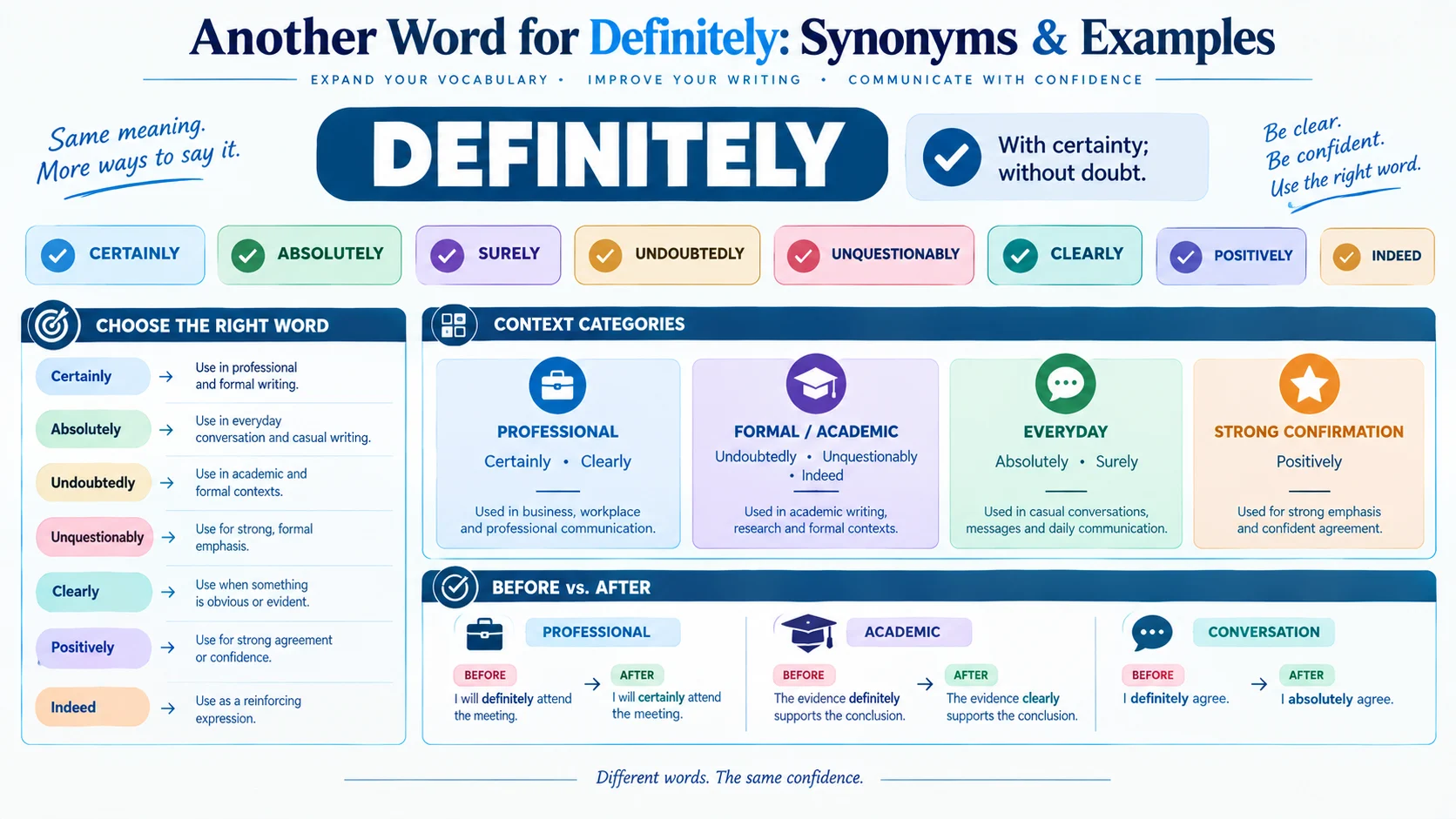
If you need another word for definitely, strong alternatives include certainly, surely, absolutely, undoubtedly, unquestionably, clearly, positively, and indeed. The best choice depends on context. Certainly works well in professional writing, absolutely adds emphasis, surely sounds conversational, and undoubtedly is especially useful when expressing strong confidence in formal or academic writing.
What Does Definitely Mean?
Definition
Definitely is an adverb that means with certainty, without doubt, or in a way that is certain to be true. It is used when a speaker or writer wants to show strong confidence in a statement, decision, prediction, or response.
For example:
“I will definitely attend the meeting.”
This means the speaker is certain that they will attend.
Depending on the sentence, definitely can express certainty, strong agreement, confirmation, emphasis, or firm intention.
Common Uses
Definitely commonly appears in:
- Everyday conversations: “I definitely want to go.”
- Professional communication: “We will definitely review the proposal.”
- Academic writing: “The evidence definitely supports the conclusion.”
- Business writing: “This change will definitely affect the timeline.”
- Personal decisions: “I’m definitely going to apply.”
- Strong agreement: “That is definitely true.”
Because the word is versatile, its best synonym changes according to the tone and purpose of the sentence.
Best Synonyms for Definitely
| Synonym | Meaning | Best Used When | Example |
|---|---|---|---|
| Certainly | Without doubt; surely | Professional and formal writing | “The policy will certainly affect future planning.” |
| Absolutely | Completely or unquestionably | Strong emphasis and agreement | “I absolutely agree with your recommendation.” |
| Surely | Certainly; without doubt | Conversational or rhetorical language | “Surely, there must be another solution.” |
| Undoubtedly | Clearly true or certain | Formal and academic writing | “The discovery is undoubtedly significant.” |
| Unquestionably | Beyond reasonable doubt | Very strong formal statements | “She is unquestionably qualified for the role.” |
| Clearly | In an obvious or easily understood way | Statements supported by visible evidence | “The results clearly show a change.” |
| Positively | With complete certainty | Firm confirmation or assurance | “I positively remember sending the email.” |
| Indeed | Truly; certainly | Formal emphasis or confirmation | “The results are indeed encouraging.” |
1. Certainly
Meaning: With certainty; without doubt.
Best Used For: Professional communication, essays, reports, business writing, and formal conversation.
Tone: Professional and confident.
Difficulty: Easy
Usage Frequency: Very Common
Best for: Resume writing, email writing, essay writing, business writing, and marketing copy.
“Certainly” is one of the closest general-purpose substitutes for “definitely.” It sounds polished without being overly formal.
Business Example:
“Certainly, we can discuss the revised contract tomorrow.”
Academic Example:
“The findings certainly warrant additional research.”
Daily Conversation Example:
“I’ll certainly let you know when I hear back.”
2. Absolutely
Meaning: Completely, unquestionably, or with strong certainty.
Best Used For: Strong agreement, emphasis, personal opinions, and confident responses.
Tone: Strong and emphatic.
Difficulty: Easy
Usage Frequency: Very Common
Best for: Email writing, conversation, marketing copy, and business communication.
“Absolutely” is stronger and more enthusiastic than “certainly” in many everyday situations.
Business Example:
“We absolutely need to address this issue before launch.”
Academic Example:
“The distinction is absolutely essential to understanding the argument.”
Daily Conversation Example:
“Would you like to come with us?”
“Absolutely.”
3. Surely
Meaning: Certainly or confidently expected to be true.
Best Used For: Conversation, informal writing, rhetorical questions, and situations involving an expected conclusion.
Tone: Conversational.
Difficulty: Easy
Usage Frequency: Common
“Surely” is not always interchangeable with “definitely.” It can suggest that something ought to be obvious or expected, rather than simply stating certainty.
Example:
“Surely, there is a better way to solve this problem.”
4. Undoubtedly
Meaning: In a way that leaves no reasonable doubt.
Best Used For: Formal, academic, analytical, and professional writing.
Tone: Formal and authoritative.
Difficulty: Advanced
Usage Frequency: Common
“Undoubtedly” is particularly useful when you want to make a confident statement in polished writing.
Business Example:
“The new system will undoubtedly improve efficiency.”
Academic Example:
“This was undoubtedly an important development in the field.”
Daily Conversation Example:
“She is undoubtedly one of the most talented people on the team.”
5. Unquestionably
Meaning: In a way that cannot reasonably be questioned or disputed.
Best Used For: Strong formal claims.
Tone: Very strong and formal.
Difficulty: Advanced
Usage Frequency: Less Common
Use “unquestionably” when the context supports an especially firm claim. It can sound stronger than the simple “definitely.”
Example:
“The project was unquestionably a major achievement.”
6. Clearly
Meaning: In an obvious, evident, or easily understood manner.
Best Used For: Evidence-based statements and explanations.
Tone: Neutral to professional.
Difficulty: Easy
Usage Frequency: Very Common
“Clearly” is best when certainty comes from evidence or obvious facts, rather than simply personal confidence.
Example:
“The data clearly indicates a change in consumer behavior.”
7. Positively
Meaning: With complete certainty or assurance.
Best Used For: Firm confirmation, especially when emphasizing that the speaker is certain.
Tone: Strong and somewhat formal.
Difficulty: Medium
Usage Frequency: Less Common
Example:
“I positively remember speaking with her last week.”
8. Indeed
Meaning: Truly, certainly, or in fact.
Best Used For: Formal emphasis, agreement, and confirmation.
Tone: Formal or literary.
Difficulty: Medium
Usage Frequency: Common
Example:
“The proposal is indeed worthy of further consideration.”
Synonyms by Context
Formal Writing
For formal writing, the most useful alternatives are:
certainly, undoubtedly, unquestionably, indeed, and clearly.
Example:
Instead of:
“The findings definitely demonstrate the importance of the policy.”
You could write:
“The findings clearly demonstrate the importance of the policy.”
Or:
“The findings undoubtedly demonstrate the importance of the policy.”
Choose “clearly” when the evidence is directly apparent. Choose “undoubtedly” when emphasizing certainty.
Professional Writing
In emails, reports, proposals, and workplace communication, certainly is usually a natural replacement.
Original:
“We will definitely consider your proposal.”
Alternative:
“We will certainly consider your proposal.”
For stronger emphasis:
“We absolutely need to resolve this issue before implementation.”
Professional writing generally benefits from choosing a synonym that matches the level of certainty rather than automatically using the strongest possible word.
Academic Writing
Academic writing requires particular care because “definitely” can sometimes sound overly absolute.
Useful alternatives include:
certainly, clearly, undoubtedly, indeed, and, where appropriate, more evidence-based constructions such as the evidence strongly suggests.
For example:
“The results clearly indicate a relationship between the two variables.”
This is often more precise than:
“The results definitely prove a relationship.”
The second sentence may overstate what the evidence actually establishes.
Daily Conversation
In casual conversation, natural alternatives include:
absolutely, surely, certainly, and positively.
Examples:
- “I’ll definitely be there.”
- “I’ll certainly be there.”
- “I’ll absolutely be there.”
- “Surely you remember her.”
The choice depends on whether you want neutral certainty, enthusiasm, or an expectation of agreement.
Professional Alternatives for Definitely
When replacing “definitely” in workplace communication, consider the exact meaning you want:
| If you mean… | Consider using… |
|---|---|
| Certain | Certainly |
| Strong agreement | Absolutely |
| Supported by evidence | Clearly |
| Strong formal certainty | Undoubtedly |
| Very firm certainty | Unquestionably |
| Confirmation | Indeed |
| Firm personal recollection | Positively |
For example:
Less precise:
“This will definitely improve results.”
More specific:
“The data clearly suggests that this approach could improve results.”
The second version communicates the basis and degree of confidence more carefully.
Simple Alternatives for Definitely
If you need an easy replacement, use:
- Certainly
- Surely
- Absolutely
- Clearly
- Indeed
Definitely → Certainly
“I definitely agree.”
“I certainly agree.”
Definitely → Absolutely
“I definitely want to participate.”
“I absolutely want to participate.”
Definitely → Surely
“Surely they know about the change.”
These alternatives are easy to understand and widely recognized by American English speakers.
Stronger Alternatives for Definitely
When you want to communicate especially strong certainty, consider:
- Absolutely
- Undoubtedly
- Unquestionably
- Positively
However, stronger language should match the evidence.
For example:
“The results clearly support the conclusion.”
is different from:
“The results unquestionably prove the conclusion.”
The first emphasizes observable evidence. The second makes a much stronger claim.
Difference Between Similar Synonyms
Definitely vs. Certainly
These are often interchangeable.
Definitely tends to sound more direct and conversational, while certainly can sound slightly more polished or formal.
- “I’ll definitely attend.”
- “I’ll certainly attend.”
Definitely vs. Absolutely
“Absolutely” generally carries more emphasis.
- “I definitely agree.” = strong certainty
- “I absolutely agree.” = very strong agreement or emphasis
Definitely vs. Surely
“Surely” can imply that something is expected or obvious.
- “She will definitely arrive.” = confident statement
- “Surely she will arrive.” = expectation, sometimes with a rhetorical tone
Definitely vs. Undoubtedly
“Undoubtedly” is more formal and is particularly common in analytical writing.
- “This is definitely important.”
- “This is undoubtedly important.”
The second sounds more formal and emphatic.
Definitely vs. Clearly
“Clearly” focuses on evidence or obviousness, while “definitely” focuses more generally on certainty.
- “He definitely made the decision.” = strong certainty
- “The evidence clearly supports the decision.” = evidence makes the conclusion apparent
Opposite Words
Words that can express the opposite or a lower degree of certainty include:
- Possibly
- Maybe
- Perhaps
- Uncertainly
- Doubtfully
- Probably not
- Not necessarily
For example:
Definitely:
“She will definitely attend.”
Possibly:
“She may possibly attend.”
Perhaps:
“Perhaps she will attend.”
The important distinction is certainty versus possibility. “Definitely” expresses a high level of confidence, while “possibly” leaves the outcome open.
FAQs
What is another word for definitely?
Common alternatives for “definitely” include certainly, absolutely, surely, undoubtedly, unquestionably, clearly, positively, and indeed. “Certainly” is one of the most versatile choices.
What is a formal synonym for definitely?
Undoubtedly, unquestionably, and certainly are useful formal alternatives. “Undoubtedly” is especially common in formal and academic contexts when the writer wants to express strong certainty.
What is a professional alternative for definitely?
Certainly is usually a natural professional alternative. Depending on context, clearly or undoubtedly may be more precise.
What word can replace definitely?
You can replace “definitely” with certainly, absolutely, surely, undoubtedly, clearly, unquestionably, positively, or indeed, depending on the intended tone and meaning.
What is a simple word for definitely?
Certainly or surely can work as simple alternatives. Absolutely is also common in everyday American English.
Is absolutely stronger than definitely?
Often, yes. “Absolutely” can add stronger emphasis, especially when expressing agreement or enthusiasm. However, the exact strength depends on context.
Is surely the same as definitely?
Not always. “Surely” can express certainty, but it may also suggest that something is expected, obvious, or surprising if it is not true.
What is the best synonym for definitely in an essay?
There is no single replacement that works in every essay. Certainly, clearly, and undoubtedly can be appropriate, but academic writers should choose the word that accurately reflects the strength of the evidence.
Conclusion
The best alternative to definitely depends on what you are trying to communicate. Certainly is a versatile professional substitute, absolutely adds emphasis, surely is more conversational, clearly connects certainty with evidence, and undoubtedly provides a formal expression of strong confidence.
For everyday writing, start with certainly or absolutely. For academic and analytical writing, consider whether clearly or undoubtedly more accurately expresses the evidence behind your statement. Choosing the synonym that matches the context will make your writing more precise, natural, and effective.
