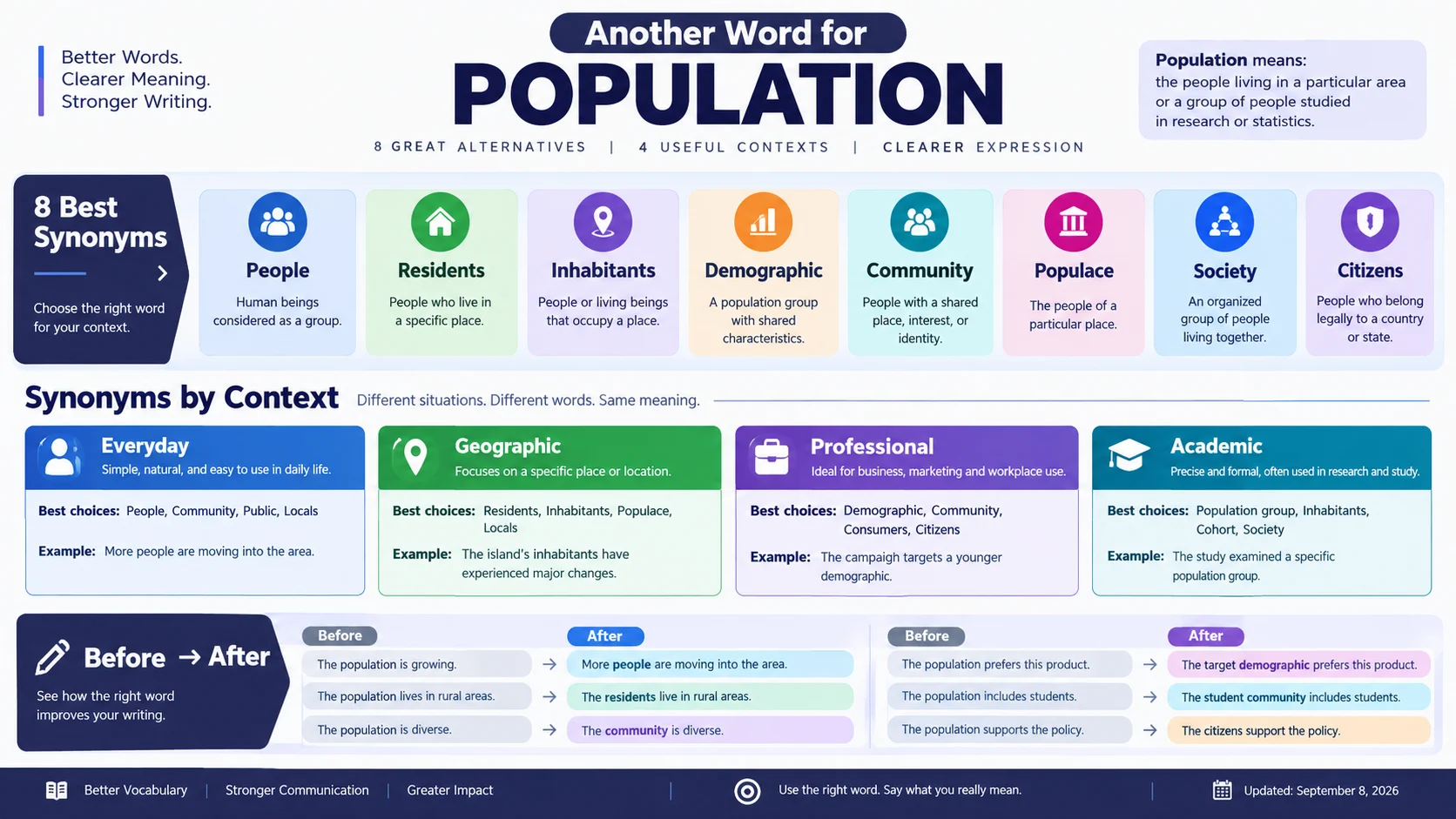
If you need another word for population, the best choice depends on what you mean. Common alternatives include people, residents, inhabitants, community, demographic, populace, society, and citizens. For a group living in a particular place, residents or inhabitants often work well. In statistics or research, demographic or population group may be more precise.
What Does Population Mean?
Definition
Population generally refers to the people living in a particular area, such as a city, state, country, or region. It can also describe a specific group of people studied in research or statistics.
For example:
The population of the city has increased significantly over the past decade.
In academic and scientific contexts, population can have a more specialized meaning. It may refer to the complete group being studied, such as the population of patients in a medical study or the population of consumers interested in a particular product.
Common Uses
The word population is commonly used in:
- Census and demographic reports
- Government and public policy
- Academic research
- Business and market research
- Geography
- Economics
- Social sciences
- Environmental studies
- General discussions about communities and people
Because its meaning changes slightly with context, choosing a synonym carefully can make your writing more precise.
Best Synonyms for Population
| Synonym | Meaning | Best Used When | Example |
|---|---|---|---|
| People | Human beings collectively | General, everyday writing | Many people live in the area. |
| Residents | People who live in a particular place | Cities, towns, neighborhoods | Local residents supported the project. |
| Inhabitants | People or animals living in a place | Formal or geographical writing | The island has about 5,000 inhabitants. |
| Populace | The people of a particular place | Formal or literary writing | The policy was welcomed by the local populace. |
| Community | People living or interacting within a shared area or group | Social and local contexts | The community supported the new school. |
| Demographic | A particular population group identified by characteristics | Statistics and marketing | The product appeals to a younger demographic. |
| Society | People considered as an organized social group | Social science and broad discussions | Technology has changed modern society. |
| Citizens | People legally belonging to a country or state | Government and civic contexts | Citizens voted in the local election. |
| Public | People as a general group | Public communication and opinion | The program was designed for the general public. |
| Population group | A defined group within a larger population | Research and statistics | The study focused on a specific population group. |
People
People is the simplest and most natural alternative to population when referring generally to human beings.
Meaning: Human beings considered as a group.
Best used for: Everyday writing, websites, general explanations, and conversational English.
Tone: Neutral and natural
Difficulty: Easy
Usage frequency: Very Common
Business example: The company wants to understand what people expect from the service.
Academic example: Researchers surveyed people from several age groups.
Daily conversation: A lot of people live around here.
Residents
Residents is more specific than people because it refers to individuals who live in a particular location.
Meaning: People who live in a specific place.
Best used for: Cities, towns, neighborhoods, states, and local communities.
Tone: Neutral to professional
Difficulty: Easy
Usage frequency: Very Common
Business example: Local residents expressed concerns about traffic.
Academic example: The researchers interviewed residents of three urban neighborhoods.
Daily conversation: The residents are asking for better public transportation.
Inhabitants
Inhabitants refers to people or living beings that live in a particular place. It is more formal than residents.
Meaning: Living beings that occupy a particular location.
Best used for: Formal reports, geography, historical writing, and descriptions of places.
Tone: Formal
Difficulty: Medium
Usage frequency: Common
Business example: The report examined the needs of the city’s inhabitants.
Academic example: The island’s inhabitants have experienced major demographic changes.
Daily conversation: The village has only a few hundred inhabitants.
Demographic
Demographic is useful when population refers to a particular group defined by characteristics such as age, income, education, or location.
Meaning: A population group categorized by shared characteristics.
Best used for: Marketing, analytics, business reports, and research.
Tone: Professional and analytical
Difficulty: Medium
Usage frequency: Very Common
Business example: The campaign targets a younger demographic.
Academic example: The study examined the demographic most affected by the policy.
Daily conversation: That restaurant attracts a younger demographic.
Synonyms by Context
Formal Writing
For formal writing, strong alternatives include inhabitants, populace, residents, population group, and society.
Choose inhabitants when emphasizing where people live.
Choose populace when referring collectively to the people of a particular place in a formal or literary style.
Example:
The government introduced new measures to improve services for the city’s inhabitants.
Professional Writing
In business and professional communication, residents, consumers, customers, demographic, community, and population group can provide greater precision.
For example, instead of:
The population prefers online shopping.
You could write:
The target demographic prefers online shopping.
The second sentence is stronger when you are talking about a specific market segment rather than everyone in a geographic population.
Academic Writing
Academic writing often requires precise terminology. Depending on the subject, useful alternatives include population group, participants, subjects, demographic, inhabitants, and cohort.
However, these words are not interchangeable in every research context. Participants refers to people who take part in a study, while population can refer to the broader group from which participants are selected.
Example:
The study examined a population of adults aged 18 to 65.
Daily Conversation
In casual English, people is usually the most natural replacement.
Instead of:
The population of this neighborhood is growing.
A casual speaker might say:
More people are moving into this neighborhood.
For a specific group living somewhere, residents is also very natural.
Professional Alternatives for Population
If you are writing a report, presentation, business proposal, or professional email, consider these alternatives:
Demographic — when discussing a specific market or social group.
Residents — when discussing people living in a location.
Consumers — when discussing people who purchase goods or services.
Customers — when referring specifically to people who buy from a business.
Community — when emphasizing a shared local or social identity.
Population group — when precision is more important than stylistic variation.
Example:
The company adjusted its services to meet the needs of the target demographic.
This is more precise than simply saying:
The company adjusted its services to meet the needs of the population.
Simple Alternatives for Population
If your goal is clear, easy-to-understand English, use:
- People
- Residents
- Community
- Citizens
- Public
- Locals
- Inhabitants
People is usually the easiest choice.
For example:
The population is concerned about rising prices.
can become:
People are concerned about rising prices.
The simpler version sounds more natural in everyday communication.
Stronger Alternatives for Population
For more precise or sophisticated writing, consider:
- Populace
- Demographic
- Population group
- Community
- Society
- Cohort
- Constituency
- Inhabitants
Be careful with cohort and constituency, because they have narrower meanings.
A cohort usually describes a group sharing a particular characteristic or experience, such as people born during the same period.
A constituency generally refers to a group represented by an elected official or organization.
Difference Between Similar Synonyms
Population vs. People
Population is more statistical or demographic, while people is broader and more conversational.
- Population: The city’s population has grown by 10%.
- People: More people are moving to the city.
Population vs. Residents
Population can include everyone living in an area, while residents specifically identifies people who live there.
- Population: The town has a population of 25,000.
- Residents: Local residents opposed the proposal.
Population vs. Demographic
Population can refer to an entire group, while demographic usually identifies a subgroup based on characteristics.
- Population: The population of the state is increasing.
- Demographic: The company is targeting a younger demographic.
Population vs. Community
Community emphasizes social connection, shared location, or identity rather than simply numerical size.
- Population: The population of the county is 500,000.
- Community: The local community organized a cleanup event.
Population vs. Citizens
Citizens specifically refers to people with legal citizenship. Not every person living in a population is necessarily a citizen.
- Population: The city’s population includes citizens, permanent residents, and temporary residents.
- Citizens: Citizens are eligible to vote in the national election.
Opposite Words
There is no single perfect opposite of population, because the appropriate antonym depends on context.
Potential contrasting terms include:
- Individual — one person rather than a group
- Minority — a smaller group within a larger population
- Outsider — someone who is not part of a particular group
- Vacancy — an empty space where people might otherwise live
- Desertion — the act of leaving a place or group
For example, individual is a useful contrast when moving from a collective group to one person:
The study examined the population as a whole rather than focusing on each individual.
FAQs
What is another word for population?
Common alternatives for population include people, residents, inhabitants, populace, community, demographic, society, citizens, and population group. The best synonym depends on whether you mean people in general, people living in a location, or a specific statistical group.
What is a formal synonym for population?
Inhabitants and populace are formal alternatives to population when referring to people living in a particular place. In research contexts, population group may be more precise.
What is a professional alternative for population?
Demographic, population group, residents, and community can work well in professional writing. The correct choice depends on the specific meaning.
What word can replace population?
Use people for simple general writing, residents for people living in a location, demographic for a defined statistical group, and inhabitants for formal descriptions of people living in a place.
What is another word for a group of people?
Depending on the context, alternatives include community, population, demographic, society, group, audience, and cohort.
What is another word for the population of a city?
Good alternatives include city residents, inhabitants, local residents, populace, or simply people living in the city.
Conclusion
The best synonym for population depends on what you want to emphasize. Use people for simple and natural language, residents when referring to people who live in a specific place, and inhabitants for a more formal geographical description. For business and research, demographic or population group can provide greater precision.
Choosing the right alternative is not just about finding a similar word. The strongest synonym is the one that preserves your intended meaning while matching the tone and context of your writing.
