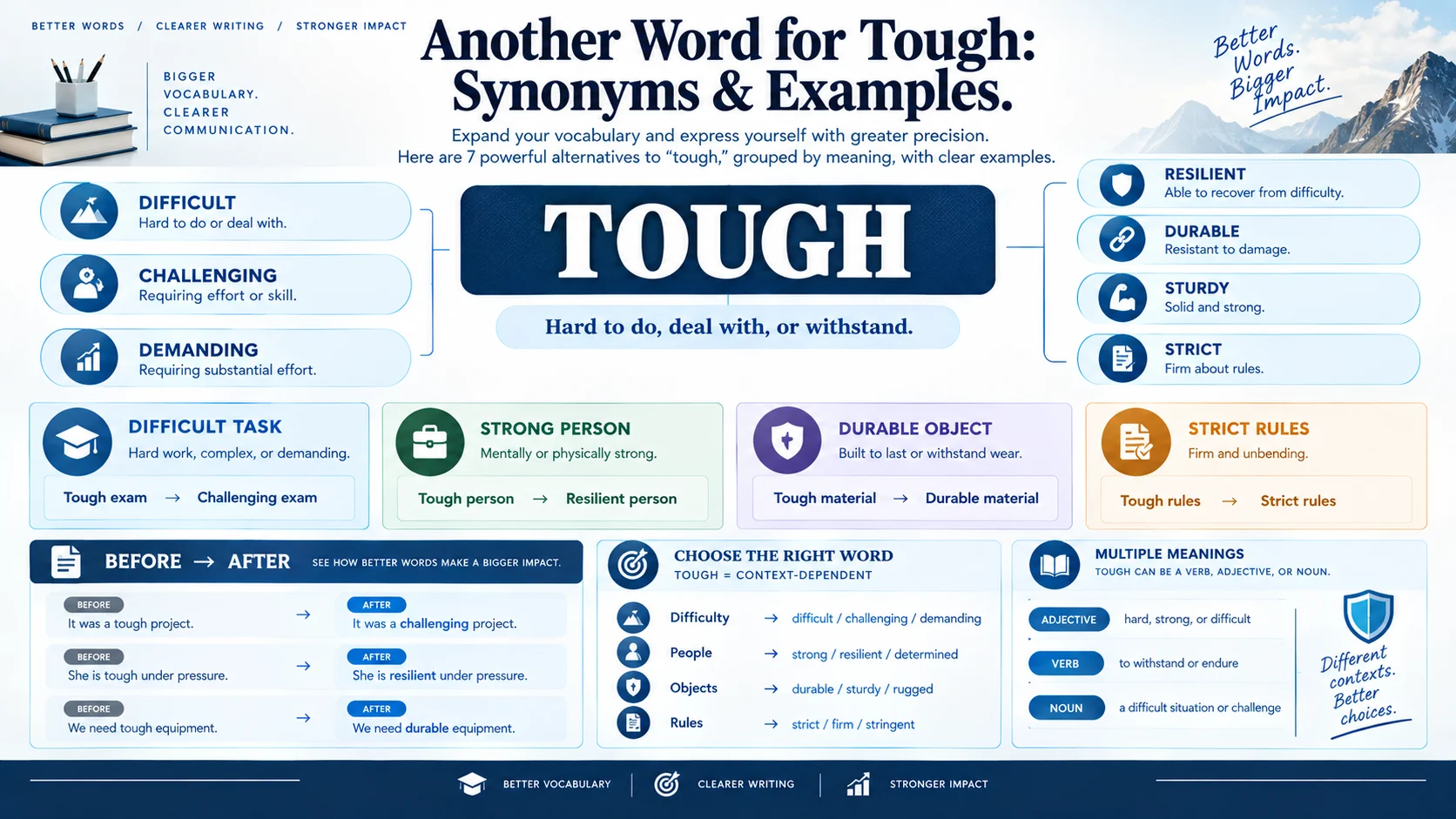
Another word for tough depends on the context. Common alternatives include difficult, challenging, hard, demanding, resilient, strong, durable, strict, firm, and rugged. For a difficult situation, use challenging or demanding; for a strong person, use resilient or strong; for a durable object, use sturdy or durable.
What Does Tough Mean?
Definition
Tough is a versatile American English adjective with several meanings. It can describe something difficult to do, physically strong, resistant to damage, emotionally resilient, strict, or severe. The best synonym therefore depends on exactly what “tough” means in the sentence.
For example:
- A tough exam means a difficult or challenging exam.
- A tough person can mean someone strong, resilient, or difficult to intimidate.
- Tough material means material that is durable or resistant to damage.
- A tough policy can mean a strict or firm policy.
- Tough meat means meat that is difficult to cut or chew.
This range of meanings is why replacing tough with the same synonym every time can make writing less precise.
Common Uses
The word commonly appears in phrases such as tough decision, tough job, tough situation, tough competition, tough questions, tough person, tough material, tough rules, and tough meat.
Oxford identifies several major senses, including difficult, strict, strong, physically aggressive, difficult to chew, and resistant to damage.
Best Synonyms for Tough
| Synonym | Meaning | Best Used When | Example |
|---|---|---|---|
| Difficult | Hard to do or understand | General difficulty | It was a difficult decision. |
| Challenging | Requiring effort or skill | Positive or neutral difficulty | The project was challenging but rewarding. |
| Hard | Difficult or demanding | Everyday conversation | This class is hard. |
| Demanding | Requiring considerable effort | Work, tasks, schedules | She has a demanding job. |
| Difficult | Not easy to deal with | Problems or circumstances | They faced a difficult situation. |
| Resilient | Able to recover from difficulty | People and organizations | She is remarkably resilient. |
| Strong | Having physical or mental strength | People or materials | He is physically strong. |
| Durable | Able to withstand use or damage | Products and materials | The boots are durable. |
| Sturdy | Solid and unlikely to break | Objects and construction | The table is sturdy. |
| Rugged | Strong enough for harsh conditions | Equipment, terrain, people | The truck has a rugged design. |
| Strict | Firm about rules | Policies and authority | The school has strict rules. |
| Firm | Strong and unlikely to change | Decisions, positions, management | She took a firm position. |
| Severe | Very serious or harsh | Conditions and consequences | The region experienced severe weather. |
| Robust | Strong and capable of handling stress | Business, systems, products | The company has a robust security system. |
| Unyielding | Refusing to weaken or change | Attitudes or positions | He remained unyielding during negotiations. |
Not every synonym is interchangeable. For example, durable works naturally for a product, while challenging works naturally for a task. Cambridge similarly distinguishes tough as meaning difficult, strong, durable, or severe depending on context.
Synonyms by Context
Formal Writing
In formal writing, choose a synonym that communicates the exact type of difficulty or strength you mean.
Good alternatives include:
- Challenging
- Demanding
- Difficult
- Rigorous
- Severe
- Complex
- Stringent
Example:
Instead of:
The company faced a tough regulatory environment.
Use:
The company faced a stringent regulatory environment.
Instead of:
Students completed a tough examination.
Use:
Students completed a rigorous examination.
These alternatives are more precise because they identify why something is tough.
Professional Writing
In business and workplace writing, challenging, demanding, rigorous, complex, resilient, robust, and stringent are often more precise than tough.
Business example:
The team faced a tough deadline.
Possible alternatives:
The team faced a demanding deadline.
Or:
The team worked under a challenging deadline.
For a person:
She is tough under pressure.
A more professional version might be:
She is resilient under pressure.
Academic Writing
Academic writing usually benefits from precise alternatives such as:
- Challenging
- Difficult
- Complex
- Rigorous
- Demanding
- Stringent
Academic example:
Researchers faced tough methodological challenges.
More precise:
Researchers faced complex methodological challenges.
Or:
Researchers encountered significant methodological difficulties.
Daily Conversation
In casual American English, hard, difficult, challenging, rough, strong, and strict are common alternatives.
Daily examples:
That exam was hard.
This has been a rough week.
She’s really strong.
My coach is strict.
The casual alternative should match the meaning of tough, not simply replace it word-for-word.
Professional Alternatives for Tough
If you’re writing a resume, cover letter, business email, or professional profile, avoid repeating tough when a more specific word communicates your meaning.
For a Tough Person
Use:
resilient, determined, composed, strong, adaptable, persistent
Resume example:
Resilient professional who performs effectively under pressure.
This is generally more specific than:
Tough professional who performs well under pressure.
For a Tough Task
Use:
challenging, demanding, complex, rigorous
Example:
Managed a demanding project with multiple deadlines.
For Tough Conditions
Use:
difficult, harsh, severe, challenging
Example:
Worked effectively under challenging conditions.
For Tough Products or Materials
Use:
durable, sturdy, robust, rugged, hard-wearing
Example:
The company manufactures durable equipment for demanding environments.
Simple Alternatives for Tough
If you need easy words that most readers immediately understand, try:
- Hard
- Difficult
- Strong
- Strict
- Rough
- Challenging
- Firm
Daily conversation example:
It was a tough day.
Possible alternatives:
It was a hard day.
It was a difficult day.
It was a rough day.
The most natural choice depends on what made the day “tough.”
Stronger Alternatives for Tough
If you want language with greater intensity, consider:
- Severe
- Formidable
- Demanding
- Rugged
- Unyielding
- Relentless
- Daunting
- Stringent
For example:
They faced a tough challenge.
A stronger version could be:
They faced a formidable challenge.
For rules:
The organization introduced tough requirements.
More precise:
The organization introduced stringent requirements.
For conditions:
The expedition encountered tough conditions.
More vivid:
The expedition encountered harsh conditions.
Difference Between Similar Synonyms
Tough vs. Hard
Hard is one of the closest everyday synonyms for tough when describing difficulty.
This assignment is hard.
This assignment is tough.
Both are natural. Tough can sound slightly more conversational and can carry additional meanings that hard does not always express.
Tough vs. Difficult
Difficult is more neutral and often more appropriate in formal writing.
It was a tough decision.
It was a difficult decision.
Both work, but difficult is often the safer choice for formal or academic prose.
Tough vs. Challenging
Challenging suggests that something requires effort, ability, or determination. It can have a more positive tone.
The course was challenging.
This can imply that the course was difficult but worthwhile.
Tough vs. Resilient
These words describe different things.
Tough can describe someone who is strong or able to withstand difficult circumstances.
Resilient specifically emphasizes the ability to recover, adapt, or continue after adversity.
She is tough.
She is resilient.
The second sentence gives a more specific picture of how she responds to difficulty.
Tough vs. Durable
Use durable for physical products or materials that resist wear, damage, or breakage.
These shoes are durable.
Durable is generally better than tough when writing product descriptions because it clearly communicates resistance to wear.
Tough vs. Strict
Use strict when tough describes rules, enforcement, or authority.
The company has tough policies.
The company has strict policies.
Strict specifically emphasizes firm adherence to rules.
Tough vs. Severe
Severe communicates a high degree of seriousness, harshness, or intensity.
The area experienced severe weather.
Using tough here would sound more conversational:
The area experienced tough weather.
The latter is possible in informal speech, but severe is more precise.
Synonym Analysis: Choosing the Right Word
Challenging
Meaning: Difficult but requiring effort, skill, or persistence.
Best used for: Tasks, jobs, projects, courses, goals.
Tone: Neutral to positive.
Difficulty: Easy.
Usage frequency: Very common.
Best for: Resume, email writing, essay writing, business writing.
Examples:
- Business: We completed a challenging project.
- Academic: The course presented challenging material.
- Daily: Moving to a new city can be challenging.
Resilient
Meaning: Able to withstand or recover from difficulty.
Best used for: People, teams, organizations, systems.
Tone: Positive and professional.
Difficulty: Medium.
Usage frequency: Common.
Best for: Resumes, business writing, essays, professional profiles.
Examples:
- Business: The company remained resilient during the downturn.
- Academic: Resilient communities can recover more quickly from disruption.
- Daily: She’s incredibly resilient.
Durable
Meaning: Able to last without being easily damaged.
Best used for: Products, materials, equipment.
Tone: Neutral and practical.
Difficulty: Easy.
Usage frequency: Very common.
Best for: Marketing copy, product descriptions, business writing.
Examples:
- Business: The manufacturer produces durable equipment.
- Academic: Researchers tested the durability of the material.
- Daily: I need a durable backpack.
Demanding
Meaning: Requiring substantial effort, time, skill, or attention.
Best used for: Jobs, schedules, tasks, responsibilities.
Tone: Neutral.
Difficulty: Medium.
Usage frequency: Common.
Best for: Resume, professional writing, academic writing.
Examples:
- Business: She manages a demanding schedule.
- Academic: The program is academically demanding.
- Daily: Raising children can be demanding.
Opposite Words
The opposite of tough depends on its meaning.
| Meaning of Tough | Possible Opposite |
|---|---|
| Difficult | Easy |
| Strong | Weak |
| Durable | Fragile |
| Strict | Lenient |
| Severe | Mild |
| Resilient | Vulnerable |
| Difficult to chew | Tender |
Cambridge specifically gives easy as an opposite when tough means difficult, and fragile/delicate when it refers to something that is not easily damaged.
FAQs
What is another word for tough?
Common alternatives include difficult, hard, challenging, demanding, strong, resilient, durable, sturdy, strict, and firm. The correct choice depends on whether tough describes difficulty, strength, durability, or strictness.
What is a formal synonym for tough?
Difficult, challenging, demanding, rigorous, stringent, severe, and resilient can work as formal alternatives, depending on the sentence.
What is a professional alternative for tough?
For professional writing, challenging, demanding, resilient, robust, rigorous, or stringent may be more precise than tough.
What word can replace tough in a resume?
Use a specific word that describes the quality you want to emphasize. Resilient works for handling adversity, adaptable for changing circumstances, persistent for sustained effort, and resourceful for solving problems.
What is another word for a tough person?
Depending on the intended meaning, use strong, resilient, determined, fearless, persistent, or formidable. If the person is physically aggressive, tough can have a different meaning and should not automatically be replaced with a positive word.
What is another word for a tough situation?
Good choices include difficult situation, challenging situation, difficult circumstance, demanding situation, or adverse circumstances.
What is another word for a tough decision?
The most natural alternatives are difficult decision, challenging decision, complex decision, or demanding decision.
What is another word for tough rules?
Use strict rules, stringent rules, firm rules, or rigorous requirements, depending on the context.
Conclusion
The best synonym for tough is not always the same because tough has several meanings. When something is difficult, choose difficult, hard, challenging, or demanding. When describing a person’s ability to withstand adversity, resilient or strong may be more precise. For products and materials, choose durable, sturdy, or rugged. For rules, strict, firm, or stringent are usually clearer.
The key is to replace tough according to meaning and context, not simply by choosing the closest word in a thesaurus. Major English dictionaries likewise separate the word’s senses for difficulty, strength, durability, strictness, and other uses.
