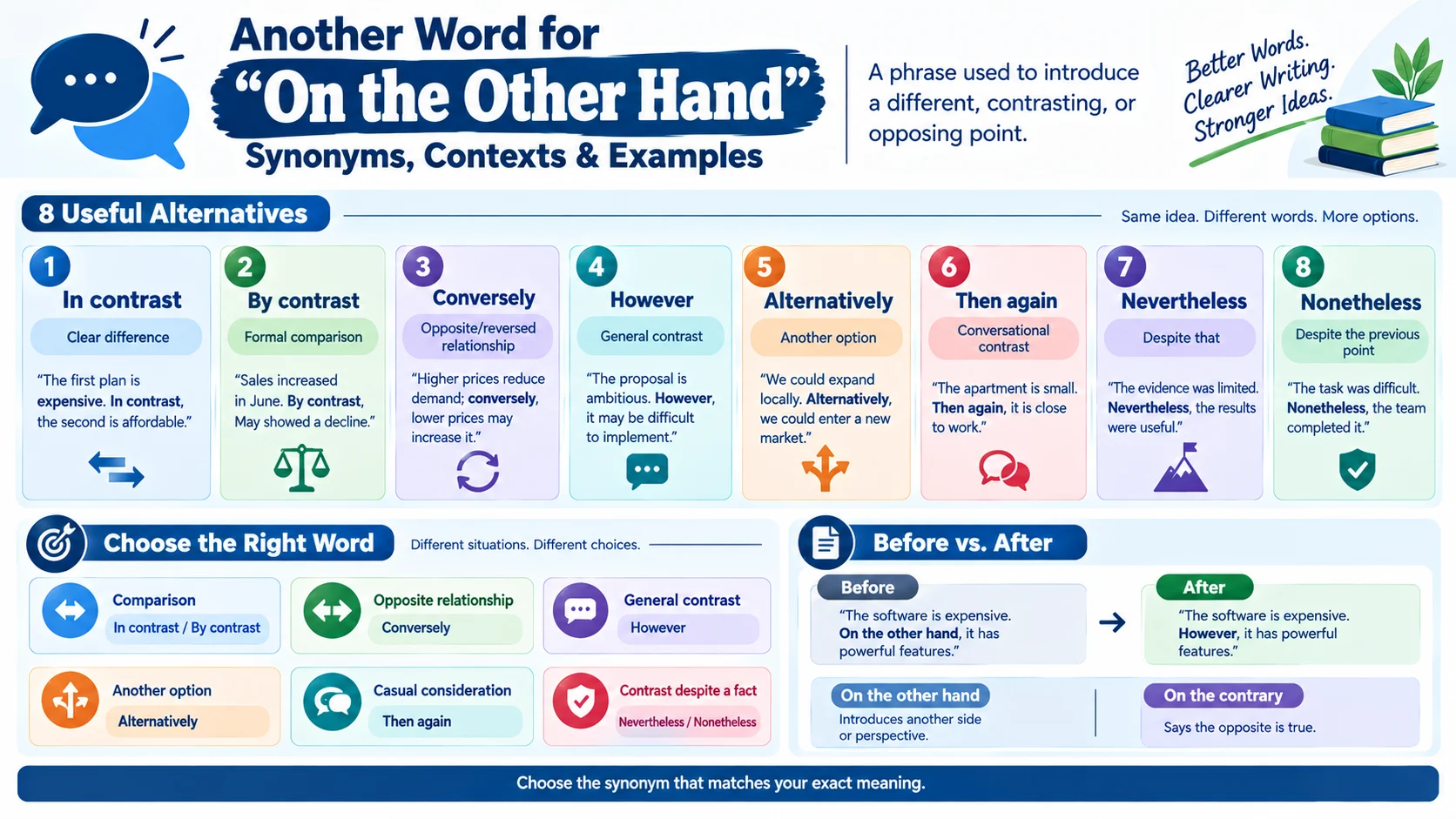
Another word for “on the other hand” is “in contrast,” “by contrast,” “conversely,” “however,” “alternatively,” or “then again.” The best choice depends on your meaning. Use in contrast to highlight differences, conversely for a formal reversal, and however to introduce a contrasting point.
What Does “On the Other Hand” Mean?
Definition
On the other hand is a phrase used to introduce a different, contrasting, or opposing point. It is especially useful when comparing two facts, ideas, opinions, choices, or perspectives.
For example:
The new software is expensive. On the other hand, it could save the company considerable time.
The phrase can also form part of the common structure “on the one hand … on the other hand,” which presents two sides of an issue. Cambridge Dictionary defines the expression as being used to compare different facts or opposing ways of thinking about a situation.
Common Uses
“On the other hand” commonly appears in:
- Essays and academic writing
- Business reports
- Professional emails
- Comparisons and reviews
- Opinion writing
- Discussions and debates
- Everyday conversation
It is generally neutral in tone and works well when you want to acknowledge another side of an issue without necessarily rejecting the first point.
Best Synonyms for “On the Other Hand”
| Synonym | Meaning | Best Used When | Example |
|---|---|---|---|
| In contrast | Shows a clear difference | Comparing two things | The first plan is expensive. In contrast, the second is affordable. |
| By contrast | Emphasizes a difference | Formal or academic comparisons | Sales increased in June. By contrast, May showed a decline. |
| Conversely | Introduces an opposite or reversed relationship | Formal and academic writing | Higher prices reduce demand; conversely, lower prices may increase it. |
| However | Introduces a contrasting idea | General and professional writing | The proposal is ambitious. However, it may be difficult to implement. |
| Alternatively | Presents another option or possibility | Choices and decisions | We could expand locally. Alternatively, we could enter a new market. |
| Then again | Introduces another consideration | Informal or conversational writing | The apartment is small. Then again, it is close to work. |
| Nonetheless | Shows contrast despite the previous point | Formal writing | The task was difficult. Nonetheless, the team completed it. |
| Nevertheless | Similar to “nonetheless” | Formal and academic writing | The evidence was limited. Nevertheless, the results were useful. |
1. In Contrast
Meaning: Shows that one thing is different from another.
Best used for: Comparisons, essays, reports, and analytical writing.
Tone: Neutral to formal
Difficulty: Easy
Usage Frequency: Very Common
Business example:
The first campaign targeted younger consumers. In contrast, the second campaign focused on established customers.
Academic example:
Urban populations increased during the period. In contrast, rural populations remained relatively stable.
Daily conversation:
My brother loves crowded places. In contrast, I prefer quiet spaces.
Best for: Resume writing, email writing, essay writing, business writing, and marketing copy.
2. By Contrast
Meaning: Used to emphasize a difference between two things.
Best used for: Formal, professional, and academic comparisons.
Tone: Formal
Difficulty: Medium
Usage Frequency: Common
Business example:
The premium package includes technical support. By contrast, the basic package offers limited assistance.
Academic example:
The northern region experienced rapid growth. By contrast, the southern region changed very little.
Daily conversation:
The old phone was heavy. By contrast, the new one is extremely light.
Best for: Academic essays, reports, business writing, and professional communication.
3. Conversely
Meaning: Indicates an opposite or reversed relationship.
Best used for: Situations where the second statement represents an opposite relationship, result, or direction.
Tone: Formal
Difficulty: Advanced
Usage Frequency: Common
Business example:
When customer satisfaction increases, retention often improves. Conversely, dissatisfaction can contribute to customer loss.
Academic example:
Higher temperatures increase evaporation. Conversely, lower temperatures generally reduce it.
Daily conversation:
Some people become more productive with pressure. Conversely, others struggle to focus.
Best for: Academic writing, research, analytical writing, and professional reports.
Important: “Conversely” is not a universal replacement for “on the other hand.” It works best when the second idea is genuinely opposite or reverses the relationship expressed in the first.
4. However
Meaning: Introduces a statement that contrasts with or qualifies what came before.
Best used for: General writing when you want a simple, flexible contrast.
Tone: Neutral to formal
Difficulty: Easy
Usage Frequency: Very Common
Business example:
The product received positive reviews. However, sales remained below expectations.
Academic example:
The study produced promising results. However, the sample size was relatively small.
Daily conversation:
I wanted to go for a walk. However, it started raining.
Best for: Emails, essays, reports, business writing, and everyday writing.
Because “however” is extremely flexible, it is often a natural alternative when “on the other hand” feels repetitive.
5. Alternatively
Meaning: Introduces another choice, method, or possibility.
Best used for: Presenting an alternative rather than simply showing contrast.
Tone: Neutral to formal
Difficulty: Medium
Usage Frequency: Common
Business example:
We could launch the product in July. Alternatively, we could wait until September.
Academic example:
Researchers could use interviews. Alternatively, they could collect data through surveys.
Daily conversation:
We can take the train. Alternatively, we could drive.
Best for: Business writing, emails, proposals, and decision-making documents.
Important: Use “alternatively” when you mean another option, not merely “a contrasting point.”
6. Then Again
Meaning: Introduces another thought or consideration that changes, qualifies, or balances the previous point.
Best used for: Informal and conversational writing.
Tone: Casual
Difficulty: Easy
Usage Frequency: Common
Business example:
The office is farther away. Then again, the rent is considerably lower.
Academic example:
This explanation seems plausible. Then again, additional evidence is needed.
Daily conversation:
The restaurant is expensive. Then again, the food is excellent.
Best for: Blogs, casual writing, conversations, and informal messages.
Synonyms by Context
Formal Writing
For formal writing, consider:
- By contrast
- In contrast
- Conversely
- Nevertheless
- Nonetheless
Example:
The initial findings were encouraging. Nevertheless, further research is necessary.
These choices can sound more precise than repeatedly using “on the other hand.”
Professional Writing
Good professional alternatives include:
- However
- In contrast
- By contrast
- Alternatively
- Nevertheless
Example:
The proposed solution would reduce costs. However, implementation would require additional staff training.
Academic Writing
Academic writing often benefits from precise contrast markers:
- In contrast
- By contrast
- Conversely
- However
- Nevertheless
- Nonetheless
Example:
The first group demonstrated substantial improvement. By contrast, the control group showed minimal change.
Choose the connector according to the logical relationship rather than simply replacing every occurrence of “on the other hand.”
Daily Conversation
Natural conversational choices include:
- On the other hand
- Then again
- However
- But
- In contrast
Example:
I like the house because it has a large yard. Then again, it is pretty far from downtown.
Professional Alternatives for “On the Other Hand”
If you are writing an email, report, proposal, or workplace document, these alternatives are particularly useful:
However: Best for a straightforward qualification or contrast.
In contrast: Best when directly comparing two different things.
By contrast: Best when emphasizing a difference between two subjects.
Conversely: Best when the second point reverses or contrasts with the relationship in the first.
Alternatively: Best when presenting another option.
Nevertheless: Best when the second statement remains true despite the first point.
Professional example
Instead of:
The software is expensive. On the other hand, it provides advanced reporting tools.
You could write:
The software is expensive. However, it provides advanced reporting tools.
Or:
The software is expensive. Nevertheless, it provides advanced reporting tools.
The best choice depends on whether you want simple contrast or emphasis on the fact that the second point remains true despite the first.
Simple Alternatives for “On the Other Hand”
For students and everyday writers, these are easy alternatives:
- But
- However
- In contrast
- Instead
- Then again
Example:
The assignment is difficult. But it is also useful.
“However” is generally more polished than “but” in formal writing, while “then again” has a more conversational feel.
Stronger Alternatives for “On the Other Hand”
When you want to make the contrast particularly clear, use:
- In contrast
- By contrast
- Conversely
- On the contrary
- Nevertheless
However, these expressions do not all have the same meaning.
On the contrary is especially important to distinguish. It is used when you want to say that the opposite of a previous statement is true. It is not simply a general synonym for presenting another side.
Example:
I don’t think the plan is ineffective. On the contrary, the early results are very promising.
Difference Between Similar Synonyms
“On the Other Hand” vs. “In Contrast”
On the other hand introduces another side, consideration, or perspective.
In contrast directly emphasizes a difference.
The job pays well. On the other hand, it requires frequent travel.
The first job requires frequent travel. In contrast, the second allows employees to work remotely.
“On the Other Hand” vs. “However”
However usually introduces a qualification or contrasting statement.
The proposal is expensive. However, it could produce significant savings.
“On the other hand” often feels more like presenting another side of a balanced discussion.
“On the Other Hand” vs. “Conversely”
Conversely suggests an opposite or reversed relationship.
Higher demand can increase prices. Conversely, lower demand can reduce them.
“On the other hand” does not necessarily imply such a direct reversal.
“On the Other Hand” vs. “Alternatively”
Alternatively means “as another option.”
We could hire an outside consultant. Alternatively, we could train our existing staff.
It should not normally replace “on the other hand” when no alternative choice is being presented.
“On the Other Hand” vs. “On the Contrary”
These expressions have different functions.
On the other hand introduces another side or perspective.
On the contrary says that the opposite of the previous statement is true.
Opposite Words
Because “on the other hand” is a contrast phrase rather than a conventional adjective or verb, it does not have one direct antonym. Depending on context, expressions that indicate similarity, agreement, or continuation may function as practical opposites.
Examples include:
- Similarly
- Likewise
- In the same way
- Additionally
- Furthermore
- Moreover
For example:
The first product is affordable. Similarly, the second product is accessible to customers on a limited budget.
These expressions connect ideas without introducing the contrast normally signaled by “on the other hand.”
FAQs
What is another word for “on the other hand”?
Common alternatives include in contrast, by contrast, conversely, however, alternatively, then again, nevertheless, and nonetheless. The correct choice depends on the relationship between the two ideas.
What is a formal synonym for “on the other hand”?
In contrast, by contrast, conversely, nevertheless, and nonetheless can work well in formal writing. “Conversely” is particularly useful when the second statement represents an opposite or reversed relationship.
What is a professional alternative for “on the other hand”?
However, in contrast, by contrast, nevertheless, and alternatively are useful professional alternatives. Choose “alternatively” specifically when introducing another option.
What word can replace “on the other hand”?
The simplest replacement is often however or in contrast. For a more formal style, use by contrast or conversely when the context supports that meaning.
Is “however” the same as “on the other hand”?
Not exactly. Both can introduce contrast, but “however” commonly qualifies or contrasts with a previous statement, while “on the other hand” often introduces another side or perspective.
Is “conversely” a synonym for “on the other hand”?
It can be related, but it is more specific. “Conversely” normally signals an opposite or reversed relationship. It should not be used simply because two ideas are different.
Can I use “on the contrary” instead?
Only when you mean that the opposite of the previous statement is true. “On the contrary” is not a general replacement for every use of “on the other hand.”
What is the simplest synonym?
However is one of the easiest alternatives for general writing. But is even simpler in casual communication.
Is “then again” formal?
No. “Then again” is generally conversational and works best in informal writing or speech.
Conclusion
The best alternative to “on the other hand” depends on the exact relationship between your ideas. Use in contrast or by contrast for clear comparisons, conversely for an opposite or reversed relationship, however for a general qualification, and alternatively when presenting another option. For casual writing, then again can provide a natural conversational alternative.
Rather than replacing the phrase mechanically, choose the connector that accurately describes the connection between your sentences. This produces clearer, more natural American English.
