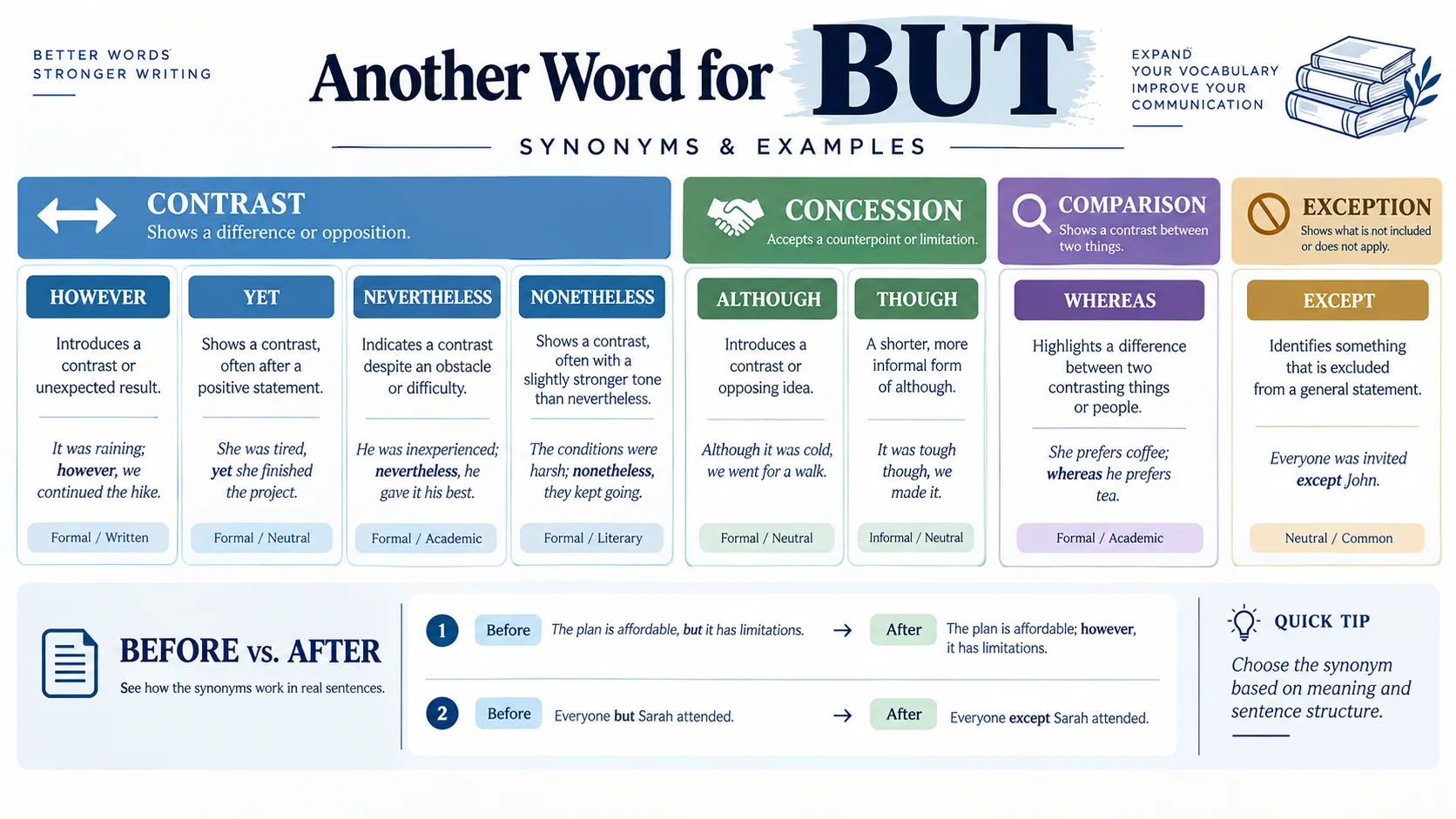
Another word for but depends on the context. Common alternatives include however, although, though, yet, nevertheless, nonetheless, whereas, and except. For formal or professional writing, however is often a natural choice, while although and though work well when introducing a contrasting idea.
What Does “But” Mean?
Definition
But is commonly used to introduce a contrast, correction, or different idea. It can also mean “except” in expressions such as “everyone but John.” Because its meaning changes by context, there is no single replacement that works in every sentence. Common alternatives include however, although, though, yet, nevertheless, except, and whereas.
Common Uses
The word but has several important uses:
- Contrast: “The product is affordable, but it is not very durable.”
- Exception: “Everyone but Maria attended.”
- Correction: “It is not blue, but green.”
- Concession: “But for your help, we would have failed.”
- Emphasis: “Everyone, but everyone, agreed.”
- Formal/literary ‘only’: “He is but a child.”
This means that choosing another word for but requires looking at the sentence rather than simply replacing the word mechanically.
Best Synonyms for But
| Synonym | Meaning | Best Used When | Example |
|---|---|---|---|
| However | In contrast; nevertheless | Formal and professional writing | The plan is expensive; however, it may be worthwhile. |
| Although | Despite the fact that | Introducing a contrasting clause | Although it was difficult, we finished on time. |
| Though | Despite the fact that; however | Conversation and flexible writing | Though the task was difficult, she completed it. |
| Yet | Nevertheless; despite that | Strong or concise contrast | The task was difficult, yet we completed it. |
| Nevertheless | In spite of that | Formal writing | The forecast was poor; nevertheless, the event continued. |
| Nonetheless | Despite that | Formal and academic writing | The evidence is limited; nonetheless, the theory remains useful. |
| Whereas | In contrast with the fact that | Comparing two different situations | The first model is inexpensive, whereas the second is more durable. |
| Except | Excluding | Expressing an exception | Everyone attended except David. |
Not all of these words are interchangeable with but. For example, however can express a similar contrast, but it does not function as a coordinating conjunction in the same way as but. Although and though introduce subordinate clauses, while but normally connects contrasting grammatical elements.
Synonyms by Context
Formal Writing
For formal writing, strong alternatives include:
however, nevertheless, nonetheless, whereas, although, and yet
But:
“The results were promising, but further research is necessary.”
Formal alternative:
“The results were promising; however, further research is necessary.”
But:
“The method is inexpensive, but it requires considerable preparation.”
Formal alternative:
“The method is inexpensive; nevertheless, it requires considerable preparation.”
Use however, nevertheless, and nonetheless when you want to create a clear transition between contrasting statements.
Professional Writing
In business communication, the best alternative depends on the relationship between the ideas.
But → however
“The proposal is attractive, but the budget is limited.”
“The proposal is attractive; however, the budget is limited.”
But → whereas
“Our current system is simple, but the new system is more flexible.”
“Our current system is simple, whereas the new system is more flexible.”
But → yet
“The company faced several challenges, but it continued to expand.”
“The company faced several challenges, yet it continued to expand.”
In professional writing, replacing every but with a more formal word is unnecessary. But is already standard and professional. The goal is clarity, not simply using longer words.
Academic Writing
Academic writing frequently uses although, whereas, however, nevertheless, nonetheless, and yet.
Example:
“The sample size was relatively small, but the findings were consistent.”
Possible revision:
“Although the sample size was relatively small, the findings were consistent.”
Or:
“The sample size was relatively small; however, the findings were consistent.”
These structures are not identical. Although makes one clause subordinate to the other, while however generally acts as a transitional adverb.
Daily Conversation
In everyday American English, but, though, and yet are often more natural than highly formal alternatives.
“I like the car, but it’s too expensive.”
“I like the car. It’s expensive, though.”
“I was tired, yet I went out.”
Though is particularly flexible in conversation. It can express a contrast at the beginning or middle of a sentence and can also appear at the end with a meaning similar to however.
Professional Alternatives for But
If you need a polished alternative to but for business or workplace writing, consider:
- However
- Nevertheless
- Nonetheless
- Although
- Whereas
- Yet
- In contrast
- On the other hand
Important Usage Note
However should not simply be inserted wherever but appears.
Correct:
“The service is reliable, but it is expensive.”
Correct:
“The service is reliable; however, it is expensive.”
Incorrect:
“The service is reliable however it is expensive.”
Cambridge notes that however cannot function as a conjunction replacing but when connecting words or phrases.
Simple Alternatives for But
For simple, easy-to-understand writing, use:
- though
- yet
- although
- except
- however
Examples:
But: “I wanted to go, but I was busy.”
Though: “I wanted to go, though I was busy.”
Although: “Although I was busy, I wanted to go.”
Yet: “I was busy, yet I wanted to go.”
The best choice depends on sentence structure. Although normally introduces a subordinate clause, while yet can connect contrasting ideas more directly.
Stronger Alternatives for But
When you want a stronger sense of contrast, consider:
Nevertheless
Meaning: despite what was just stated.
Tone: Formal
Difficulty: Advanced
Usage: Common
“The evidence was limited. Nevertheless, the researchers continued.”
Nonetheless
Meaning: despite that; nevertheless.
Tone: Formal
Difficulty: Advanced
Usage: Common
“The process is complicated. Nonetheless, it can be completed efficiently.”
Yet
Meaning: despite that; nevertheless.
Tone: Neutral
Difficulty: Easy
Usage: Very common
“The project was expensive, yet it produced excellent results.”
Even though
Meaning: despite the fact that.
Tone: Neutral
Difficulty: Easy
Usage: Very common
“Even though the deadline was short, the team completed the project.”
Even though generally creates a stronger contrast than although.
Difference Between Similar Synonyms
But vs. However
But is a coordinating conjunction:
“The idea is interesting, but it is difficult to implement.”
However is a transitional adverb:
“The idea is interesting; however, it is difficult to implement.”
Both express contrast, but their grammatical roles differ.
But vs. Although
But connects contrasting elements:
“The course is useful, but it is expensive.”
Although introduces a subordinate clause:
“Although the course is expensive, it is useful.”
But vs. Though
Though can often express a similar contrast to although, but it is generally more flexible in conversational English. It can also appear at the end of a sentence:
“The restaurant was expensive. The food was excellent, though.”
This sentence-ending use is especially common in speech.
But vs. Yet
Yet can emphasize an unexpected contrast:
“She had very little experience, yet she performed exceptionally well.”
It is often useful when the second idea seems surprising in light of the first.
But vs. Except
These words are not interchangeable when but means “except.”
“Everyone but John attended.”
Means:
“Everyone except John attended.”
In this use, except, apart from, and excluding can often replace but.
Synonym Profile: The Most Useful Alternatives
However
Meaning: in contrast; nevertheless
Best Used For: formal, professional, academic, and business writing
Tone: Formal
Difficulty: Medium
Usage Frequency: Very Common
Best For: Resume, email writing, essay writing, marketing copy, business writing
Business: “Sales increased; however, profit margins declined.”
Academic: “The sample was small; however, the findings were significant.”
Daily: “I like it. However, it costs too much.”
Although
Meaning: despite the fact that
Best Used For: essays, reports, formal writing, and balanced statements
Tone: Neutral to formal
Difficulty: Medium
Usage Frequency: Very Common
Best For: Essay writing, academic writing, business writing
Business: “Although costs increased, customer demand remained stable.”
Academic: “Although the sample was limited, the results were consistent.”
Daily: “Although I was tired, I went to the store.”
Though
Meaning: despite that; although; however
Best Used For: conversation and natural prose
Tone: Casual to neutral
Difficulty: Easy
Usage Frequency: Very Common
Best For: Email writing, daily conversation, general writing
Business: “The proposal is expensive, though it offers several benefits.”
Academic: “The evidence is limited, though the results are noteworthy.”
Daily: “It was a long trip. I enjoyed it, though.”
Nevertheless
Meaning: despite that
Best Used For: formal contrast
Tone: Formal
Difficulty: Advanced
Usage Frequency: Common
Best For: Academic writing, business writing, formal reports
“The risks are considerable. Nevertheless, the project may be worthwhile.”
Opposite Words
There is no single perfect antonym for but because but is primarily a grammatical connector rather than a word with one fixed lexical meaning.
However, when but expresses contrast, words or conjunctions that express addition, agreement, or continuation may provide the opposite relationship.
Examples include:
- and
- also
- similarly
- likewise
- furthermore
- moreover
For example:
“The product is affordable but durable.”
The relationship changes when the ideas are joined with and:
“The product is affordable and durable.”
FAQs
What is another word for but?
Common alternatives include however, although, though, yet, nevertheless, nonetheless, whereas, and except. The correct replacement depends on whether but expresses contrast, concession, or an exception.
What is a formal synonym for but?
However, nevertheless, nonetheless, although, and whereas are useful formal alternatives. However is particularly common in professional and academic writing.
What is a professional alternative for but?
However, nevertheless, and whereas are common professional alternatives. However, but itself is completely acceptable in professional writing when the sentence is clear.
What word can replace but in an essay?
Try however, although, nevertheless, nonetheless, yet, or whereas, depending on the sentence structure. Do not replace but automatically; choose the word that expresses the intended relationship.
What is another word for but in a sentence?
For contrast, try however, though, although, yet, nevertheless, or nonetheless. For an exception, use except or apart from.
Is “however” the same as “but”?
They can express a similar contrast, but they are grammatically different. But is a coordinating conjunction, while however functions as a transitional adverb.
What is a synonym for “but” meaning “except”?
Use except, apart from, or excluding. For example, “Everyone but Sarah came” can become “Everyone except Sarah came.”
Conclusion
The best another word for but depends on what you mean. For general contrast, however, though, yet, and although are useful alternatives. For formal writing, however, nevertheless, and nonetheless can provide a more formal transition. When but means “except,” use except, apart from, or excluding instead.
The key is to choose the replacement according to meaning, grammar, tone, and context, rather than treating synonyms as interchangeable words.
