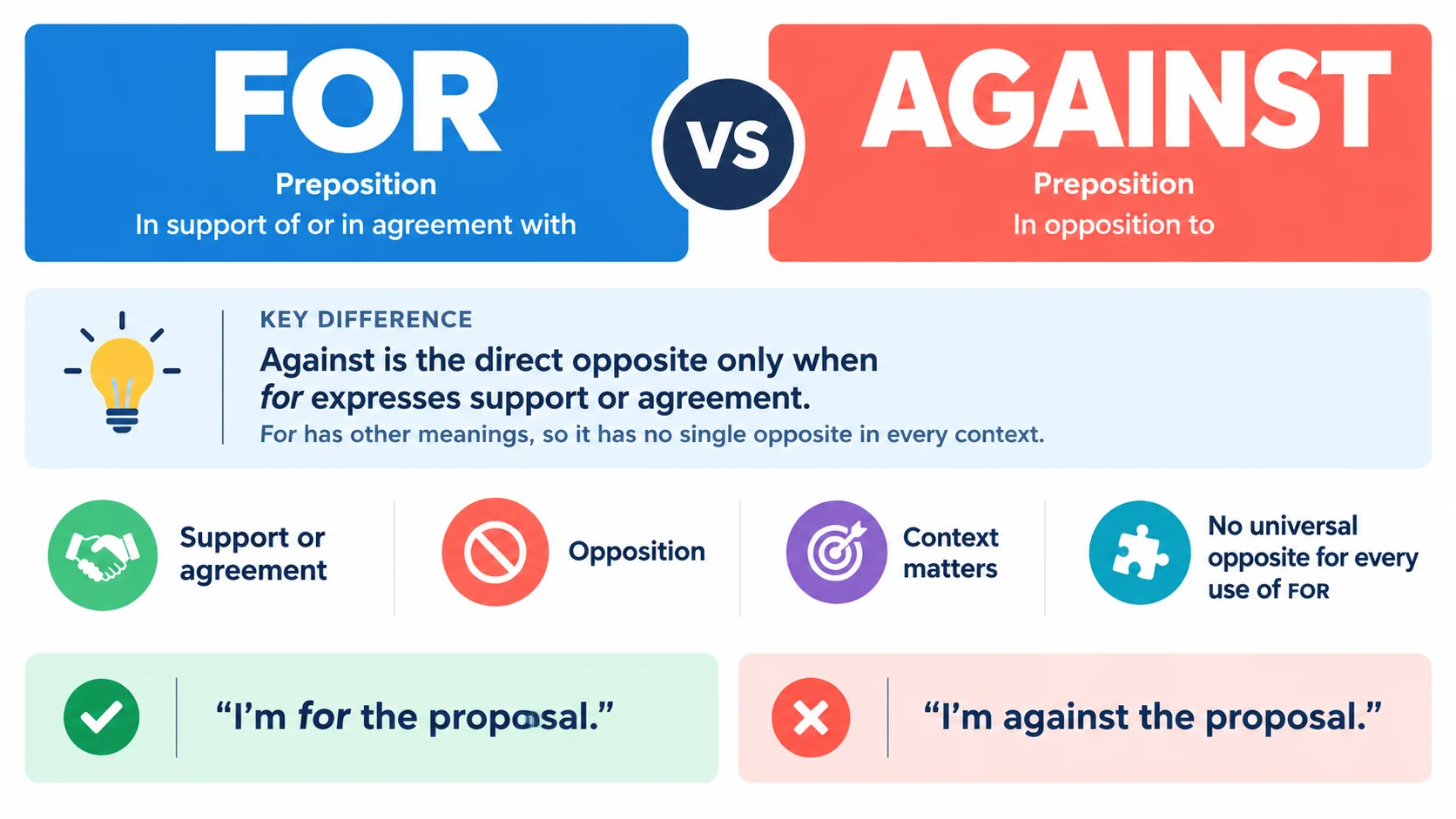
The strongest antonym for “for” is “against” when for means support or agreement. However, for has many other meanings, such as purpose, duration, destination, and benefit, so no single opposite works in every context. Choose the opposite based on the meaning used in the sentence.
Part of speech: Preposition, with additional uses in other grammatical roles.
Primary opposite: against, but only when for means “in support of” or “in agreement with.” Cambridge defines for in this sense as expressing support or agreement, while against expresses opposition.
The key point is that for does not have one universal antonym. It has many meanings, including purpose, destination, benefit, duration, exchange, and support. Only some of those meanings have a natural opposite.
Direct and Strong Antonyms
| Antonym | Tone or Nuance | Example Sentence |
|---|---|---|
| against | Direct and neutral when for means support or agreement | “I’m for the proposal, but my coworker is against it.” |
Against is the only strong direct antonym worth presenting for the central support sense of for. The pair is especially clear in questions such as “Are you for or against the plan?” and statements such as “She voted for the proposal” versus “She voted against the proposal.” Cambridge explicitly presents these meanings as opposing uses.
This is a complementary contrast in many contexts: a person can be described as being for a proposal or against it. However, against is not a universal opposite of every occurrence of for.
Contextual and Subtle Opposites
Because for is highly polysemous, its opposite depends on what the word is doing in the sentence. Cambridge lists several distinct uses, including support, help, relation, responsibility, and other functions.
| Context | Best Opposite | Why It Fits |
|---|---|---|
| for = in support of | against | Shows opposition rather than support |
| for = in the direction of a destination | No fixed antonym | The sentence usually needs a different relationship, not an opposite preposition |
| for = intended for someone | No fixed antonym | The contrasting idea might be “not intended for,” depending on context |
| for = during a period | No fixed antonym | Duration does not normally have a single lexical opposite |
| for = because of or on behalf of | No fixed antonym | The relationship changes by sentence, rather than forming a standard antonym pair |
Consider these examples:
- “We are for the new schedule.” → “We are against the new schedule.”
- “This gift is for Maya.” → There is no natural one-word antonym of for here.
- “They stayed there for three weeks.” → No standard antonym replaces for without changing the entire construction.
- “I bought this notebook for school.” → The opposite is not automatically against school.
This distinction matters because replacing every for with against would produce grammatical or semantic errors.
Words That Seem Opposite But Are Not
From is a common source of confusion. It can contrast with to when describing movement or direction, but it is not the general antonym of for. In “a letter for Sarah,” from could identify the sender in “a letter from Sarah,” but the two prepositions describe different relationships rather than opposite meanings.
Without can also look like an opposite because it expresses absence or lack. For example, “coffee with sugar” can contrast with “coffee without sugar.” But without is not the antonym of for. The words perform unrelated grammatical and semantic functions.
Another important distinction is with. In some expressions, with can mean being on the same side or supporting someone, and its opposite is against. Cambridge explicitly identifies against as the opposite of with in that sense. That does not make with an antonym of for.
Subtle Tone Differences
The choice between for and against is usually straightforward when expressing a position, but surrounding wording can change the strength and tone.
“For” is often neutral and concise:
“I’m for the change.”
“Against” is equally direct for opposition:
“I’m against the change.”
More formal writing may use phrases such as in favor of and in opposition to. These are not single-word antonyms, but they can make the contrast more explicit in professional or academic writing. Cambridge describes “in opposition to” as expressing disagreement with someone or something.
For example:
“The committee was in favor of expanding the program.”
versus:
“The committee was in opposition to expanding the program.”
In everyday American English, “for or against” is usually the simpler choice.
Frequently Asked Questions
What is the direct antonym of for?
The strongest direct antonym is against when for means “in support of” or “in agreement with.” There is no single universal antonym for for because the preposition has several distinct meanings.
What is the opposite of for in a sentence?
It depends on the sentence. If for expresses support, against is the natural opposite. If for expresses purpose, destination, duration, or intended recipient, no fixed one-word antonym may exist.
Can I use against as the opposite of for in formal writing?
Yes, when both words describe positions on an issue. “The report argues for the proposal” and “The report argues against the proposal” are clear and natural. In more formal prose, “in favor of” and “in opposition to” are also useful.
Practical Word Choice
- Identify the meaning first. If for means support or agreement, use against as the direct opposite. If it has another meaning, do not force an antonym into the sentence.
- Match the context and tone. Use for and against for simple, direct contrasts. Consider in favor of or in opposition to when a more formal construction is appropriate.
Conclusion
For is unusual because it is a highly versatile preposition rather than a word with one fixed opposite. Against is the clearest direct antonym when for means support or agreement, but that relationship does not extend to every use of for.
The safest approach is to identify the meaning of for before choosing an opposite. If the sentence expresses a position, against usually creates the intended contrast. If for expresses purpose, duration, destination, or another relationship, a direct antonym may not exist. What example using for would you like to analyze?
