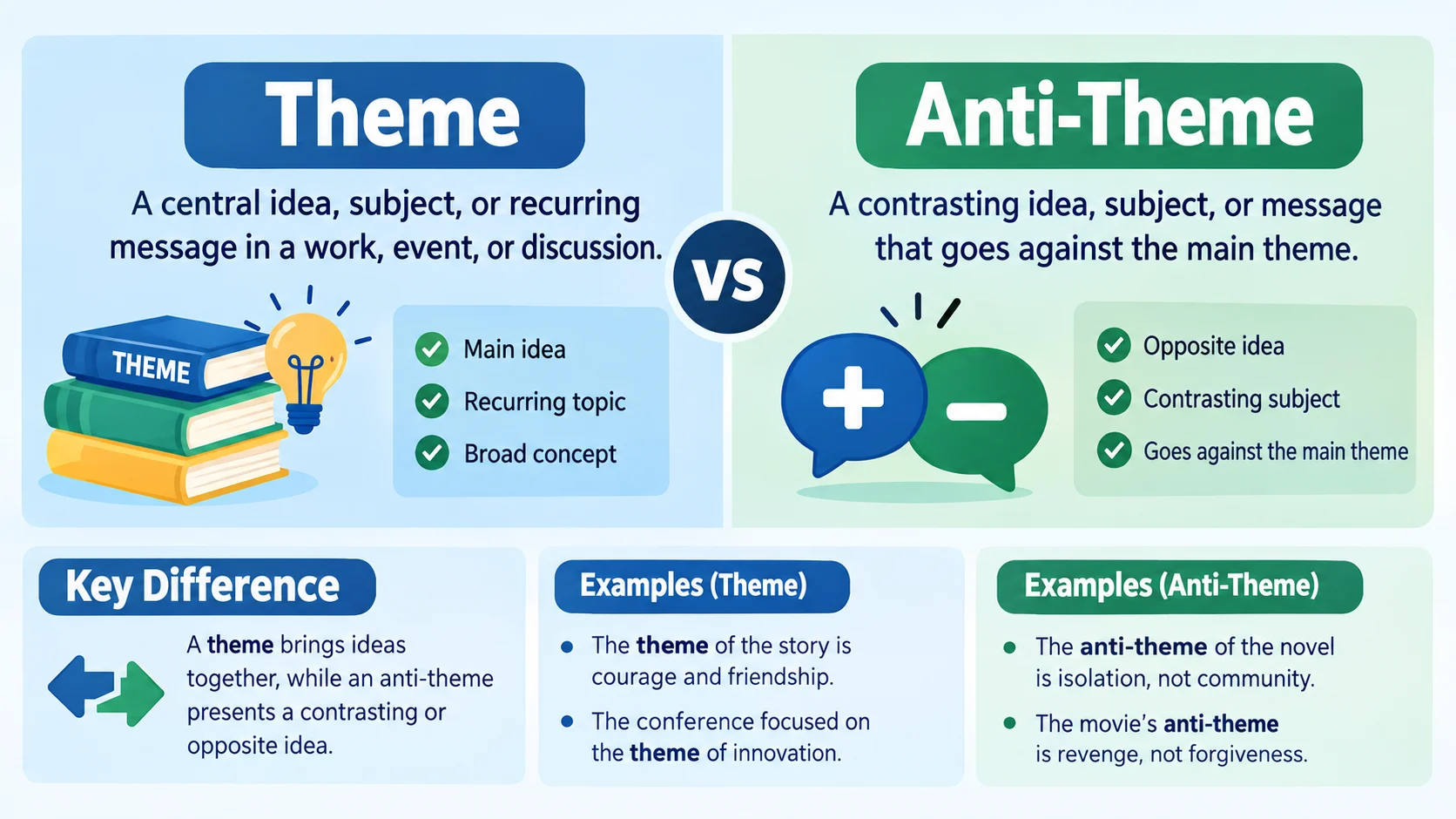
The opposite of theme depends on context because theme means a central subject, message, or recurring idea. In discussions and writing, digression is often the strongest contextual opposite because it moves away from the main subject. Other context-based opposites include tangent, aside, and parenthesis. There is no single universally accepted direct antonym for theme.
Direct and Strong Antonyms
Since theme lacks a single exact semantic opposite, the following words function as the most natural contextual antonyms in American English.
| Antonym | Tone or Nuance | Example Sentence |
|---|---|---|
| Digression | Departure from the main topic | The speaker’s digression distracted the audience from the conference theme. |
| Tangent | Informal shift away from the subject | Our meeting went off on a tangent instead of focusing on the theme. |
| Aside | Brief departure from the main point | The article included an aside that was unrelated to its theme. |
| Parenthesis | Interrupting or secondary thought | The professor returned to the theme after a lengthy parenthesis. |
These words oppose theme because they move attention away from a central subject rather than supporting it. (OpenSynonym)
Contextual and Subtle Opposites
The best opposite changes depending on how theme is being used.
Theme as a Central Subject
Best Opposite: Digression
Why It Fits: A theme unifies discussion around one idea, while a digression leads away from that idea.
Example:
- Theme: The documentary’s theme was environmental conservation.
- Opposite: Several digressions made the documentary harder to follow.
Theme as a Recurring Literary Message
Best Opposite: Anti-theme (specialized literary use)
Why It Fits: In literary analysis, some writers use anti-theme to describe a competing or contrasting idea that challenges the dominant theme. However, it is not a standard dictionary antonym and should be treated as a specialized term rather than a general opposite. (Writing Stack Exchange)
Example:
- Theme: Community creates strength.
- Anti-theme: Isolation creates independence.
Theme as a Discussion Topic
Best Opposite: Tangent
Why It Fits: A tangent shifts attention away from the main topic.
Example:
- The manager introduced a clear theme for the meeting.
- A long tangent consumed most of the discussion.
Words That Seem Opposite But Are Not
Topic
Many people assume topic is the opposite of theme, but it is actually very close in meaning.
- Topic = subject being discussed
- Theme = central idea or recurring message
Example:
- Topic: Workplace communication
- Theme: The importance of trust in workplace communication
These words are related, not opposite. (Cambridge Dictionary)
Motif
A motif is also not an antonym.
A motif is a repeated image, symbol, or element that supports a theme.
Example:
- Theme: Freedom
- Motif: Birds repeatedly appearing throughout a novel
The motif helps develop the theme rather than oppose it. (Wikipedia)
Common Grammatical or Semantic Confusions
Theme vs. Thesis
A thesis is a specific argument or claim, while a theme is a broader underlying idea.
Example:
- Theme: Courage
- Thesis: Courage grows when people face uncertainty.
A thesis may express a theme, but the two words are not opposites.
Theme vs. Plot
A plot is what happens in a story. A theme is what the story means.
Example:
A novel may describe a cross-country road trip as its plot, while friendship serves as its theme.
Because they represent different concepts, neither word functions as the other’s antonym.
Subtle Tone Differences
Choosing between digression, tangent, and aside affects tone.
Digression
Often sounds more formal and is common in academic or professional writing.
Example: The essay’s frequent digressions weakened its focus.
Tangent
More conversational and common in everyday speech.
Example: We started discussing budgets but quickly went off on a tangent.
Aside
Usually suggests a short or minor departure.
Example: The presenter added a humorous aside before returning to the main theme.
Selecting the right word helps match the situation and audience.
Frequently Asked Questions
What is the opposite of theme?
There is no universally accepted direct antonym for theme. In most writing and discussion contexts, digression is the strongest contextual opposite because it represents a departure from the central idea or subject. (EWA: Learn English)
Is digression the antonym of theme?
Not in a strict dictionary sense. However, when theme means the main subject or unifying idea, digression functions as a practical opposite because it moves attention away from that focus.
What is the opposite of theme in literature?
In literary discussions, some writers use anti-theme to describe a contrasting idea that challenges the primary theme. This is a specialized analytical term rather than a universally recognized antonym. (Writing Stack Exchange)
Suggested Reading and Internal Links
- Difference Between Theme and Motif
- Theme vs Topic: Understanding the Distinction
Practical Word Choice
Tip 1: Identify the Intended Meaning
Before choosing an antonym, determine whether theme refers to a discussion topic, a literary message, or a recurring idea.
Tip 2: Match Context and Tone
Use digression in formal writing, tangent in casual conversation, and aside for brief departures from the main point.
Conclusion
Finding antonyms for theme is more complicated than finding opposites for many everyday words. Because a theme is a central subject or unifying idea, there is no single perfect antonym accepted across all contexts.
In most situations, words such as digression, tangent, aside, and parenthesis work as contextual opposites because they represent movement away from the main idea. The best choice depends on how the word is being used.
When selecting an opposite, focus on the role the word plays in the sentence rather than searching for a one-size-fits-all answer. What example of a theme and its opposite would you use in your own writing?
