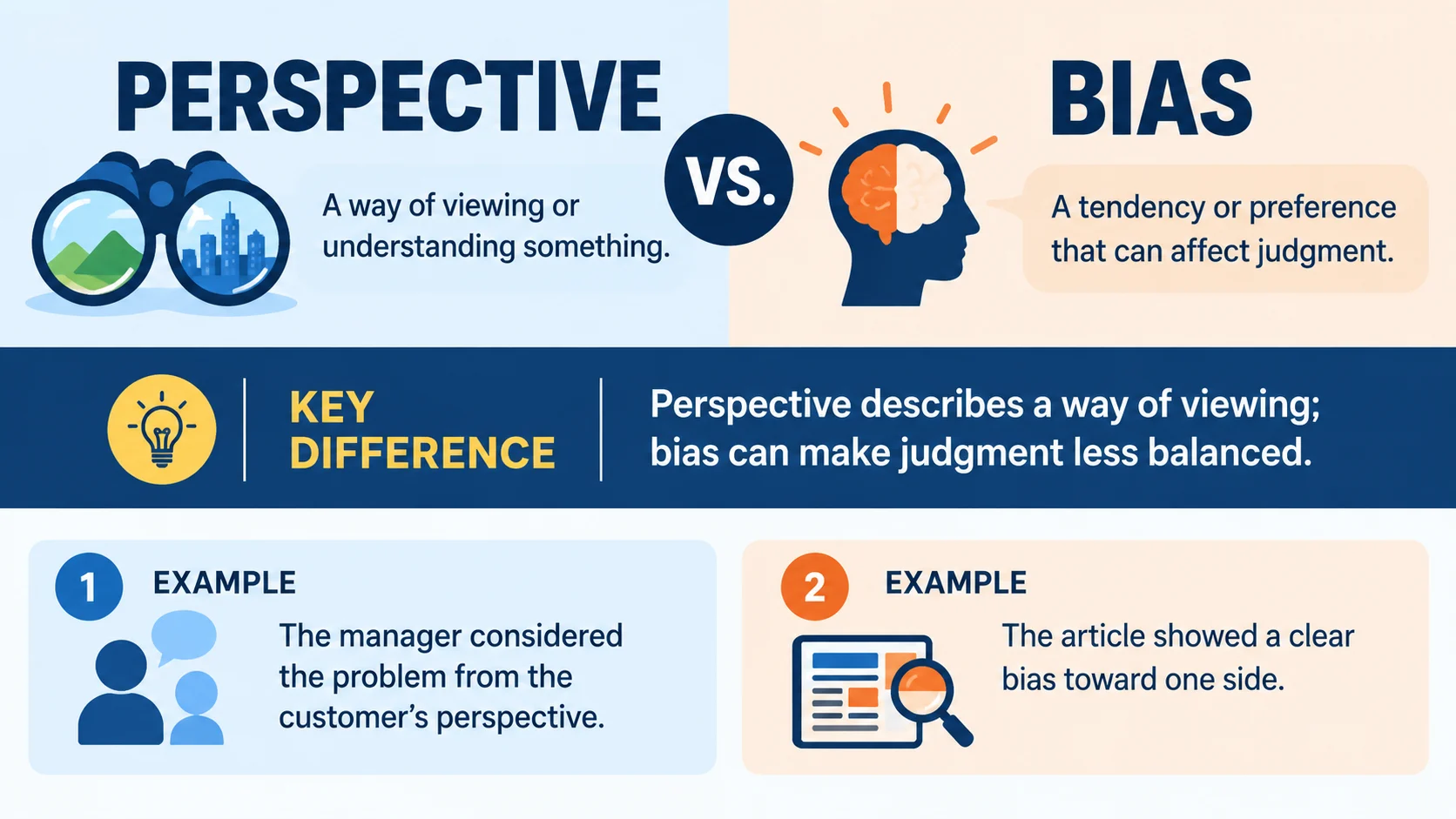
There is no single perfect antonym for perspective. When perspective means a balanced or accurate way of viewing something, bias or subjectivity can serve as contextual opposites. When it means a particular viewpoint, an opposing viewpoint is the clearest contrast. The correct choice depends on context.
Part of speech: Noun
Primary contextual opposite: Bias
Perspective means a particular way of viewing, understanding, or interpreting something. It can also describe the ability to see a situation in relation to other facts and judge its importance fairly. Because the word has several related meanings, it does not have one universal direct antonym.
When perspective means balanced understanding, bias is a strong contextual opposite because bias can influence judgment toward a particular side. When perspective means an individual viewpoint, however, an opposing viewpoint is usually the more natural contrast.
Direct and Strong Antonyms
Perspective is unusual because dictionaries do not establish one simple lexical opposite that works across all of its meanings. The following terms are therefore best understood according to the sense being used.
| Antonym | Tone or Nuance | Example Sentence |
|---|---|---|
| Bias | Strong contextual opposite when perspective means balanced judgment | The report showed a clear bias toward one side of the dispute. |
| Subjectivity | Contextual opposite when perspective emphasizes objective or fair assessment | The editor removed some subjectivity from the analysis. |
| Opposing viewpoint | Relational contrast when perspective means a particular way of viewing an issue | The second speaker presented an opposing viewpoint. |
| Lack of perspective | Contextual opposite when perspective means awareness of relative importance | Stress can give you a temporary lack of perspective. |
These terms should not all be treated as interchangeable. Bias is not the opposite of every perspective, because a perspective can be thoughtful, balanced, or well supported. Likewise, subjectivity is not inherently negative. It simply emphasizes personal experience, feelings, or interpretation.
Contextual and Subtle Opposites
The best opposite changes according to what perspective means in a sentence.
1. Perspective as a balanced understanding
Best contextual opposite: bias
Here, perspective refers to seeing a situation in proper relation to the surrounding facts. Bias introduces a preference or inclination that can affect judgment.
Example:
“After reviewing the full timeline, the manager gained perspective on the disagreement.”
A contrasting sentence might be:
“The manager’s bias made it difficult to evaluate the disagreement fairly.”
2. Perspective as a personal way of viewing something
Best contextual opposite: opposing viewpoint
In this sense, perspective is simply a person’s particular way of considering an issue. The opposite does not have to be a negative quality. It can simply be another position.
Example:
“From the customer’s perspective, the return policy was confusing.”
A natural contrast is:
“From the retailer’s opposing viewpoint, the policy was designed to prevent abuse.”
3. Perspective as objectivity or fairness
Best contextual opposite: subjectivity
This choice works when the sentence emphasizes the difference between a broader, fair assessment and an interpretation strongly shaped by personal feelings or experience.
Example:
“The researcher tried to put the results into perspective rather than react emotionally.”
A contrasting statement could be:
“The commentary reflected considerable subjectivity.”
4. Perspective as awareness of relative importance
Best contextual opposite: lack of perspective
This phrase is particularly useful when someone treats a relatively small problem as though it were much larger than it is.
Example:
“Missing one deadline is frustrating, but it helps to keep the mistake in perspective.”
The contextual opposite would be:
“His lack of perspective made the minor setback seem disastrous.”
Words That Seem Opposite But Are Not
Several words can look like antonyms of perspective but are not exact opposites.
Viewpoint is not an antonym. It is actually a close synonym. Both words can describe a particular way of looking at an issue. “The employee’s perspective” and “the employee’s viewpoint” can often describe essentially the same idea.
Objectivity is also not a straightforward antonym. Objectivity emphasizes freedom from personal bias, while perspective can refer to either a personal viewpoint or a balanced understanding. Someone can have a personal perspective while still trying to be objective.
For example:
“Her perspective on remote work comes from years of experience.”
This does not imply that her perspective is biased or subjective. It simply identifies the experience shaping her view.
Subtle Tone Differences
Choosing the right contextual opposite can change the tone of your writing.
Bias is the strongest choice when you want to emphasize an inclination that affects judgment. It often carries a negative implication.
“His perspective on the proposal differed from mine” is neutral.
“His bias against the proposal affected his judgment” is more critical.
Subjectivity is more analytical and formal. It is useful in academic, professional, and research-oriented writing when personal interpretation is important.
“The review contains some subjectivity” sounds more measured than “The review is biased.”
Opposing viewpoint is neutral and especially useful when two legitimate positions differ.
“The committee considered an opposing viewpoint before making its decision.”
This wording does not suggest that either side is automatically correct or incorrect.
Lack of perspective is useful when someone fails to recognize the larger context or relative importance of an event.
“She was upset about the mistake, but her friend helped her regain perspective.”
The phrase focuses on missing context rather than on a particular competing opinion.
Frequently Asked Questions
What is the direct antonym of perspective?
There is no single direct antonym that works for every meaning of perspective. When perspective means balanced or fair understanding, bias can be a strong contextual opposite. When it means a particular viewpoint, an opposing viewpoint is more precise.
What is the opposite of perspective when it means a point of view?
When perspective means a person’s particular way of viewing an issue, opposing viewpoint is a natural contextual contrast. It identifies another position rather than suggesting that the original perspective is inherently wrong or biased.
Is bias the opposite of perspective?
Not generally. Bias is a contextual opposite only when perspective means balanced or fair judgment. A perspective can be personal without being biased. For precise writing, use bias only when an unfair preference or inclination is part of the intended contrast.
Suggested Reading and Internal Links
- Words for different points of view
- Objectivity and subjectivity in writing
Practical Word Choice
- Identify the intended meaning. Decide whether perspective means a viewpoint, balanced understanding, or awareness of relative importance.
- Match the context and tone. Use bias for an inclination affecting judgment, subjectivity for personal interpretation, opposing viewpoint for a contrasting position, and lack of perspective for missing context.
Final Thoughts
The word perspective does not have one universal opposite because it covers several related meanings. A person’s perspective can simply be a viewpoint, while perspective can also mean the ability to understand a situation fairly and in context.
For precise American English, choose the contrasting word according to the sense you mean. Bias, subjectivity, opposing viewpoint, and lack of perspective each describe a different kind of contrast rather than interchangeable antonyms.
When you replace “perspective” in a sentence, first ask what kind of contrast you actually need. What example would you use to show the difference?
