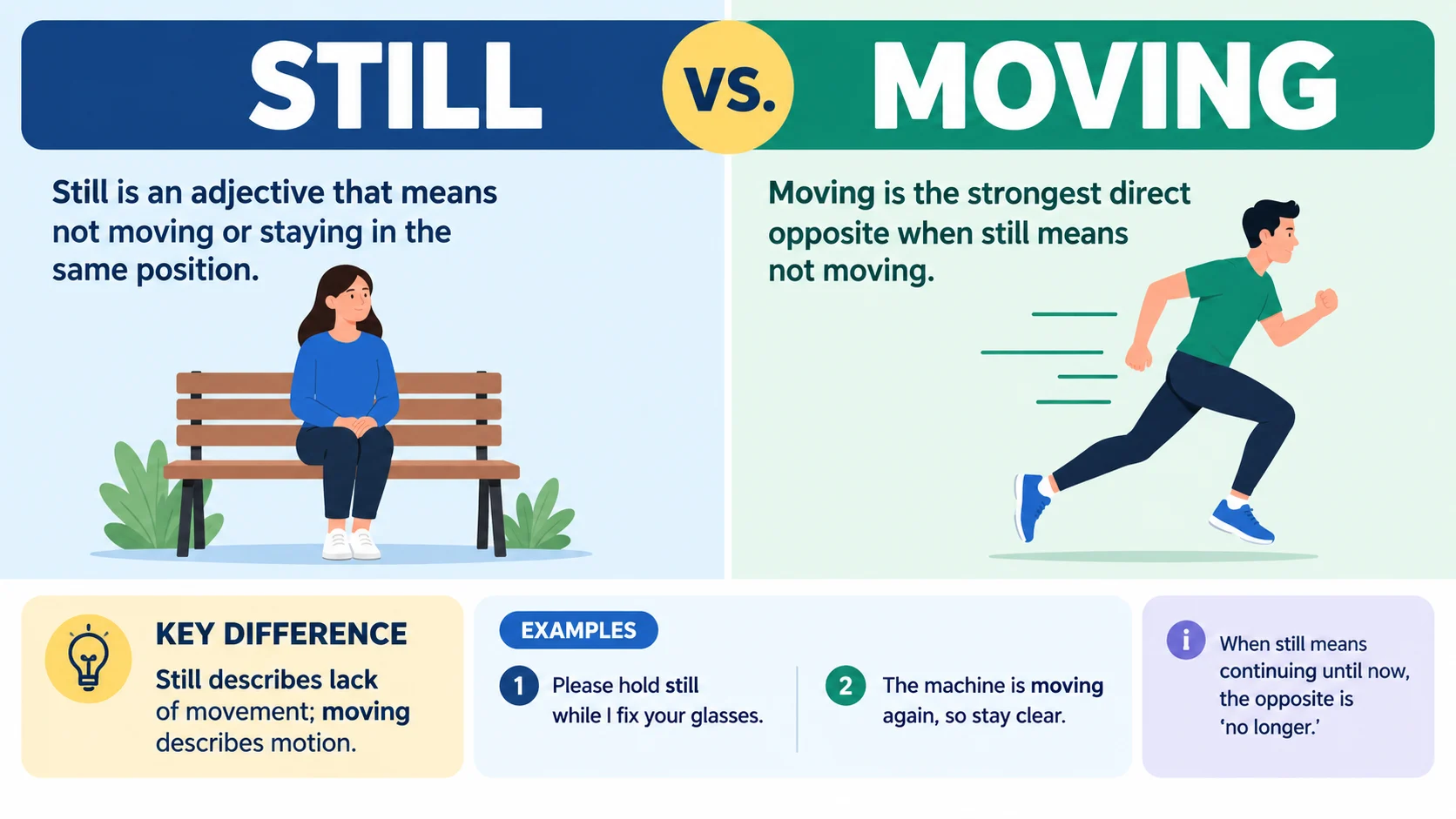
The strongest antonym of still depends on its meaning. When still means “not moving,” the direct opposite is moving. When still means “continuing until now,” the strongest opposite is no longer. Other meanings of still, such as “despite that,” do not have one exact antonym.
Direct and Strong Antonyms
| Antonym | Tone or Nuance | Example Sentence |
|---|---|---|
| Moving | The clearest physical opposite of still; neutral and everyday | “The machine is moving again, so stay clear.” |
| No longer | The clearest opposite when still means a situation continues | “She no longer works at that company.” |
| Not anymore | Natural, conversational alternative to no longer | “I do not live there anymore.” |
| Not any longer | A slightly more explicit alternative to no longer | “The discount is not available any longer.” |
Moving is the strongest direct antonym when still describes physical position or motion. If someone says, “Hold still while I fix your glasses,” moving describes the opposite behavior. This is a straightforward complementary contrast: something is either staying in place or moving. Cambridge’s American English material defines still as staying in the same position or not moving, while its thesaurus lists moving as the antonym. (Cambridge Dictionary)
No longer is different. It works when still means that an action, condition, or situation continues up to the present. “I still teach English” means the teaching continues. “I no longer teach English” means that continuation has ended. Cambridge’s grammar guide explicitly gives no longer, not any longer, and not any more as opposites of still in this use. (Cambridge Dictionary)
Contextual and Subtle Opposites
Still has several important meanings, so the best opposite changes with context.
| Context | Best Opposite | Why It Fits |
|---|---|---|
| Physical position | Moving | It reverses the idea of remaining motionless. |
| A situation continues | No longer | It indicates that the situation has stopped being true. |
| A person remains in a place or role | No longer | It signals that the person has left or changed that status. |
| A calm scene or unmoving air | Moving or active | The contrast depends on whether the emphasis is physical motion or activity. |
Consider these examples.
“She sat still for the portrait.” The natural opposite is “She moved during the portrait.” Here, still describes physical lack of movement.
“The lake was still at sunrise.” In this sentence, still describes calm, undisturbed water. Moving water provides the contextual contrast, although “moving” is not necessarily a perfect lexical opposite for every use of still. Cambridge describes still water as calm and not flowing. (Cambridge Dictionary)
“Are you still at the office?” asks whether the situation continues. “No, I’m no longer at the office” directly reverses that meaning.
Still can also mean “despite that,” as in “It was raining, but we still went outside.” This use does not have one clean antonym. Words such as therefore or consequently can express a different logical relationship, but they are not direct antonyms of still. Cambridge classifies this use as an adverb expressing contrast or continuation despite another fact. (Cambridge Dictionary)
Words That Seem Opposite But Are Not
Common Grammatical or Semantic Confusions
Two common sources of confusion are yet and already.
Yet is not simply the antonym of still. In questions and negative statements, yet commonly refers to something expected that has not happened up to a particular point. For example, “I haven’t finished yet” means the task remains unfinished. “I still haven’t finished” emphasizes that the unfinished situation has continued, often longer than expected. Cambridge explains this distinction directly. (Cambridge Dictionary)
Already is also not a general antonym of still. “She has already left” focuses on the fact that the departure happened earlier than expected or before the current reference point. “She is still here” focuses on continued presence. These words can contrast in some contexts, but they do not form a simple antonym pair. (Cambridge Dictionary)
Subtle Tone Differences
Moving is usually neutral and concrete. It works well in everyday instructions: “Keep moving so everyone can get through the doorway.” Active can also contrast with still when the emphasis is on activity rather than literal movement: “The office was quiet but active.”
For the continuation sense, no longer is concise and neutral, making it especially useful in professional or formal writing: “The policy is no longer in effect.” Not anymore is more conversational: “I do not use that account anymore.” Not any longer is also natural, but it can sound slightly more explicit or deliberate.
These choices matter because still itself often signals that a condition continues despite time, expectation, or circumstances. “He is still waiting” highlights continuation. “He is no longer waiting” reverses that continuation. The contrast is about time and state, not physical movement.
Frequently Asked Questions
What is the direct antonym of still?
The direct antonym of still is moving when still means “not moving” or “staying in the same position.” For the adverbial meaning of “continuing until now,” the appropriate opposite is no longer. The sentence determines which antonym is correct.
What is the opposite of still when it means continuing?
When still means that something continues to happen or remain true, no longer is the clearest opposite. For example, “She still works here” contrasts with “She no longer works here.” In conversational American English, “not anymore” is also common.
Is moving always the opposite of still?
No. Moving is the strongest direct opposite when still refers to physical lack of movement. It does not work for every meaning. In “I still work here,” for example, moving makes no semantic sense as the opposite. The correct contrast is “I no longer work here.”
Conclusion
The word still has more than one major meaning, so its antonyms cannot be reduced to a single word. Moving is the clearest direct opposite for physical stillness, while no longer reverses the idea of continued existence, action, or status.
Context is the key to choosing accurately. Before replacing still, ask whether it describes movement, continuation, or another relationship such as contrast. That small distinction prevents awkward or inaccurate word choices.
Which sentence are you trying to rewrite with an opposite of still?
