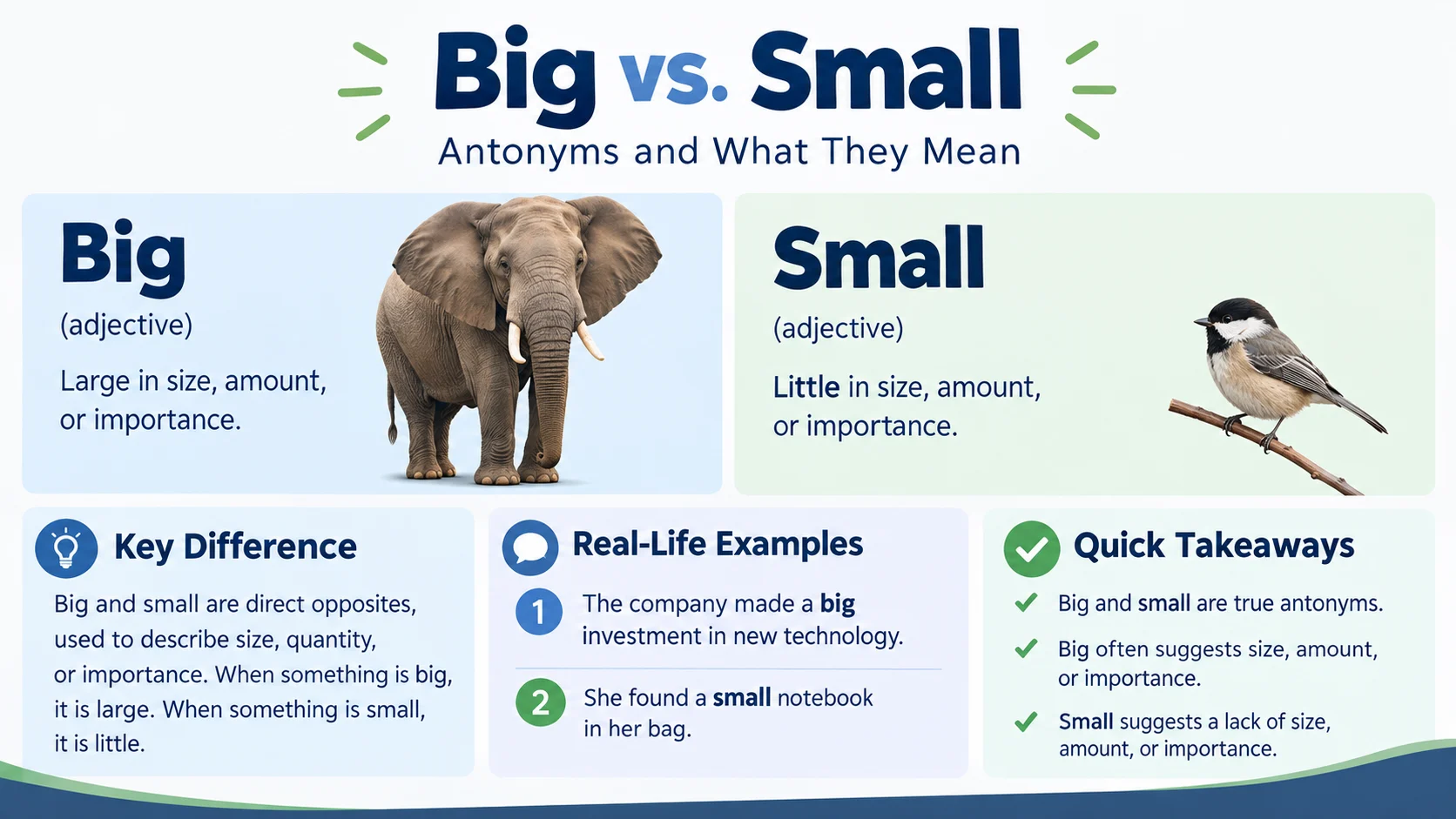
The strongest direct antonym of big is small when big means large in size or amount. Big can also mean important, serious, or influential, so context can change the most natural opposite. Little is another common opposite for size, especially in informal American English.
Direct and Strong Antonyms
| Antonym | Tone or Nuance | Example Sentence |
|---|---|---|
| Small | Neutral, broad, and precise | We moved into a small apartment downtown. |
| Little | More conversational and often informal; can sound affectionate | She lives in a little house near the lake. |
Small
Small is the strongest general-purpose antonym of big. It can describe physical dimensions, quantities, groups, businesses, places, and many other things.
- The restaurant has a small dining room.
- We received a small number of applications.
- He made a small change to the report.
It is also useful when the writer wants a neutral word. Cambridge describes small as having the broadest meaning for things that are not as large as normal or average. (Cambridge Dictionary)
Little
Little can also contrast directly with big, particularly when talking about physical size or a small amount. It is generally more conversational than small and can carry an affectionate or informal tone.
- They adopted a little dog from the shelter.
- I only need a little coffee.
- She lives in a little apartment near campus.
The choice is not always interchangeable. “A small business” is a standard neutral expression, while “a little business” can sound informal or may suggest affection, modesty, or limited scale.
Contextual and Subtle Opposites
The best opposite of big depends on what the word means in a particular sentence.
| Context | Best Opposite | Why It Fits |
|---|---|---|
| Physical size | Small | Directly contrasts physical dimensions |
| Amount or quantity | Small | Contrasts a large amount with a limited amount |
| Informal size description | Little | Natural in everyday speech |
| Importance or seriousness | Minor | Contrasts a major or serious matter with a less significant one |
| Influence or prominence | Unimportant | Contrasts importance or influence |
When Big Means Important
Consider the sentence, “This is a big decision.” Here, big does not describe physical size. It means important or serious. Small would not necessarily be the best replacement for the opposite meaning.
A more precise contrast could be minor:
This is a big decision.
This is a minor decision.
Similarly, “That was a big problem” can contrast naturally with “That was a minor problem.”
These are contextual opposites, not replacements for small as the general antonym of big. Cambridge lists an important or serious sense of big, including examples involving decisions, differences, and problems. (Cambridge Dictionary)
When Big Means Popular
In informal American English, big can describe something that is extremely popular. For example:
That artist is big right now.
In this sense, small is not necessarily its exact opposite. Depending on the intended meaning, a writer might instead say unpopular, less popular, or unknown. These are contextual contrasts rather than direct antonyms of the core adjective big.
Words That Seem Opposite But Are Not
Large
Large is not an antonym of big. It is usually a near-synonym. In fact, big and large can often describe the same object or amount. Cambridge notes that both have broad meanings related to size, with big generally being somewhat more informal. (Cambridge Dictionary)
They live in a big house.
They live in a large house.
Both sentences describe a house greater than ordinary size. Neither word expresses the opposite.
Huge
Huge is also not an antonym. It is a stronger way to express very large size.
They bought a huge sofa.
The opposite of huge may be tiny in a particular context, but that does not make tiny the primary antonym of big. The basic contrast remains big versus small.
Subtle Tone Differences
Small is usually the safest choice for neutral or professional writing.
The company operates from a small office.
Little sounds more conversational:
We found a little café near the station.
The two can also communicate different attitudes. “A small dog” is primarily descriptive. “A little dog” may sound warmer or more affectionate.
For professional writing, small is often more precise:
The study included a small sample.
For everyday conversation, either word may work depending on the noun and intended tone.
Frequently Asked Questions
What is the direct antonym of big?
The direct antonym of big is small when big refers to size or amount. They form a common gradable pair: something can be very big, moderately big, small, or extremely small. (Cambridge Dictionary)
What is the opposite of big when it means important?
When big means important, serious, or influential, minor or unimportant may be more precise than small. For example, “a big decision” can contrast naturally with “a minor decision,” because the comparison concerns importance rather than physical size.
Should I use small or little as the opposite of big?
Use small for the broadest and most neutral choice, especially in formal or professional writing. Little is common in conversation and can sound more informal or affectionate. For example, “a small company” is neutral, while “a little company” sounds more conversational.
Practical Word Choice
- Identify the intended meaning. If big describes physical size or amount, choose small. If it means importance, consider a contextual opposite such as minor.
- Match the tone and context. Choose small for neutral and professional writing, while little often works naturally in casual conversation.
Conclusion
Small is the clearest general antonym of big, especially when discussing physical size or quantity. Little can also work, particularly in conversational American English, but its tone can be more informal or affectionate.
Context matters when big has a meaning beyond size. In phrases such as “a big decision” or “a big problem,” words such as minor may provide a more precise contrast than small.
The best choice depends on what you are actually trying to contrast: size, amount, importance, or tone. What sentence are you trying to write with big or one of its antonyms?
