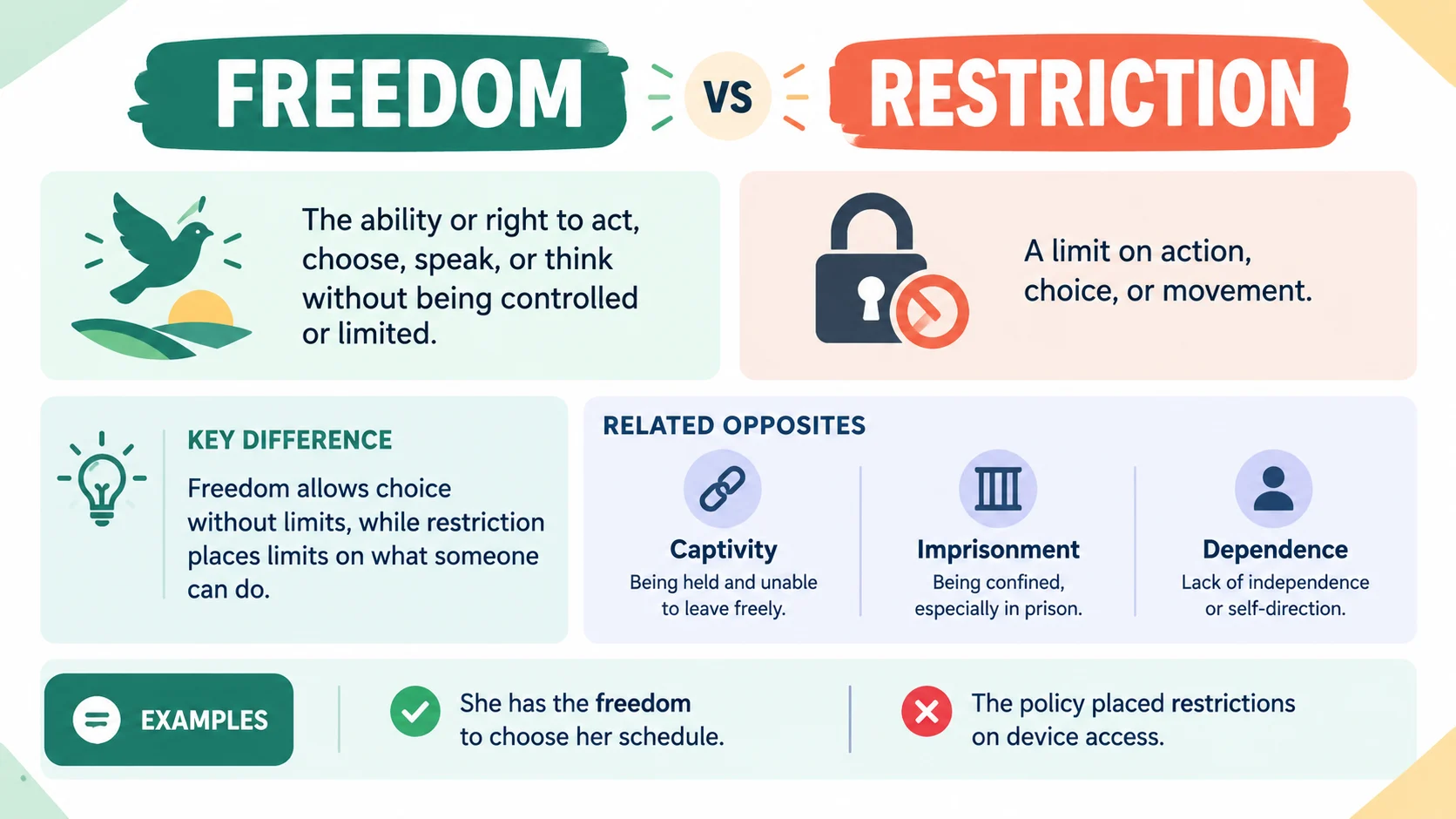
Freedom means having the ability or right to act, choose, speak, or think without being controlled or limited. When freedom refers broadly to the absence of limits on a person’s choices or actions, restriction is a strong direct opposite because it describes a condition that limits what someone can do.
However, freedom has several important meanings. It can refer to personal choice, political or civil rights, release from prison, or freedom from something harmful. Because of that range, the most precise antonym can change with the context.
Direct and Strong Antonyms
| Antonym | Tone or Nuance | Example Sentence |
|---|---|---|
| Restriction | General and neutral; a limit on action, choice, or movement | The new policy placed restrictions on when employees could access the facility. |
| Captivity | Strong; being held and unable to leave freely | The rescued hikers described the experience as months of captivity. |
| Bondage | Strong and serious; a condition of being controlled or severely unfree | The novel explores how debt can leave workers in a form of economic bondage. |
| Imprisonment | Formal and specific; being confined, especially in prison | His imprisonment removed nearly all freedom of movement. |
| Dependence | Best when freedom means independence or self-direction | Financial dependence made it harder for her to make decisions on her own. |
| Servitude | Formal and strong; a condition of being forced to serve or remain under another’s control | The historical account describes years of servitude under an abusive system. |
These words apply to different senses of freedom, so they should not be treated as interchangeable. Restriction is the broadest choice, while captivity and imprisonment are more specific forms of limited freedom.
Contextual and Subtle Opposites
The best opposite depends on what freedom means in the sentence.
| Context | Best Opposite | Why It Fits |
|---|---|---|
| Personal choice or action | Restriction | Focuses on limits placed on what someone can do. |
| Ability to leave | Captivity | Emphasizes being held or unable to leave. |
| Release from prison | Imprisonment | Directly contrasts freedom with being confined. |
| Independence or self-direction | Dependence | Contrasts self-reliance with reliance on another person or system. |
| Severe control or forced service | Bondage or servitude | Adds a stronger sense of domination or lack of autonomy. |
| Freedom from control in speech or behavior | Restraint | Works when the emphasis is on holding back expression or conduct. |
For example, saying, “The employee has little freedom in how the work is done,” makes restriction natural. Saying, “The prisoners finally regained their freedom,” makes imprisonment or captivity more precise.
Another useful term is unfreedom, which literally describes a lack of freedom. It is more common in academic or social science writing than in everyday American English, so it is usually not the best choice for ordinary conversation.
Words That Seem Opposite But Are Not
Control
Control can oppose freedom in particular situations, but it is not always an exact antonym. Control can be neutral or beneficial, while freedom specifically concerns the ability or right to act without being controlled or limited.
Compare:
“The manager gave the team freedom to choose the design.”
“The manager maintained control over the final approval.”
Here, control creates a contextual contrast, but it does not necessarily mean a complete absence of freedom.
Discipline
Discipline is another contextual contrast rather than a universal antonym. Discipline involves rules, training, or controlled behavior. A disciplined person can still have considerable freedom.
For example:
“She has the freedom to choose her schedule, but she follows a strict training routine.”
The routine creates limits without eliminating her overall freedom.
Subtle Tone Differences
Choosing among these words changes the strength and tone of the sentence.
Restriction is usually the safest neutral choice. It works well in workplace, academic, legal, and everyday writing.
Captivity is more vivid and specific. It emphasizes that someone is being held and cannot leave freely.
Bondage is much stronger. It can describe severe physical, social, economic, or figurative control and carries a serious tone.
Imprisonment is precise when physical confinement or incarceration is involved.
Dependence shifts the meaning toward autonomy. It is useful when someone cannot act independently because they rely heavily on another person or system.
Servitude is formal and more specific. It works when the idea involves forced service or subordination rather than an ordinary limitation.
For example, “The company introduced restrictions on personal devices” sounds neutral and professional. “The workers lived in bondage” communicates a far more severe condition. The words should not be treated as interchangeable simply because they can all contrast with freedom.
Frequently Asked Questions
What is the direct antonym of freedom?
Restriction is a strong general antonym when freedom means the ability to act without limits or control. Other antonyms become more precise in specific contexts, such as imprisonment for confinement or dependence when freedom means independence.
What is the opposite of freedom when someone is being held somewhere?
Captivity or imprisonment is more precise than the general word restriction. Captivity emphasizes being held and unable to leave, while imprisonment specifically emphasizes confinement, especially in a prison or similar setting.
Which antonym of freedom should I use in formal writing?
Use restriction when you mean a general limit, imprisonment for confinement, dependence for lack of independence, and servitude for forced service or subordination. Choose the word that matches the exact meaning and tone of your sentence.
Conclusion
Freedom does not have one universal opposite for every sentence. Restriction works as the strongest general choice when freedom means the absence of limits, while captivity, imprisonment, dependence, bondage, and servitude provide more specific contrasts.
Good word choice depends on the exact sense of freedom you want to describe. A precise antonym makes the sentence clearer and prevents a mild limitation from sounding like severe confinement. Which antonym best fits a sentence you are writing?
