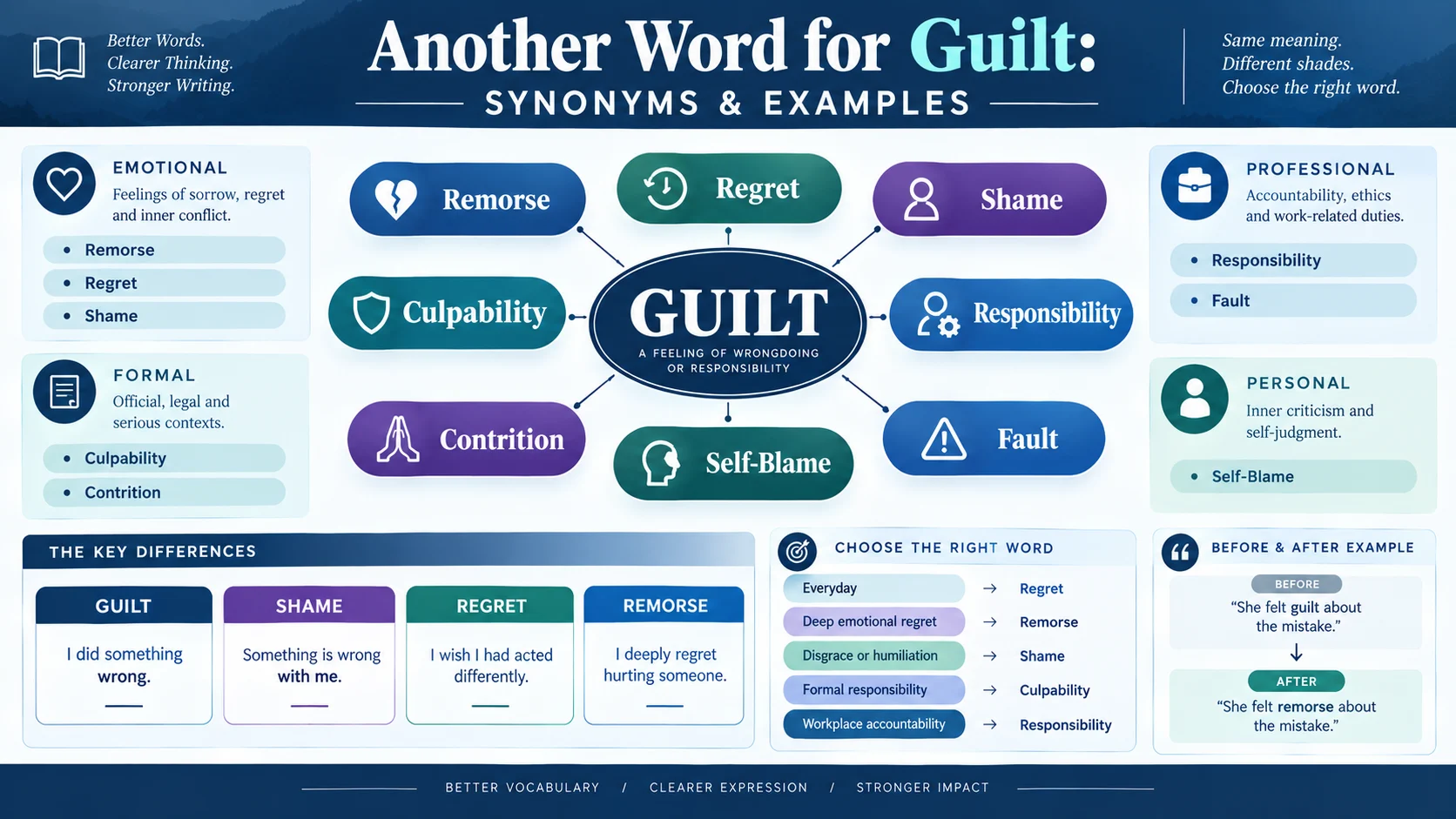
If you need another word for guilt, the best choice depends on the context. Common alternatives include remorse, regret, shame, culpability, responsibility, self-blame, contrition, and fault. For everyday writing, regret or remorse often works well, while culpability and blameworthiness are stronger choices for formal or legal contexts.
What Does Guilt Mean?
Definition
Guilt is the feeling that you have done something wrong, harmful, dishonest, or morally unacceptable. It can also refer to responsibility for an offense or wrongdoing, especially in legal or formal contexts.
The word can describe both an emotional state and a state of responsibility.
For example:
- She felt guilt after hurting her friend.
- The evidence established his guilt.
- He struggled with guilt over the decision.
Because guilt has several meanings, the best synonym depends on whether you are describing an emotion, moral responsibility, legal responsibility, or personal regret.
Common Uses
Guilt commonly appears in:
- Personal and emotional writing
- Conversations about relationships
- Psychology and self-reflection
- Essays and academic writing
- Professional discussions of responsibility
- Legal or criminal contexts
- Stories and creative writing
Best Synonyms for Guilt
| Synonym | Meaning | Best Used When | Example |
|---|---|---|---|
| Remorse | Deep regret for wrongdoing | Someone sincerely regrets an action | He felt genuine remorse for his mistake. |
| Regret | Sadness or disappointment about something done | The situation is less morally serious | She expressed regret about her decision. |
| Shame | Painful feeling of humiliation or disgrace | The focus is on how someone feels about themselves | He felt shame after lying to his family. |
| Culpability | Responsibility for wrongdoing | Formal, legal, or academic writing | The investigation examined his culpability. |
| Responsibility | Duty or accountability for an action | Professional or neutral contexts | She accepted responsibility for the error. |
| Self-blame | Holding yourself responsible for something | Personal or psychological contexts | Excessive self-blame can make recovery difficult. |
| Contrition | Sincere remorse for wrongdoing | Formal or serious writing | His apology showed genuine contrition. |
| Fault | Responsibility for a mistake or problem | Everyday and professional contexts | She admitted fault for the misunderstanding. |
Remorse
Remorse is one of the closest emotional synonyms for guilt. It suggests deep and sincere regret about having done something wrong.
Tone: Serious
Difficulty: Medium
Usage Frequency: Common
Best For: Essays, personal writing, professional statements, and serious conversations
Business example:
The manager expressed remorse for the communication error.
Academic example:
The character’s remorse becomes an important part of the novel’s moral conflict.
Daily conversation:
I felt a lot of remorse after saying those things.
Regret
Regret is broader and usually milder than guilt. You can regret an action without believing you have committed a moral offense.
Tone: Neutral
Difficulty: Easy
Usage Frequency: Very Common
Best For: Emails, everyday conversation, essays, and professional writing
Business example:
We regret the inconvenience caused by the delay.
Academic example:
The protagonist later regrets refusing the opportunity.
Daily conversation:
I regret not calling her sooner.
Shame
Shame overlaps with guilt but focuses more strongly on negative feelings about yourself. Guilt often means “I did something wrong,” while shame can feel more like “There is something wrong with me.”
Tone: Strong and emotional
Difficulty: Easy
Usage Frequency: Very Common
Best For: Personal writing, psychology, literature, and emotional storytelling
Business example:
The employee felt shame after the public criticism.
Academic example:
The study distinguishes feelings of shame from feelings of guilt.
Daily conversation:
She was overcome with shame after the argument.
Culpability
Culpability means the degree to which someone is responsible or blameworthy for wrongdoing. It is much more formal than guilt.
Tone: Formal
Difficulty: Advanced
Usage Frequency: Less Common
Best For: Legal writing, academic writing, journalism, and formal analysis
Business example:
The review assessed each department’s culpability for the failure.
Academic example:
The paper examines individual culpability in cases of institutional misconduct.
Daily conversation:
This word is uncommon in casual speech.
Synonyms by Context
Formal Writing
For formal writing, consider:
- Culpability
- Responsibility
- Fault
- Blameworthiness
- Contrition
- Remorse
Use culpability when you mean responsibility for wrongdoing. Use contrition or remorse when you are emphasizing emotional regret.
Example:
Instead of:
The report discusses the employee’s guilt.
Try:
The report examines the employee’s culpability.
Professional Writing
In workplace communication, responsibility, accountability, fault, and regret are usually more appropriate than emotionally loaded alternatives.
For example:
I accept responsibility for the error.
This sounds more professional than:
I feel guilty about the error.
For customer service, regret is particularly useful:
We regret the inconvenience caused by the delay.
Academic Writing
Academic writing often benefits from precise words such as culpability, responsibility, remorse, contrition, and self-blame.
The correct choice depends on the subject. In psychology, self-blame may be more precise than guilt. In literary analysis, remorse or shame may better describe a character’s emotional experience.
Daily Conversation
For everyday speech, the most natural alternatives are:
- Regret
- Remorse
- Shame
- Fault
- Responsibility
For example:
I feel guilty about forgetting her birthday.
can become:
I regret forgetting her birthday.
However, the two sentences are not exactly equivalent. The first emphasizes a feeling of wrongdoing; the second emphasizes disappointment about the action.
Professional Alternatives for Guilt
If you are writing a professional email, report, resume, or workplace statement, consider these alternatives:
Responsibility is useful when acknowledging an action or outcome.
I accept responsibility for the mistake.
Accountability emphasizes being answerable for an outcome.
The manager took accountability for the team’s decision.
Fault is direct and useful when identifying responsibility for an error.
The company acknowledged its fault in the matter.
Regret works well when expressing dissatisfaction about something that happened.
We regret the confusion caused by the announcement.
Culpability is appropriate when discussing serious wrongdoing in formal analysis.
The investigation sought to determine individual culpability.
Simple Alternatives for Guilt
If you need an easy word that most readers will immediately understand, try:
- Regret
- Shame
- Fault
- Blame
- Responsibility
- Remorse
For general audiences, regret is often the safest replacement because it is familiar and flexible.
Stronger Alternatives for Guilt
When you need a word with stronger emotional or formal force, consider:
Remorse: Strong emotional regret over wrongdoing.
Contrition: Sincere sorrow and repentance after doing something wrong.
Culpability: Formal responsibility for wrongdoing.
Blameworthiness: The condition of deserving blame.
Shame: A powerful feeling of disgrace or humiliation.
For example:
He felt guilt over his actions.
can become:
He felt profound remorse over his actions.
The second sentence communicates a deeper emotional response.
Difference Between Similar Synonyms
Guilt vs. Remorse
Guilt is the feeling that you have done something wrong. Remorse usually indicates a deeper level of regret.
She felt guilt after breaking the promise.
She felt remorse after realizing how deeply she had hurt him.
Guilt vs. Regret
Regret does not necessarily involve wrongdoing. You can regret missing an opportunity, changing jobs, or making a poor decision.
Guilt more strongly suggests moral responsibility.
Guilt vs. Shame
Guilt generally focuses on an action: I did something wrong.
Shame can focus on the self: I am ashamed of who I was or what I did.
Guilt vs. Blame
Guilt can describe an internal emotional experience. Blame usually refers to assigning responsibility to someone.
He felt guilt over the accident.
The investigation placed blame on the contractor.
Guilt vs. Culpability
Culpability is a formal term for responsibility or blameworthiness, particularly in legal, ethical, or institutional contexts.
It is not normally interchangeable with emotional guilt.
Opposite Words
Common opposites of guilt include:
- Innocence
- Pride
- Self-acceptance
- Forgiveness
- Blamelessness
- Justification
The best opposite depends on the meaning of guilt. Innocence is the clearest opposite when guilt means legal or moral responsibility. Self-acceptance or forgiveness may be more appropriate when guilt refers to an emotional state.
FAQs
What is another word for guilt?
Common alternatives for guilt include remorse, regret, shame, culpability, responsibility, fault, self-blame, and contrition. The best synonym depends on whether you mean emotional regret, moral responsibility, or legal responsibility.
What is a formal synonym for guilt?
Culpability is a strong formal synonym when guilt means responsibility for wrongdoing. Contrition and remorse are better choices when referring to sincere regret.
What is a professional alternative for guilt?
Responsibility, accountability, fault, and regret are useful professional alternatives. For example, “I accept responsibility for the error” sounds more constructive than “I feel guilty about the error.”
What word can replace guilt in an essay?
Depending on the context, use remorse, regret, shame, culpability, responsibility, self-blame, or contrition. Choose the word that matches the exact meaning rather than replacing guilt automatically.
What is another word for feeling guilty?
Possible alternatives include feeling remorseful, feeling ashamed, experiencing regret, or blaming yourself. The most accurate option depends on why the person feels guilty.
What is a synonym for guilt in a legal context?
In legal or formal contexts, culpability, responsibility, liability, or blameworthiness may be appropriate, although these terms have distinct legal meanings and should not automatically be treated as exact synonyms.
What is a softer word for guilt?
Regret is usually softer than guilt. It expresses disappointment or sorrow about an action without necessarily suggesting serious moral wrongdoing.
What is a stronger word for guilt?
Remorse, contrition, and culpability can be stronger alternatives depending on context. Remorse emphasizes deep emotional regret, while culpability emphasizes responsibility for wrongdoing.
Conclusion
The best synonym for guilt depends on what you want to communicate. Choose remorse for deep regret, regret for a milder emotional response, shame for a painful sense of disgrace, culpability for formal responsibility, and responsibility or accountability for professional situations.
When replacing guilt, focus on the specific meaning rather than simply choosing the closest dictionary synonym. A precise word makes your writing clearer, more natural, and more effective.

1 thought on “Another Word for Guilt| 15 Synonyms & Examples For 2026”