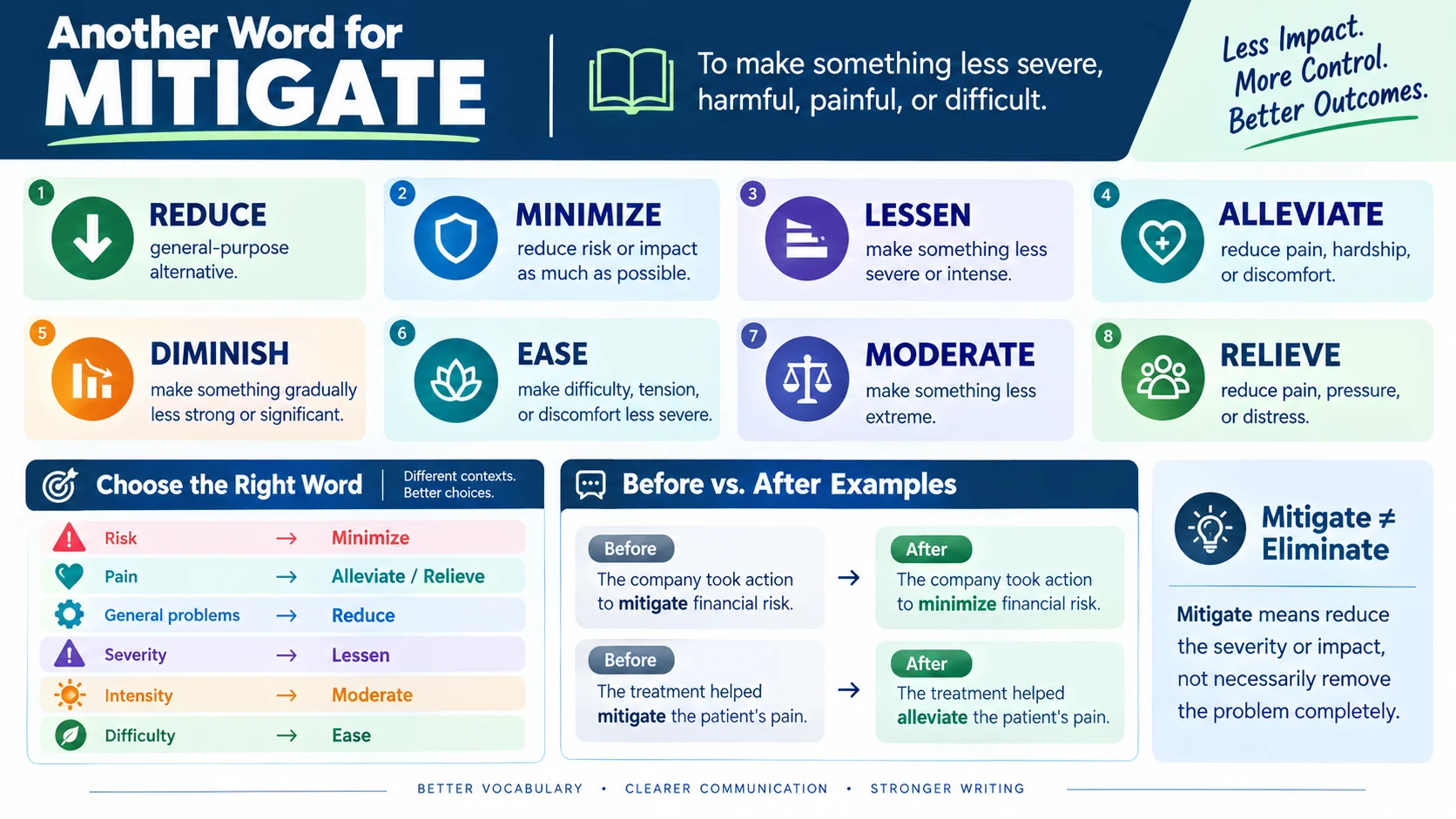
Another word for mitigate is reduce, lessen, minimize, alleviate, or diminish. The best choice depends on context. Use reduce for general situations, alleviate for pain or hardship, minimize for limiting risk or impact, and lessen for making something less severe.
What Does Mitigate Mean?
Definition
Mitigate means to make something less severe, harmful, painful, serious, or difficult. It often describes an action taken to reduce the negative effects of a problem rather than eliminate the problem completely.
For example:
The company introduced new security measures to mitigate the risk of data breaches.
Here, mitigate means to reduce the potential harm or likelihood of a data breach.
The word is especially common in business, law, government, academic writing, risk management, medicine, and professional communication.
Common Uses
You can use mitigate when talking about:
- Risks
- Damage
- Problems
- Negative effects
- Financial losses
- Environmental harm
- Pain or discomfort
- Consequences
- Conflict
- Threats
- Business uncertainty
A useful distinction is that mitigate usually suggests reducing a problem rather than completely removing it.
Best Synonyms for Mitigate
| Synonym | Meaning | Best Used When | Example |
|---|---|---|---|
| Reduce | Make something smaller or less severe | General situations | We need to reduce operating costs. |
| Lessen | Make something less intense or serious | Effects, pain, or severity | The treatment lessened her discomfort. |
| Minimize | Reduce something to the smallest practical amount | Risk, damage, errors, or costs | The team took steps to minimize risk. |
| Alleviate | Make pain, difficulty, or suffering less severe | Pain, hardship, or distress | The medication helped alleviate pain. |
| Diminish | Make something gradually become less | Strength, importance, intensity, or effect | The criticism diminished public confidence. |
| Moderate | Make something less extreme | Behavior, conditions, or intensity | The policy moderated the impact of inflation. |
| Relieve | Reduce pain, pressure, difficulty, or distress | Physical or emotional problems | The changes relieved some financial pressure. |
| Ease | Make something less difficult, painful, or tense | Everyday and professional language | The new process eased the workload. |
| Neutralize | Counteract or make an effect ineffective | Threats, forces, or harmful effects | The security system helped neutralize the threat. |
| Offset | Counterbalance a negative effect | Costs, losses, or environmental effects | The savings offset the additional expense. |
1. Reduce
Meaning: To make something smaller, lower, or less severe.
Tone: Neutral
Difficulty: Easy
Usage Frequency: Very Common
Best for: Everyday conversation, business writing, emails, essays, and professional communication.
Business example:
The company implemented new procedures to reduce operational risk.
Academic example:
Regular exercise may reduce the risk of cardiovascular disease.
Daily conversation:
Taking a break can reduce stress.
Best general replacement: If you are unsure which synonym to choose, reduce is usually the safest and most natural alternative.
2. Lessen
Meaning: To make something less severe, intense, or difficult.
Tone: Neutral
Difficulty: Easy
Usage Frequency: Common
Best for: Pain, severity, effects, concerns, and emotional difficulties.
Business example:
The new policy could lessen the financial burden on small businesses.
Academic example:
The intervention was designed to lessen the effects of sleep deprivation.
Daily conversation:
A short walk helped lessen my headache.
3. Minimize
Meaning: To reduce something as much as reasonably possible.
Tone: Professional
Difficulty: Easy
Usage Frequency: Very Common
Best for: Risk, errors, costs, losses, delays, and negative consequences.
Business example:
The company created a backup system to minimize the risk of data loss.
Academic example:
Researchers controlled the variables to minimize experimental error.
Daily conversation:
Leave early to minimize the chance of getting stuck in traffic.
4. Alleviate
Meaning: To make pain, suffering, difficulty, or discomfort less severe.
Tone: Formal
Difficulty: Advanced
Usage Frequency: Common
Best for: Pain, stress, suffering, hardship, and difficult conditions.
Business example:
The program was introduced to alleviate financial pressure on employees.
Academic example:
The treatment may alleviate symptoms associated with the condition.
Daily conversation:
A warm shower helped alleviate my back pain.
Important distinction: Alleviate is particularly natural when the thing being reduced is pain, suffering, discomfort, or hardship.
Synonyms by Context
Formal Writing
For formal writing, strong alternatives include:
- Alleviate
- Diminish
- Moderate
- Minimize
- Reduce
- Lessen
Example:
The proposed reforms aim to mitigate the negative effects of economic uncertainty.
Possible alternatives:
The proposed reforms aim to reduce the negative effects of economic uncertainty.
The proposed reforms aim to alleviate the economic difficulties faced by vulnerable households.
The proposed reforms aim to minimize the potential consequences of economic uncertainty.
The correct synonym depends on what you want to emphasize.
Professional Writing
In business and workplace communication, reduce, minimize, limit, and mitigate are especially useful.
Original:
The company adopted new procedures to mitigate financial risk.
Alternative:
The company adopted new procedures to minimize financial risk.
Alternative:
The company adopted new procedures to reduce financial risk.
In risk-management language, mitigate can sound more precise because it implies taking deliberate action to control a potential negative outcome.
Academic Writing
Academic alternatives include:
- Reduce
- Lessen
- Alleviate
- Minimize
- Diminish
- Moderate
Example:
Researchers developed a new method to mitigate the effects of environmental pollution.
Depending on the intended meaning, this could become:
Researchers developed a new method to reduce the effects of environmental pollution.
or:
Researchers developed a new method to minimize the harmful effects of environmental pollution.
Daily Conversation
For everyday speech, simpler words are usually more natural:
- Reduce
- Ease
- Lessen
- Help
- Relieve
Instead of:
This should mitigate the problem.
A conversational speaker might say:
This should reduce the problem.
Or:
This should help ease the problem.
Professional Alternatives for Mitigate
If you are writing an email, report, proposal, resume, or business document, consider these alternatives:
Reduce: Best all-purpose professional choice.
Minimize: Best for risk, errors, costs, and negative outcomes.
Limit: Best when emphasizing a boundary or restriction.
Alleviate: Best for hardship, pressure, pain, or difficulty.
Address: Best when discussing action taken toward a problem, although it does not necessarily mean reducing the problem.
Control: Best when discussing risks, processes, or conditions.
Manage: Best when a problem cannot be completely eliminated but can be handled effectively.
Resume Example
Instead of:
Implemented procedures to mitigate operational risks.
You could write:
Implemented procedures to minimize operational risks.
Or:
Implemented procedures to reduce operational risks.
Minimize is particularly useful when describing measurable risk-reduction efforts.
Simple Alternatives for Mitigate
If your audience may not be familiar with formal vocabulary, use:
- Reduce
- Lessen
- Ease
- Help
- Lower
- Limit
- Relieve
For example:
Formal:
The policy was designed to mitigate financial hardship.
Simple:
The policy was designed to reduce financial hardship.
Formal:
The treatment may mitigate symptoms.
Simple:
The treatment may ease symptoms.
Stronger Alternatives for Mitigate
No synonym is automatically “stronger” in every sentence, but some words communicate a more specific or forceful action.
Minimize suggests reducing something as much as possible.
The company took steps to minimize security risks.
Neutralize suggests counteracting a threat or harmful force.
The security system helped neutralize the threat.
Eliminate means completely remove something and is therefore much stronger than mitigate.
The new system eliminated the source of the error.
Be careful: eliminate is not a direct synonym for mitigate because mitigating a problem does not necessarily mean removing it.
Difference Between Similar Synonyms
Mitigate vs. Reduce
Reduce is broader and more common. It simply means making something smaller or less.
Mitigate usually emphasizes reducing the harmful, serious, or negative effects of something.
The company reduced its expenses.
The company introduced safeguards to mitigate financial risk.
Mitigate vs. Minimize
Minimize often suggests reducing something to the lowest practical level.
We need to minimize errors.
Mitigate focuses more broadly on reducing the severity or consequences of a negative situation.
We need to mitigate the effects of the disruption.
Mitigate vs. Alleviate
Alleviate is strongly associated with pain, suffering, discomfort, and hardship.
The treatment alleviated the patient’s pain.
Mitigate has a broader range and works naturally with risks, damage, consequences, and negative effects.
The company took action to mitigate the risk.
Mitigate vs. Prevent
These words are not interchangeable.
Prevent means stopping something from happening.
Mitigate means reducing its severity or impact if it occurs or while it is occurring.
For example:
Security measures may prevent unauthorized access.
Backup systems may mitigate the damage caused by unauthorized access.
Opposite Words
Words that express an opposite or contrasting idea include:
- Worsen
- Aggravate
- Intensify
- Increase
- Escalate
- Exacerbate
- Amplify
For example:
The new policy was intended to mitigate the problem.
The opposite idea would be:
The new policy exacerbated the problem.
Exacerbate is especially useful when something makes an existing problem more severe.
Frequently Asked Questions
What is another word for mitigate?
Common alternatives for mitigate include reduce, lessen, minimize, alleviate, diminish, moderate, ease, relieve, and offset. The best synonym depends on what is being reduced and the tone of the sentence.
What is a formal synonym for mitigate?
Alleviate, diminish, moderate, minimize, and reduce can all work in formal writing. Alleviate is especially suitable for pain, hardship, or suffering, while minimize works well for risk and negative consequences.
What is a professional alternative for mitigate?
Reduce and minimize are strong professional alternatives. For business risk, minimize risk is especially natural. For financial pressure or hardship, alleviate may be more appropriate.
What word can replace mitigate in a sentence?
The simplest replacement is usually reduce. However, minimize, lessen, alleviate, ease, diminish, or moderate may be more precise depending on the sentence.
Is reduce the same as mitigate?
Not exactly. Reduce is a broad term meaning to make something smaller or less. Mitigate specifically emphasizes reducing the severity, harmful effects, or consequences of something.
What is the opposite of mitigate?
Common opposites include worsen, aggravate, intensify, escalate, and exacerbate. These words describe making a situation more severe rather than less severe.
Is mitigate a positive or negative word?
Mitigate is generally neutral in tone. It describes an action intended to reduce a negative effect, risk, problem, or consequence.
Conclusion
The best alternative for mitigate depends on the context. Reduce is the most versatile everyday replacement, while minimize is particularly useful for risks, errors, and negative outcomes. Alleviate works especially well for pain, hardship, and suffering. Lessen is a natural choice when discussing severity or intensity, and ease is useful in conversational writing.
When choosing a synonym, consider not only the basic meaning but also the tone, audience, and type of problem being described. In professional and academic writing, precise word choice can make a sentence clearer without making it unnecessarily complicated.
