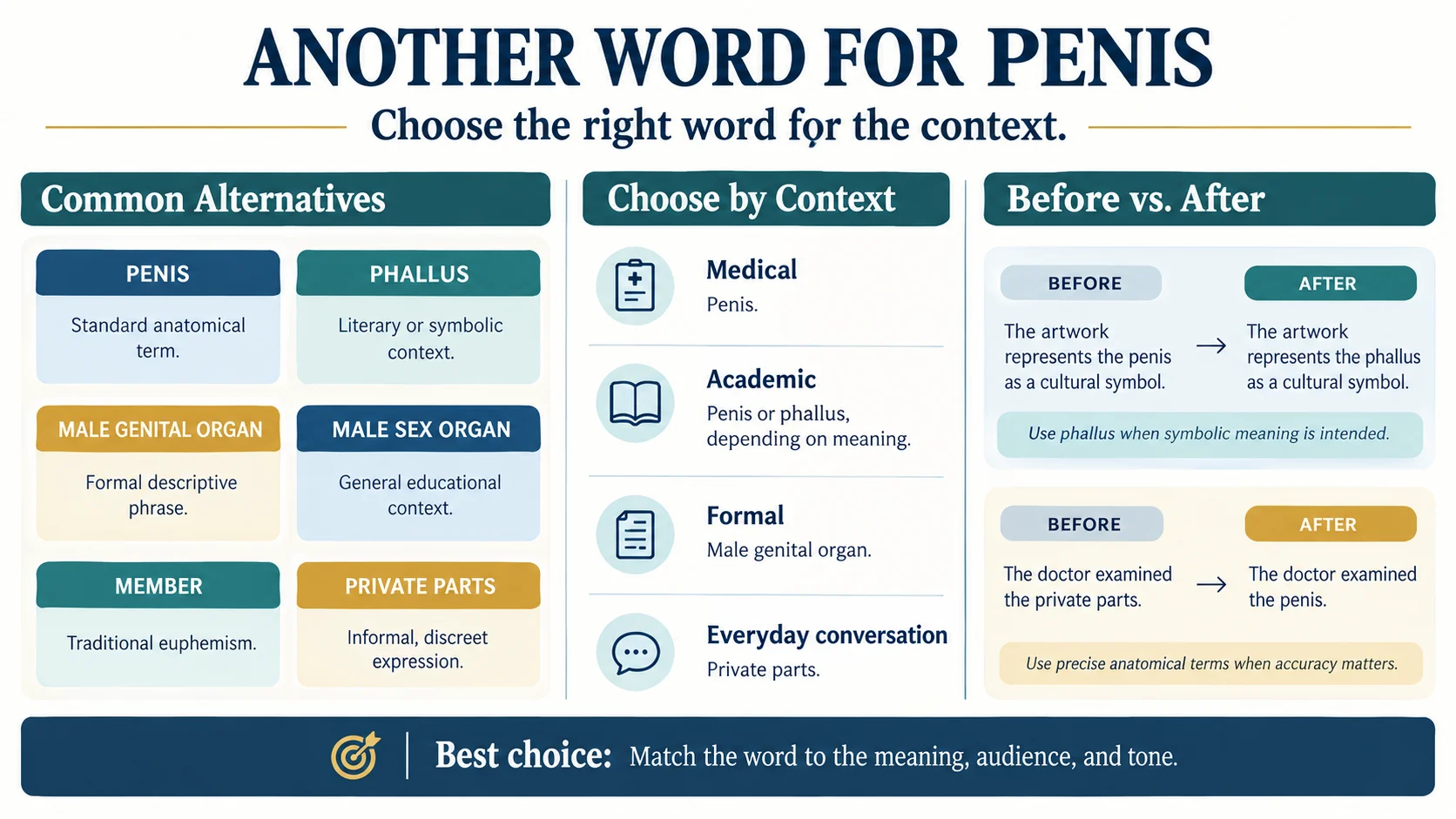
Another word for penis depends on the context. Phallus is a formal alternative, while male genital organ is a neutral descriptive phrase and member is a more discreet expression. Informal alternatives include privates and various slang terms. For medical, educational, or professional writing, penis remains the clearest and most accurate word.
What Does Penis Mean?
Definition
The penis is an external reproductive and urinary organ typically associated with male anatomy. It contains the urethra, which carries urine out of the body, and plays a role in sexual reproduction.
In American English, penis is the standard anatomical term used in medical education, health information, biology, and everyday communication. Its meaning is specific, making it more precise than many informal alternatives.
Common Uses
The word appears in several contexts:
- Medical writing: Describing anatomy, symptoms, examinations, or health conditions.
- Academic writing: Explaining human biology, reproduction, and anatomy.
- Everyday conversation: Discussing the body, personal health, or anatomy.
- Informal conversation: Using slang or euphemisms when a less direct expression is preferred.
- Literature and cultural studies: Discussing symbolism, imagery, or representations of the phallus.
The best alternative depends on whether accuracy, formality, discretion, or an informal tone is most important.
Best Synonyms for Penis
Not every alternative is a true synonym. Some terms describe the same anatomical structure, while others refer to the genital area generally or are used as euphemisms.
| Synonym or alternative | Meaning | Best used when | Example |
|---|---|---|---|
| Phallus | A term for the penis, especially in symbolic or cultural contexts | Literature, art, or academic discussion | The sculpture features a phallus as a symbol of fertility. |
| Male genital organ | A descriptive anatomical phrase | Educational or explanatory writing | The male genital organ has reproductive and urinary functions. |
| Male sex organ | A general descriptive term | Introductory biology or health education | The penis is a male sex organ. |
| Member | A traditional euphemism for the penis | Discreet or formalized expression | The passage refers indirectly to the male member. |
| Genital organ | An anatomical term for an organ involved in reproduction | Medical or educational contexts | The physician examined the external genital organ. |
| Genitals | External reproductive organs; the term may refer to more than one structure | General health discussions | The lesson explains how to care for the genitals. |
| Private parts | A common euphemism for intimate body parts | Everyday conversation and child-friendly explanations | Children should learn the correct names for their private parts. |
| Privates | An informal term for intimate body parts | Casual conversation | He used a towel to cover his privates. |
| Phallic organ | A descriptive expression emphasizing phallic shape or symbolism | Specialized academic or literary writing | The critic interpreted the image as a phallic symbol. |
| Male anatomy | The physical structures associated with male bodies | General education | The chapter introduces male anatomy. |
Important distinction: Phallus is not always interchangeable with penis. It often carries symbolic, artistic, or cultural meaning. Likewise, genitals, private parts, and male anatomy may refer to a broader range of structures rather than the penis alone.
Synonyms by Context
Formal Writing
For formal writing, choose terminology that communicates the intended meaning without sounding unnecessarily vague.
Recommended alternatives: phallus, genital organ, male genital organ.
Phallus works well in discussions of mythology, symbolism, art, and cultural history. Male genital organ is useful when explaining anatomy to readers who may be unfamiliar with technical vocabulary.
Example: “The researcher examined the phallus as a recurring symbol in ancient art.”
For a medical report, however, penis is generally more direct and precise.
Professional Writing
Professional communication should prioritize clarity, accuracy, and respect.
Recommended alternatives: penis, genital organ, external genitalia, or male reproductive anatomy, depending on the subject.
Example: “The educational material explains the anatomy and function of the penis.”
In clinical documentation, use the specific anatomical term that accurately describes the body part or condition. Avoid replacing a precise term with privates or member when medical accuracy matters.
Academic Writing
Academic terminology varies by discipline.
- Biology: penis, male reproductive anatomy.
- Medicine: penis, penile tissue, external genitalia, as appropriate.
- Literary studies: phallus, phallic symbol.
- Anthropology and cultural studies: phallus, when discussing its cultural or symbolic significance.
Example: “The article explores the phallus as a symbol of authority in historical representations.”
Use penile when an adjective is needed, as in penile anatomy or penile tissue. It is not a noun synonym for penis.
Daily Conversation
Everyday conversation often favors familiar or indirect language.
Common alternatives: private parts, privates, and context-specific slang.
Example: “The child asked a question about his private parts.”
These expressions may be suitable when discretion is more important than anatomical precision. However, private parts can refer to several intimate body areas, so it should not be treated as an exact synonym in every sentence.
Slang varies considerably by age group, region, relationship, and situation. A word that sounds humorous among friends may seem vulgar or inappropriate in another setting.
Professional Alternatives for Penis
If you need an appropriate term for a report, presentation, educational resource, or workplace document, consider these options.
| Alternative | Tone | Best application |
|---|---|---|
| Penis | Neutral and precise | Medical, educational, and professional writing |
| Male genital organ | Formal and descriptive | General anatomy explanations |
| Genital organ | Technical and neutral | Anatomical descriptions where context is clear |
| Penile anatomy | Scientific | Medical and biological discussions |
| Phallus | Formal or symbolic | Art history, literature, and cultural analysis |
Important Synonym Analysis
Penis
- Meaning: The specific external anatomical organ.
- Best used for: Accurate identification of the body part.
- Tone: Neutral.
- Difficulty: Easy.
- Usage frequency: Very common.
- Best for: Health education, academic essays, medical communication, and factual writing.
Phallus
- Meaning: The penis, particularly as represented symbolically or culturally.
- Best used for: Literary analysis, art criticism, and historical discussions.
- Tone: Formal, scholarly, or symbolic.
- Difficulty: Advanced.
- Usage frequency: Less common.
- Best for: Academic essays, cultural studies, and specialized writing.
Male genital organ
- Meaning: A descriptive phrase identifying the anatomical structure.
- Best used for: General educational explanations and formal descriptions.
- Tone: Formal and neutral.
- Difficulty: Medium.
- Usage frequency: Common in explanatory contexts.
- Best for: Educational materials, reports, and professional communication.
Private parts
- Meaning: A euphemistic expression for intimate body areas.
- Best used for: Informal conversation and age-appropriate explanations.
- Tone: Gentle, discreet, and conversational.
- Difficulty: Easy.
- Usage frequency: Very common in everyday speech.
- Best for: Family conversations and introductory personal-safety education.
These alternatives are not suitable for every purpose. Resume writing and marketing copy ordinarily do not require a synonym for penis unless the subject is directly relevant. In those cases, select terminology according to the document’s purpose rather than trying to replace the word automatically.
Simple Alternatives for Penis
For readers who prefer familiar language, the following expressions may be easier to understand:
- Private parts: A discreet expression for intimate body areas.
- Privates: An informal variation of private parts.
- Male sex organ: A straightforward descriptive phrase.
- Genitals: A familiar anatomical term that can refer to multiple reproductive structures.
For children, it is often helpful to explain that penis is the correct anatomical name while acknowledging that families may use other expressions at home.
Stronger Alternatives for Penis
If “stronger” means more technical, specific, or expressive, the right word depends on the intended effect.
- Penile structure: A technical phrase emphasizing anatomy.
- Penile organ: A formal descriptive expression, although penis is generally more natural.
- Phallus: A more literary or symbolic term.
- Phallic symbol: An expression for an object or image interpreted as resembling or representing a penis.
These expressions have different grammatical functions. For example, phallic is an adjective, while phallus is a noun. A phallic symbol may represent the penis without being an anatomical organ.
Difference Between Similar Synonyms
Understanding the distinctions between related words helps prevent awkward or inaccurate writing.
| Word | Key difference |
|---|---|
| Penis | The precise anatomical name |
| Phallus | Often emphasizes symbolism, representation, or cultural meaning |
| Genitals | Refers to reproductive structures more broadly |
| Male genital organ | A descriptive alternative that may sound more formal |
| Member | A traditional euphemism whose meaning depends on context |
| Private parts | An indirect phrase that may refer to several intimate body areas |
| Penile | An adjective meaning relating to the penis |
Before and After Examples
Medical writing
Before: “The doctor examined the private parts.”
After: “The doctor examined the penis.”
Why it works: The revised sentence identifies the anatomical structure more precisely, assuming that was the body part examined.
Academic writing
Before: “The artwork uses the penis as a cultural symbol.”
After: “The artwork uses the phallus as a cultural symbol.”
Why it works: Phallus may be more appropriate when discussing symbolism rather than anatomy.
Everyday conversation
Before: “The child asked about his genital organ.”
After: “The child asked about his private parts.”
Why it works: The second sentence sounds more conversational, although private parts is less anatomically specific.
Opposite Words
There is no single exact antonym for penis. It names a specific anatomical structure, rather than a quality or action that naturally has an opposite.
Depending on the context, related contrasting terms may include:
- Vulva: The external female genital structures; it is not an exact linguistic opposite of penis.
- Clitoris: A distinct anatomical structure that is not an antonym of penis.
- Female genital anatomy: A broad descriptive category for comparison in anatomy education.
For scientific writing, describe the relevant anatomical structures directly instead of presenting them as strict opposites.
FAQs
What is another word for penis?
Phallus, male genital organ, and male sex organ are alternatives. Private parts is a more informal euphemism, while penis remains the clearest anatomical term.
What is a formal synonym for penis?
Phallus is a formal alternative in symbolic, literary, and cultural contexts. For straightforward anatomical writing, male genital organ is a descriptive alternative, although penis is usually more precise.
What is a professional alternative for penis?
Use penis in most medical, educational, and professional documents. Terms such as penile anatomy and male genital organ can work when the sentence requires an adjective or a broader descriptive expression.
What word can replace penis in academic writing?
The best choice depends on the discipline. Biology and medicine generally favor penis, while literary and cultural analysis may use phallus when discussing symbolism.
Is phallus the same as penis?
Not in every context. Phallus can refer to the penis, but it frequently emphasizes symbolic or cultural representation. Penis is the more direct anatomical term.
Is private parts a synonym for penis?
It is a common euphemism, but it can refer to multiple intimate body areas. Use penis when you need to identify the specific anatomical structure.
What is the polite word for penis?
Penis is already a neutral, medically accepted term. Private parts is more indirect and may be preferable in some casual or child-friendly conversations.
Is penile another word for penis?
No. Penile is an adjective meaning “relating to the penis.” For example, penile anatomy describes the anatomy of the penis.
Conclusion
The best alternative to penis depends on your audience and purpose. Choose penis for anatomical accuracy, phallus for appropriate literary or symbolic contexts, male genital organ for descriptive writing, and private parts when a discreet, informal expression is more suitable.
A useful synonym does more than replace a word. It preserves the intended meaning, matches the tone, and helps readers understand the sentence without confusion.
