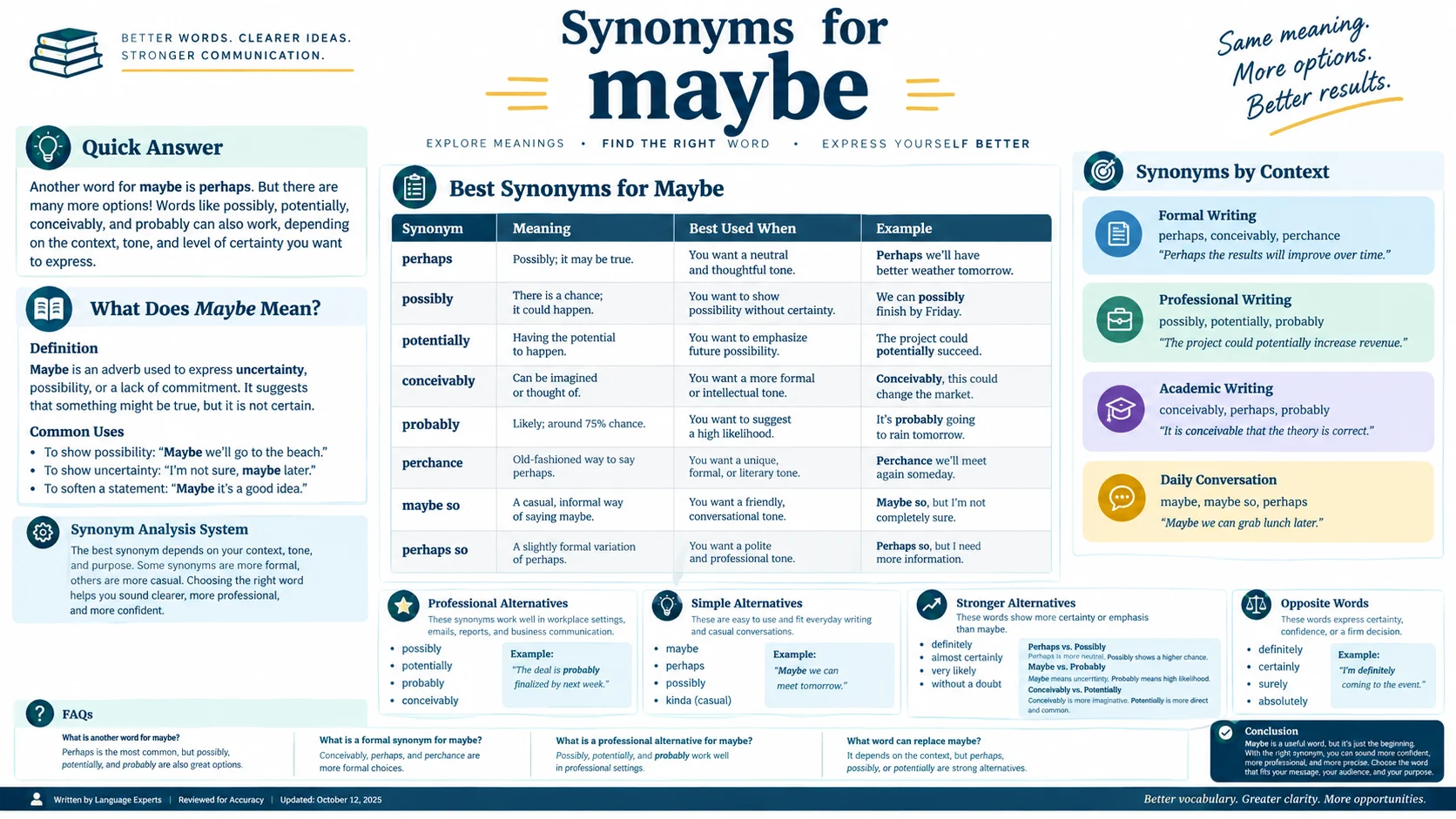
Another word for maybe is perhaps. Other useful synonyms include possibly, potentially, conceivably, probably, perchance, and it is possible that. The best alternative depends on your intended meaning, level of certainty, and writing style. Use perhaps for a neutral tone, possibly to express uncertainty, and probably when something seems likely.
What Does Maybe Mean?
Definition
Maybe is an adverb used to express possibility, uncertainty, or hesitation. It indicates that something may happen, may be true, or may be worth considering, but it is not certain.
For example, “Maybe we should revise the proposal” suggests that revising the proposal is an option rather than a definite decision.
Common Uses
The word maybe appears in everyday conversations, professional emails, academic discussions, and informal writing. Its meaning can vary slightly according to context.
- Expressing possibility: Maybe it will rain tomorrow.
- Showing uncertainty: Maybe she has already left.
- Making a suggestion: Maybe we should try another approach.
- Giving a tentative answer: Maybe I can attend the meeting.
Although maybe is versatile, repeating it too often can make writing sound hesitant. Choosing a more precise synonym can improve clarity and confidence.
Best Synonyms for Maybe
The following table compares common alternatives according to their meanings and typical uses.
| Synonym | Meaning | Best Used When | Example |
|---|---|---|---|
| Perhaps | Possibly; it may be true | Neutral or formal writing | Perhaps we should reconsider the offer. |
| Possibly | Something may happen or be true | Expressing uncertainty | We could possibly finish today. |
| Potentially | Having the possibility to develop or occur | Discussing future outcomes | The change could potentially improve efficiency. |
| Probably | Likely to happen or be true | Expressing a stronger expectation | She will probably arrive early. |
| Conceivably | Something can be imagined as possible | Formal or analytical writing | Conceivably, the plan could succeed. |
| Perchance | Perhaps; possibly | Literary or deliberately old-fashioned writing | Perchance, we shall meet again. |
| It is possible that | Something may be true | Formal explanations | It is possible that demand will increase. |
| There is a chance | An event may occur | Conversational or practical situations | There is a chance we will finish early. |
| Might | Indicates a possible action or event | Direct, natural sentences | We might visit this weekend. |
| Could be | Something may be true | Casual conversation | That could be the right answer. |
| Maybe so | Acknowledges a possibility | Informal discussion | Maybe so, but we need more evidence. |
| In all likelihood | Very likely | Formal predictions | In all likelihood, the project will proceed. |
Best overall choice: Perhaps is the closest general synonym for maybe. However, probably communicates greater confidence, while possibly emphasizes uncertainty.
Synonyms for Maybe by Context
Formal Writing
When writing reports, proposals, formal letters, or professional documents, consider these alternatives:
- Perhaps: A neutral and widely accepted choice.
- Conceivably: Suitable when discussing a possibility that is imaginable but uncertain.
- Possibly: Useful for presenting an uncertain outcome.
- It is possible that: Appropriate for complete, carefully qualified statements.
- Potentially: Best when describing possible effects, benefits, or future developments.
Example: “Perhaps further analysis would clarify the issue.”
For highly formal writing, choose the expression that communicates your intended level of certainty rather than replacing every occurrence of maybe mechanically.
Professional Writing
In business communication, the best synonym depends on whether you are discussing an opportunity, a forecast, or an undecided action.
| Situation | Recommended Alternative | Example |
|---|---|---|
| Suggesting an idea | Perhaps | Perhaps we should review the budget. |
| Discussing an opportunity | Potentially | This strategy could potentially increase sales. |
| Giving a forecast | Probably | The client will probably respond tomorrow. |
| Offering an option | Could | We could schedule another meeting. |
| Acknowledging uncertainty | Possibly | We may possibly need additional resources. |
Business example: Instead of writing, “Maybe this campaign will attract more customers,” write, “This campaign could attract additional customers.”
The revised sentence is more direct without claiming that the outcome is guaranteed.
Academic Writing
Academic writing often requires precise statements that distinguish possibility from probability and established evidence.
Useful alternatives include perhaps, possibly, conceivably, and it is plausible that.
Examples:
- “Perhaps this interpretation explains the observed pattern.”
- “It is possible that the sample size affected the results.”
- “It is plausible that environmental factors contributed to the outcome.”
Avoid using probably or certainly unless the available evidence supports the degree of confidence expressed.
Daily Conversation
In casual conversations, simple expressions usually sound more natural than formal alternatives.
Common choices include:
- Maybe: Maybe we can meet later.
- Perhaps: Perhaps we can meet later.
- Might: We might meet later.
- Could be: That could be true.
- Maybe so: Maybe so, but I’m not convinced.
- There’s a chance: There’s a chance we’ll get tickets.
Use maybe when you want a relaxed tone. Choose perhaps when you want to sound slightly more measured or polite.
Professional Alternatives for Maybe
If you want your writing to sound clear and professional, consider these five alternatives.
1. Perhaps
Meaning: Something may be true or worth considering.
Best used for: Emails, reports, proposals, and polite suggestions.
Tone: Neutral to formal.
Difficulty: Easy.
Usage frequency: Very common.
Best for: Email writing, essays, business writing, and professional correspondence.
- Business: “Perhaps we should discuss the revised timeline.”
- Academic: “Perhaps this finding warrants further investigation.”
- Daily conversation: “Perhaps we can try again tomorrow.”
2. Potentially
Meaning: Having the possibility of producing a particular result.
Best used for: Opportunities, projected outcomes, and business benefits.
Tone: Professional and analytical.
Difficulty: Medium.
Usage frequency: Common.
Best for: Resumes, business writing, marketing copy, and reports.
- Business: “The new process could potentially reduce operating costs.”
- Academic: “The intervention could potentially improve learning outcomes.”
- Daily conversation: “That could potentially work.”
Use potentially when discussing what might be possible, not when you simply need a conversational substitute for maybe.
3. Possibly
Meaning: Perhaps; something may happen or be true.
Best used for: Uncertain outcomes and tentative possibilities.
Tone: Neutral.
Difficulty: Easy.
Usage frequency: Very common.
Best for: Emails, essays, reports, and everyday communication.
- Business: “Could we possibly move the meeting to Thursday?”
- Academic: “The variation could possibly reflect sampling differences.”
- Daily conversation: “Could you possibly help me?”
In requests, possibly can soften a question and make it sound more courteous.
4. Probably
Meaning: Something is likely to happen or be true.
Best used for: Predictions and expectations supported by a reasonable basis.
Tone: Neutral.
Difficulty: Easy.
Usage frequency: Very common.
Best for: Business forecasts, general writing, and everyday communication.
- Business: “The shipment will probably arrive tomorrow.”
- Academic: “The difference probably reflects variation between groups.”
- Daily conversation: “I’ll probably stay home tonight.”
Unlike maybe, probably suggests that an outcome is more likely than not.
5. Conceivably
Meaning: In a way that can reasonably be imagined as possible.
Best used for: Hypothetical situations and careful analysis.
Tone: Formal and intellectual.
Difficulty: Advanced.
Usage frequency: Less common.
Best for: Academic essays, analytical reports, and formal arguments.
- Business: “The proposed change could conceivably affect delivery schedules.”
- Academic: “This mechanism could conceivably explain the unexpected result.”
- Daily conversation: “Conceivably, we could finish tonight.”
Because it is less common in everyday speech, use conceivably when its precise meaning adds value.
Simple Alternatives for Maybe
If you need easy words for schoolwork, messages, or daily conversation, these alternatives are usually sufficient:
- Perhaps: Perhaps he is busy.
- Possibly: We could possibly go tomorrow.
- Might: She might call later.
- Could: It could happen again.
- Maybe so: Maybe so, but let’s check.
- There is a chance: There is a chance we will win.
For most readers, perhaps, possibly, and might are the most useful simple alternatives. Remember that might and could are modal verbs, so they often require restructuring the sentence rather than a direct word-for-word replacement.
Stronger Alternatives for Maybe
Sometimes maybe sounds too uncertain. If you intend to communicate a more definite expectation, consider these expressions:
- Probably: The event will probably take place.
- Likely: The event is likely to take place.
- In all likelihood: In all likelihood, the event will take place.
- Almost certainly: The event will almost certainly take place.
- Very likely: It is very likely that the event will take place.
These expressions do not mean exactly the same thing as maybe. They suggest increasing confidence, so choose them only when the evidence or your actual belief justifies that confidence.
For example, “Maybe the application will be approved” expresses uncertainty. “The application will probably be approved” communicates a stronger expectation.
Difference Between Similar Synonyms
Several synonyms for maybe overlap in meaning, but they differ in certainty, tone, and usage.
| Word | Main Difference | Example |
|---|---|---|
| Maybe | General possibility or uncertainty | Maybe she will join us. |
| Perhaps | A neutral, often slightly more polished alternative | Perhaps she will join us. |
| Possibly | Emphasizes that something can happen | She could possibly join us. |
| Potentially | Focuses on what may develop or result | The plan could potentially succeed. |
| Probably | Expresses a stronger likelihood | She will probably join us. |
| Conceivably | Describes something imaginable as possible | She could conceivably join us. |
| Certainly | Expresses confidence rather than uncertainty | She will certainly join us. |
Maybe vs. perhaps: These are often interchangeable. Perhaps may sound more polished in formal writing.
Maybe vs. possibly: Both express uncertainty, but possibly often fits naturally into questions and statements about whether something can occur.
Maybe vs. probably: Probably indicates that something is likely, while maybe leaves the outcome more open.
Maybe vs. potentially: Potentially emphasizes a possible outcome or capability, particularly in professional and technical contexts.
Maybe vs. certainly: These words express contrasting levels of confidence. Maybe signals uncertainty; certainly signals strong confidence.
Opposite Words for Maybe
There is no single perfect antonym for maybe in every context. Depending on the sentence, useful opposites include:
- Definitely: Without doubt or hesitation.
- Certainly: With confidence or assurance.
- Surely: Used to express strong expectation or confidence.
- Absolutely: Completely or without qualification.
- Undoubtedly: Without reasonable doubt.
Example: “Maybe the proposal will succeed” expresses uncertainty, while “The proposal will definitely succeed” expresses confidence.
These are contextual opposites rather than exact antonyms in every grammatical construction.
FAQs
What is another word for maybe?
Perhaps is the closest general synonym. Other options include possibly, potentially, conceivably, and probably, depending on the intended meaning.
What is a formal synonym for maybe?
Perhaps, conceivably, and it is possible that are suitable for formal writing. Perchance is also a synonym, but it is uncommon and often sounds literary or old-fashioned.
What is a professional alternative for maybe?
Use perhaps for polite suggestions, possibly for uncertainty, and potentially for possible business outcomes. Use probably when an outcome is genuinely likely.
What word can replace maybe in an essay?
Perhaps, possibly, and it is plausible that can work well in essays. The best option depends on whether you are proposing an interpretation, describing uncertainty, or discussing a hypothesis.
Is maybe formal or informal?
Maybe is acceptable in many situations, including professional conversations. However, perhaps may sound more polished in formal writing, while potentially is useful for discussing possible outcomes.
What is a stronger word than maybe?
Probably, likely, and almost certainly express greater confidence than maybe. Choose the level that accurately reflects your evidence or expectation.
What is a synonym for maybe in a resume?
Depending on the sentence, alternatives such as potentially, capable of, and positioned to may be appropriate. Avoid inserting a synonym without rewriting the sentence naturally. For example, replace “Maybe able to improve sales” with “Positioned to support sales growth” only if the statement accurately describes your qualifications.
Can maybe and perhaps be used interchangeably?
Yes, in many sentences. For example, “Maybe we should wait” and “Perhaps we should wait” communicate similar ideas. Perhaps may sound slightly more formal, but the difference depends on context.
Conclusion
The best word to use instead of maybe depends on what you want to communicate. Perhaps is the most versatile general replacement, possibly emphasizes uncertainty, potentially highlights future possibilities, and probably indicates a stronger likelihood.
For professional emails and business writing, choose words that make your intended meaning clear without overstating certainty. In academic writing, distinguish between a possibility and a probability. In everyday conversation, maybe, perhaps, and might remain natural and effective choices.
A good synonym does more than replace a word. It helps you communicate the right meaning, tone, and level of confidence.
