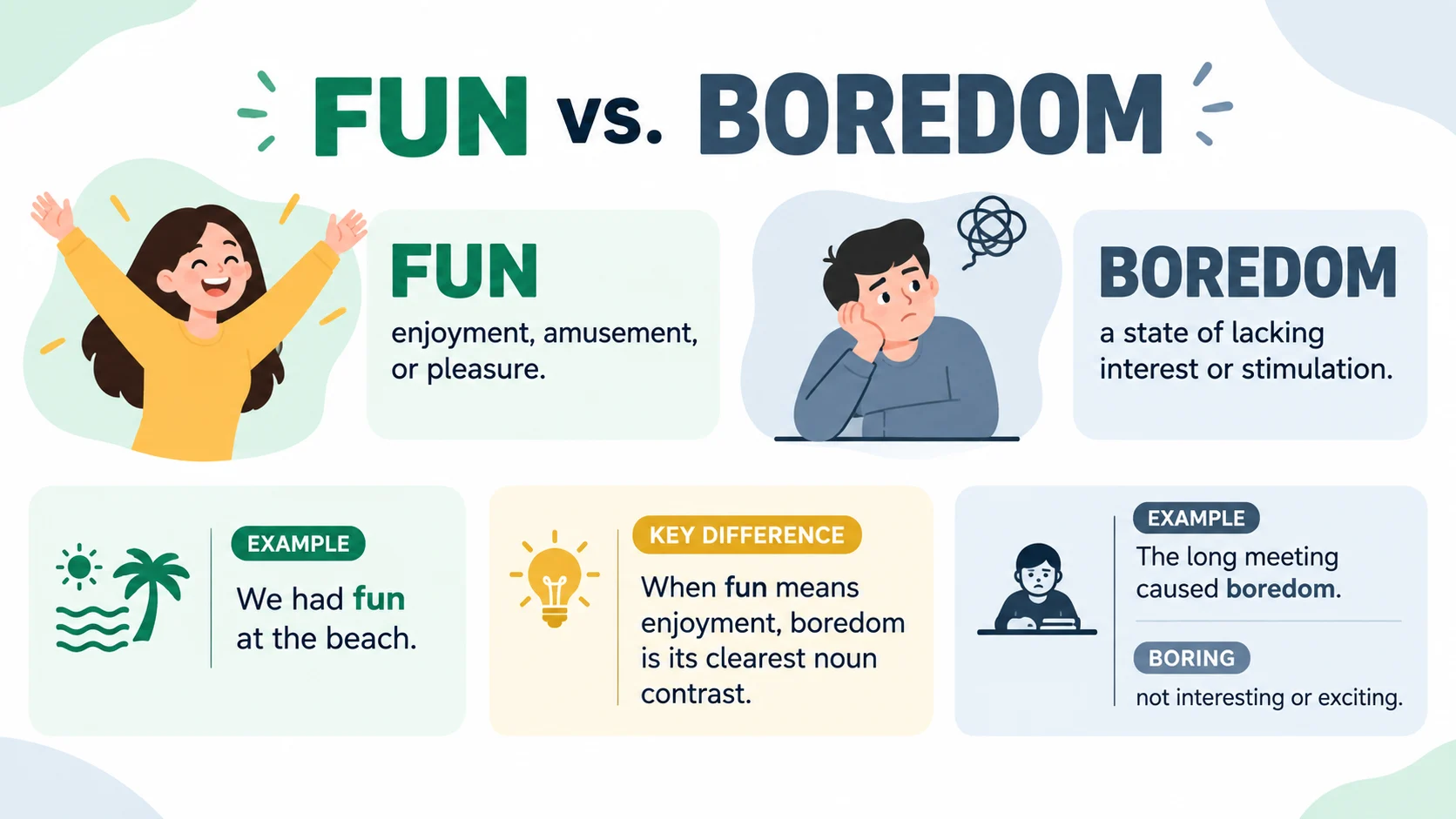
The word fun usually refers to pleasure, enjoyment, amusement, or an activity that people enjoy. It can also describe something enjoyable, as in “That was a fun weekend.”
Direct and Strong Antonyms
| Antonym | Tone or Nuance | Example Sentence |
|---|---|---|
| Boredom | Direct noun contrast; lack of interest or enjoyment | The long meeting left everyone in a state of boredom. |
| Misery | Much stronger; emphasizes serious unhappiness or suffering | The difficult situation brought months of misery. |
| Boring | Natural adjective contrast; lacking interest or excitement | The lecture was informative but boring. |
| Unpleasant | Focuses on an experience that is disagreeable rather than enjoyable | The crowded, delayed flight was unpleasant. |
| Tedious | More formal and specific; emphasizes tiring repetition or dullness | Entering the same information repeatedly was tedious. |
These words are not interchangeable in every context. Boredom is the closest match when fun means enjoyment. Misery is considerably stronger because it describes severe unhappiness, not simply the absence of entertainment. Boring describes something that does not interest or excite you.
For the adjective fun, boring is usually the most natural everyday choice. For example, “The movie was fun” can naturally become “The movie was boring” when describing the opposite experience.
Contextual and Subtle Opposites
The best opposite of fun depends on what you want to emphasize.
| Context | Best Opposite | Why It Fits |
|---|---|---|
| Lack of enjoyment | Boredom | Describes a state in which nothing feels interesting or engaging. |
| Something not enjoyable | Boring | Describes an activity, event, person, or experience that lacks interest or excitement. |
| Strong unhappiness | Misery | Fits situations involving significant suffering or unhappiness. |
| Repetitive work | Tedious | Highlights dullness caused by repetition or a long, tiring process. |
| Negative experience | Unpleasant | Emphasizes discomfort or dislike rather than simple lack of entertainment. |
| Serious atmosphere | Seriousness | Contrasts with the lighthearted sense of fun, but not with enjoyment itself. |
Consider these sentences:
“Waiting three hours at the airport was boring.”
“Waiting three hours at the airport caused boredom.”
“The entire travel experience was unpleasant.”
All three can contrast with fun, but they communicate different ideas. The first describes the experience. The second describes the person’s state. The third emphasizes that the experience was disagreeable.
This distinction matters because fun can also describe playful or nonserious behavior. In that context, seriousness may be a contextual contrast, although it is not a direct antonym for the basic meaning of enjoyment.
Words That Seem Opposite But Are Not
Seriousness
Seriousness is not a direct antonym of fun. Something can be both serious and enjoyable. For example, a serious documentary can still be fascinating and rewarding to watch.
Use seriousness when the contrast concerns attitude or tone:
“The meeting required professionalism and seriousness.”
Use boring when the contrast concerns lack of interest:
“The meeting was boring because the discussion never changed.”
Work
Work is sometimes treated as an opposite of fun, especially in the expression “all work and no play.” However, it is a contextual contrast, not a true semantic opposite. Work can be enjoyable, and fun can happen while people are working.
For example:
“Her job is hard work, but she still has fun with her team.”
The sentence shows why work cannot automatically mean the opposite of fun.
Subtle Tone Differences
Choosing the right opposite can make your writing more precise.
Boring is everyday and direct. It works well in conversation:
“That movie was boring.”
Tedious is more specific and somewhat more formal. It suggests that something is dull because it involves repetition or requires sustained effort:
“The paperwork was tedious.”
Unpleasant is broader. Something unpleasant may be boring, uncomfortable, irritating, or otherwise disagreeable:
“The conversation became unpleasant.”
Boredom names the experience of having little interest or stimulation:
“After an hour of waiting, boredom set in.”
Misery is far stronger than boredom. It suggests substantial unhappiness or suffering, so it should not replace boredom in ordinary situations.
This range is useful in professional and academic writing. Instead of saying that a repetitive process was simply “not fun,” you might write, “The process was tedious.” Instead of calling a difficult personal situation “boring,” you might use “unpleasant” if discomfort is the real issue.
Frequently Asked Questions
What is the direct antonym of fun?
When fun is a noun meaning enjoyment or amusement, boredom is the clearest direct contrast. It describes a state of lacking interest or stimulation. Misery is a stronger emotional contrast, but it does not simply mean the absence of fun.
What is the opposite of fun when describing an activity?
When fun is an adjective meaning enjoyable, boring is usually the most natural opposite in American English. For example, “The game was fun” contrasts naturally with “The game was boring.” Tedious works when repetition or dull effort is the main issue.
Is serious the opposite of fun?
Not exactly. Serious can contrast with the playful or nonserious sense of fun, but it is not the direct opposite of fun as enjoyment. A serious activity can still be enjoyable, so choose boring, tedious, or unpleasant when describing a lack of enjoyment.
Conclusion
The most useful answer to “What is the opposite of fun?” is boredom when fun is used as a noun meaning enjoyment. When fun describes an activity or experience, boring is usually the natural adjective contrast.
Other words can work when the context changes. Tedious emphasizes repetition, unpleasant emphasizes a negative experience, and misery expresses much stronger unhappiness. Choosing the precise contrast makes your English clearer and more natural.
What sentence are you trying to write with an opposite of fun?
